Integrating AI vision cameras with Manufacturing Execution Systems and ERP platforms is where the real operational value of visual inspection is either fully unlocked or quietly wasted. A camera that detects a defect in isolation produces an inspection result. A camera whose output flows directly into the MES — triggering a work order, updating a production record, enriching a lot traceability chain, and feeding quality data back into the ERP — produces operational intelligence that compounds across every shift, every line, and every audit cycle. iFactory AI Vision Camera is architected from the ground up to close this gap: connecting inspection outputs to existing PLCs, SCADA, SAP, Oracle, and CMMS infrastructure via open API, OPC-UA, MQTT, and REST — without replacing any system already in place. Plant engineers and IT/OT integration teams who want to see how this data flow is structured for their specific architecture can Book a Demo with iFactory's integration team.
Stop Running AI Vision in Isolation — Connect It to the Systems That Drive Your Plant
iFactory AI Vision Camera integrates with existing MES, ERP, PLC, and SCADA infrastructure via OPC-UA, MQTT, and REST API — delivering inspection outputs as structured, actionable data across your entire production system from day one.
Why MES and ERP Integration Is the Critical Step Most Vision Deployments Miss
The majority of AI vision camera deployments in manufacturing are not failing at detection — they are failing at data utilization. A camera running a trained model at 99.4 percent accuracy that logs results to a local system, isolated from the MES and ERP, produces inspection data that sits unused until someone manually exports it. Meanwhile, defect trends go unanalyzed, lot traceability chains remain incomplete, work orders are raised manually hours after a detection event, and quality records require hand transcription before they can enter a compliance audit. The integration layer is not an optional enhancement to an AI vision deployment — it is the mechanism by which detection accuracy translates into production outcomes that appear in OEE metrics, compliance records, and financial results.
iFactory AI Vision Camera is designed to eliminate the integration gap. Every inspection event generates structured output — defect type, classification, confidence score, location, timestamp, production context — and routes it through the integration layer to the appropriate downstream system automatically. The result is a bidirectional data flow where the MES informs the vision system of the current production order, shift, and product specification, and the vision system returns inspection results, defect annotations, and quality disposition decisions that update production records in real time.
Consistent across all trained defect categories — but accuracy is only realized as value when results flow into connected systems.
Sub-50ms edge inference — fast enough to trigger downstream MES updates and PLC rejection signals within the same production cycle.
Every inspection event logged to an immutable timestamped record — FDA 21 CFR Part 11 compliant, ERP-accessible, and audit-ready on demand.
Integration with existing MES and ERP via pre-built connectors — live without infrastructure replacement in 1 to 2 weeks.
The Integration Architecture: How iFactory AI Vision Camera Connects to MES and ERP
Understanding the integration architecture is essential before selecting protocols, designing data flows, or defining what gets connected where. iFactory AI Vision Camera operates on an edge-to-enterprise architecture: the AI inference runs on-premise on NVIDIA edge hardware at sub-50ms latency with no cloud dependency, and the structured output of that inference is routed to downstream systems through a defined integration layer using industrial-standard protocols. The architecture has three layers — edge, integration middleware, and enterprise systems — and each layer has a defined role in the data flow.
Edge Layer
Camera capture → AI inference → structured result output. Runs on NVIDIA Jetson. No internet required. ONVIF and RTSP compatible with existing cameras.
Integration Middleware
OPC-UA, MQTT, REST API. Protocol translation and routing. Bidirectional: receives production context from MES, returns inspection results. Event-driven — data moves on detection, not on polling schedule.
Enterprise Systems
SAP PM, Oracle, Maximo, any CMMS or MES. Receives inspection results, triggers work orders, updates lot records, feeds OEE dashboards and compliance logs.
Compliance Layer
Immutable timestamped inspection records. FDA 21 CFR Part 11. HACCP digital logs. Audit packages generated on demand — no manual transcription.
Protocol Selection: OPC-UA, MQTT, and REST — When to Use Each
The single most common integration mistake is treating OPC-UA, MQTT, and REST as competing choices rather than complementary layers of the same data architecture. Each protocol is optimized for a different part of the integration flow, and the best-practice approach — used in iFactory AI Vision Camera deployments — combines all three in a defined hierarchy. OPC-UA organizes the data with semantic context and structured equipment models. MQTT moves it efficiently between the edge and enterprise systems using a publish-subscribe pattern with minimal network overhead. REST provides the on-demand query interface that MES and ERP systems use for scheduled data access and historical retrieval.
OPC-UA — Structured Data with Equipment Context
OPC-UA is the standard for machine-to-machine and machine-to-MES communication in industrial environments. It carries structured data with semantic tagging — inspection result, asset ID, production order, shift, product specification — in a format that MES and ERP systems can consume and act on without additional transformation. iFactory uses OPC-UA for real-time inspection result delivery to MES, PLC rejection signal triggering, and SCADA dashboard updates where structured, reliable, low-latency data transfer is required. For regulated environments requiring 21 CFR Part 11 or GAMP 5 compliance, OPC-UA's data integrity and timestamping capabilities make it the preferred protocol for quality-critical data paths.
MQTT — Lightweight Event Streaming from Edge to Enterprise
MQTT's publish-subscribe architecture makes it the optimal protocol for high-frequency, event-driven data streams from edge devices to cloud analytics and enterprise dashboards. iFactory AI Vision Camera publishes inspection events to an MQTT broker the moment a detection occurs — defect confirmed, PPE violation detected, thermal anomaly flagged — and subscribed systems (the CMMS, the OEE analytics dashboard, the maintenance team's mobile app) receive the event in real time without polling. MQTT's lightweight payload format keeps network overhead minimal even at high inspection rates, making it the right choice for facilities inspecting thousands of units per hour across multiple camera positions.
REST API — On-Demand Access and ERP Synchronization
REST APIs provide the request-response interface that ERP systems use for scheduled data pulls, historical record retrieval, and configuration management. iFactory's REST API enables SAP, Oracle, or any ERP system to query inspection result history, pull quality summary data for production orders, retrieve compliance documentation packages, and push production context (current order number, product specification, batch ID) to the vision system before a production run begins. REST is also the integration path for MES systems that pull production KPIs on a scheduled basis and for management reporting systems that aggregate quality data across facilities.
Six Best Practices for AI Vision Camera Integration with MES and ERP
Integration failure in AI vision deployments is almost never a technology problem — it is a design and sequencing problem. The practices below reflect what separates deployments that deliver measurable production outcomes from those that produce inspection data no one acts on. Plant engineers and IT/OT integration teams who want to review how these practices apply to their specific MES and ERP architecture can Book a Demo with iFactory's integration team before committing to an architecture.
01 · Define Data Ownership Before Connecting Systems
Architecture FirstThe most common integration failure is connecting systems before defining what data flows where, who owns each record, and how conflicts are resolved when the vision system and MES disagree on a quality disposition. Before writing a single API call, document the master data source for each data type — product specification (ERP owns it, vision system reads it), inspection result (vision system owns it, MES reads it), lot disposition (MES owns it, ERP reads it). iFactory's integration onboarding process begins with a data ownership mapping session that produces a documented data flow diagram before any configuration work begins.
02 · Use Bidirectional Data Flow — Not One-Way Reporting
Closed-Loop IntegrationA vision system that only sends data to the MES is a reporting tool. A vision system that receives production context from the MES — current order number, product specification, tolerance limits, batch ID — and returns inspection results that update production records is a closed-loop quality control system. iFactory AI Vision Camera integration is bidirectional by design: the MES pushes production context before each run, and the vision system returns structured inspection results that automatically update the active production order record, trigger lot disposition logic, and feed quality KPIs into ERP-side reporting without manual data entry.
03 · Deploy Edge-First — Keep Inference Off the Network Path
Zero Cloud DependencyAI inference that depends on network connectivity to a cloud processing layer introduces latency, a single point of failure, and data security exposure that are incompatible with production-line inspection at throughput speed. iFactory AI Vision Camera runs all inference on-premise on NVIDIA edge hardware — sub-50ms latency, no internet dependency, no production data leaving the facility. The integration layer connects edge inference outputs to enterprise systems through controlled API interfaces, not by routing raw video or image data through the enterprise network. This architecture keeps inspection throughput independent of network conditions and eliminates the compliance exposure of transmitting production images to external cloud infrastructure.
04 · Automate Work Order Generation — Eliminate the Detection-to-Action Gap
Real-Time ResponseUnder manual inspection, the path from defect detection to corrective action averages four to six hours — detection at the station, manual log entry, shift-end review, work order creation, technician assignment. iFactory AI Vision Camera closes this gap to under three minutes by generating annotated work orders automatically on confirmed defect detection: defect image, classification, confidence score, and location data are packaged into a CMMS work order and routed to the responsible technician via push notification — synchronized to SAP PM, Oracle, or any connected CMMS through the REST or OPC-UA integration path. No manual transcription, no shift-end review required.
05 · Build Lot Traceability from Inspection Data, Not from Manual Records
End-to-End TraceabilityLot traceability chains built from manual inspection records have structural gaps — missing sign-offs, retroactively reconstructed records, and classification inconsistencies between shifts. AI vision inspection data is captured automatically at the moment of detection, with full production context (batch ID, production order, line, shift, operator station) embedded in every record. iFactory's integration with MES and ERP lot management systems creates an unbroken digital traceability chain from incoming material through inspection to finished goods disposition — accessible on demand for customer audits, regulatory inspections, and recall investigations without manual record reconstruction.
06 · Start with a Pilot Line — Validate Integration Before Scaling
Phased DeploymentThe fastest path to enterprise-wide AI vision integration is a well-executed single-line pilot, not a simultaneous multi-line rollout. A pilot deployment on one production line — the highest-value or highest-defect-rate line — validates the integration architecture, confirms data flow correctness between the vision system and the MES and ERP, and establishes the performance benchmarks that justify wider deployment. iFactory's standard deployment approach activates the pilot line first, validates all integration touchpoints against the documented data flow design, and only extends to additional lines once the pilot has confirmed stable data flow and measurable quality improvement. Plant engineers who want to see how a pilot is structured for their specific production environment can Book a Demo with iFactory's deployment team.
How iFactory AI Vision Camera Integrates with SAP, Oracle, and CMMS Platforms
iFactory AI Vision Camera does not require SAP or Oracle to change their data structures, workflows, or configuration. The integration is designed as an intelligent data provider that speaks the protocols these systems already understand — delivering inspection results as structured records that fit directly into existing work order management, lot tracking, quality management, and plant maintenance modules. The connection is configured once during deployment and operates continuously without maintenance overhead.
Compliance and Audit Traceability: What MES-Integrated Vision Data Makes Possible
Compliance audits — whether FDA 21 CFR Part 11, ISO 9001, IATF 16949, or customer-specific quality system requirements — require documented evidence that every inspection was performed, every result was recorded, and every non-conformance was addressed. Manual inspection records satisfy these requirements imperfectly: retroactive sign-offs, illegible handwriting, missing entries, and shift-change gaps are the documentation weaknesses that audit findings are built from. AI vision camera data, when connected to the MES and ERP through iFactory's integration layer, generates compliance-grade inspection records automatically — immutable, timestamped, and formatted to the audit requirements of each applicable standard. Manufacturers evaluating compliance documentation capabilities before a deployment commitment can Book a Demo with iFactory to see the audit documentation workflow running on a live production environment.
Immutable Inspection Records with Production Context
Every inspection event generates a record containing the detection result, defect classification, confidence score, annotated image, production order number, batch ID, line, shift, and exact timestamp — written to an immutable log that cannot be retroactively modified. Records are accessible directly from the ERP compliance documentation module or exportable on demand as audit-ready packages. FDA 21 CFR Part 11 requirements for electronic records and electronic signatures are satisfied without additional compliance software.
Non-Conformance and CAPA Workflow Integration
Confirmed defect detections automatically initiate non-conformance records in the MES or ERP quality management module — with defect evidence pre-populated and the non-conformance routed to the quality team for disposition and corrective action assignment. CAPA (Corrective and Preventive Action) workflows triggered from AI vision data carry richer defect evidence — annotated images, defect trend data, production process context — than CAPAs initiated from manual inspection reports, improving root cause analysis quality and reducing CAPA cycle time.
OEE Quality Component — Real-Time Quality Rate in Production Metrics
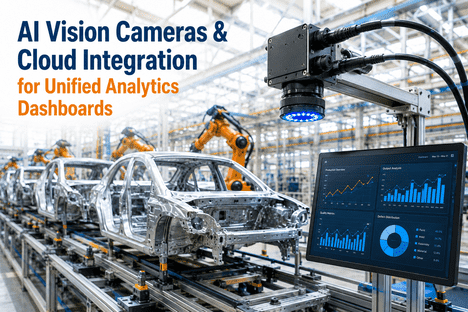
The quality component of OEE (Overall Equipment Effectiveness) is the ratio of good units produced to total units started. Under manual inspection, this figure is calculated at shift end from paper records. With iFactory AI Vision Camera integrated to the MES, the quality rate is updated in real time — visible on the production dashboard as each inspection result flows in. Quality-driven OEE losses are visible as they accumulate, enabling supervisors to intervene before a quality issue compounds into a full shift loss rather than discovering it at shift review.
Frequently Asked Questions: AI Vision Camera Integration with MES and ERP
Does iFactory AI Vision Camera require us to modify our existing SAP or Oracle system?
No. iFactory connects to SAP PM, SAP QM, Oracle WIP, Oracle QM, Maximo, and other ERP and CMMS platforms through their existing API interfaces — REST, OPC-UA, and MQTT — without requiring system modification, custom development within the ERP, or changes to existing data structures. The integration is configured on the iFactory side during deployment using pre-built connectors for SAP and Oracle that map iFactory data fields to the appropriate ERP record types.
What integration protocols does iFactory AI Vision Camera support?
iFactory AI Vision Camera supports OPC-UA for structured real-time data delivery to MES and SCADA systems, MQTT for event-driven streaming from edge to enterprise systems and mobile dashboards, and REST API for scheduled synchronization and on-demand data access by ERP systems. The three protocols are used in combination — OPC-UA for machine-to-MES data paths, MQTT for event streaming and alerts, and REST for ERP integration and reporting. Modbus and Profibus legacy protocol support is also available via edge gateway configuration for facilities with older PLC infrastructure.
How does the AI vision system receive production context from the MES?
Before each production run, iFactory AI Vision Camera receives the active production order details — product ID, specification, tolerance parameters, batch number, and shift information — from the MES via the REST API or OPC-UA interface. This context is embedded in every inspection record generated during the run, creating a direct link between inspection results and the production order they belong to. When the order changes, the vision system receives the updated context automatically — no manual configuration required between product changeovers.
Can iFactory AI Vision Camera work with existing ONVIF-compatible cameras already installed at inspection stations?
Yes. iFactory supports ONVIF and RTSP protocols, which are standard across most industrial camera hardware. In many facilities, existing cameras at inspection stations are directly compatible, reducing hardware cost to edge processing units and software configuration only. iFactory's pre-deployment assessment confirms compatibility and identifies the minimum additional hardware required for stations where existing cameras do not meet the resolution or positioning requirements for the target defect types. Book a Demo to receive a camera compatibility assessment for your current infrastructure.
How does automated work order generation from AI vision integrate with our CMMS workflow?
When a defect is confirmed by the AI vision system, iFactory generates a structured work order record containing the defect image, classification, confidence score, location, and production context, and routes it to the CMMS (SAP PM, Oracle, Maximo, or iFactory's native CMMS) via the configured integration path. The work order is assigned to the responsible technician based on the defined routing logic and triggers a push notification on the technician's mobile device. The entire detection-to-assignment sequence completes in under three minutes without manual intervention, eliminating the four-to-six-hour average detection-to-action gap typical of manual inspection operations.
What does deployment look like for a facility that already has an MES but no existing vision infrastructure?
iFactory's deployment team conducts a pre-deployment assessment that identifies inspection station locations, defines the camera and edge hardware configuration, and designs the integration data flows for the specific MES in place. For facilities with SAP or Oracle, pre-built integration connectors reduce configuration time significantly. Full deployment — camera installation, AI model training, MES integration configuration, and go-live — is completed in 1 to 2 weeks. 90-day implementation support is included in the standard deployment package, covering integration validation, model performance monitoring, and MES data flow verification.
Ready to Connect AI Vision to Your MES and ERP — Without Replacing Either?
iFactory AI Vision Camera integrates with existing production systems via OPC-UA, MQTT, and REST — delivering inspection data as structured, actionable records to MES, ERP, CMMS, and OEE dashboards from day one. Live in 1 to 2 weeks. No infrastructure replacement required.