Deploying AI Vision Cameras across a manufacturing facility raises legitimate and important questions that operations managers, IT security teams, and plant engineers must answer before a single sensor goes live. What data is being captured? Where does it go? Who can access it? How is it protected from unauthorized access, network intrusion, or misuse? And when cameras monitor production floors where workers are present, how are employee privacy rights balanced against the operational intelligence the facility depends on? These questions are not barriers to deployment — they are the foundation of a secure, compliant, and trustworthy AI vision program. iFactory's AI Vision Camera platform is architected from the ground up to address each of these concerns through its edge-first, zero-cloud-dependency design, layered cybersecurity controls, and privacy-by-design data handling principles. Understanding how the platform manages data security and worker privacy is as important as understanding how it detects defects.
See How iFactory AI Vision Camera Protects Data and Preserves Privacy in Industrial Environments
iFactory's AI Vision Camera runs entirely on-premise — no cloud transmission, no external data exposure, no third-party data dependency. Book a walkthrough to see the platform's edge AI architecture, network security controls, and privacy-by-design data handling in a live manufacturing context.
The Edge AI Architecture That Eliminates Cloud Data Exposure
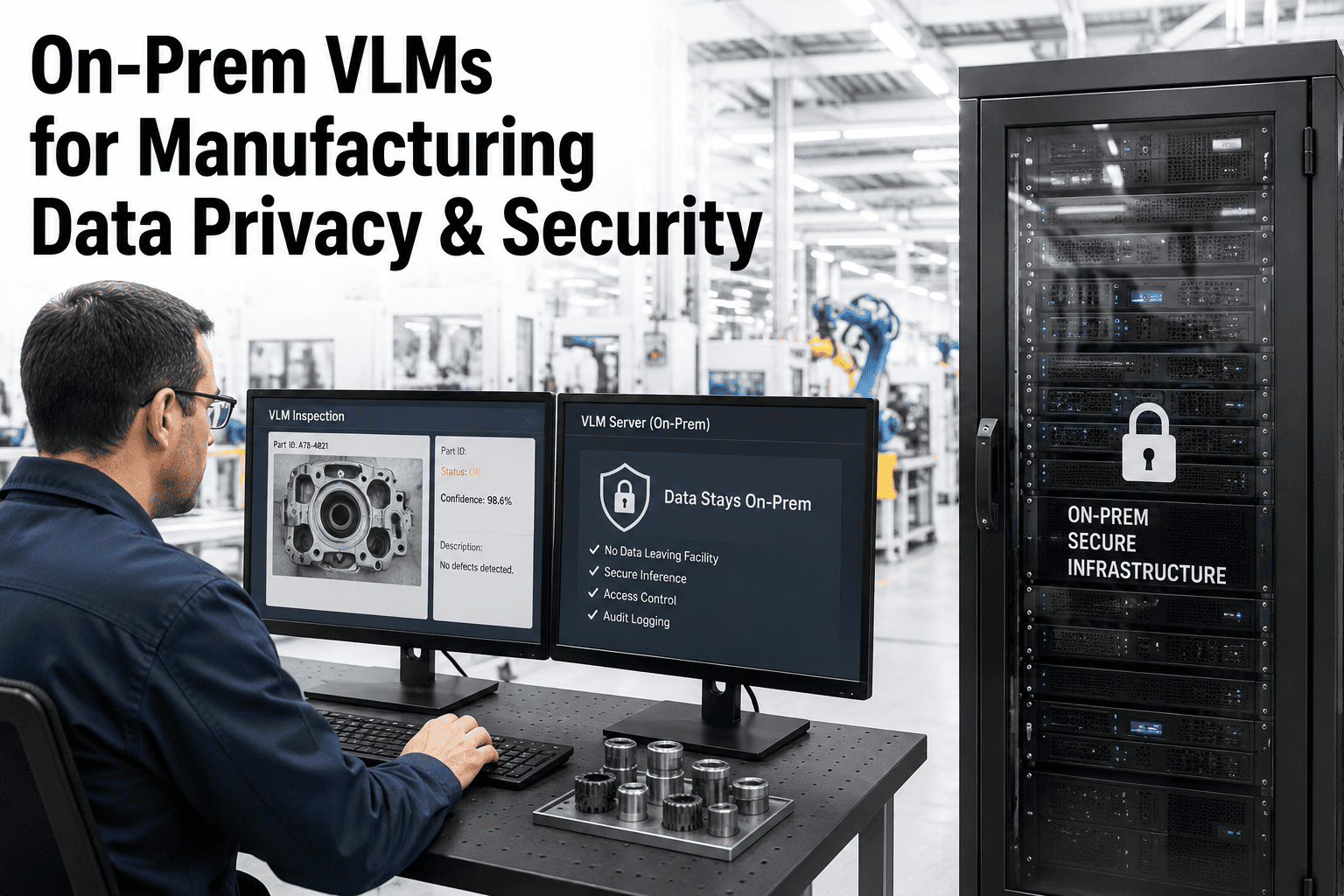
The most significant security and privacy advantage of iFactory's AI Vision Camera is structural, not procedural: all AI inference runs entirely on on-premise NVIDIA GPU hardware at the production line. Video frames are analyzed locally, at the edge, in under 50 milliseconds. No raw video footage is transmitted to a cloud server. No image data leaves the factory network. Only the output of the AI inference — annotated defect classifications, confidence scores, alert metadata, and work order triggers — moves through the system. This architecture satisfies NIST privacy engineering guidance's foundational principle of data minimization at the point of collection, and it eliminates the exposure surface that cloud-dependent AI camera systems create by definition.
This is not simply a feature preference — it is an increasingly mandatory requirement in industrial procurement specifications, data sovereignty regulations, and operational technology (OT) security frameworks. Manufacturing facilities handling proprietary process data, precision tooling parameters, or production run information operate in environments where transmitting production video to external cloud infrastructure creates intellectual property exposure that cannot be acceptable. iFactory's edge-first design ensures that the AI operates within the facility's security perimeter, subject to the facility's own access controls, firewalls, and network segmentation policies — not dependent on the security posture of a third-party cloud provider.
Cybersecurity Controls for Industrial AI Vision Deployments
Industrial network security for AI vision systems requires a layered defense approach that accounts for the specific threat vectors of operational technology environments. Manufacturing plants are increasingly targeted by ransomware and intrusion campaigns precisely because OT networks have historically operated under the assumption that physical separation from IT networks provided adequate protection. As AI Vision Camera systems integrate with CMMS platforms, ERP systems, SAP PM, and production scheduling infrastructure, the network boundaries that OT security relied on become more complex — and the security architecture governing the AI Vision system must be designed accordingly.
iFactory's platform supports network segmentation that isolates the AI Vision Camera system from both the broader IT network and the internet, while maintaining the internal integrations needed for work order automation and analytics reporting. Role-based access controls govern which personnel can view camera feeds, access annotated inspection records, or modify AI model configurations. Firmware update mechanisms are authenticated and signed, preventing unauthorized model modification. Each edge compute unit operates as an independent node — meaning a compromise of one device does not propagate across the network or expose the inference pipeline running on other units.
Network Segmentation and OT Isolation
iFactory's AI Vision Camera system supports deployment within an isolated OT network segment that communicates with IT systems only through defined, monitored integration points. This prevents a compromise of an IT-facing system from propagating into the AI Vision inspection layer, and ensures that the camera network is not directly reachable from the internet or from general enterprise network traffic. Facilities operating air-gapped environments can run the full AI inspection capability without any external network connectivity.
Role-Based Access Control and Authentication
Access to camera feeds, inspection records, annotated defect evidence, and AI model configuration is governed by role-based access control with individual authentication requirements. Quality engineers, maintenance technicians, production supervisors, and IT administrators are assigned access permissions appropriate to their operational role. No single user role has unrestricted access to all system components. Audit logs record every access event, configuration change, and model update — creating a complete chain of custody for all inspection data.
Encrypted Data Transmission and Storage
All data transmitted between edge compute units and internal management systems — including inspection metadata, work order triggers, and analytics dashboards — is encrypted in transit using current transport layer security standards. Stored inspection records and annotated evidence files are encrypted at rest within the facility's storage infrastructure. Encryption key management is handled within the facility's control environment, not by external cloud key management services, ensuring that decryption capability cannot be accessed by third parties.
Firmware Integrity and Authenticated Model Updates
AI model updates and firmware changes to edge compute units are authenticated and cryptographically signed before deployment. Unsigned or unverified updates are rejected by the device, preventing adversarial model modification that could cause the inspection system to systematically misclassify defects or fail to detect safety violations. Remote model update capability — enabling AI model improvements without physical device access — is controlled through the same authenticated access management framework that governs all system configuration changes.
Worker Privacy in AI Vision Deployments: The Privacy-by-Design Framework
The deployment of AI Vision Cameras in manufacturing environments where workers are present creates privacy obligations that extend beyond cybersecurity into labor relations, employment law, and data protection regulation. In jurisdictions governed by GDPR in Europe, CCPA in California, and equivalent frameworks across Asia-Pacific and South America, the collection of visual data from identified individuals in a workplace context is subject to data minimization requirements, purpose limitation principles, and in many cases explicit consent or works council notification obligations. iFactory's platform is designed to address these obligations through a privacy-by-design approach that minimizes the collection of personally identifiable information at the point of capture, not through retrospective policy controls after data has already been gathered and stored.
The operational focus of iFactory's AI Vision Camera is production quality, equipment health, and safety compliance — not individual worker monitoring or behavioral tracking. The platform's AI models are trained and configured to detect and classify production-relevant events: surface defects on parts, dimensional non-conformances, thermal anomalies on equipment, PPE compliance status, and label verification mismatches. The system does not identify individuals by name or biometric identifier, does not track individual worker movement patterns across the facility, and does not create individual performance profiles linked to identified personnel. This scope limitation is both a privacy control and a product design principle — the AI Vision Camera is a production intelligence platform, not a personnel surveillance system. Manufacturing organizations considering deployment who want to see how the platform is configured for their specific privacy regulatory environment can Book a Demo with iFactory's industrial implementation team for a compliance-focused walkthrough.
What iFactory AI Vision Monitors
Production-Focused ScopeWhat iFactory AI Vision Does Not Do
Privacy BoundariesRegulatory Compliance Framework: GDPR, CCPA, and Industrial Data Protection
Manufacturing facilities deploying AI Vision Camera systems in 2026 must navigate an increasingly complex web of data protection regulations that apply differently depending on the jurisdiction, the nature of the data collected, and the processing purpose. iFactory's platform architecture is designed to support compliance with the primary regulatory frameworks governing industrial AI vision deployments — not by providing legal compliance guarantees, but by ensuring that the platform's data handling design is consistent with the technical and organizational requirements these frameworks impose on data controllers.
Intellectual Property Protection: Keeping Proprietary Process Data Inside the Facility
For manufacturing facilities producing proprietary products, precision components, or technology-intensive goods, the images captured by an AI Vision Camera system contain more than quality inspection data — they contain visual documentation of production processes, tooling configurations, assembly sequences, and material characteristics that represent significant competitive and intellectual property value. A camera system that transmits this footage to a cloud server operated by a third-party vendor creates an IP exposure that most facilities would not accept for any other category of proprietary technical documentation. iFactory's zero-cloud-dependency architecture eliminates this exposure by ensuring that production footage and inspection evidence never leave the facility's controlled environment. The AI inference runs inside the factory. The annotated defect records are stored inside the factory. The work orders and quality data are integrated with internal systems inside the factory. No production imagery is accessible from outside the facility network boundary.
This is particularly significant for facilities supplying automotive OEM customers, aerospace primes, semiconductor fabricators, and defense manufacturers — sectors where the process documentation captured in production footage may itself be governed by proprietary information agreements, export control regulations, or customer data protection requirements that explicitly prohibit transmission of production data to external systems. iFactory's platform supports compliance with these customer-imposed data handling requirements without requiring modifications to the AI Vision inspection capability or reductions in detection performance. Facilities with specific IP protection requirements are encouraged to Book a Demo to discuss how the platform's data architecture maps to their contractual and regulatory obligations.
No raw video footage or production process imagery leaves the facility network under iFactory's edge AI architecture.
All defect detection and classification runs on on-premise NVIDIA GPU hardware — no external cloud processing required or used.
iFactory's AI Vision Camera operates fully without internet connectivity for facilities requiring complete network isolation.
Role-based access control with individual authentication and full audit logging governs all access to inspection records and camera configuration.
Implementing AI Vision Camera Security: A Deployment Checklist
A secure AI Vision Camera deployment requires deliberate planning across four domains — network architecture, access management, data governance, and worker communication — before the first camera goes live. The following checklist reflects the implementation practices that iFactory recommends for manufacturing facilities deploying AI Vision across quality inspection, equipment monitoring, and safety compliance use cases. Facilities that work through this framework before deployment avoid the most common security and privacy gaps that emerge when AI Vision is deployed as a pure technology project without cross-functional input from IT security, legal, HR, and operations.
Network Architecture — Segment the AI Vision system from general enterprise networks
Deploy the AI Vision Camera network within a dedicated OT network segment with firewall rules that permit only the specific integration traffic required for CMMS work order creation and analytics dashboard access. Deny all inbound traffic from internet-facing systems. If the facility requires internet access for remote support, implement a bastion host with multi-factor authentication rather than direct network access to the AI Vision infrastructure.
Access Management — Implement role-based access before going live
Define user roles and access permissions before deployment — not after. Quality engineers, maintenance technicians, production supervisors, IT administrators, and external implementation partners should have clearly defined, minimum-necessary access to camera feeds, inspection records, and system configuration. Shared credentials should not be used for any AI Vision system access. Audit log review should be assigned to a named responsible individual.
Data Governance — Define retention policies and data handling procedures
Establish documented retention windows for raw video footage and inference records before deployment, aligned with the facility's quality record retention requirements and applicable data protection regulation. Document the categories of data the system captures, the purpose of each category, and the personnel who can access each category. This documentation is required for GDPR compliance and supports EU AI Act technical documentation obligations.
Worker Communication — Inform before deploying, not after
In jurisdictions governed by GDPR or equivalent frameworks, workers must be informed before AI Vision Camera systems that may capture their image are deployed. This notification should explain what the system monitors, what data is captured, how long it is retained, who can access it, and what it is not used for — including individual performance monitoring or biometric identification. In facilities with works councils or union representation, the applicable co-determination or information procedures should be completed before deployment begins.
Vendor Security Assessment — Evaluate the platform's security architecture independently
Before deploying any AI Vision Camera platform, conduct an independent security assessment of the platform's network architecture, data transmission practices, firmware update mechanisms, and access control design. Request documentation of the vendor's data handling practices and verify that the platform's architecture supports your facility's data sovereignty requirements. iFactory's implementation team provides full technical architecture documentation to support this assessment.
Ongoing Security — Treat AI Vision as a managed security asset
AI Vision Camera systems are persistent network-connected devices that require ongoing security management — firmware updates, access control reviews, network segmentation audits, and periodic penetration testing — on the same schedule as other OT network assets. Designate a named responsible owner for AI Vision system security within the IT or OT security function and include it in the facility's regular security review cycle from day one of deployment.
Deploy iFactory AI Vision Camera With Full Confidence in Data Security and Worker Privacy
iFactory's AI Vision Camera runs entirely on-premise — 99.4% defect detection accuracy, zero cloud data transmission, full network isolation support, and privacy-by-design data handling. Built for manufacturing environments where security and compliance are non-negotiable alongside quality performance. Facilities ready to evaluate the platform's security architecture can Book a Demo for a security-focused technical walkthrough with iFactory's implementation team.