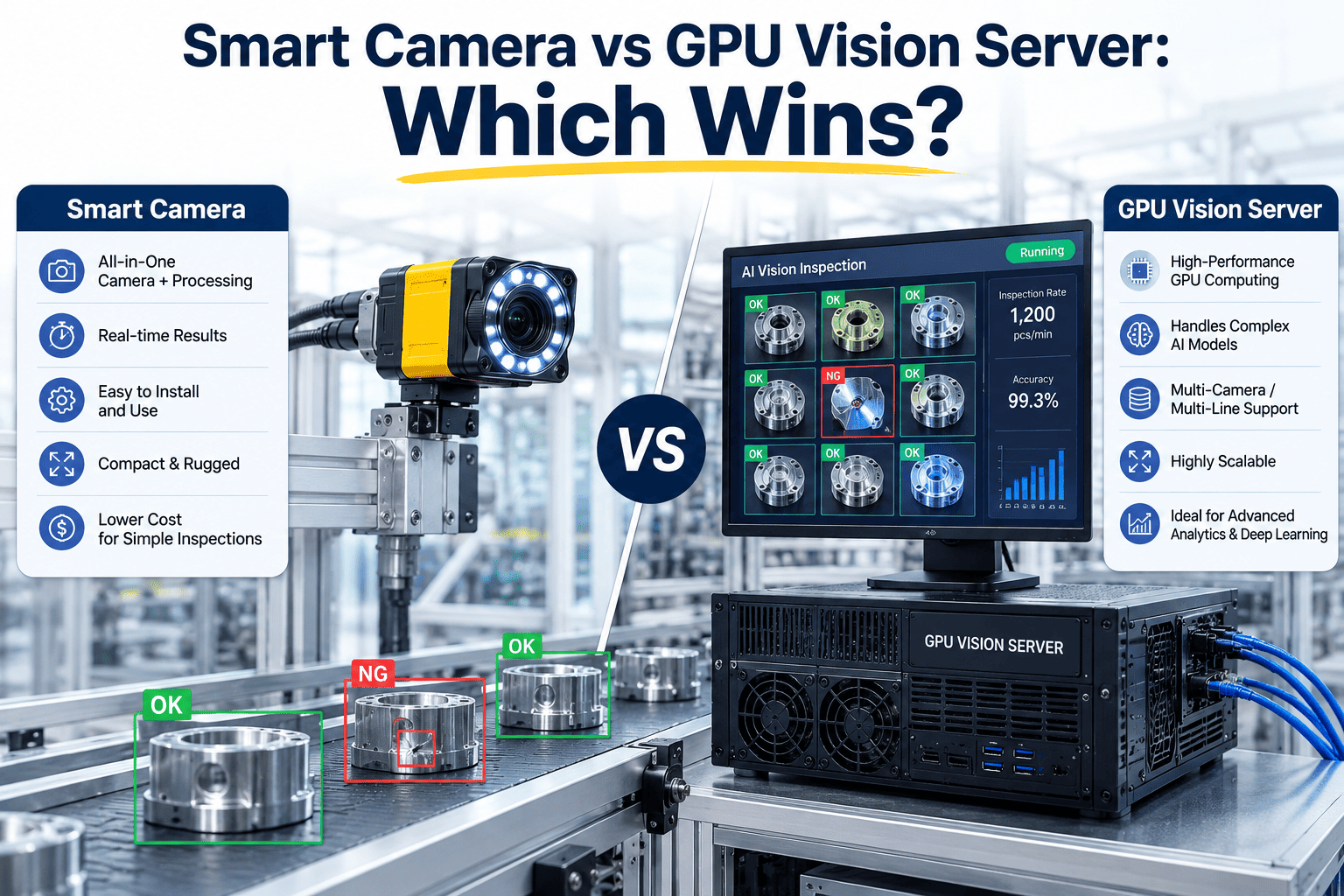
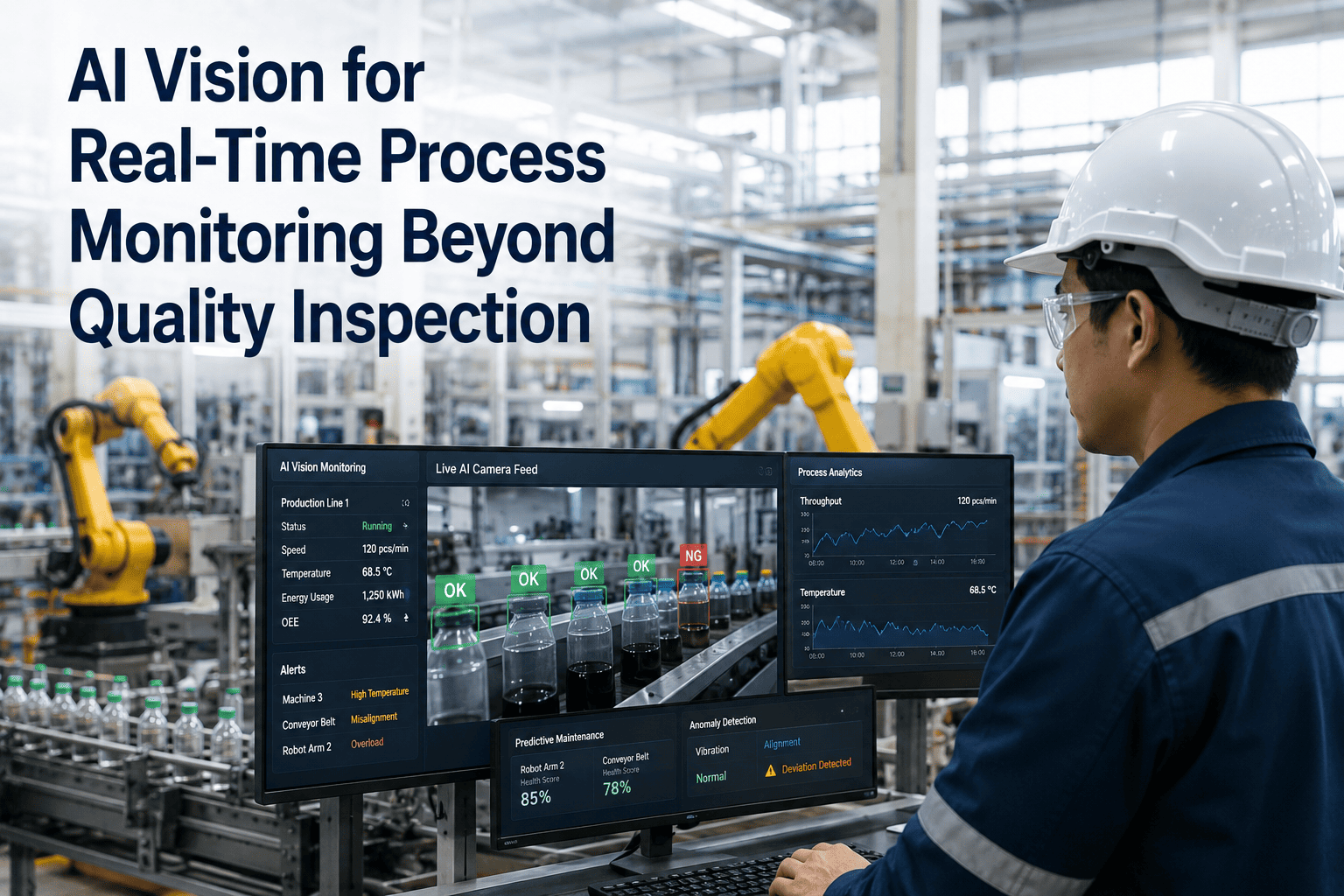
AI Vision Cameras and Smart Sensors are the two most consequential monitoring technologies available to factory engineers in 2026 — but they are not competing to do the same job, and choosing between them without understanding this distinction is one of the most expensive mistakes a plant can make. AI vision cameras solve the problem of what your products and equipment look like: surface defects, label misalignments, assembly errors, and packaging failures that no sensor can detect. Smart sensors solve the problem of what your machines feel: vibration signatures, bearing wear, thermal anomalies, and motor fatigue developing weeks before any visible symptom appears. The factories achieving the highest defect-reduction and uptime results in 2026 are deploying both technologies unified on a single on-premise platform — and iFactory's AI Vision Camera module is built specifically to serve as the visual intelligence layer in exactly that architecture.See how iFactory unifies AI vision and sensor data on a single production platform Book a Demo.
A direct comparison of AI vision cameras and smart sensor systems — covering defect detection, predictive maintenance, deployment complexity, and how iFactory unifies both on a single sovereign edge platform.
What Each Technology Actually Does
Before comparing deployment costs and use cases, it is essential to be precise about what each technology is designed to detect. AI vision cameras and smart sensors are not substitutes for each other — they address fundamentally different classes of factory problem, and conflating them leads to underinvestment in both.
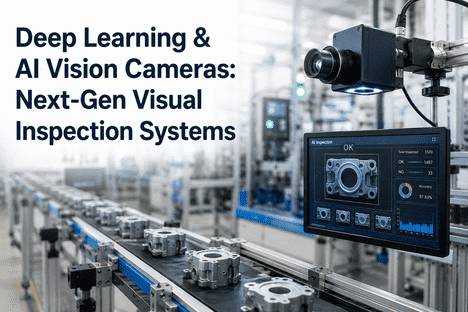
AI Vision Cameras use high-resolution RGB, thermal, or multi-spectral camera feeds analyzed by deep-learning models running on edge GPU hardware. They answer the question: "Does this product, component, or production zone look correct right now?" Every defect class they detect — surface scratches, weld discontinuities, label misalignments, fill-level deviations, PPE violations — is a visual problem. iFactory's AI Vision Camera module runs YOLOv8 and Vision Transformer models on NVIDIA Jetson hardware at sub-50ms inference latency with zero cloud dependency, providing 99.4% detection accuracy across all shifts.
Smart Sensors — vibration accelerometers, temperature probes, current transducers, pressure transmitters — answer the question: "What is this machine's internal condition right now?" They generate continuous telemetry that AI models analyze to detect bearing wear, motor overload, seal degradation, and lubrication failure developing 60 to 90 days before any visible symptom appears. Neither technology replaces the other. A production line with only vision cameras misses mechanical failures. A line with only smart sensors misses every surface defect and label error.
Where AI Vision Cameras Win
AI Vision Cameras provide capabilities that no sensor array can replicate. If your quality problem is visual — and for most discrete and process manufacturers, the majority of consumer-facing defects are — vision is the only technology that addresses it directly.
AI vision cameras inspect every single unit at line speed — not a statistical sample. iFactory's AI Vision module evaluates 200+ units per minute at sub-50ms inference, generating a per-unit timestamped record that satisfies FSMA, HACCP, and BRC audit requirements with zero manual input.
Cracks, scratches, corrosion, weld discontinuities, surface discoloration, and foreign body contamination are invisible to any sensor. AI vision using YOLOv8 and Vision Transformer models detects these defects at confidence thresholds of 0.75–0.90 and classifies them by type, severity, and location within the same inference pass.
Label misalignment, barcode illegibility, incorrect date codes, and seal integrity failures are among the leading causes of product recalls. iFactory's AI Vision module integrates OCR verification with visual inspection in a single camera pass — catching packaging errors before they leave the facility.
Smart sensors cannot detect whether an operator is wearing a hairnet or has entered a restricted zone. iFactory's AI Vision PPE detection model monitors worker safety compliance in real time, generates shift-level compliance logs, and alerts supervisors instantly on violations — satisfying OSHA recordkeeping without manual auditing.
Regulators and third-party auditors increasingly require photographic evidence of inspection. iFactory retains annotated defect images with timestamps for a minimum of 12 months — providing BRC Grade A and SQF Level 3 auditors with incontrovertible visual proof of corrective action that sensor logs alone cannot supply. Book a Demo to see iFactory's visual audit trail in a live production environment.
Where Smart Sensors Win
Smart sensors operate continuously in environments and conditions where cameras provide no useful signal — inside sealed enclosures, in complete darkness, in extreme temperatures, or on rotating shafts. Their competitive advantage is early-warning predictive intelligence on mechanical asset health.
Vibration accelerometers detect bearing race defect frequencies and imbalance signatures that develop gradually over weeks. iFactory's predictive maintenance module processes this telemetry to flag assets requiring intervention 60 to 90 days before failure — converting emergency shutdowns into planned Saturday maintenance windows.
Temperature sensors on switchgear, motor windings, and transformer connections detect overheating caused by loose connections, phase imbalance, or insulation degradation. These faults develop invisibly inside sealed electrical enclosures where no camera can see — and they are among the leading causes of catastrophic unplanned downtime.
Vibration, pressure, and temperature sensors operate reliably in IP67/IP68 rated enclosures exposed to wash-down water, chemical cleaning agents, extreme heat, and sub-zero freezer environments where camera optics would degrade or require costly protection housings.
Pressure transmitters, flow meters, and current transducers stream process condition data continuously without requiring line stoppages or inspection windows. This enables iFactory to detect process drift — increasing duct static pressure, falling conveyor belt tension, rising motor current draw — in real time as a leading indicator of upstream failure.
Head-to-Head Comparison: AI Vision Cameras vs Smart Sensors
For plant engineers making a technology investment decision, the most useful comparison is against specific operational criteria — not a general capabilities summary. The table below maps each technology against the dimensions that drive ROI in industrial manufacturing environments.
| Capability | AI Vision Cameras | Smart Sensors | iFactory Support |
|---|---|---|---|
| Surface defect detection | Excellent — detects cracks, scratches, contamination, discoloration at 99.4% accuracy | None — sensors detect no visual or surface characteristics | YOLOv8 + ViT models on NVIDIA edge GPU; per-unit annotated image archive |
| Mechanical failure prediction | Limited — thermal cameras detect heat signatures on exposed components only | Excellent — vibration and temperature analysis predicts failure 60–90 days in advance | Predictive maintenance module with AI anomaly detection on all sensor feeds |
| Label and packaging inspection | Excellent — OCR, barcode reading, seal integrity, fill-level verification | None — sensors cannot read or verify label content or placement | Integrated OCR + vision pipeline; auto-generated CAPA on packaging failures |
| PPE and safety compliance | Excellent — real-time PPE detection, zone violation alerts, shift compliance logs | None — sensors detect no personnel safety characteristics | PPE detection model; OSHA-compliant shift logs with zero manual entry |
| Harsh environment operation | Moderate — requires IP-rated housings and controlled lighting in wet zones | Excellent — IP67/IP68 rated; operates in extreme heat, cold, and wash-down conditions | Work order scheduling for camera maintenance; CIP zone clearance documentation |
| Cloud dependency | None with iFactory — all inference on-premise on NVIDIA edge hardware | None with iFactory — all analytics processed on-premise via PLC and OPC-UA | Fully air-gap ready; zero data leaves the facility; IEC 62443-aligned architecture |
| Regulatory audit documentation | Excellent — per-unit image archives satisfy FDA, BRC, SQF, FSMA requirements | Good — sensor trend logs support maintenance compliance records | Unified compliance dossier: vision records + sensor maintenance logs in one export |
| Deployment time with iFactory | 1–2 weeks using existing ONVIF/RTSP camera infrastructure | 1–2 weeks via PLC and OPC-UA sensor integration templates | Pre-built food, automotive, and FMCG templates; 90-day implementation support |
The Layered Intelligence Architecture: Why Leading Factories Deploy Both
The question of AI Vision Cameras versus Smart Sensors resolves quickly when you examine what the highest-performing factories are actually doing in 2026. They are not choosing one — they are deploying both as complementary layers of a unified production intelligence architecture. McKinsey's Industry 4.0 data shows that facilities combining vision and sensor intelligence achieve up to 70% maintenance cost reduction compared to those using either technology in isolation.
iFactory is designed specifically to serve as the unifying platform for this architecture. Sensor telemetry from PLCs and OPC-UA feeds and AI vision outputs from ONVIF-compatible cameras are processed on the same on-premise NVIDIA edge server, feeding the same OEE analytics dashboard, the same work order management system, and the same compliance documentation module. There is no separate portal for vision data and a separate portal for sensor data — it is a single production intelligence layer covering every asset and every inspection point across the floor.
Vibration and temperature sensors stream telemetry from every motor, pump, conveyor drive, and compressor. iFactory's AI engine detects anomalous frequency signatures and thermal trends, generating predictive maintenance work orders 48 hours or more before failure — before any visible symptom appears on a camera feed.
Every unit passing through inspection zones is evaluated at sub-50ms latency for surface defects, dimensional conformance, label accuracy, and seal integrity. Defective units trigger automatic line-stop or divert-gate signals via PLC output. All inspection events are archived with annotated images and fed into iFactory's HACCP and quality compliance records in real time. Book a Demo to see the combined sensor and vision dashboard running live.
iFactory's OEE Analytics module combines sensor availability data, vision-derived quality rejection rates, and production throughput into a single line-level OEE score. This reveals the true relationship between mechanical asset health and product quality — a degrading bearing that causes conveyor vibration creates dimensional defects that only the vision layer detects, but only the unified dashboard shows both events linked.
Whether a trigger comes from a sensor anomaly or a vision defect detection, iFactory automatically generates a work order with annotated evidence, assigns it to the responsible technician, and logs it in the compliance record. FDA 21 CFR Part 11 compliant. SAP PM and CMMS syncronized. Zero manual transcription.
Decision Framework: Which Technology to Prioritize First
For plant engineers working within capital constraints, the sequencing decision matters. The following framework maps the primary operational problem to the right starting point — while designing for eventual integration of both technologies on iFactory's unified platform.
| Primary Problem | Start With | Why | Add Next |
|---|---|---|---|
| High product defect escape rate or recalls | AI Vision Cameras | 100% inspection coverage eliminates defect escapes that sampling misses; direct impact on recall risk and customer complaints | Smart sensors to prevent equipment-induced quality drift |
| Frequent unplanned equipment downtime | Smart Sensors | Predictive maintenance prevents the emergency stoppages driving production loss; fastest path to measurable uptime improvement | AI Vision to detect quality impact of equipment degradation before it escalates |
| Regulatory audit findings or HACCP compliance gaps | AI Vision Cameras | Per-unit image archives and automated HACCP logs directly address documentation requirements regulators cite most frequently | Smart sensors to complete the maintenance compliance record layer |
| PPE non-compliance or safety violations | AI Vision Cameras | Only AI vision can detect PPE violations in real time; sensor data has no role in personnel safety monitoring | Smart sensors for equipment safety — thermal hotspots, pressure faults, electrical overloads |
| High maintenance labor cost or over-maintained assets | Smart Sensors | Condition-based maintenance replaces fixed-interval servicing; sensors identify which assets need attention and which do not | AI Vision to verify that post-maintenance product quality returns to specification |
What iFactory Delivers on a Unified Vision and Sensor Platform
iFactory's AI Vision Camera module and predictive maintenance sensor integration are engineered to run on the same on-premise platform — sharing work order management, OEE analytics, and compliance documentation with no system duplication.
AI vision defect detection accuracy maintained across all shifts with on-premise NVIDIA edge inference.
Smart sensor AI models predict equipment failures 48 hours or more in advance from connected telemetry.
Combined predictive maintenance and vision-triggered early intervention reduces unplanned production stoppages.
Pre-built industry templates bring iFactory vision and sensor integration live in 1 to 2 weeks on existing infrastructure.
Frequently Asked Questions
iFactory connects to your factory through existing cameras and PLCs — no infrastructure replacement, no cloud dependency, live in 1 to 2 weeks with pre-built industry templates.