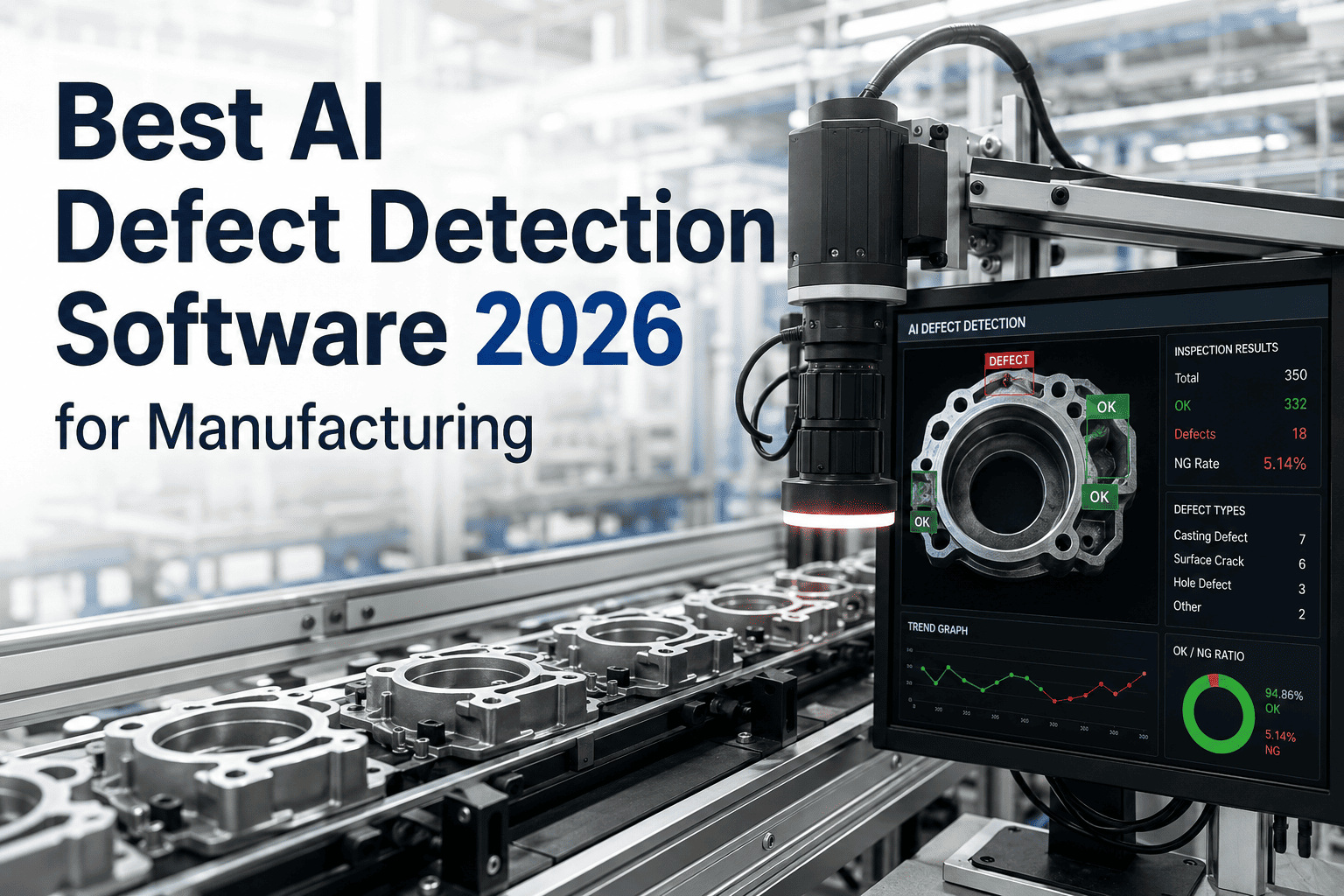
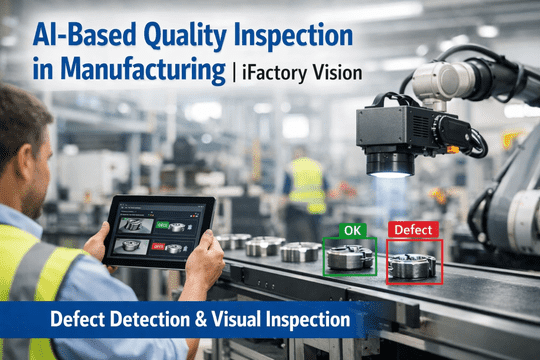
Choosing an AI vision inspection platform in 2026 is not the safe procurement decision it used to be. The AI-based machine vision market has surged from $24 billion in 2025 to nearly $29 billion this year and is on track to reach $91 billion by 2032 — a wave that has flooded the shortlist with everything from 40-year-old hardware giants to two-year-old cloud-native startups, each promising 99%+ accuracy. The wrong pick locks a plant into years of custom model training, hidden cloud egress fees, and an integrator's phone number for every line change. To see how iFactory stacks up on a live line, book a 30-minute walkthrough.
2026 Comparison Guide
Best AI Vision Inspection Platforms — The Honest 2026 Buyer's Comparison
Cut through the marketing. Compare AI vision platforms across the seven criteria that decide whether a system ships value in weeks or turns into a two-year integration project — accuracy, training workflow, edge deployment, camera support, CMMS integration, industry fit, and true total cost of ownership.
$91B
AI machine vision market by 2032
20.95%
Sector CAGR through 2032
7
Criteria that separate winners from losers
4 wks
What "fast deploy" should actually mean
Why Getting the Platform Choice Wrong Costs More Than the Platform
The per-camera license is almost never where AI vision projects go sideways. The real trouble hides in categories buyers rarely price at the shortlist stage — data labeling per SKU, cloud egress, a required integrator for anything beyond the happy path, and a model that stops learning after onboarding. Perpetual licenses run $4,000-$18,000 per camera; SaaS $500-$2,500 per camera per year — but labeling adds $1,500-$6,000 per model and network infrastructure $12,000-$40,000 on a 5-20 camera deployment.
What Buyers See on the Quote
~18%
Of 5-year TCO — the AI software license alone
What Actually Drives 5-Year TCO
Data labeling and model preparation per SKU
Edge compute or on-premise server infrastructure
System integrator fees for PLC and MES exchange
Cloud inference, storage, and data egress charges
Ongoing retraining as products and lighting drift
Operations labor to review false positives
The Seven Criteria That Actually Separate Platforms
Marketing pages compare on accuracy. Procurement teams that ship successful deployments compare on seven dimensions — each one either lowers TCO or extends time-to-value. Use these to build the shortlist before demos start.
01
Detection Accuracy on Your Defects
Vendor claims mean nothing until models are trained on your defect classes with your lighting. Ask for mAP on your samples and false-positive rate at your target catch rate.
02
Training Workflow and Data Efficiency
Some platforms need 5 labeled images per defect, others need 500. That is the difference between production-ready in a week and production-ready in a quarter.
03
Edge Deployment vs Cloud Dependency
Edge processing on-camera or at a local NVIDIA GPU node delivers single-digit millisecond decisions. Cloud-only inference adds latency and recurring fees to the TCO forever.
04
Camera and Hardware Support
Hardware-locked platforms perform only with the vendor's cameras. Software-first platforms sit on your existing area-scan, line-scan, or 3D cameras — match to your installed base.
05
CMMS, MES, and PLC Integration Depth
A detection that does not close a loop is a science project. Confirm the platform supports REST, MQTT, OPC UA and can raise a CMMS work order on recurring defect patterns.
06
Industry Specialization
A platform trained on electronics defects will underperform on aluminum surface flaws until it is retrained end-to-end. Pre-built libraries for your industry collapse the timeline.
07
True Three-Year Total Cost of Ownership
Model hardware, license, integration, labeling, cloud, retraining, and operations labor over three years. Low per-camera numbers often mean the highest TCO — insist on line-item quotes.
The Four Platform Archetypes You Are Actually Choosing Between
Every AI vision vendor fits into one of four archetypes. Understanding the archetype is more useful than remembering a vendor logo — it determines the trade-offs you inherit on licensing, integration, retraining, and the ceiling on how the system evolves.
Archetype A
Hardware-First Machine Vision Giants
Decades of industrial deployment, IP67-rated smart cameras with embedded AI, and deep-learning modules bolted onto rule-based cores. Best where imaging is tightly controlled and the plant commits to the full vendor stack.
Integrated hardwareHigher training data needSI-heavy integration
Archetype B
Software-First Cloud AI Platforms
Hardware-agnostic training studios that run on your cameras, download ONNX models, and lean on cloud pipelines for labeling and retraining. Flexible and no-code, but weaker on closed-loop line integration without an SI.
BYO camerasCloud-first trainingNo workflow layer
Archetype C
Edge-Native AI Vision Systems
Purpose-built smart cameras with an NVIDIA GPU on board that train in under an hour on a handful of images and run inference locally. No cloud dependency, no per-inspection charges, faster time-to-value on standard defects.
On-device inferenceLow-sample trainingFlat licensing
Archetype D
Industrial AI Platforms with CMMS Loop
Vision inference plus an inspection workflow, an eQMS, and a native path from a recurring defect pattern to a CMMS work order on the root-cause asset. This is where iFactory sits — the archetype for teams that want detection to drive maintenance and yield.
Edge inferenceNative CMMS loopIndustry libraries
Head-to-Head: How the Archetypes Stack Up
Side-by-side across the criteria buyers score during shortlisting. The point is to expose the trade-off you accept the moment you pick a lane.
| Evaluation Dimension |
Hardware-First |
Software Cloud |
Edge-Native AI |
Industrial + CMMS |
| Training data per defect | 200-500+ images | 50-200 images | 5-50 images | 5-50 images |
| Deployment timeline | Months | Weeks to months | Days | 4 weeks typical |
| Edge inference latency | Low (proprietary) | Cloud round-trip | Sub-10ms on-device | Sub-10ms on-device |
| Camera flexibility | Vendor stack only | Camera-agnostic | Vendor camera | Camera-agnostic |
| PLC and MES integration | Deep, proprietary | Requires SI | Native protocols | REST, MQTT, OPC UA |
| CMMS work order loop | Not included | Not included | Not included | Native |
| Recurring cloud fees | Low | High | None | None |
| Fits industry libraries | Broad, generic | Broad, generic | Broad, generic | Metals, food, pharma, auto |
Score Your Shortlist Against All Seven Criteria
Run your top vendors through the seven-criteria scorecard with a vision engineer who has deployed on lines like yours.
Total Cost of Ownership — Where the Real Money Hides
Anchoring vendor comparisons on per-camera license is how budgets overrun by 40%. A five-year TCO has ten cost categories — the license line is often less than a fifth of the total. The six below are where variance between quoted and actual runs largest.
License and Hardware
$4,000-$18,000 perpetual per camera on full-featured platforms, or $500-$2,500 per camera per year on SaaS tiers. Add smart-camera hardware where the archetype requires it, and annual maintenance at 15-22% of license cost.
Data Labeling per Model
$1,500-$6,000 to prepare and annotate labeled datasets for each new SKU or defect class. Repeats every time production adds a variant or a new line runs a different alloy, coating, or geometry.
Network and Edge Infrastructure
$12,000-$40,000 in one-time costs for a 5-20 camera deployment — switches, PoE, edge servers, storage. A 5MP camera at 30 fps generates around 450 MB per minute of raw image data.
Cloud Inference and Storage
$3,000-$18,000 per year for off-premise inference, storage, and retraining pipelines. Recurring fees compound and often surpass the initial license spend by year three on cloud-first architectures.
System Integration and NRE
$20,000-$150,000 per line for PLC exchange, MES data flow, and reject actuation. On complex deployments, integration often exceeds hardware cost — and on hardware-first stacks it is unavoidable.
Operations Labor Model
Time spent by quality engineers reviewing false positives, retraining models on new variants, and coordinating maintenance. Undercounted on the quote, always paid on the P&L, and where cheap platforms get expensive.
The Three-Phase Evaluation Process That Prevents Buyer's Remorse
Most AI vision purchase mistakes trace back to skipping a phase. The process below is what quality leaders who deploy multi-site vision programs use before contract signature.
Phase 1
Shortlist Against Documented Requirements
Define the defect profile — occurrence rate, visual complexity, part geometry, current escape rate — before speaking with vendors. Score candidates against the seven criteria without the sales team in the room. This phase filters archetypes and gets you to three finalists.
Phase 2
Structured Demo with Your Own Samples
Ship real defective and good samples to each finalist. Insist the demo runs on your images, not the vendor reference library. Track training time to first working model, false-positive rate at the target catch rate, and how quickly a new defect variant gets integrated once shown.
Phase 3
Contract Review with Line-Item TCO
Demand a five-year TCO quote with all ten cost categories visible, ensure integration and managed-services scope are quoted to the same completeness across proposals, and require written acceptance criteria for go-live. Verbal promises become contractual commitments here.
Red Flags in Vendor Demos You Should Not Ignore
Every AI vision demo lands the headline number. The red flags are in what the demo will not show — each one signals a platform that underperforms once the sales engineer is off the account.
The Demo Runs on the Vendor's Images
A model trained on reference imagery under studio lighting is not one that will hold accuracy on your line. If the vendor cannot demo on your samples inside 48 hours of receiving them, that is your answer on data efficiency.
Accuracy Without a False-Positive Rate
99% detection with a 5% false-positive rate is unusable on a fast line. Insist on both numbers together, at the catch-rate threshold you need, on your data — not headline mAP on a public benchmark.
No Path from Detection to Work Order
A platform that flags a defect but has no native CMMS or maintenance loop leaves the highest-value use case on the table. Recurring defect patterns are maintenance signals — a system without that loop is only half the deployment.
Integration Marketed as an Ecosystem
If protocols are proprietary and every PLC integration routes through a certified integrator, the license fee is only the down payment. Ask specifically about REST, MQTT, and OPC UA — and ask to see them, not read a datasheet.
Where iFactory Fits — and Where It Does Not
iFactory is built as an Archetype D platform — vision inference, an inspection workflow, and a native CMMS loop. Right choice for manufacturers who want detection to close the loop back to maintenance and yield. Wrong choice for teams wanting a pure component to embed inside a home-grown vision stack.
Edge Inference with Industry Libraries
Pre-built defect libraries across metals, food and beverage, pharma, and automotive collapse the training phase — models train in days on your samples, not months on a labeled dataset built from scratch.
Native CMMS Work Order Loop
Recurring defect patterns raise a work order on the source asset — the work roll, the extrusion die, the coating nozzle — instead of dying as a note on a quality dashboard nobody reads.
Camera-Agnostic Deployment
Runs on your existing area-scan, line-scan, or 3D cameras through REST, MQTT, and OPC UA. No rip-and-replace of installed hardware, no vendor lock-in on the sensing layer, no cloud dependency for inference.
Four-Week Deployment Standard
A single-line pilot to production go-live in four weeks is the operating standard — proven on the line, with acceptance criteria written into the SOW, before any commitment to scale.
Frequently Asked Questions
Which AI vision platform archetype is best for a plant just starting with vision inspection?
For a first vision deployment, Archetype C (edge-native) or Archetype D (industrial with CMMS loop) almost always beat the hardware-first and cloud-only lanes on time-to-value. They train on tens of images instead of hundreds, run inference locally with no recurring cloud fees, and can be piloted on a single line in weeks rather than quarters. If you also want the defect data to drive a maintenance work order — which is where the real yield story lives — Archetype D is the fit, and you can
book a walkthrough to see it on a live line.
How do we compare vendors fairly when every deck claims 99%+ accuracy?
Accuracy is only useful paired with a false-positive rate, and only on your samples. Ship real defective and good parts to each finalist and insist the demo runs on your images inside 48 hours of receiving them. Compare training time to first working model, false-positive rate at your target catch rate, and how the model handles a new defect variant introduced mid-demo. That is a signal of production behavior; a headline mAP is not. Our engineers can help set up a structured demo protocol —
talk to a specialist to walk through it.
Is cloud-based AI vision cheaper than edge deployment?
On a two-year horizon, sometimes. On a five-year TCO, almost never. Cloud-first architectures accrue inference charges, storage fees, and data egress costs that compound quarterly and usually cross the perpetual-license figure of a comparable edge deployment by year three. Cloud also adds round-trip latency that is unacceptable for automated reject actuation at fast line speeds, and creates a WAN dependency that stops inspection when the connection drops. Edge inference on an NVIDIA GPU at the camera avoids all of these —
book a demo to see it running.
How much training data do we actually need to get a vision model to production?
It depends entirely on the platform. Hardware-first machine vision stacks typically need 200-500+ labeled images per defect class before a model reaches production accuracy. Software cloud platforms sit in the 50-200 range, and edge-native or industrial AI platforms with pre-trained industry libraries frequently ship on 5-50 images per class. That gap is the difference between production-ready in a week and production-ready in a quarter — one of the largest hidden drivers of vision program timeline slippage in the industry. To scope your training data need,
reach out to a specialist.
What does "CMMS integration" actually mean on an AI vision platform?
On a real Archetype D deployment, CMMS integration means a recurring defect pattern — a scratch at a fixed pitch on every coil, a coating miss in the same spot, a porosity cluster from the same batch — automatically raises a work order on the source asset with the annotated image, severity, location, and recommended intervention window attached. Closeout outcomes then feed back as training data for the next model iteration. That is a closed loop; a dashboard notification is not. To see what it looks like on your equipment,
book a demo.
Score Every Vendor on the Same Seven Criteria
See How iFactory Compares to Your Shortlist — On Your Line, on Your Samples
Bring the defects that are getting past your current system, the platforms you are evaluating, and the constraints your plant actually runs under. In 30 minutes a vision engineer will walk you through the seven-criteria scorecard, run detection on your samples where possible, and give you a straight answer on where iFactory fits — and where it does not.
7
Scoring criteria applied
30 min
Structured walkthrough
Live
Detection on your samples