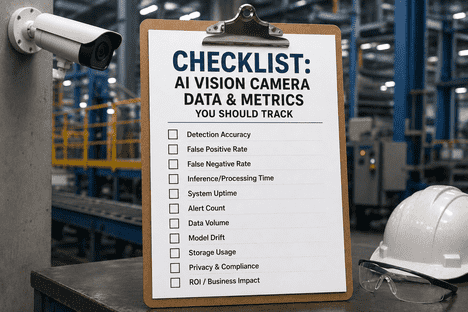
Tracking the right data from your AI Vision Camera system is what separates a deployment that continuously improves from one that delivers static performance and eventually loses the confidence of your production team. Most manufacturers who install AI vision cameras monitor defect counts and rejection rates — but stop short of capturing the full range of metrics that reveal model health, inspection coverage quality, and operational ROI over time. This checklist defines every metric category that quality engineers and reliability managers should be tracking, from basic detection KPIs to model confidence trends, throughput impact data, and compliance documentation completeness. Use this as your operational data tracking framework for iFactory's AI Vision Camera platform or to audit the data you are currently capturing from an existing deployment.
Why Structured Metric Tracking is Essential for AI Vision Programs
Untracked Models Drift Without Warning
AI vision models deployed without systematic performance metric tracking experience gradual accuracy degradation as product appearance, packaging materials, and production conditions change over time. Without trend data on model confidence scores and detection rates, performance drift is invisible until a customer claim or audit surfaces a gap that has been growing for weeks. Structured metric tracking is the early warning system that keeps model performance within specification — and Book a Demo with iFactory to see how automated model health dashboards make drift visible before it becomes a quality event.
Metrics Justify Investment and Drive Expansion
Quality managers who cannot quantify the financial impact of their AI vision deployment — in terms of defect escape reduction, inspection labor reallocation, and throughput recovery — consistently struggle to secure budget for expanding camera coverage to additional lines or facilities. The metrics on this checklist are specifically selected to produce the ROI evidence that operations and finance leadership require to authorize the next phase of deployment investment.
What Structured Metric Tracking Delivers for AI Vision Programs
Early Model Drift Detection Before Quality Events
Confidence score trend monitoring and distribution shift alerts surface model performance degradation weeks before it translates into customer-visible quality events — giving quality teams the advance warning needed to authorize retraining before production quality is affected.
Supplier Quality Evidence from Production Data
Correlating AI vision defect data with raw material lot numbers produces objective, time-stamped supplier quality evidence that supports incoming material improvement programs and cost recovery conversations with suppliers whose material variation is contributing to elevated defect rates.
ROI Documentation for Deployment Expansion
Throughput recovery metrics, customer complaint rate trends, and rework cost data provide the financial evidence that operations and finance leadership require to authorize expanding AI vision coverage from pilot lines to full facility deployment — converting quality manager advocacy into data-supported capital requests.
Audit Readiness Without Manual Assembly
When inspection record completeness rates and per-lot traceability data are tracked automatically, GFSI scheme audit preparation transforms from a multi-day manual documentation assembly task into a report generation exercise measured in minutes — freeing quality staff for productive improvement work rather than compliance paperwork.
Process Root Cause from Defect Pattern Analytics
Defect clustering analysis, shift comparison data, and SKU-level performance segmentation convert high-volume AI vision inspection data into actionable root cause signals — enabling continuous improvement teams to prioritize process investigations with objective data rather than operator recollection and production log summaries.
Hardware Maintenance Planning from Performance Trends
Image quality score trends, lighting intensity monitoring, and trigger synchronization error tracking convert AI vision hardware condition data into planned maintenance actions — preventing the unplanned camera downtime and imaging degradation events that create uninspected production windows and coverage gaps.