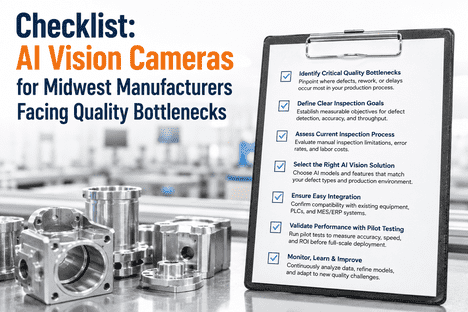
Checklist: AI Vision Cameras for Midwest Manufacturers Facing Quality Bottlenecks
By Austin on May 27, 2026
Midwest manufacturers across Ohio, Michigan, Indiana, Illinois, and Wisconsin operate some of the most demanding production environments in the country — automotive stamping and assembly, fabricated metals, industrial machinery, food processing, and pharmaceutical packaging lines running multi-shift schedules where a quality bottleneck at a single inspection station slows the entire line. The cost of that bottleneck compounds quickly: human visual inspection handles 2 to 3 parts per minute while a production line downstream runs at 10 to 20 times that throughput rate, inspection accuracy degrades 15 to 25% after two continuous hours on the same task, and inter-inspector agreement on defect severity sits at only 55 to 70% — meaning the same part gets a different quality verdict depending on which shift is running. AI Vision Cameras eliminate all three of these failure modes simultaneously, inspecting 10,000 or more parts per hour at sub-100ms inference speed with 95 to 99% detection accuracy maintained identically across every shift and every product variant. This checklist is structured for Midwest plant managers, quality engineers, and operations directors evaluating whether AI Vision Camera deployment is the right solution for their current inspection bottleneck — and for those already committed to deployment, it provides the step-by-step readiness and implementation sequence that determines whether a deployment delivers its projected ROI within the first production quarter. Book a Demo to see how iFactory's AI Vision Camera platform resolves the specific quality bottlenecks that Midwest manufacturers face across automotive, metals, food, and industrial production lines.
Eliminate Your Quality Bottleneck With AI Vision Cameras Built for Midwest Production Environments
iFactory's AI Vision Camera platform detects surface defects, assembly errors, dimensional deviations, and contamination events at production line speed — with 95–99% accuracy, sub-100ms inference, and direct integration into your existing MES, ERP, and quality management systems.
Why Midwest Manufacturers Face Disproportionate Quality Inspection Pressure
High-Mix Production and Frequent Changeovers Create Inspection Inconsistency
Midwest manufacturers — particularly in automotive tier supply, fabricated metals, and industrial machinery — run high-mix product portfolios with frequent changeovers between part numbers and specifications. Each changeover requires inspectors to recalibrate visually for a different defect profile, different tolerances, and different acceptable appearance criteria. AI Vision Camera models switch product profiles automatically on lot change commands from the MES — maintaining identical inspection standards across every product variant without the human recalibration delay that drives escape events immediately after changeovers. Book a Demo to see multi-product profile switching in action on a Midwest automotive supplier line.
Labor Availability Constraints Make Manual Inspection Unsustainable at Scale
Ohio, Michigan, and Indiana rank among the top five US states for manufacturing employment concentration — and all three face persistent skilled labor shortages that make staffing dedicated inspection positions at every line increasingly difficult and expensive. When inspection positions go unfilled, line output is throttled or quality gates are compromised. AI Vision Cameras operate continuously across all shifts without headcount constraints — allowing Midwest manufacturers to redeploy inspection labor to higher-value process improvement roles rather than replacing one unfilled position with another.
10,000+Parts inspected per hour by AI Vision Cameras vs. 120–180 parts per hour for a human inspector under sustained production conditions
95–99%Detection accuracy maintained by AI Vision inspection systems — identical across all shifts, all operators, and all product variants
374%Three-year ROI documented for AI vision inspection deployments, with average payback period of 7–8 months from go-live
37%Average defect reduction documented across AI vision inspection deployments in automotive, metals, and food manufacturing environments
AI Vision Camera Deployment Checklist — Phase by Phase
1. Quality Bottleneck Identification & Current State Assessment
2. Defect Type & Camera Configuration Readiness
3. IT Infrastructure & MES Integration Readiness
4. AI Model Training & Validation Protocol
5. Live Deployment, Operator Training & Change Management
6. Quality Data Utilisation & Continuous Improvement Integration
FULL INSPECTION COVERAGEREAL-TIME DEFECT ALERTS
Deploy AI Vision Cameras Across Your Midwest Production Lines — With Expert Implementation Support
iFactory's AI Vision Camera platform is purpose-built for the quality challenges Midwest manufacturers face in automotive, metals, food processing, and industrial production. From defect taxonomy definition through go-live validation, our implementation team handles every phase of the deployment so your quality engineers can focus on results, not configuration.
"We were running three dedicated inspectors on our stamped metal components line across two shifts — and still shipping defective parts to our automotive customer. The inspection station was clocked at 180 parts per hour while the press was running at 1,400 parts per hour, so we were doing spot sampling at 13% coverage and calling it inspection. After deploying iFactory's AI Vision Camera at the line exit, we went to 100% inspection coverage at 1,400 parts per hour with a 97.4% detection rate confirmed in validation. Our customer PPM dropped from 340 to under 20 in the first quarter. The three inspectors we freed up are now running first-article inspection and supplier quality activities we were previously unable to staff."
Running a four-press stamping facility at 8 million parts annually
What Midwest Manufacturers Gain When This Checklist Is Completed Successfully
100% Inspection Coverage at Line Speed
Every part passing through the AI Vision Camera inspection point is evaluated against the full defect taxonomy at sub-100ms inference speed — eliminating the sampling compromises that manual inspection forces at production rates above a few hundred parts per hour. For Midwest manufacturers whose customers specify 100% inspection in their quality plans, this is the only technically viable path to compliance at full production throughput.
Shift-Consistent Quality Standards
iFactory's AI Vision Camera applies a single, fixed classification model to every part on every shift — eliminating the shift-to-shift quality variation that most Midwest manufacturers track in their SPC data as a chronic special cause. When customer returns correlate with specific shifts, specific inspectors, or the period immediately after a changeover, AI Vision Camera deployment removes the human variability factor that is driving the pattern.
Real-Time Process Control Feedback
Defect rate trends detected by the AI Vision Camera — a gradual increase in surface scratch frequency that indicates tooling wear, or a sudden spike in dimensional non-conformance that indicates a fixture shift — are visible in real time on the iFactory dashboard and triggered as alerts to the quality engineer's mobile device. Process corrections happen in minutes rather than after end-of-shift data review, limiting the scrap produced during any given process excursion.
Automated Inspection Traceability for Customer Audits
iFactory logs every inspection result with image, timestamp, defect classification, severity score, and part or lot ID — creating a complete, searchable inspection record for every production run. For Midwest automotive and industrial manufacturers facing customer IATF 16949 audits or PPAP documentation requirements, this automated traceability record eliminates the document preparation burden that previously consumed quality engineering time before every major customer review.
Defect Root Cause Acceleration
The structured defect image archive and defect rate trend data generated by iFactory's AI Vision Camera reduces the time to root cause identification for recurring defect events from days to hours. Quality engineers can filter the defect archive by time window, shift, product variant, and defect severity — immediately identifying whether a defect pattern is random or assignable, and whether it correlates with a specific process variable change, tooling replacement, or material lot introduction.
Measurable ROI Within the First Production Quarter
Documented AI Vision Camera deployments in manufacturing environments comparable to Midwest automotive, metals, and food production consistently achieve payback within 7 to 8 months — driven by scrap reduction, customer return avoidance, inspection labour redeployment, and throughput recovery from bottleneck elimination. iFactory's implementation team provides the ROI tracking framework as a standard project deliverable, so the financial result of the deployment is documented and presentable at the 90-day operations review.
AI Vision Camera Deployment: Frequently Asked Questions from Midwest Manufacturers
1. How long does it take to deploy iFactory's AI Vision Camera at a Midwest manufacturing facility?
A standard single-station deployment follows a 60 to 90 day timeline from site assessment to go-live: approximately 2 weeks for site assessment and hardware specification, 2 to 3 weeks for hardware installation and camera setup, 3 to 4 weeks for AI model training and validation on your production image library, and 1 to 2 weeks of parallel operation before transitioning to AI-only inspection. Facilities with existing defect image libraries and clear integration specifications at the start of the project typically complete deployment in 60 days; facilities that require image capture sessions and custom MES integrations are typically in the 75 to 90 day range.
2. What Midwest manufacturing industries is iFactory's AI Vision Camera most commonly deployed in?
iFactory's AI Vision Camera platform is deployed across the full range of Midwest manufacturing industries — automotive stamped and cast components, fabricated metal products, industrial machinery assemblies, food and beverage packaging lines, pharmaceutical blister pack inspection, and electronic components assembly. The defect categories and inspection requirements differ significantly across these industries, but the deployment methodology and platform architecture are consistent. iFactory maintains pre-configured defect model libraries for the most common defect categories in each of these industries, which reduces the training data requirement for new deployments in those sectors.
3. Can iFactory's AI Vision Camera integrate with the SAP or Plex MES systems common in Midwest automotive suppliers?
Yes. iFactory integrates with SAP, Plex, Infor, Oracle, and custom MES platforms used by Midwest manufacturers — delivering defect count, defect category, and part disposition data directly into your quality record and production order systems. The specific integration method (direct database connector, REST API, OPC-UA, or file-based exchange) is determined during the site assessment phase and configured before go-live. Most SAP and Plex integrations are operational within 2 to 3 weeks of integration work starting. Book a Demo to discuss your specific MES integration requirement with iFactory's engineering team.
4. How does iFactory's AI Vision Camera handle product changeovers on high-mix Midwest production lines?
iFactory maintains a separate AI inspection model profile for each product variant in the production programme. When a lot or job change command is received from the MES — or manually entered by the operator at the inspection station — the system automatically loads the correct inspection profile for the new product, including the defect taxonomy, classification thresholds, and acceptable appearance criteria specific to that variant. Changeover time at the inspection station is under 30 seconds, which is typically faster than the physical changeover of tooling or fixtures at the production operation feeding the inspection point.
5. What happens when the AI Vision Camera encounters a defect type it has not been trained on?
When the AI model encounters an image that does not match any trained defect category — a novel defect signature from a new failure mode — the system classifies the image as an anomaly and routes it for human review rather than making an autonomous accept or reject decision. The anomaly images are flagged in the iFactory dashboard for quality engineer review, and confirmed novel defects can be added to the training set to expand the model's classification capability. This anomaly detection behaviour is a critical safety net that prevents unknown defect types from escaping detection while the model is still being trained on novel failure modes.
6. Does iFactory's platform support IATF 16949 and customer-specific quality documentation requirements?
Yes. iFactory's AI Vision Camera platform generates the inspection records, defect traceability logs, and quality performance reports that satisfy IATF 16949 clause requirements for documented inspection processes, measurement system qualification, and quality record retention. Customer-specific requirements from major automotive OEMs — Ford, GM, Stellantis, and their Tier 1 networks — including part-level inspection traceability, defect image retention, and outgoing quality reporting, are addressed by iFactory's standard record architecture. The platform supports configurable data retention periods up to the 15-year minimum required by some OEM supplier quality agreements.
7. What is the typical ROI timeframe for AI Vision Camera deployment at a Midwest manufacturing plant?
Documented deployments in manufacturing environments comparable to Midwest automotive, metals, and food production show an average payback period of 7 to 8 months, with a three-year ROI of 374%. The fastest ROI typically comes from three sources: elimination of customer return costs for defect categories the AI catches that manual inspection was escaping; reduction in end-of-line scrap from earlier defect detection; and throughput recovery from removing the inspection bottleneck at stations where the inspector was pacing the line. iFactory's implementation team provides a facility-specific ROI model built from your production volume, defect rates, and labour cost data before deployment begins.
8. How does iFactory support ongoing AI model performance and retraining after initial deployment?
iFactory monitors AI model performance continuously against the validated baseline — detection rate, false positive rate, and confusion matrix by defect category — and alerts the quality team when any metric drifts beyond the defined tolerance band. When model performance degradation is detected, iFactory's platform provides tools for quality engineers to add new training images, adjust classification thresholds, and retrain the model without requiring iFactory engineering involvement for routine updates. For significant model changes — new product variants, major process changes, or new defect category additions — iFactory's support team provides guided retraining support as a standard platform subscription service. Book a Demo to understand iFactory's ongoing model support programme for Midwest manufacturing deployments.
START YOUR ASSESSMENTMIDWEST MANUFACTURING SPECIALISTS
Request an AI Vision Camera Quality Assessment for Your Midwest Facility
iFactory's manufacturing team will review your current inspection bottleneck, defect escape profile, and production environment — then build a quantified deployment plan and ROI model specific to your facility, your product mix, and your quality requirements.