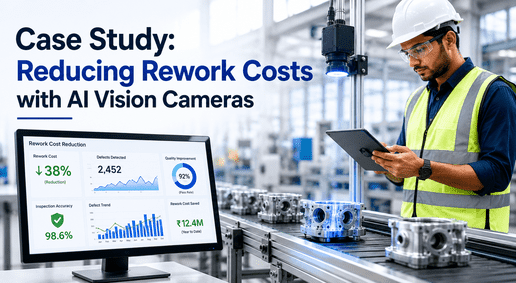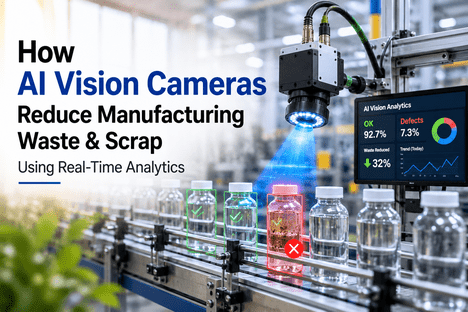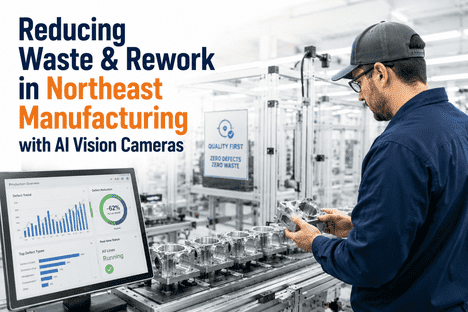
Northeast manufacturers — spanning pharmaceutical and medical device facilities across New Jersey and Massachusetts, precision aerospace and defense suppliers in Connecticut and New York, food processing operations throughout Pennsylvania and upstate New York, and the dense electronics and industrial equipment corridor running from Boston to Philadelphia — operate under a quality compliance burden that is among the most demanding of any manufacturing region in the United States. The cost of poor quality in these environments is not abstract: every manufacturing company loses an average of 20% of total revenue to scrap, rework, warranty claims, and inspection overhead, which means a $10 million Northeast plant is quietly burning $2 million annually before a single customer return is logged. Rework is particularly destructive in this region because the labor cost per hour in the Northeast is substantially above the national manufacturing average — every part that cycles back through a production operation for correction carries a labor cost that compounds the material loss. The structural root cause of this waste is a quality inspection process that relies on human visual inspection for 60 to 80% of its detection coverage: a method that misses 20 to 30% of defects under real production conditions, degrades measurably within two hours of continuous observation, and produces different accept/reject decisions depending on which shift and which inspector is at the station. iFactory's AI Vision Camera platform eliminates this structural weakness — deploying deep learning vision models that inspect 10,000 or more parts per hour at 95 to 99% detection accuracy, maintained identically across every shift, every product variant, and every production speed, with every inspection result logged as a complete traceability record. Book a Demo to see how iFactory reduces waste and rework for Northeast manufacturers across pharmaceutical, medical device, aerospace, food, and precision industrial production lines.
The Rework Problem in Northeast Manufacturing: Why It Costs More Here Than Anywhere Else
Rework in manufacturing is the symptom of a defect detection system that catches problems too late. When a defect passes the first inspection gate and is identified at a downstream assembly stage, at final inspection, or — worst of all — at the customer — the cost of that defect multiplies at each stage it was missed. A surface defect caught at the first station costs one part. The same defect caught after three assembly operations costs the part plus all the labor and materials added since the first station. Caught by the customer, it costs the part, the assembly, the warranty claim, the return logistics, and potentially the customer relationship. In the Northeast, where hourly manufacturing labor rates in states like Massachusetts, Connecticut, New Jersey, and New York run 15 to 25% above the national manufacturing average, the rework labor cost multiplier is larger than in any other US manufacturing region. This economic reality makes early-stage AI-powered defect detection not just operationally valuable but financially urgent for Northeast manufacturers competing against lower-cost domestic and international producers.
The second dimension of the Northeast manufacturing waste problem is compliance-driven rework. Pharmaceutical and medical device manufacturers operating under FDA 21 CFR Part 820 and ISO 13485 requirements face mandatory investigation and documentation requirements for every quality escape that reaches a downstream stage. Each investigation consumes quality engineering hours that are among the highest-cost labor categories in any production facility. A single Form 483 observation for inadequate inspection process controls can trigger a corrective action that absorbs 200 to 400 quality engineering hours over its full lifecycle — hours that are entirely avoidable when the root cause is an inspection process that misses defects the AI Vision Camera would have caught at the first station. Book a Demo to see how iFactory supports FDA-regulated Northeast manufacturers with automated inspection traceability and real-time defect alerting.
Where AI Vision Cameras Eliminate Waste and Rework in Northeast Production Environments
The Northeast's manufacturing industry profile creates five specific defect detection and rework scenarios where AI Vision Cameras deliver the highest financial return — each driven by the combination of complex products, high labor costs, and stringent regulatory requirements that define production in this region.
Pharmaceutical & Medical Device — Eliminating Rework from Visual Inspection Failures
New Jersey and Massachusetts are home to the highest concentration of FDA-regulated pharmaceutical and medical device manufacturing facilities in the United States. In these environments, a visual inspection failure — a crack in a tablet coating missed at the packaging line, a particulate in a vial not caught at the fill-finish station, a burr on a surgical instrument that passes the inspection gate — does not generate a rework order. It generates a batch rejection, a CAPA investigation, and potentially an FDA observation. iFactory's AI Vision Camera system provides 100% part coverage at production line speed with 95 to 99% detection accuracy, generating the structured inspection record that supports cGMP compliance and satisfies the documentation expectations FDA investigators increasingly apply in 2025 facility inspections.
Aerospace & Defense — Weld, Surface, and Assembly Inspection at Zero-Defect Standards
Connecticut and New York host the largest concentration of aerospace and defense tier suppliers outside of the US South — including precision machined components, structural assemblies, and avionics systems for prime contractors. In aerospace manufacturing, the cost of rework is compounded by first article inspection requirements, material traceability obligations, and AS9100 quality management standards that require documented root cause analysis for every non-conformance. AI Vision Cameras deployed at weld inspection, surface finish verification, and final assembly check stations detect the dimensional deviations, surface irregularities, and assembly omissions that currently generate the majority of first-time-quality failures and the rework cycles that follow them.
Food & Beverage Processing — Foreign Object Detection and Label Compliance
Pennsylvania, upstate New York, and New England food and beverage processors face a dual waste challenge: product loss from contamination events that trigger line holds or batch withdrawals, and rework cost from labelling and packaging non-conformances that require manual re-work before shipment. iFactory's AI Vision Camera platform covers both categories — detecting foreign objects, packaging defects, fill level deviations, and seal integrity failures at production line speed, and verifying label correctness, date code accuracy, and batch code placement against the production specification for every package. Detection at the line eliminates the far more expensive alternative of detection at distribution or retail.
Electronics & PCB Assembly — Solder, Component, and Coating Defect Elimination
The electronics manufacturing corridor from Boston through the greater New York metro area and into New Jersey produces PCBs, sensors, industrial controls, and specialty electronics where solder joint defects, component placement errors, and conformal coating voids are the dominant sources of field failure and warranty cost. Traditional AOI systems detect the defect categories they were programmed to find during setup and consistently miss novel defect signatures — which is why defect escape rates remain significant even in facilities with AOI deployed. iFactory's deep learning AI Vision Camera model learns from production image history, generalizes to novel defect signatures without rule updates, and improves classification accuracy as additional data accumulates — reducing escape rates below what rule-based AOI systems can achieve.
Precision Industrial & Fabricated Metals — Dimensional and Surface Quality Verification
Precision machining, fabricated metal, and specialty plastics manufacturers operating throughout the Northeast — supplying semiconductor equipment, industrial machinery, energy infrastructure, and defense applications — run high-mix low-volume production where changeover frequency makes manual inspection both the bottleneck and the primary source of escape events immediately after product switches. iFactory's AI Vision Camera handles multi-product inspection with automatic profile switching on lot-change commands from the MES, maintaining identical quality standards across every product variant without the visual recalibration delay that drives human inspection escape events during the first production run after each changeover.
How iFactory's AI Vision Camera Reduces Waste at Every Stage of the Production Process
The financial case for AI Vision Camera deployment is most compelling when it is built from the full cascade of waste that a single undetected defect generates as it moves downstream — not just the scrap value of the defective part. iFactory's platform attacks waste at four distinct points in the production flow, each with its own ROI contribution.
First-Station Detection — Minimum Waste Per Defect
When the AI Vision Camera catches a defect at the first inspection station — before any downstream value is added — the waste is limited to the cost of one part and the material used to that point. iFactory's platform is deployed as close to the defect-generating operation as physically possible, ensuring that defects are classified and rejected before they enter the next production step. For Northeast pharmaceutical and medical device manufacturers, first-station detection also prevents the CAPA investigation cost that attaches to defects caught downstream of their origin point.
Process Drift Detection — Preventing Batch-Level Scrap Events
iFactory's defect rate trending capability identifies when a defect category is increasing in frequency — signaling a process drift, tooling wear event, or material quality shift — before it generates a batch-level scrap event. For Northeast food processors and pharmaceutical manufacturers where a single batch rejection can represent $50,000 to $500,000 in finished product value, this early warning capability is the highest-value function of the AI Vision Camera platform. The defect rate alert reaches the quality engineer's mobile device in real time, enabling a process investigation and correction within minutes rather than after the full batch has been produced.
Rework Elimination Through 100% Coverage
The rework cycle — detect, return to rework station, correct, re-inspect, return to production flow — is one of the most expensive activities in any manufacturing operation because it touches multiple labor categories and interrupts production scheduling. iFactory's 100% inspection coverage at line speed eliminates the rework cycle for defect categories where the root cause can be corrected at the source rather than downstream. When the AI Vision Camera detects a defect at the operation generating it, the process correction is immediate — not a scheduled rework batch processed at the end of the shift.
Customer Return Prevention — Eliminating the Highest-Cost Defect Stage
A defect that reaches the customer costs an order of magnitude more than one caught at the production line. In the Northeast, where many manufacturers supply highly regulated industries with zero-tolerance recall obligations, a single customer escape event can trigger investigation costs of $100,000 to $1 million before the direct product recall and return costs are included. iFactory's documented 85% reduction in customer complaints across manufacturing deployments reflects the direct financial impact of catching the defects that currently escape to the customer through the gaps in manual inspection coverage.
The Rework Cost Drivers That AI Vision Cameras Address Directly
Based on quality cost data from manufacturing deployments comparable to Northeast production environments, the following factors drive the largest share of rework and scrap cost — and represent the primary value streams that AI Vision Camera deployment recovers.
Compliance Traceability: How iFactory Supports FDA-Regulated Northeast Manufacturers
For Northeast pharmaceutical, medical device, and food manufacturers, waste reduction and rework elimination are inseparable from compliance documentation. The FDA's 73% increase in warning letter issuance in the second half of 2025 — combined with its deployment of AI-powered facility risk targeting tools — has sharply increased the compliance cost of inadequate inspection documentation for manufacturers in this region. iFactory's AI Vision Camera platform generates the complete, automated inspection record that FDA-regulated facilities require: every inspection result logged with the part image, timestamp, defect category, severity classification, and lot or serial number, retained in a searchable archive for the duration required by your quality plan.
For medical device manufacturers transitioning toward ISO 13485 alignment under the FDA's Quality Management System Regulation (QMSR) framework expected to take effect in 2026, iFactory's platform supports the inspection documentation and measurement system qualification requirements that QMSR compliance demands. The automated inspection record eliminates the manual data entry work that currently absorbs 40 to 60% of quality engineering time at inspection-intensive medical device facilities — redirecting that capacity toward the process improvement activities that actually reduce the non-conformance rate. Book a Demo to see iFactory's compliance documentation architecture for FDA-regulated Northeast manufacturers.
iFactory's AI Vision Camera platform does not just classify individual parts — it continuously monitors defect rate trends across the production run, building a statistical baseline for each defect category that distinguishes normal variation from an assignable cause shift. When the defect rate for a specific category rises above the configured control limit, the platform generates a real-time alert to the quality engineer's mobile device with the defect image archive, the time-stamped rate trend, and the lot number affected. For Northeast pharmaceutical and food manufacturers where a single process drift event can convert a batch into $100,000 or more of waste, this real-time statistical monitoring is the single highest-ROI capability of the AI Vision Camera platform — catching the process deviation before it produces a batch rejection rather than after.
Comparing AI Vision Cameras Against Traditional Inspection Methods for Waste Reduction
| Performance Dimension | Human Visual Inspection | Rule-Based AOI System | iFactory AI Vision Camera |
|---|---|---|---|
| Defect Detection Accuracy | 70–80% (degrades over shift) | 85–92% (known defect types only) | 95–99% consistent |
| Inspection Throughput | 120–180 parts/hour | Varies — limited by camera speed | 10,000+ parts/hour |
| Shift-to-Shift Consistency | 55–70% inter-inspector agreement | Consistent for programmed rules | Identical, 24/7 |
| Novel Defect Detection | Variable — depends on inspector | Not detected (rule not defined) | Anomaly detection built-in |
| Inspection Record Generation | Manual — incomplete coverage | Partial — result log only | 100% automated with images |
| FDA / ISO Traceability Support | Limited — manual documentation | Partial — no image archive | Full audit-ready record |
| Real-Time Process Alerts | End-of-shift data review | Alarm on single part reject | Defect rate trend alerts |
| Typical Rework Rate Impact | Baseline — no improvement | Modest — known defects only | 37% average defect reduction |
Customer Voice: Rework Elimination at a Northeast Manufacturer
"We were spending $1.4 million annually on rework and end-of-line re-inspection at our precision components facility — and we couldn't get below a 2.3% defect escape rate to our medical device customer no matter how many inspectors we added. The problem wasn't the number of inspectors; it was that no human team can maintain 98% accuracy across a 16-hour production day on parts this complex. After deploying iFactory's AI Vision Camera at our two critical inspection stations, our defect escape rate dropped to 0.08% within the first quarter. We reduced our inspection labor from seven dedicated positions to two — with the five positions we freed up now running first-article and incoming material inspection that we previously didn't have bandwidth for. The $1.8 million we save annually in rework avoidance paid back the deployment investment in under six months."
Frequently Asked Questions: AI Vision Cameras for Waste and Rework Reduction in Northeast Manufacturing
How does iFactory's AI Vision Camera reduce rework costs specifically in Northeast manufacturing environments?
iFactory's AI Vision Camera reduces rework costs through three mechanisms: first-station defect detection that catches defects before downstream value is added, eliminating the labor multiplier effect of late-stage detection; process drift alerting that identifies worsening defect trends before they generate batch-level scrap events; and 100% inspection coverage that closes the night shift and changeover coverage gaps where the majority of rework-generating escapes currently occur in Northeast facilities. In the Northeast specifically, where manufacturing labor costs are 15 to 25% above the national average, the rework labor elimination component of this value stack is substantially higher per unit than in lower-cost manufacturing regions.
Can iFactory's AI Vision Camera meet FDA inspection documentation requirements for pharmaceutical and medical device manufacturers?
Yes. iFactory's platform generates a complete, automated inspection record for every inspected part — including the captured image, timestamp, defect classification, severity score, and part or lot identifier — stored in a searchable archive with configurable retention periods up to the 15-year minimum required by some FDA-regulated quality plans. The inspection record format supports cGMP documentation requirements under 21 CFR Part 820 and the ISO 13485 alignment requirements under the upcoming QMSR framework. iFactory's implementation team provides the measurement system validation documentation required to qualify the AI Vision Camera as an inspection method under your facility's quality management system. Book a Demo to review iFactory's compliance documentation package with your quality team.
What defect types does iFactory's AI Vision Camera detect in Northeast manufacturing applications?
iFactory's AI Vision Camera platform detects the full spectrum of defect categories relevant to Northeast manufacturing industries: surface defects including scratches, cracks, porosity, and coating voids; dimensional non-conformances detectable through visual measurement; assembly errors including missing components, incorrect orientation, and fastener absence; labelling and packaging defects including incorrect date codes, misaligned labels, and seal failures; solder joint defects in electronics assembly; and contamination events including foreign objects, particulates, and colour deviations. The platform uses deep learning models trained on your specific production image library rather than generic rule libraries, which is why it outperforms traditional AOI systems on the novel and subtle defect categories that generate the majority of customer escapes in complex Northeast manufacturing environments.
How long does it take to deploy iFactory's AI Vision Camera at a Northeast manufacturing facility?
A standard single-station deployment follows a 60 to 90 day timeline covering site assessment and hardware specification, AI model training on your production image library, integration with your MES or quality management system, validation against historical inspection records, and a parallel operation period before transitioning to AI-only inspection. Northeast facilities operating under FDA change control or AS9100 qualification requirements typically complete in 75 to 90 days to accommodate the validation documentation process. iFactory's implementation team provides the full validation package — including IQ, OQ, and PQ documentation — as a standard project deliverable for regulated facilities.
How does iFactory's platform handle the high-mix, frequent-changeover production common in Northeast manufacturing?
iFactory maintains a separate AI inspection model profile for each product variant, automatically switching to the correct profile when a lot change command is received from the MES or entered by the operator. The changeover time at the inspection station is under 30 seconds — faster than the physical changeover of tooling or fixtures at the producing operation. For Northeast precision manufacturers and aerospace suppliers running dozens of active part numbers simultaneously, this automatic multi-product switching eliminates the visual recalibration period after each changeover that is currently the highest-risk window for defect escapes in manual inspection operations.
What is the typical waste and rework cost reduction achieved by iFactory's AI Vision Camera deployments?
Documented deployments show 37% average defect reduction, 85% reduction in customer complaints, and $1.8 million or more in annual rework and warranty cost avoidance at facilities comparable to Northeast manufacturing operations in scale and complexity. The three-year ROI averages 374% with a 7 to 8 month payback period. For Northeast manufacturers where the cost of poor quality baseline is higher than the national average due to elevated labor rates and compliance overhead, the absolute dollar value of waste and rework elimination typically exceeds the documented averages for equivalent production volumes in lower-cost regions. iFactory's implementation team provides a facility-specific ROI model built from your production volume, defect rate, and labor cost data before deployment begins.
Does iFactory integrate with the MES and quality management systems used by Northeast manufacturers?
Yes. iFactory integrates with SAP, Oracle, Plex, Infor, TrackWise, and custom MES and QMS platforms used by Northeast manufacturers — delivering defect counts, defect images, and part disposition data directly into your existing quality record and production order workflows. Integration is provided via REST API, OPC-UA, SECS/GEM for semiconductor environments, or file-based exchange depending on your system architecture. Most MES integrations are operational within 2 to 3 weeks of integration work starting, within the overall 60 to 90 day deployment timeline.
How does iFactory's AI Vision Camera support AS9100 quality requirements for Northeast aerospace manufacturers?
iFactory's platform generates the inspection documentation required by AS9100 revision D — including 100% inspection records with part traceability, measurement system calibration logs, and defect trend analysis that supports the non-conformance investigation and CAPA documentation process. The platform's defect rate trending capability supports the statistical process monitoring requirements of AS9100 by providing real-time control chart data from inspection results without manual data collection. For first article inspection requirements, iFactory's inspection archive provides the dimensional and visual inspection evidence required to support FAIR documentation. Book a Demo to review iFactory's AS9100 documentation support with your quality engineering team.