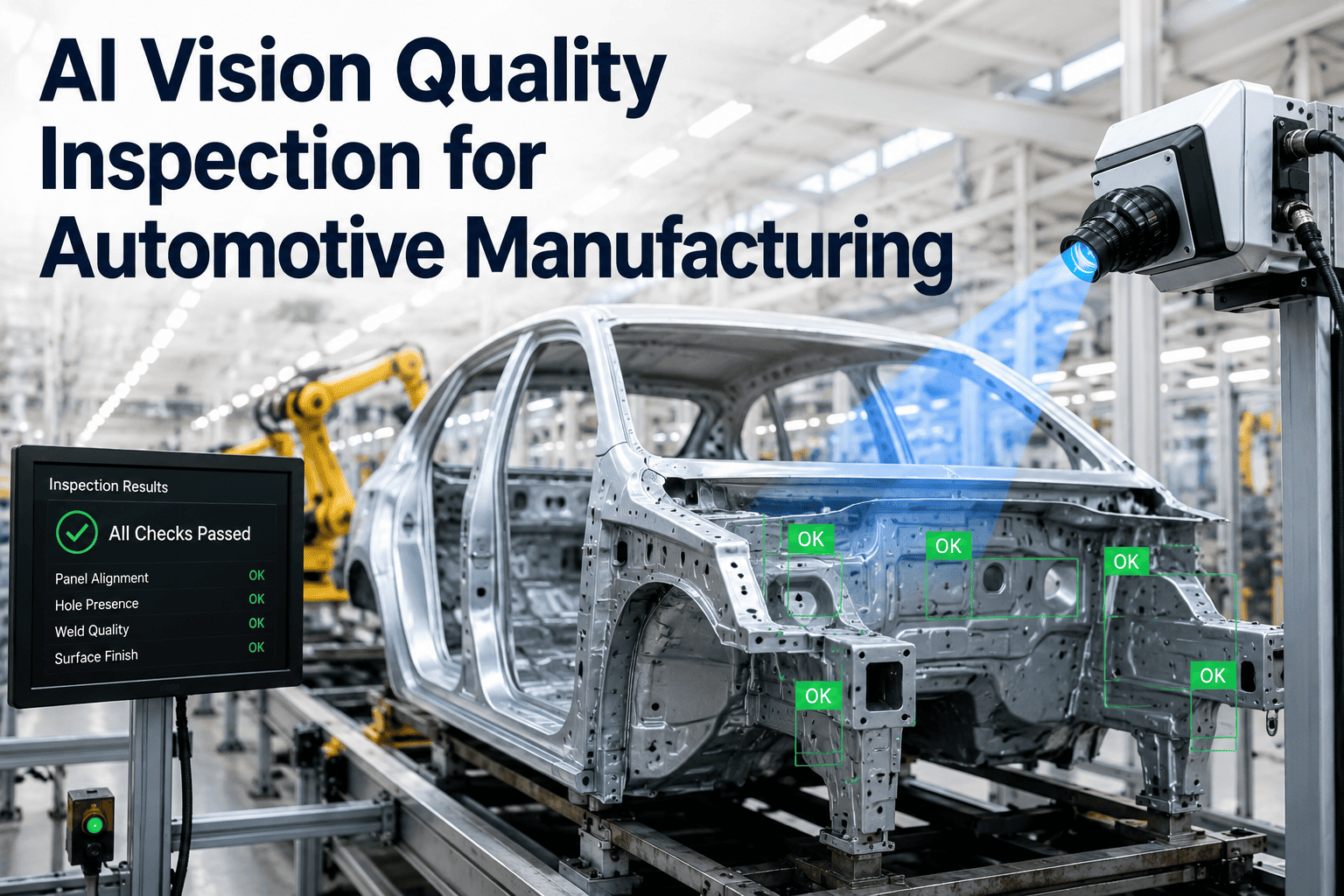
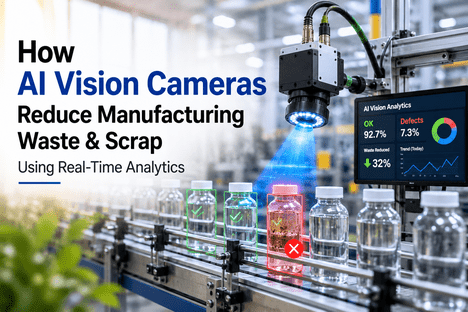
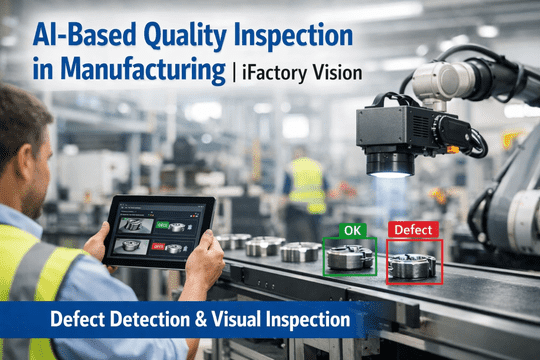
Every defective part that escapes inspection carries the energy, water, labor, and raw materials already spent on it directly to the waste pile. In automotive stamping, electronics assembly, food processing, and metals fabrication, scrap rates of 5 to 15 percent are standard, and each percentage point represents thousands of dollars in embedded materials plus measurable carbon emissions. AI vision inspection catches defects at the earliest possible stage, before additional value is added, and documented deployments show scrap reductions of 30 to 50 percent. This is not only a quality improvement — it is a sustainability strategy with quantifiable ESG impact that operators can report to stakeholders right now.
AI Vision for Sustainable Manufacturing
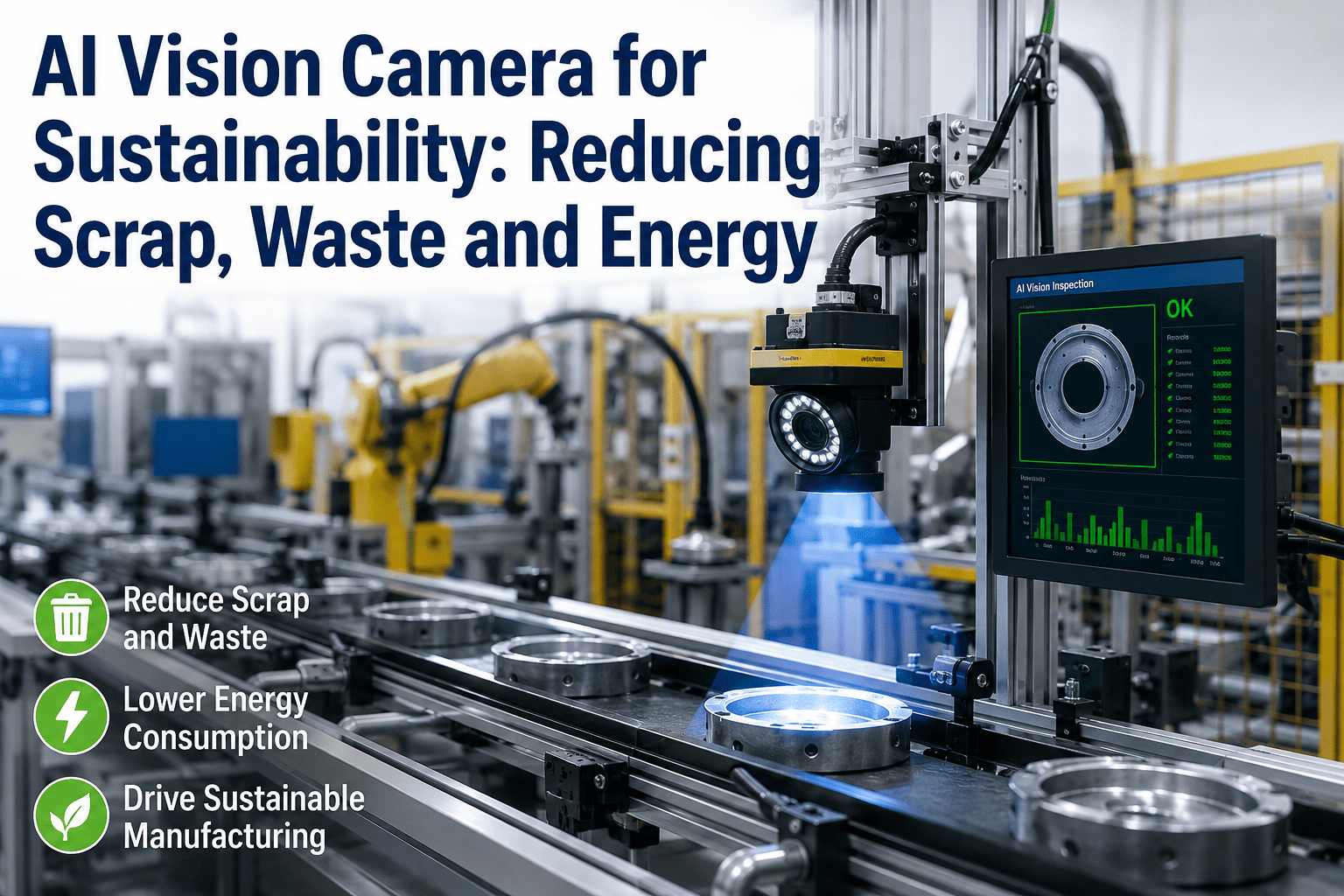
AI Vision Camera for Sustainability: Reducing Scrap, Waste and Energy
Detect defects at the source, stop waste before it compounds, and turn quality inspection into a measurable sustainability driver with deep-learning vision cameras deployed on your existing production lines.
30-50%
Scrap reduction with AI vision
60-70%
Of scrap cost is embedded energy and labor
6-12 mo
Payback from scrap savings alone
Every Part
Inspected at full line speed
The Real Cost of a Defective Part
A part that gets scrapped after machining has already consumed cutting fluids, electricity, tooling wear, and operator time. If it passes machining and gets scrapped after assembly, the waste multiplies — fasteners, sub-components, adhesives, and the labor of multiple stations are all lost. If the defect is caught only at final inspection or by the customer, the waste includes packaging, shipping, and potentially a full product recall. The material cost of scrap is typically only 30 to 40 percent of its true cost; the remaining 60 to 70 percent is embedded energy, labor, and overhead that is never recovered. AI vision cameras positioned at key checkpoints catch defects when the invested cost is still low, converting what would have been total waste into a minor correction.
60-70%
of scrap cost is embedded energy and labor, not raw material
5-15%
typical scrap rate across discrete and process manufacturing
30-50%
documented scrap reduction with AI vision inspection systems
2-3x
cost multiplier when defects are caught late versus early
How Waste Compounds Across Production Stages
A defect that enters the production flow does not stay the same size — it grows in cost at every stage it survives. A raw-material flaw caught at incoming inspection costs almost nothing to discard. The same flaw caught after machining has consumed cutting energy, tool life, and operator hours. Caught after assembly, it has also consumed fasteners, sub-components, and multi-station labor. By the time it reaches final inspection or the customer, the cumulative waste is many times the original material value. The visual below shows how the cost of a single defective part escalates through each production stage — and where AI vision cameras intervene to stop the multiplication before it starts.
Cumulative Waste Escalation Per Defective Part
1
Incoming Material
2% waste
Minimal value lost
2
Machining
5% waste
Energy + tooling added
3
Assembly
8% waste
Sub-components lost
4
Finishing
12% waste
Coating + curing wasted
5
Shipping
15%+ waste
Packaging + recall risk
AI Vision catches defects at Stage 1-2 — waste stays at 2%, not 15%
Where AI Vision Breaks the Waste Cycle
Traditional quality control relies on manual inspection at a few checkpoints, statistical sampling, or end-of-line testing. All three share the same structural weakness: they catch defects after value has already been added. A human inspector checking every tenth part on a fast-moving line will miss subtle defects that a trained neural network catches consistently. Statistical sampling means 90 percent of parts are never visually inspected. End-of-line testing is thorough but happens after every production step has already been spent on the defective unit. AI vision cameras inspect every part at every critical checkpoint, catching defects at the point of origin and logging the image for process improvement.
Without AI Vision
Catching Defects Too Late
Manual inspection catches 60-80% of visible defects, misses subtle variations
Statistical sampling leaves the majority of parts completely uninspected
End-of-line detection means all upstream processing value is already lost
Root cause analysis is slow and depends on operator memory and logs
Performance varies by shift, fatigue level, and individual skill
With AI Vision
Stopping Defects at the Source
99%+ detection rate on trained defect classes, every single part inspected
Full inspection replaces sampling — no part leaves a checkpoint unchecked
Defects caught at origin before any additional value is added to the part
Automatic image logging accelerates root cause identification and correction
Consistent performance regardless of shift, speed, lighting, or operator state
The difference between catching a defect at machining versus at final inspection is not incremental — it is the difference between a minor material adjustment and a fully wasted assembly. See what AI vision would catch on your line.
Book a 30-minute demo and we will run anomaly detection on your production footage.
Quantifying the ESG Impact
Sustainability reporting under frameworks like CSRD, GRI, and TCFD increasingly demands quantified metrics on waste, emissions, and resource efficiency — not just aspirations. AI vision inspection provides hard data that feeds directly into these disclosures. Every defect caught early is a quantified reduction in material waste, a measurable saving in processing energy, and a documented decrease in emissions from waste handling. For facilities with ESG targets, AI vision converts a quality tool into a sustainability metric engine that produces audit-ready numbers automatically.
30-50%
Reduction in production scrap
Direct Scope 3 material waste reduction, quantified per shift and per product line
15-25%
Energy savings on defective parts
Scope 2 emission reduction from eliminating processing of parts that would be scrapped
Real-time
ESG data stream
Continuous defect and reject data feeds sustainability dashboards and audit trails
Measurable
Water and chemical reduction
Eliminated rework cycles reduce water, solvents, and cleaning chemical consumption
Documented
First-pass yield improvement
Production efficiency metric that factors into sustainability assessments and board reports
Industry Benchmarks: Scrap Reduction with AI Vision
Scrap rates and reduction potential vary by industry, but the pattern is consistent: AI vision inspection delivers measurable scrap reduction across every sector where visual defects are a primary failure mode. The table below summarizes documented benchmarks from AI vision deployments in manufacturing, drawn from published case studies and industry research on deep-learning quality inspection systems.
| Industry |
Typical Scrap Rate |
AI Vision Reduction |
Energy Savings |
CO2 Reduction |
| Automotive Stamping |
8-12% |
40-50% |
15-25% |
18-30% |
| Electronics PCBA |
5-8% |
30-45% |
10-18% |
12-22% |
| Food Processing |
10-15% |
35-50% |
20-30% |
15-25% |
| Metal Fabrication |
6-10% |
35-45% |
12-20% |
14-24% |
| Pharmaceutical |
3-6% |
25-40% |
8-15% |
10-18% |
| Textiles |
8-14% |
30-45% |
15-25% |
12-20% |
The Energy Equation: Stopping Waste at the Source
The energy embedded in a defective part grows with every production stage it passes through. A steel blank entering a stamping press carries the energy of smelting, rolling, and transport. After stamping, it also carries the energy of the press cycle, lubrication, and cooling. After welding and painting, it carries heat treatment, coating application, and curing oven energy. When that part is scrapped at final inspection, all embedded energy is lost — and the replacement part must go through the entire cycle again, effectively doubling the energy cost. AI vision positioned at early checkpoints catches defects when only the base material energy plus one process stage has been invested, cutting energy waste by 70 to 85 percent compared to end-of-line detection.
Cumulative Energy Invested Per Part by Production Stage
After Incoming Material
100%
AI Vision catches defects at the Incoming or Machining stage — only 100-250% energy at risk instead of 700%
From Pilot to Full ROI: The Deployment Timeline
The financial case for AI vision as a sustainability tool follows a predictable timeline from installation to full return. In most deployments, the system is installed on existing camera infrastructure, trained on a few days of production data, and begins catching defects within the first week. Scrap reduction typically becomes measurable within the first month, and full ROI from scrap savings alone is achieved within 6 to 12 months depending on baseline scrap rate and production volume. After payback, every additional month generates net savings while simultaneously producing ESG metrics for reporting.
Deployment and ROI Progression
1
Install
Week 1-2
Cameras mounted at key checkpoints, edge hardware connected to existing network infrastructure
2
Train
Week 3-4
Deep-learning model trained on production imagery, defect classes defined with quality engineering team
3
Validate
Month 2-3
Detection accuracy validated against manual inspection baseline, false-positive rates tuned to production needs
4
Scale
Month 4-6
Deployment expanded to additional lines and checkpoints, integration with SCADA and MES systems
5
Full ROI
Month 6-12
Cumulative scrap savings exceed total system cost, ESG metrics flowing automatically to dashboards
Frequently Asked Questions
How does AI vision actually reduce scrap compared to manual inspection?
Manual inspection is inherently limited by human visual acuity, fatigue, and the speed of the production line. Operators typically check a sample of parts or inspect at a single point in the process, which means defects between checkpoints or too subtle for the human eye go undetected until later stages. AI vision cameras inspect every single part at full line speed, trained on thousands of defect examples spanning the full range of failure modes. The system detects scratches, dents, misalignments, color variations, and surface defects with over 99 percent consistency regardless of lighting changes or operator fatigue. Because defects are caught at the checkpoint where they occur, the part is rejected before additional processing energy or labor is invested, which is where the real scrap reduction comes from.
See this in action on a demo call.
What ESG metrics can AI vision inspection actually improve?
AI vision inspection feeds directly into several material ESG metrics that matter for CSRD, GRI, and TCFD reporting. The most direct impact is on Scope 3 material waste because every defect caught early is a quantified reduction in raw material that would otherwise become scrap. It also reduces Scope 2 energy emissions because parts rejected early do not consume the processing energy of downstream stations. Water consumption drops because rework cycles are eliminated, meaning no additional washing, cooling, or cleaning of parts that will ultimately be scrapped. First-pass yield improvement is a measurable production efficiency metric that factors into sustainability assessments. All of these are hard numbers captured automatically by the vision system, not estimates, which makes them audit-ready for ESG disclosures.
Talk to our team about ESG integration.
How quickly does AI vision pay for itself through scrap reduction?
The payback timeline depends on three variables: the current scrap rate, the value of the material being processed, and the production volume. In high-volume automotive stamping where scrap rates are 8 to 12 percent and steel costs are significant, payback from scrap reduction alone typically occurs within 6 to 9 months. In electronics assembly where individual part values are lower but volumes are very high, the timeline is similar because cumulative savings from small per-unit reductions add up quickly. In food processing, where both material waste and regulatory compliance costs are high, payback can be as fast as 4 to 6 months. After the payback period, the system continues generating savings that go directly to the bottom line while also producing sustainability metrics that justify the investment to leadership.
Can AI vision work on existing production lines without major modifications?
AI vision inspection is designed to be retrofit-friendly. Cameras are mounted above or beside existing conveyors and workstations using standard industrial mounting hardware. The edge inference device that runs the detection model connects to the existing network and draws power from standard industrial supplies. There is no need to modify the production line itself, change the material flow, or integrate with the PLC at the initial deployment stage. The system can run in parallel with existing quality checks during a validation period, and once detection accuracy is confirmed, integration with the line stop or reject mechanism can be added through standard I/O or OPC-UA protocols. Most installations are completed in one to two days per checkpoint, and the system begins learning from production data immediately.
Schedule an installation assessment.
How do we measure and report sustainability gains from AI vision to stakeholders?
The AI vision system generates a continuous data stream of defect detections, reject events, and images that forms the basis for sustainability reporting. Each rejected part is logged with a timestamp, defect classification, and production stage, which allows you to calculate the exact material weight, processing energy, and labor hours saved compared to your baseline scrap rate. This data can be aggregated into monthly or quarterly ESG reports showing trends in scrap reduction, energy efficiency improvement, and waste minimization. For CSRD compliance, the data provides the quantitative evidence required for material impact disclosures. For internal reporting, dashboards can show real-time sustainability KPIs alongside traditional quality metrics, giving leadership a single view of how quality improvement translates into environmental performance.
Request a walkthrough of the reporting dashboard.
Turn Waste Prevention Into a Measurable Process
See AI Vision Slash Scrap on Your Production Line — in 30 Minutes
Every part scrapped after full processing is a preventable emission, a wasted kilowatt-hour, and a material cost that did not need to happen. Bring your production footage and your scrap data. We will show you exactly what AI vision would catch, what it would save, and what your sustainability dashboard would look like.
ESG Ready
Audit-trail data