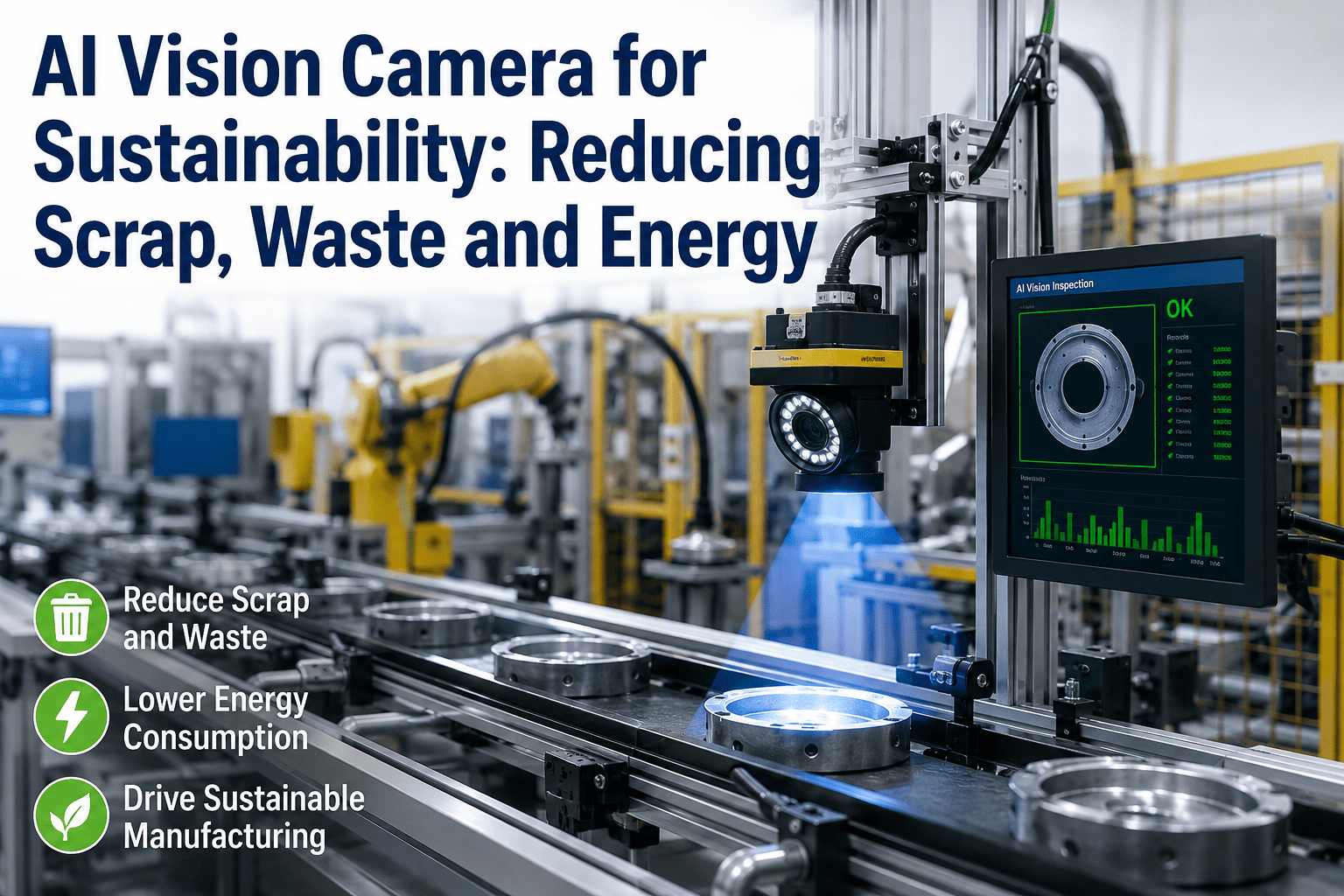
Manufacturing's environmental footprint is no longer measured only at the smokestack — it is embedded in every defective unit produced, every rework cycle completed, every hour a machine runs past its optimal maintenance threshold, and every kilowatt consumed by equipment operating inefficiently under reactive management. AI Vision Cameras are fundamentally changing this equation by providing continuous, real-time visibility into the production variables that drive both quality failures and energy waste simultaneously. iFactory's AI Vision Camera platform — delivering 99.4% defect detection accuracy with sub-50ms edge AI inference — is increasingly being deployed not just as a quality control system, but as a core pillar of sustainable manufacturing strategy, helping facilities reduce scrap rates, recover material yield, cut rework energy consumption, and generate the ESG-grade operational data that regulatory and customer reporting frameworks now require.
The Hidden Sustainability Cost of Defects and Reactive Manufacturing
Every defective product that leaves a production line without detection carries more than a warranty risk — it carries a fully embedded energy and material cost that is never recovered. The raw material had to be mined, refined, and transported. The production line consumed electricity, heat, compressed air, and machine time to process a unit that ultimately delivered no value. If that unit reaches the rework stage, those energy costs are incurred a second time. If it reaches the customer and is returned, logistics emissions are added to the total. Research published in Environmental Chemistry Letters found that implementing AI to optimize factory processes can reduce energy consumption, waste, and carbon emissions by 30% to 50% compared to traditional methods — and the primary mechanism for this reduction is the elimination of defect-driven waste at source, before it accumulates cost and carbon across the production system.
iFactory's AI Vision Camera interrupts this chain at the earliest possible moment — at the point of production, in under 50 milliseconds per unit. By catching defects before they accumulate embedded value, the platform prevents the downstream energy multiplication effect that makes scrap rates one of the most significant and underreported contributors to a manufacturing facility's total energy intensity per finished good.
Scrap Elimination Is Carbon Elimination: How Defect Detection Reduces Energy Intensity Per Unit
The relationship between defect rates and energy consumption is direct and calculable, yet it is rarely included in sustainability reporting because most quality and energy teams operate in separate functional silos. When AI Vision detects a defect at the earliest production stage, it prevents that unit from consuming additional energy at every downstream process — machining, coating, assembly, packaging, and logistics. A defect detected at the first production stage costs a fraction of the energy compared to the same defect discovered at final inspection or by the end customer. Facilities operating with a 5% scrap rate and 10 kWh per unit energy consumption are wasting 0.5 kWh per finished product on average — a figure that compounds across millions of annual production cycles into a carbon exposure that directly affects Scope 1 and Scope 3 emissions reporting.
iFactory's AI Vision Camera addresses this at the source. By running 100% inspection at production line speed — not sampled inspection — the platform identifies flawed units at the first possible moment, before additional energy is embedded. Facilities that have reduced defect escape rates from the 5–10% range to under 1% using iFactory's platform report proportional reductions in per-unit energy consumption, with the recovered efficiency feeding directly into measurable improvements in carbon intensity per case, per unit, or per tonne of finished product — the metrics increasingly required for corporate ESG disclosures and regulatory environmental compliance frameworks.
Thermal Monitoring and Predictive Maintenance: Eliminating the Energy Waste of Degraded Equipment
Equipment running past its optimal maintenance threshold does not just risk unplanned downtime — it consumes disproportionately more energy per unit of output than the same equipment operating within its designed performance envelope. A bearing operating with developing degradation increases motor load and current draw. A conveyor with a misaligned drive system creates friction losses that translate directly into wasted electrical energy. A cooling system with a partially blocked filter forces compressors to run longer cycles at higher power to maintain the same setpoint temperature. These inefficiencies are largely invisible without continuous sensor monitoring, and they accumulate into significant energy overconsumption that never appears in maintenance reports because the equipment is technically "still running."
iFactory's AI Vision Camera platform addresses this through thermal imaging integration and vibration-correlated predictive health monitoring. The thermal imaging module detects hotspots on motors, drive systems, electrical panels, and heat-generating process equipment that are indicative of developing mechanical degradation, lubrication failure, or electrical overload — all of which create energy waste before they create visible failures. By catching these anomalies in their early stages, the platform enables planned maintenance that restores equipment to its energy-efficient design operating point, rather than allowing continued degradation to drive energy overconsumption for weeks or months before a breakdown forces intervention. Facilities implementing thermal-integrated AI Vision monitoring have documented equipment energy efficiency improvements of 10–15% following the elimination of degradation-driven overconsumption.
Material Yield Optimization: Recovering Raw Material Value That Manual Inspection Discards
In industries where raw materials carry a high environmental extraction cost — metals, specialty polymers, textiles, pharmaceutical intermediates — material yield is as much a sustainability metric as it is a financial one. Manual inspection practices in these environments frequently discard entire batches or rolls when a localized defect is detected, because the inspection resolution is insufficient to precisely locate and contain the flaw. AI Vision provides the spatial precision to isolate the exact defect location within a part, panel, roll, or batch — enabling intelligent sorting and cutting decisions that recover the conforming portion of the material rather than treating the entire unit as scrap.
iFactory's AI Vision Camera platform delivers bounding box annotation on every detected defect — identifying not just the presence of a flaw but its precise location, dimensions, and severity classification. This spatial specificity enables intelligent disposition decisions: a surface scratch on one corner of a glass panel does not require discarding the entire sheet; a coating inconsistency on one section of a rolled material does not require scrapping the full roll. The recovered material yield from this precision-based approach directly reduces raw material consumption, the energy embedded in producing discarded material, and the volume of industrial waste requiring treatment or disposal — all core metrics for sustainability reporting under GRI, CDP, and corporate ESG frameworks.
PPE Compliance Monitoring: AI Vision as a Safety-Integrated Sustainability Tool
Workplace safety and sustainability are increasingly treated as integrated dimensions of operational responsibility under ESG frameworks. iFactory's AI Vision Camera platform includes continuous PPE compliance monitoring — detecting helmet, glove, protective footwear, and high-visibility vest status across all active production zones in real time, with automated supervisor alerts generated within seconds of a detected violation. Beyond the direct safety benefit, PPE compliance monitoring delivers measurable sustainability outcomes by reducing the frequency of workplace incidents that trigger regulatory investigations, production shutdowns, and remediation activities — all of which generate significant energy and material consumption with no productive output value.
Facilities that have deployed iFactory's PPE monitoring alongside quality inspection have documented PPE compliance rate improvements from audited averages of 70–75% to continuously monitored rates above 97%. The reduction in incident frequency has a compounding sustainability effect: fewer incidents mean fewer emergency response activities, less remediation material, fewer replacement units produced for damaged goods, and reduced regulatory process documentation that consumes administrative resources. The AI Vision Camera becomes a dual-purpose platform — protecting personnel and protecting the facility's sustainability performance simultaneously. To see how the PPE monitoring capability is configured alongside defect detection in a live production environment, Book a Demo with iFactory's industrial AI team.
AI Vision Camera Sustainability Impact: Measured Outcomes Across Manufacturing Deployments
The sustainability gains documented below reflect operational data from manufacturing facilities that have deployed iFactory's AI Vision Camera platform across quality inspection, thermal monitoring, and PPE compliance use cases. The improvements span the full sustainability impact chain — from raw material yield and energy intensity to compliance documentation and ESG reporting readiness.
| Sustainability Metric | Manual / Reactive Operations | AI Vision Camera Deployment | Measured Improvement |
|---|---|---|---|
| Defect-driven material scrap rate | 5–12% of production volume | Under 1% post-deployment | 80–90% scrap reduction |
| Energy wasted on rework cycles | Double energy cost per reworked unit | 25–40% rework rate reduction | Proportional energy recovery |
| Equipment energy efficiency (degraded vs optimal) | 10–20% overconsumption from degraded assets | 10–15% energy efficiency improvement post-PM | Predictive maintenance driven |
| Manual inspection energy and labor intensity | High — multi-shift manual coverage | 80% labor hour reduction | Continuous AI coverage, no fatigue |
| PPE compliance rate (safety-sustainability link) | 70–75% audited average | 97%+ continuously monitored | Incident-driven waste eliminated |
| Scope 3 emissions from returned goods logistics | Present — defect escape drives returns | Near-zero at sub-1% escape rate | Return logistics emissions avoided |
| ESG / audit documentation readiness | 20–40 hours manual assembly per audit | Under 90 minutes automated | 92%+ documentation time saving |
AI Vision Camera as an ESG Data Infrastructure Layer
The sustainability value of iFactory's AI Vision Camera extends beyond operational efficiency improvements into ESG reporting infrastructure. Every defect detection event, every thermal anomaly flag, every PPE compliance incident, and every production run result is logged in a continuously updated, time-stamped digital record that links product quality data to energy performance and safety compliance data in a single query-ready system. This creates the operational data foundation that sustainability reporting frameworks — GRI Standards, CDP disclosure, TCFD, ISO 14001, and increasingly mandatory EU Corporate Sustainability Reporting Directive requirements — require but that most manufacturing operations currently cannot provide from their fragmented manual and semi-digital record systems.
Manufacturers using iFactory's platform are able to produce audit-ready documentation of defect rates, scrap volumes, rework rates, energy-linked maintenance events, and safety compliance statistics as a byproduct of normal production operations — without the 20–40 hours of manual data assembly that sustainability audit preparation typically requires. This positions the AI Vision Camera not only as a quality and safety tool but as a strategic ESG infrastructure investment that reduces the reporting burden on sustainability teams while improving the accuracy and granularity of the data they produce. For a demonstration of how iFactory's reporting and analytics capabilities support ESG disclosure preparation, Book a Demo with iFactory's industrial analytics team.