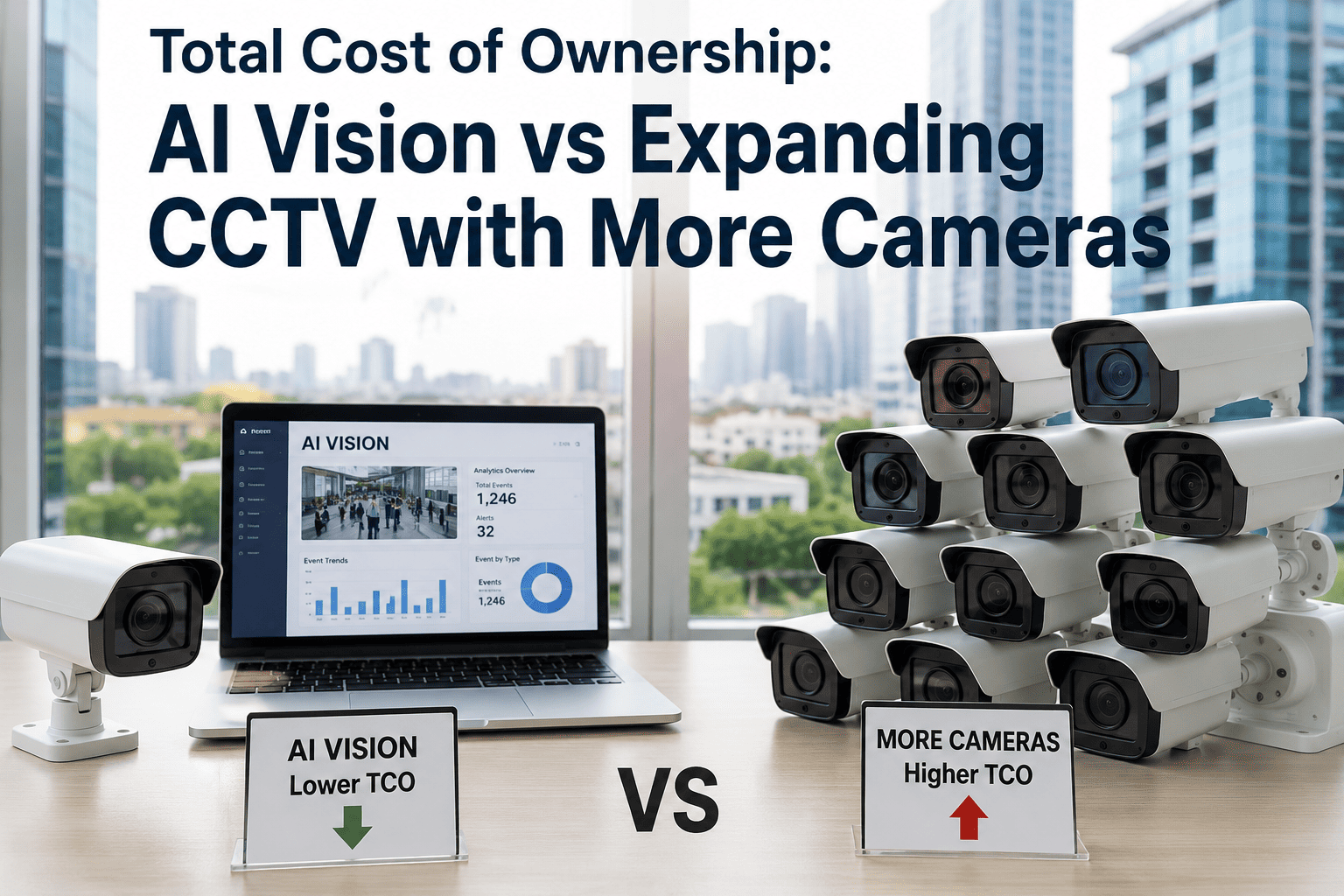
Industrial manufacturers evaluating AI vision camera systems for quality inspection, defect detection, and production line monitoring face a complex purchasing decision that extends far beyond the camera's sticker price. The total cost of ownership (TCO) for AI vision systems includes hardware acquisition, installation and integration, software licensing, model training and validation, ongoing maintenance, and the operational costs of data storage and compute infrastructure. Without a structured framework for evaluating these cost components, manufacturers risk underinvesting in critical capabilities or overcommitting to systems whose long-term operating costs erode the ROI that initially justified the investment. This breakdown provides manufacturing decision-makers with a detailed, line-item analysis of AI vision camera costs and the TCO model required to build a defensible business case.
Hardware Costs: What You Are Actually Paying For in an AI Vision Camera System
The hardware component of an AI vision camera system includes the camera sensor and optics, the onboard or edge processing unit, lighting and enclosure systems, and the mounting infrastructure required for integration into a production line. Entry-level AI vision cameras with embedded processors suitable for basic presence-absence inspection and barcode reading typically range from $3,000 to $8,000 per unit. Mid-range systems capable of high-resolution defect detection, dimensional measurement, and classification across multiple product variants fall in the $8,000 to $25,000 range. High-performance AI vision camera systems designed for ultra-high-speed production lines, sub-micron precision inspection, or multi-spectral analysis can exceed $40,000 per unit, especially when custom optics and specialized illumination are required.
The camera sensor selection drives significant cost variation. CMOS sensors with global shutter capabilities adequate for most manufacturing inspection applications add $500 to $2,000 to the unit cost, while specialized sensors — thermal, hyperspectral, or time-of-flight — can add $5,000 to $15,000. Manufacturers should also budget for enclosure and cooling infrastructure when deploying AI vision cameras in washdown, high-temperature, or dust-heavy environments, adding $1,000 to $4,000 per installation point. For a detailed walkthrough of hardware specifications and pricing for your specific production environment, schedule a consultation with iFactory's application engineering team.
Software Licensing and AI Model Lifecycle Costs
Software licensing represents a recurring cost that often surprises manufacturers who focus exclusively on hardware pricing during the evaluation phase. AI vision camera platforms typically offer one of three licensing models: perpetual licenses with annual maintenance fees (15–22% of license cost per year), subscription-based SaaS pricing ($500–$2,500 per camera per year depending on feature tier), or usage-based pricing tied to inspection volume or runtime hours. Perpetual licenses range from $4,000 to $18,000 per camera for full-featured AI vision software suites that include model training, deployment, and monitoring capabilities.
The AI model lifecycle introduces costs that fall outside traditional machine vision budgeting frameworks. Training a defect detection model for a new product SKU requires labeled image datasets, which typically cost $1,500 to $6,000 per model to prepare and annotate depending on defect complexity and the number of training images required. Model validation, edge-case testing, and field performance monitoring add another $2,000 to $5,000 per model annually. Facilities rotating through dozens of SKUs per year should budget $25,000 to $70,000 annually for ongoing model lifecycle management. Manufacturers interested in platforms that minimize these costs through automated model training and transfer learning should Book a Demo to see iFactory's approach.
Installation, Integration, and Infrastructure Costs
Installing an AI vision camera system on an existing production line involves mechanical mounting and alignment, electrical and network connectivity, integration with the plant's MES or SCADA systems, and configuration of the AI inference pipeline. Integration costs vary based on the complexity of the existing automation architecture. Simple standalone installations on a single line with minimal data integration requirements range from $4,000 to $10,000. Multi-line deployments requiring integration with existing PLCs, reject mechanisms, data historians, and enterprise reporting systems typically cost $15,000 to $45,000 for integration services.
Network infrastructure upgrades represent a frequently overlooked cost element. AI vision cameras generate significant data volumes — a single 5-megapixel camera capturing 30 frames per second produces approximately 450 MB per minute of uncompressed image data. Deployments of five to twenty cameras require network switches, additional compute or edge server capacity, and storage infrastructure that adds $12,000 to $40,000 in one-time infrastructure costs. Recurring cloud storage and data egress fees for off-premise AI inference or model retraining pipelines range from $3,000 to $18,000 annually depending on inspection volume and retention policies.
Total Cost of Ownership Model: Three-Year Projection
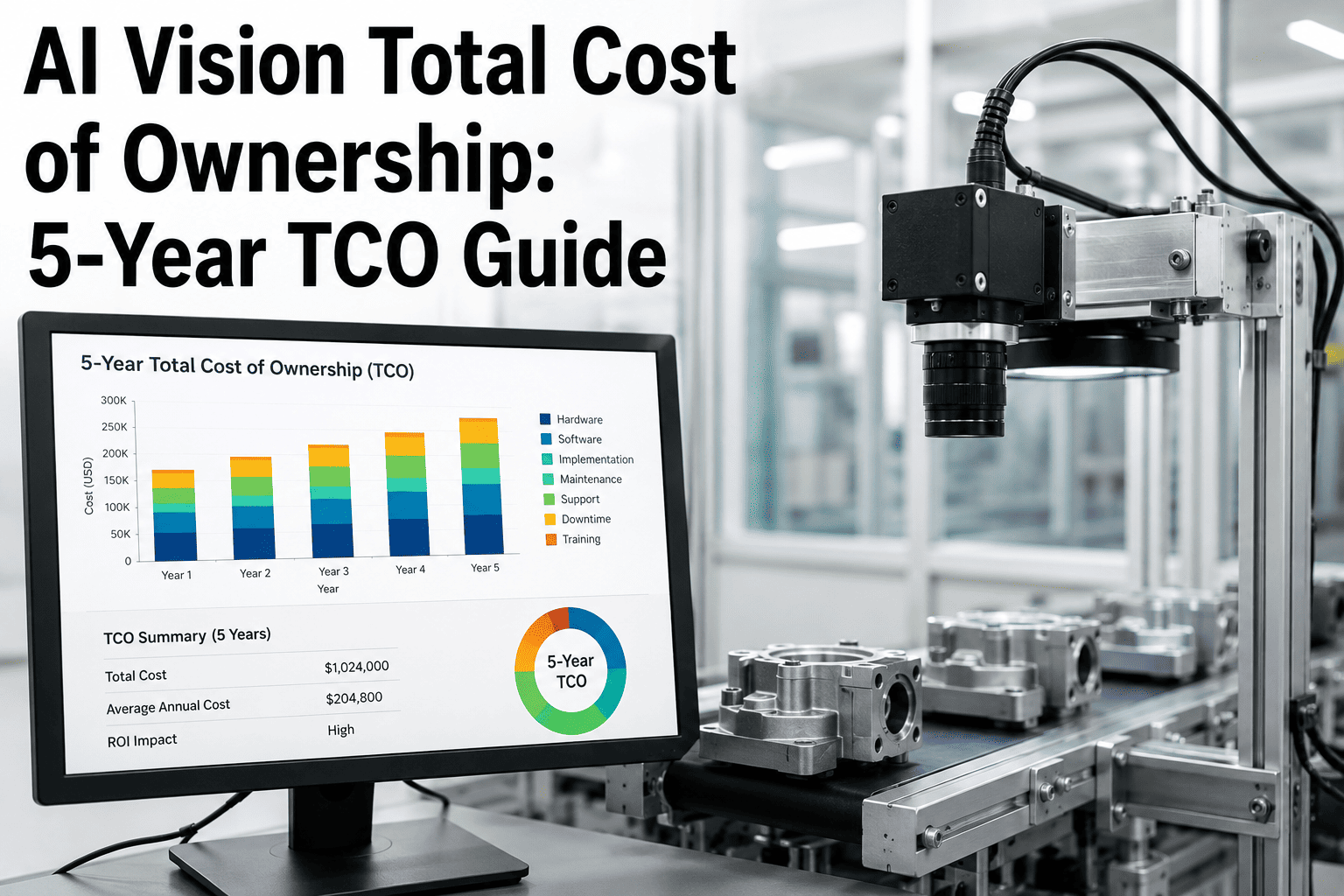
A realistic TCO model for AI vision camera systems must account for all cost categories across a minimum three-year horizon, since the ROI calculation depends heavily on the system's useful life and the recurring cost trajectory. The following benchmark model reflects a mid-complexity deployment of six AI vision cameras across three production lines in a discrete manufacturing facility. Adjust the quantities and unit costs proportionally for smaller or larger deployments.
| Cost Category | Year 1 | Year 2 | Year 3 | 3-Year Total |
|---|---|---|---|---|
| Camera Hardware (6 units) | $72,000–$132,000 | $0 | $0 | $72,000–$132,000 |
| Software Licenses (perpetual + 15% annual maintenance) | $42,000–$72,000 | $6,300–$10,800 | $6,300–$10,800 | $54,600–$93,600 |
| AI Model Training & Validation (6 SKUs) | $30,000–$66,000 | $15,000–$36,000 | $15,000–$36,000 | $60,000–$138,000 |
| Installation & Integration | $22,000–$55,000 | $0 | $0 | $22,000–$55,000 |
| Infrastructure (network, compute, storage) | $18,000–$45,000 | $3,000–$9,000 | $3,000–$9,000 | $24,000–$63,000 |
| Training & Change Management | $8,000–$18,000 | $3,000–$6,000 | $3,000–$6,000 | $14,000–$30,000 |
| Total Cost of Ownership | $192,000–$388,000 | $27,300–$61,800 | $27,300–$61,800 | $246,600–$511,600 |
The upfront-loaded cost structure means that Year 1 represents 72–78% of the three-year TCO. This makes the per-unit inspection cost heavily dependent on production volume and system utilization. A six-camera system running 6,000 production hours per year at the midpoint of the TCO range yields a per-camera-per-hour cost of approximately $3.50–$4.20 in Year 1, dropping to $0.50–$0.80 per camera-hour in Years 2 and 3 as the hardware and integration costs are fully amortized. Manufacturers who want a customized TCO projection for their specific production parameters can Book a Demo for a personalized assessment.
Calculating ROI: Where AI Vision Camera Systems Deliver Measurable Returns
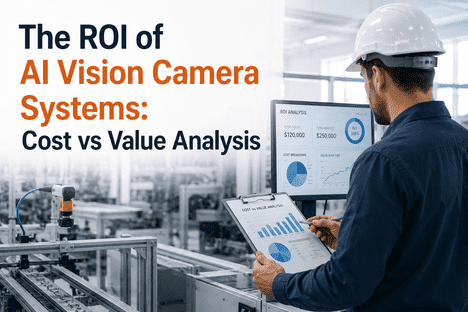
The ROI case for AI vision camera systems rests on three primary value drivers: defect detection and scrap reduction, labor reallocation from manual inspection, and downstream cost avoidance from prevented customer escapes and warranty claims. A mid-size manufacturing facility producing 12 million units annually across three lines with a pre-inspection defect rate of 1.2% — of which 30% currently escapes to customers — faces an estimated $480,000 to $950,000 in annual scrap, rework, warranty, and customer impact costs. An AI vision camera system detecting 90% of defects at the point of manufacture recovers the majority of this leakage.
Manual inspection labor displacement provides the second major ROI driver. Facilities employing six to ten full-time visual inspectors across three shifts at $38,000–$52,000 per inspector annually (including burden) incur $228,000 to $520,000 in annual inspection labor costs alone. AI vision systems performing the same inspection function at higher consistency and throughput typically allow redeployment of 60–80% of inspection labor to higher-value quality engineering and process improvement roles — capturing $137,000 to $416,000 in annual labor savings. When combined with defect reduction savings, the payback period for a six-camera deployment at the midpoint TCO range falls between 11 and 17 months. For a detailed ROI model customized to your defect profiles and production volume, Book a Demo with iFactory's manufacturing solutions team.
AI Vision Cameras vs. Traditional Machine Vision: Cost Comparison
Traditional machine vision systems — rule-based inspection platforms relying on programmed thresholds for pass-fail decisions — have been the standard for automated inspection in manufacturing for over two decades. While the per-unit hardware cost of traditional machine vision cameras ($2,000–$8,000) is generally lower than AI vision cameras, the total cost comparison reverses when system configuration, programming, and maintenance costs are included. A traditional machine vision system for a new part requires custom programming by a vision application engineer — typically $8,000 to $25,000 per application — and must be re-engineered whenever the part geometry, surface finish, or defect profile changes.
AI vision camera systems eliminate this re-engineering cost by learning defect detection from labeled images rather than programmed rules. A typical facility running 30 SKUs over a three-year period will spend $240,000 to $750,000 on traditional vision system reconfigurations and reprogramming, compared to $60,000 to $138,000 for AI model training and retraining over the same period — a 65–75% reduction in ongoing application engineering costs. This cost advantage compounds as SKU rotation accelerates and defect profiles evolve, making AI vision systems increasingly cost-advantaged over traditional approaches as production complexity increases. iFactory's AI vision camera platform is purpose-built for manufacturers who need inspection systems that adapt to changing production requirements without recurring engineering investment.
Hidden Costs Manufacturers Frequently Overlook in AI Vision Camera Investments
Several cost categories consistently escape consideration during the initial budgeting phase and emerge as budget overruns during deployment. Image dataset curation and labeling for model training represents the most common underestimated cost. Manufacturers often assume existing quality data and images are sufficient for model training, only to discover that data labeling for defect categories, illumination variation, and normal product variation requires 5,000 to 15,000 labeled images per model at $0.30–$0.60 per annotation — a $1,500 to $9,000 cost per model that scales linearly with the number of product variants.
System performance monitoring and model drift management is the second frequently overlooked cost. AI vision models deployed in production environments experience performance degradation over time as lighting conditions shift, product surfaces vary, and new defect types emerge. Maintaining model accuracy at production-grade levels requires ongoing performance monitoring, retraining triggers, and model update deployment — activities that require 0.25 to 0.5 FTE of dedicated engineering or data science support per facility, representing $30,000 to $65,000 in annual personnel cost. Platforms that minimize this burden through automated retraining pipelines and user-friendly model management interfaces deliver significant operational cost advantages.
Strategic Implementation Roadmap for AI Vision Camera Deployment
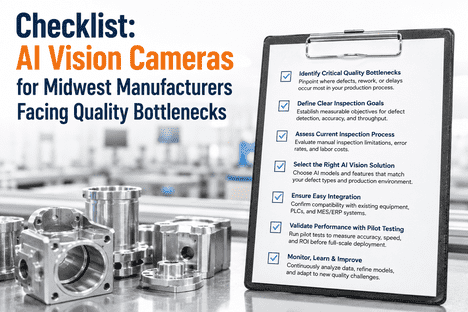
Deploying AI vision camera systems across a manufacturing operation requires a phased approach that controls cost exposure while building organizational capability. The implementation roadmap below reflects validated deployment patterns from discrete manufacturing facilities ranging from three-line operations to twenty-line enterprise production networks. Each phase is designed to deliver measurable ROI before the subsequent phase begins, ensuring that investment decisions are informed by operational data rather than vendor projections.
Production engineers evaluating AI vision for quality applications can see iFactory's platform configured for their specific inspection requirements — from defect detection on packaging lines to fill-level verification and seal integrity inspection.