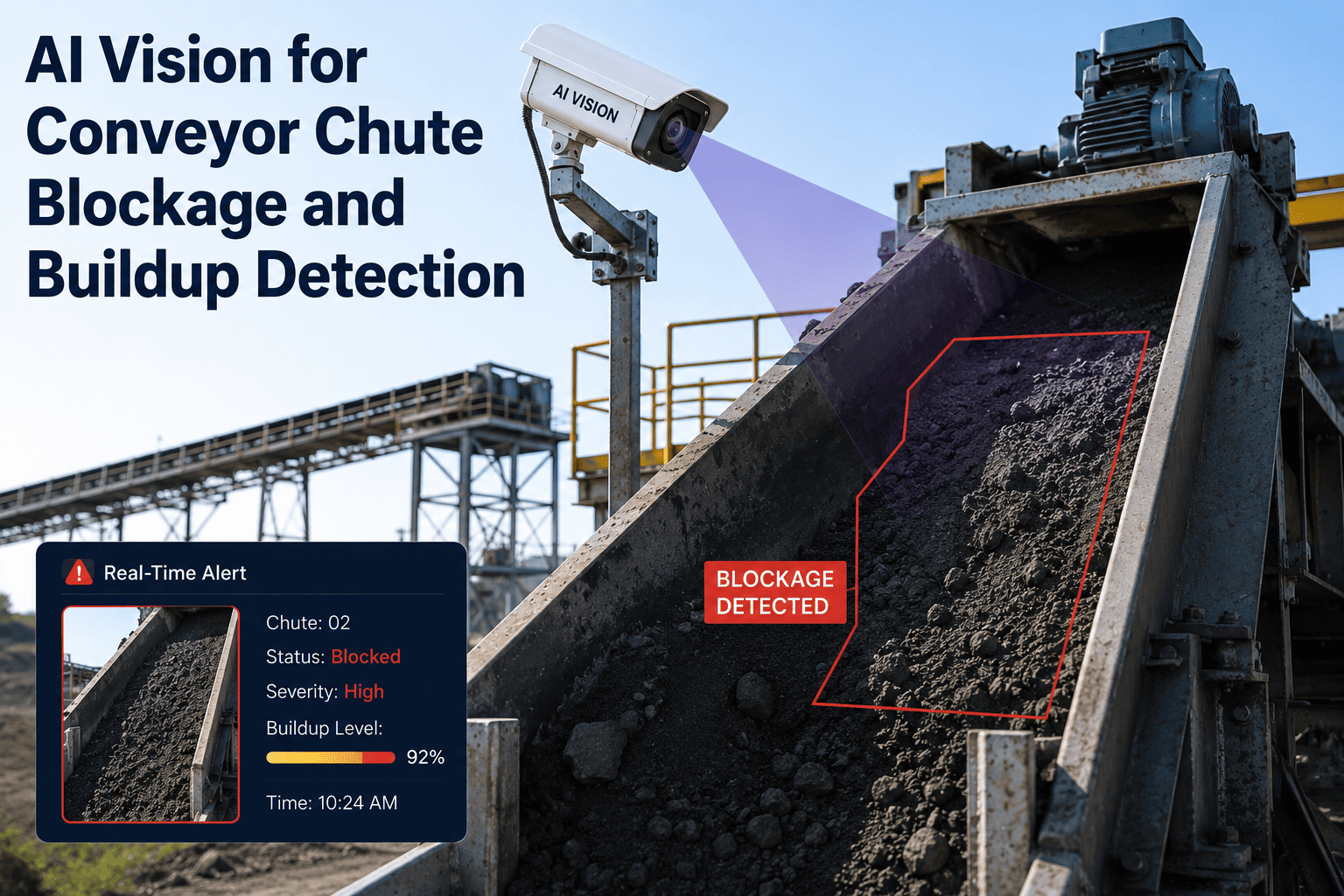
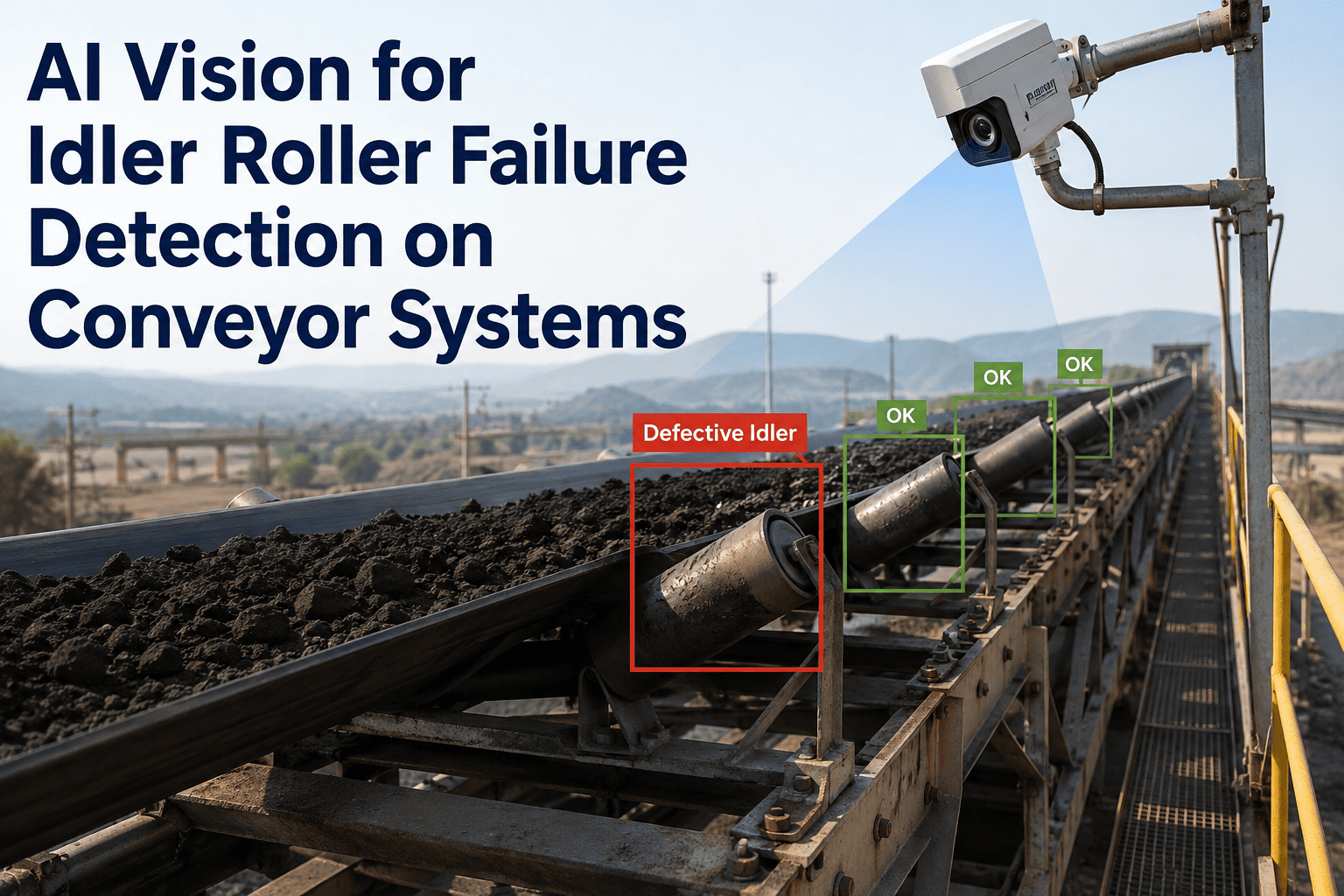
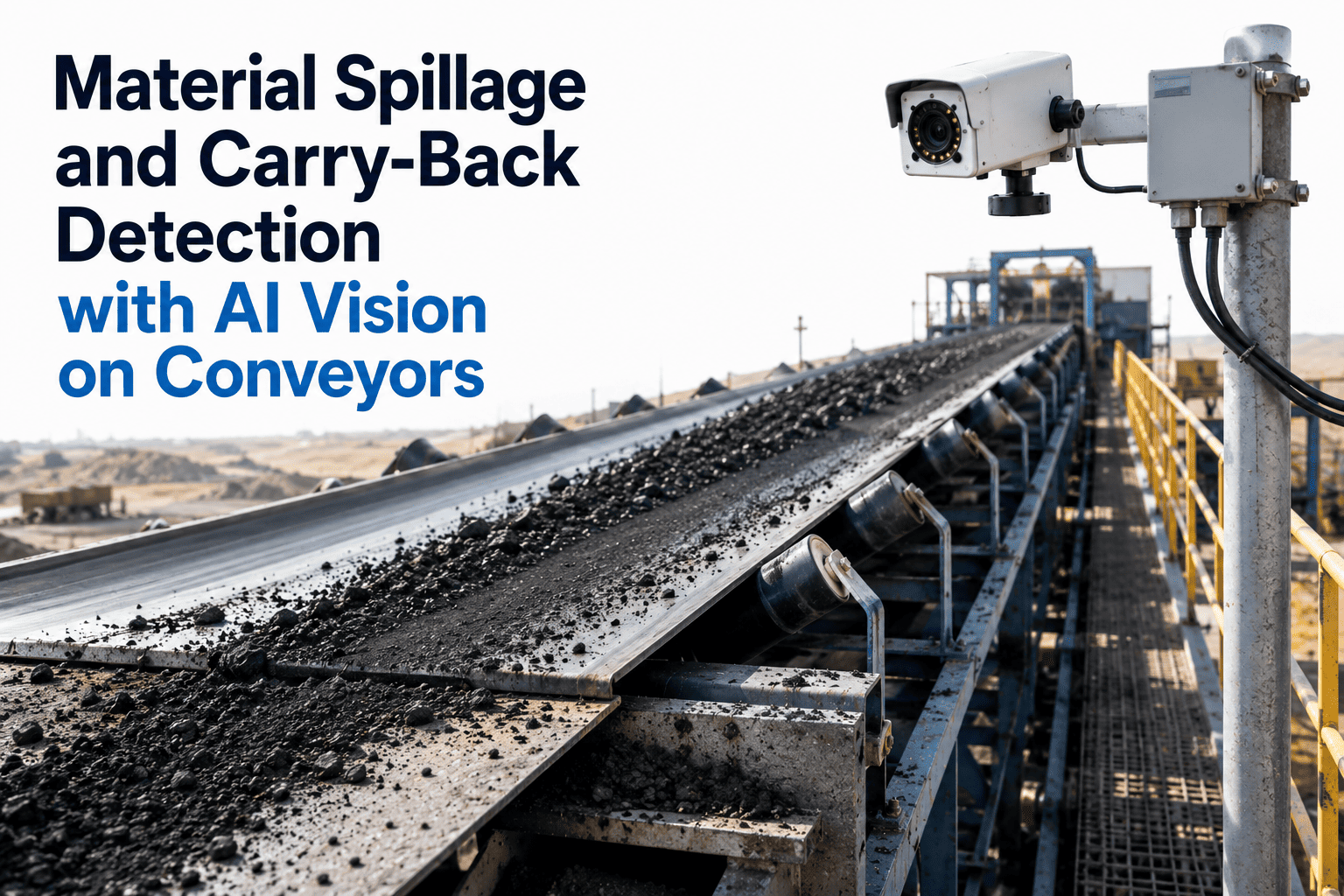
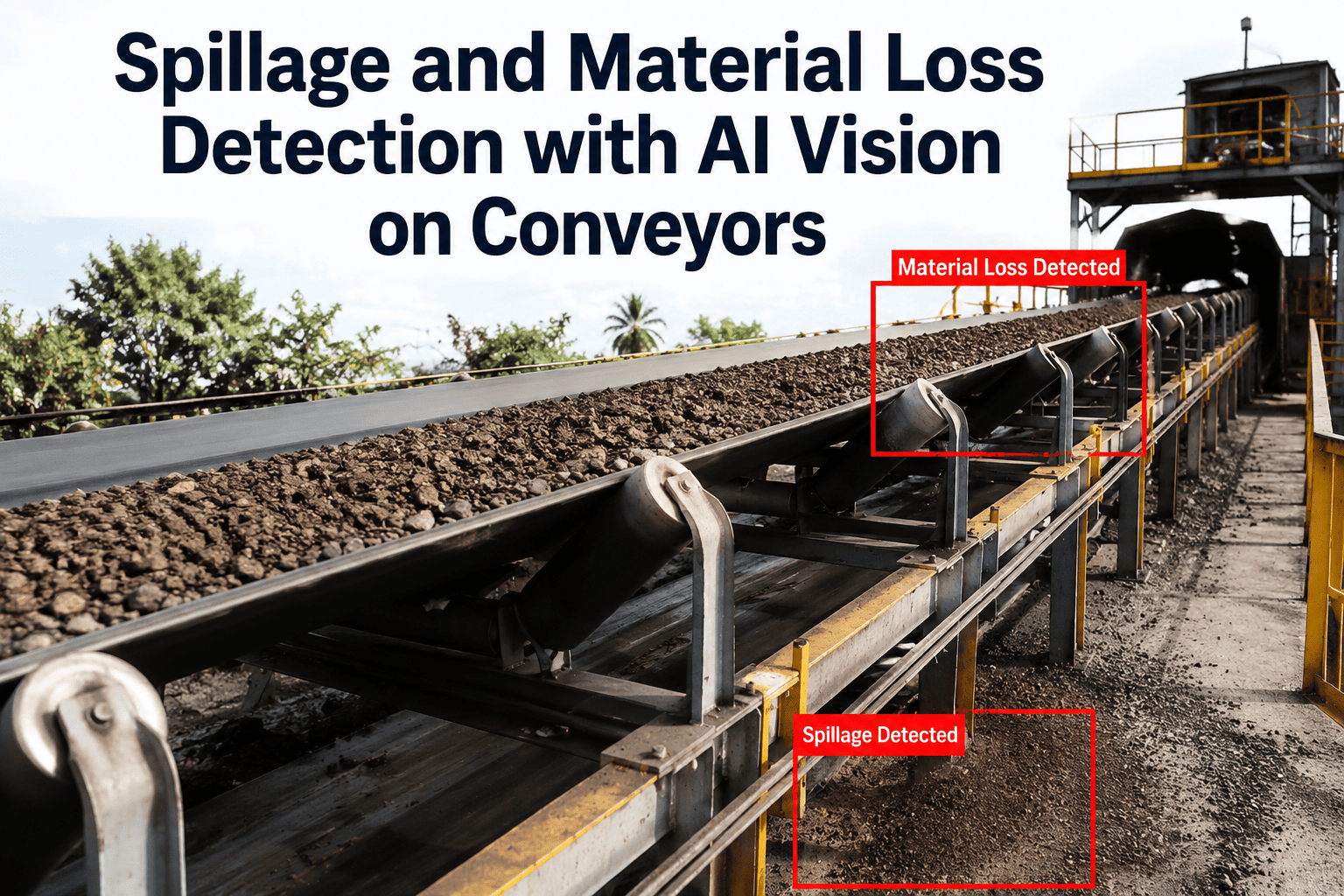
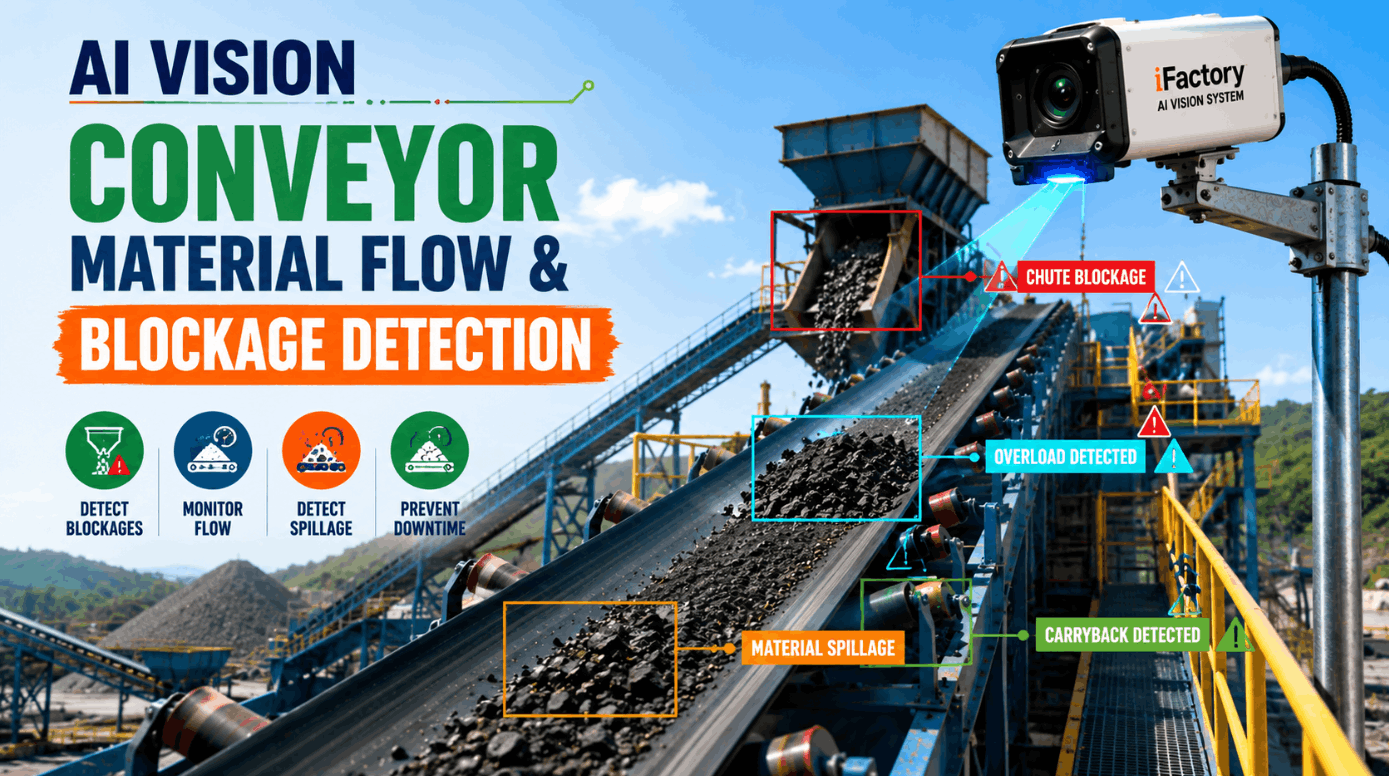
A blocked transfer chute rarely announces itself until material is already backing up onto the belt, spilling over the skirt boards, or grinding against a buildup of caked material that has been accumulating unnoticed for shifts. Chute inspection usually depends on someone walking past at the right moment or a level sensor that only trips once material has already piled dangerously high. AI cameras watch chute interiors and transfer points continuously, catching buildup while it is still a cleaning task rather than a shutdown, and our conveyor monitoring team can help you identify which transfer points on your line carry the highest blockage risk.
Conveyor Monitoring
Catch Buildup Before It Becomes a Blockage
Material buildup inside a transfer chute rarely happens all at once. It accumulates layer by layer, often at the same recurring pinch points, until enough material has caked up to restrict flow, cause spillage, or damage the belt underneath. Continuous vision monitoring catches that accumulation early, while it is still a routine cleaning task.
Why Chute Blockages Are a Recurring, Predictable Problem
Transfer chutes are shaped to guide bulk material from one conveyor onto the next, but the same geometry that makes the transfer possible also creates natural spots where material can cling and accumulate, particularly with wet, sticky, or fine material that adheres to chute walls rather than flowing freely through. Once a layer of material sticks, subsequent material tends to build against it rather than washing it away, and the buildup compounds shift over shift until it narrows the effective flow path enough to cause spillage, belt damage from uneven loading, or in severe cases a full blockage that backs material up onto the belt itself.
Recurring
buildup tends to happen at the same chute pinch points repeatedly
Gradual
accumulation builds shift over shift until flow is meaningfully restricted
Costly
a full blockage can force an unplanned line stop and manual chute clearing
Preventable
early buildup detection turns clearing into a scheduled cleaning task
Where Buildup Typically Forms
Chute Wall Corners
Sharp internal angles where material flow slows create the most common starting point for caked material to begin accumulating.
Transfer Point Throats
The narrowest section of a transfer chute is most sensitive to even modest buildup, since a small reduction in flow area has an outsized effect there.
Impact Plates
Plates positioned to absorb material impact and redirect flow are prone to sticky buildup from wet or fine material adhering on contact.
Skirt Board Seals
Material escaping past worn skirt board seals accumulates externally along the chute and belt edge rather than staying contained internally.
Want to know which of your transfer points has the highest recurring blockage history?
Book a walkthrough to review sample buildup detections from a similar material handling setup.
How Buildup Progresses From Minor to a Full Stoppage
1
A thin layer of material sticks to a chute wall or corner, invisible from outside without a direct camera view
2
Subsequent material builds against the existing layer, gradually narrowing the effective flow path through the chute
3
Flow restriction causes spillage, uneven belt loading, or visible material backing up at the transfer point
4
Left unaddressed, the chute reaches a full blockage requiring a line stop and manual clearing to resume operation
Each of these stages is visually distinct to a camera positioned with a clear view into the chute interior or transfer point. Stage one and two, the stages where intervention is cheapest and fastest, are exactly the stages a manual inspection schedule is least likely to catch, since they produce no external spillage or belt disruption yet and are only visible from inside the chute itself.
Detection Coverage: Manual Checks Versus Continuous Vision
| Detection Method | What It Catches | Typical Response Timing |
| Visual walk-by inspection |
Only buildup severe enough to be visible from outside the chute |
Reactive, often after spillage has already started |
| Chute level sensor |
Material backing up to the sensor's fixed mounting height |
Late-stage, close to a full blockage event |
| Continuous interior vision monitoring |
Early-stage buildup at specific chute zones before flow is restricted |
Proactive, flagged while still a routine cleaning task |
Not sure how your current sensor coverage compares to full interior visibility?
Talk to our team about reviewing your existing chute instrumentation.
Why Some Materials Cause Far More Buildup Than Others
Not every material handled on a conveyor system carries the same blockage risk, and understanding which characteristics drive buildup helps explain why certain transfer points at a plant have a documented history of repeated blockages while others rarely see any accumulation at all. Moisture content is usually the single biggest factor, since damp or wet material clings to chute surfaces far more readily than dry material of the same particle size. Fine particle size compounds the problem, since fine material packs more densely against a sticking point than coarse material, which tends to bounce and dislodge itself more easily as it moves through a chute. Temperature also plays a role with certain materials that soften or become tackier at elevated temperatures, creating a buildup risk that varies by season or by upstream process conditions rather than staying constant year-round.
Moisture Content
Damp material adheres to chute walls far more readily than dry material, making moisture the single largest driver of buildup risk.
Fine Particle Size
Fine material packs densely against sticking points, while coarser material tends to dislodge itself more easily during normal flow.
Elevated Temperature
Certain materials become tackier when warm, creating a buildup risk that shifts with upstream process conditions or seasonal temperature.
Chute Geometry
Steeper chute angles and smoother liner materials generally reduce buildup risk regardless of the material characteristics involved.
What a Blockage Costs Beyond the Immediate Stop
The most visible cost of a chute blockage is the line stop required to clear it, but the downstream effects often extend well beyond that immediate disruption. Material that has been backing up against a partial blockage frequently spills over chute edges or skirt boards before the blockage is even noticed, creating a housekeeping cleanup task in addition to the chute clearing itself. A severe blockage can also place unexpected mechanical stress on the belt and structure upstream of the chute, since material continuing to feed into a restricted transfer point has nowhere to go but to pile against the belt or force its way past seals that were never designed for that kind of pressure. In processes with tightly linked upstream and downstream equipment, a single blocked chute can also force a cascading shutdown of connected equipment that has nowhere to send or receive material while the blockage is being cleared, turning what started as a single transfer point problem into a broader production stoppage.
These downstream effects are part of why catching buildup at an early stage matters more than it might first appear. The direct cost of clearing an early-stage buildup during a routine cleaning pass is a fraction of the cost of clearing a full blockage after spillage, belt stress, and potentially a cascading shutdown have already occurred.
Frequently Asked Questions
Can a camera actually get a clear view inside an enclosed transfer chute?
Camera placement for chute monitoring typically uses access points already built into most chute designs for inspection or maintenance, such as viewing ports or removable panels, fitted with a camera and supplemental lighting suited to the enclosed, dusty environment inside a chute. Where no existing access point suits the required viewing angle, a small viewing port can often be added during a planned maintenance window rather than requiring a full chute redesign.
Reach out to our team to review access options for your specific chute design.
Does this work for both dry, free-flowing material and wet, sticky material?
Wet and sticky material tends to produce more visually obvious buildup patterns since it adheres and cakes rather than simply piling loosely, which generally makes it easier for a vision model to detect early accumulation compared to dry material that may simply pile without sticking to chute walls. Both material types are supported, though camera and lighting setup are typically tuned to the specific material characteristics and chute geometry involved.
Book a demo to see detection examples for your specific material type.
How does this integrate with an existing cleaning or maintenance schedule?
Flagged buildup is generally routed as a prioritized item on the existing cleaning worklist rather than requiring a separate response process, since the goal is to inform when and where cleaning attention is needed most, not to replace the cleaning crew or process already in place. Most plants find that flagged buildup lets cleaning crews target the specific chutes and zones that need attention rather than working through a full plant on a fixed rotating schedule regardless of actual condition.
Talk to our team about integrating flagged buildup into your current cleaning routine.
Will this reduce unplanned downtime from chute blockages specifically?
Because early-stage buildup is generally flagged well before it progresses to a flow-restricting blockage, most of the reduction in unplanned downtime comes from catching accumulation at chutes with a known history of blockage-related stops, which tend to be a small number of specific pinch points across a typical plant rather than spread evenly across every transfer point. Targeting monitoring at those known problem chutes first tends to produce the fastest visible reduction in blockage-related stops.
Book a walkthrough to discuss your specific blockage history and priority chutes.
Can this be piloted on a small number of chutes before a wider rollout?
Starting with the transfer points that have the most frequent blockage or spillage history is a common and practical approach, since it lets the maintenance team validate detection accuracy and cleaning workflow integration on a known problem area before expanding coverage across the full chute inventory on a line. This also tends to produce the clearest early evidence of value, since high-frequency problem chutes generate detection events quickly enough to demonstrate the approach within a short pilot window.
Reach out to scope a pilot for your highest-risk transfer points.
Stop Clearing Chutes After They're Already Blocked
Catch Buildup While It's Still a Cleaning Task
Share your current chute blockage and cleaning history. We'll show you what continuous interior monitoring would have flagged before your last few unplanned stops.