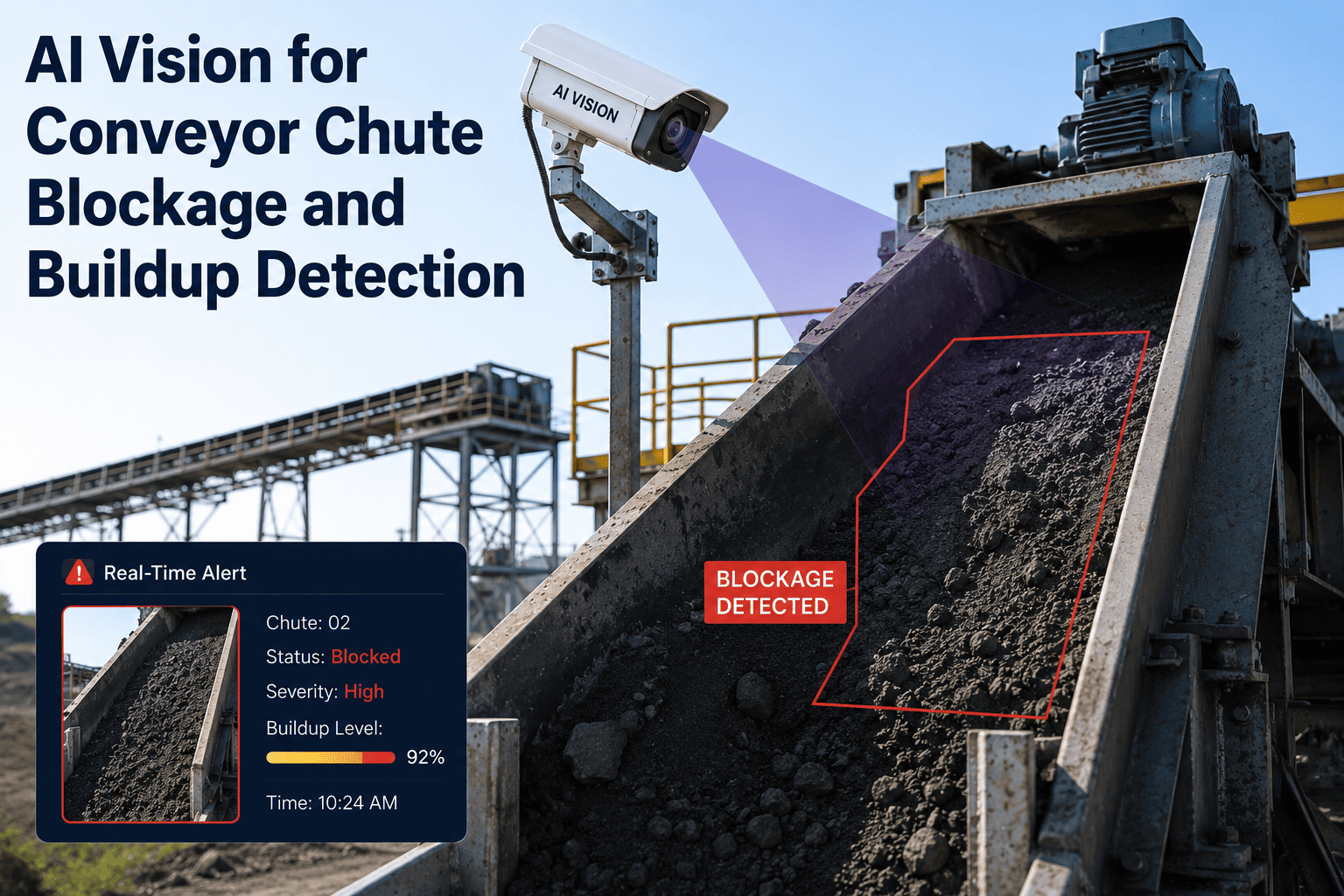
Conveyor systems are the arteries of material handling operations across mining, aggregate processing, cement, steel, bulk shipping, and power generation. When material flow stops — whether from chute blockages, carryback buildup, belt overload, or spillage at transfer points — the entire production chain grinds to a halt. Traditional monitoring approaches rely on manual inspections, level sensors, or basic camera feeds that require constant human attention and react to problems only after they have already caused downtime. AI vision conveyor material flow and blockage detection transforms this reactive paradigm by applying deep learning models directly to live video streams, enabling real-time identification of flow anomalies before they escalate into production-stopping events. iFactory's Vision Anomaly Detection platform — purpose-built for industrial conveyor monitoring — classifies material flow conditions, detects blockages and carryback at the moment they begin forming, and triggers immediate alerts that integrate with existing control systems and CMMS workflows. The result is a shift from waiting for a plugged chute to stop production toward detecting the flow irregularity that predicts the plug is forming — and acting on it while there is still time to prevent the stoppage. This page explains how AI vision blockage detection works, what material flow conditions it identifies, and how maintenance and operations teams can deploy it to reduce unplanned downtime, cleanup costs, and safety risks across conveyor networks. Book a Demo to see the platform in action on your conveyor system.
Why AI Vision for Conveyor Material Flow Monitoring
Conveyor systems present a unique monitoring challenge because material flow conditions change continuously based on feed rate, material moisture content, belt speed, and transfer point geometry. A chute that runs cleanly at one throughput level may plug repeatedly at another. Carryback that accumulates gradually over a shift can suddenly release as a spillage event. Overload conditions may develop over minutes or seconds depending on upstream process variability. Conventional sensors — light curtains, paddle switches, belt scales — detect only binary states: material is present or it is not, the belt is loaded or it is not. They cannot distinguish between a momentary surge and a developing blockage, nor can they differentiate between normal material carryback and a buildup that is about to cause a spill. AI vision fills this gap by analyzing the visual characteristics of material flow — texture, volume, velocity, trajectory, and accumulation patterns — at every transfer point, chute, and belt segment under camera coverage. The deep learning model is trained on thousands of hours of conveyor footage spanning different material types, lighting conditions, and operational states. It learns the difference between normal flow variation and the visual signatures that precede blockages, carryback events, and spillage. When it detects an anomaly, it classifies the type and severity of the flow disruption and sends an alert within seconds. This capability is particularly valuable in environments where conveyors run unattended for extended periods — remote mining operations, night shifts with reduced staffing, and long overland conveyor routes where manual inspection intervals are hours apart. iFactory's AI vision camera platform is purpose-built for these industrial conditions, with ruggedized housings, edge processing for low-bandwidth sites, and OPC-UA and REST API outputs that connect directly to PLCs, SCADA systems, and CMMS platforms for automated response workflows.
Material Flow Conditions Detected by AI Vision
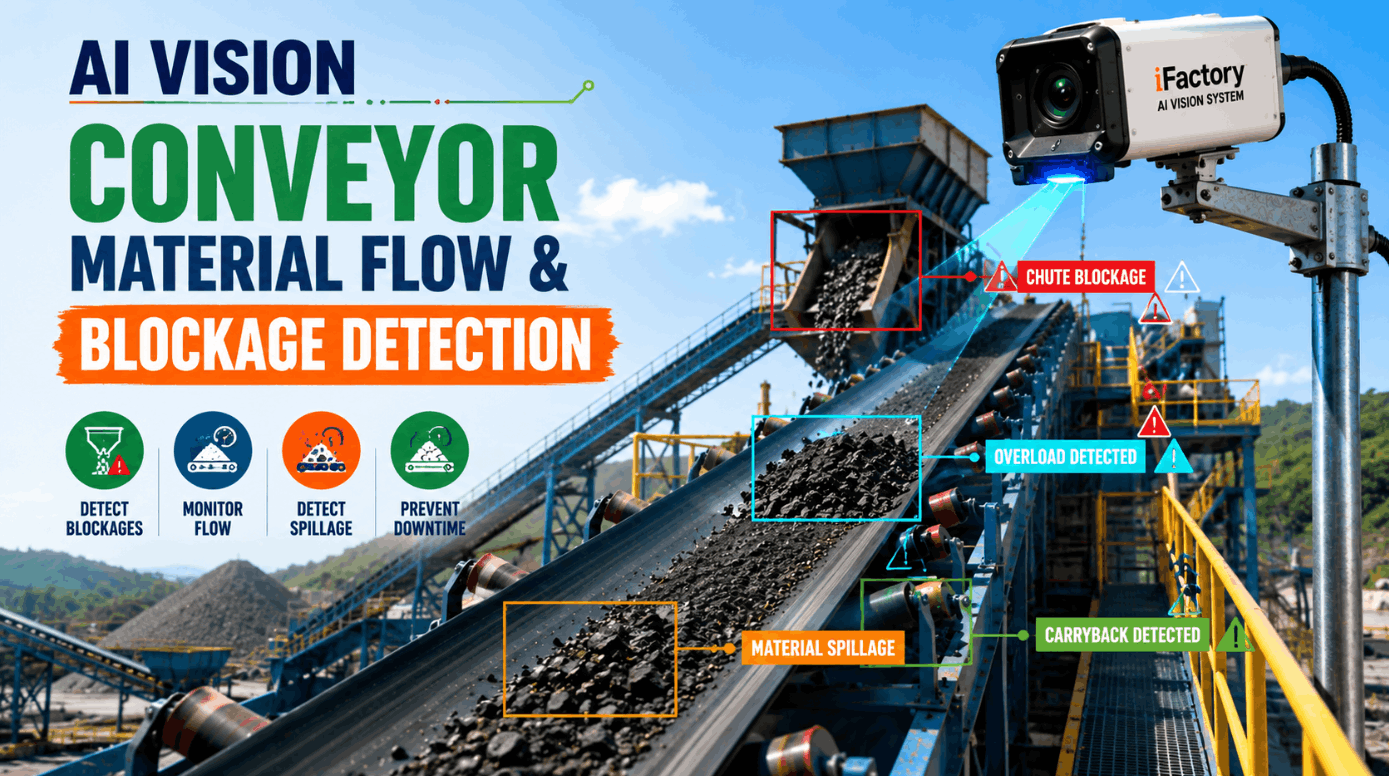
The AI vision model for conveyor monitoring classifies five primary flow anomaly categories, each with distinct visual indicators and operational consequences. The detection model processes video at real-time frame rates and assigns a confidence score to each classification, enabling operators to set alert thresholds that balance sensitivity with false positive tolerance.
| Flow Condition | Visual Signature | Operational Impact | Detection Latency |
|---|---|---|---|
| Chute Blockage | Material accumulation at chute throat, reduced or stopped discharge flow | Complete belt stoppage, cleanup labor, potential belt damage | 2-5 seconds from onset |
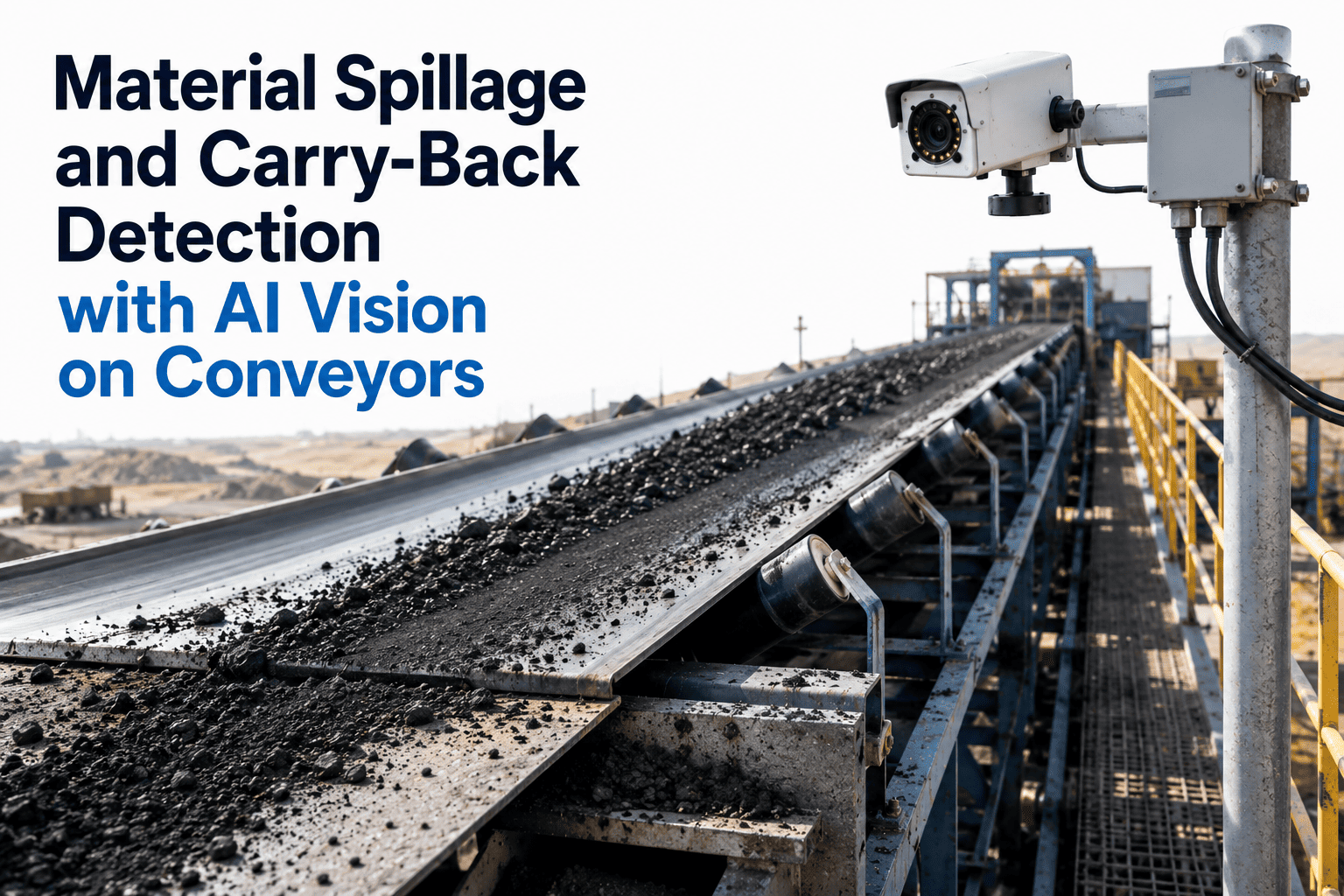
| Carryback | Material adhering to return belt, dropping along belt path | Housekeeping cost, belt damage, spillage accumulation | 10-30 seconds for trend detection |
| Belt Overload | Material height exceeding belt edge clearance, spillage at load zone | Belt sagging, material loss, spillage cleanup, component wear | 5-10 seconds from onset |
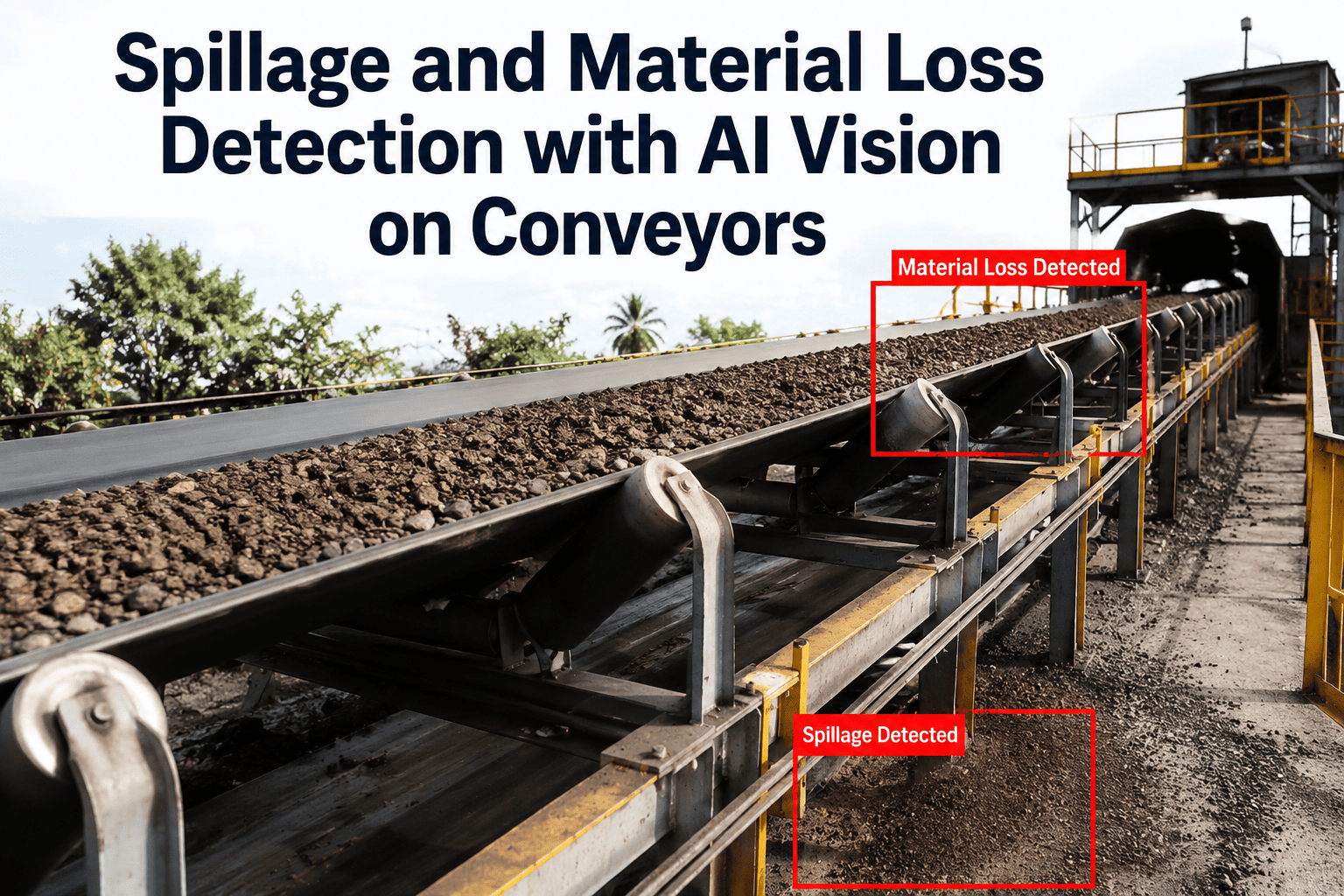
| Material Spillage | Material outside belt edge, accumulating at transfer point floor | Cleanup cost, safety hazard, environmental compliance risk | 5-15 seconds from onset |
| Flow Anomaly | Irregular material trajectory, surge flow, or flow interruption | Process instability, downstream starvation, quality variation | 3-10 seconds from onset |
Each detection category is configurable per camera location and conveyor segment. Operators can adjust sensitivity, alert routing, and automated response actions — such as sending a work order to the maintenance queue when carryback exceeds a defined accumulation threshold, or triggering a belt stop command when a chute blockage is confirmed. The AI model continuously learns from operator feedback, reducing false positives over time as it adapts to site-specific material characteristics and lighting conditions.
How AI Vision Blockage Detection Integrates with Maintenance Operations
The value of AI vision blockage detection is maximized when detection data flows directly into maintenance and operations workflows rather than停留在 a standalone alerting dashboard. iFactory's platform outputs detection events through OPC-UA and REST APIs that connect to PLC-based control systems for immediate automated response — such as slowing the feed rate when a chute shows early signs of blockage — and to CMMS platforms for work order generation when corrective maintenance is required. A carryback detection event that persists beyond a configurable duration automatically creates a work order for belt cleaning or scraper adjustment, with the event timestamp, location, and severity classification attached. A spillage detection event triggers an alert to the cleanup crew dispatcher with the location map and estimated volume. This closed-loop workflow ensures that AI detection does not merely inform operators but drives maintenance action. Teams that integrate AI vision detection with their CMMS report average spillage cleanup cost reductions of 40-60% and conveyor-related unplanned downtime decreases of 35-55% within the first six months of deployment. Book a Demo to see how iFactory's vision-to-workflow integration connects conveyor inspection data directly to your maintenance response process.
Measurable Outcomes from AI Vision Conveyor Monitoring
Organizations deploying AI vision for conveyor material flow and blockage detection report measurable improvements across multiple operational dimensions. The detection latency — typically under 10 seconds from anomaly onset to alert — enables operators and maintenance teams to intervene while the condition is still correctable, before it escalates into a full stoppage. Chute blockages that previously required 30-60 minutes of cleanup labor are resolved in under 10 minutes when detected early. Carryback-related belt damage decreases as scraper adjustments are triggered by accumulation trends rather than scheduled inspections. Spillage cleanup costs drop as detection-driven dispatch replaces scheduled patrol cleaning. The data captured by the AI vision system also feeds root cause analysis: if a particular chute shows recurrent blockage patterns at certain throughput levels, the engineering team can investigate the transfer point geometry or material conditioning upstream. Over time, the detection data reveals systemic issues that drive design changes, reducing the underlying causes of flow disruptions rather than只是 responding to symptoms. iFactory's AI vision camera platform captures and stores detection events with associated video clips, providing a searchable library of flow anomaly incidents that supports continuous improvement initiatives and operator training.
Deployment Considerations for Conveyor AI Vision Systems
Successful deployment of AI vision for conveyor monitoring requires attention to camera placement, lighting conditions, network infrastructure, and model configuration. Each transfer point, chute, and belt segment has unique visual characteristics that influence detection performance. Critical installation points include chute discharge zones where blockages form, transfer point impact areas where spillage and carryback originate, and belt load zones where overload conditions are visible. Cameras must be positioned to capture the material flow profile without obstruction, with lighting designed to eliminate shadows and glare that degrade model accuracy. iFactory's deployment team conducts site surveys to map conveyor geometry, identify optimal camera positions, and specify lighting requirements before installation. The AI model is configured per location using a baseline training dataset and then refined with site-specific footage during a calibration period. Ongoing model performance monitoring identifies drift caused by changes in material type, belt speed, or lighting, and triggers retraining when accuracy falls below configured thresholds. The AI vision camera system supports edge processing for sites with limited network bandwidth, storing detection events locally and syncing event data to the central platform when connectivity is available. This architecture enables reliable operation at remote conveyor installations where continuous cloud connectivity is not feasible.
Frequently Asked Questions About AI Vision Conveyor Detection
AI vision detects chute blockages, carryback accumulation, belt overload conditions, material spillage at transfer points, and general flow anomalies such as irregular material trajectory or flow interruption. The model classifies each condition by type and severity, enabling operators to prioritize response based on operational risk. Detection sensitivity is configurable per camera location to balance early warning with false positive tolerance.
Detection latency from anomaly onset to alert is typically 2-10 seconds depending on the type of flow condition. Chute blockages are detected within 2-5 seconds as material accumulation visibly reduces discharge flow. Carryback trends are identified over 10-30 seconds of observation to distinguish between normal intermittent carryback and a developing buildup condition. Alert thresholds can be configured to balance speed of detection with confidence level.
Yes. iFactory's platform outputs detection events through OPC-UA and REST APIs that connect to PLCs, SCADA systems, and CMMS platforms. Detection events can trigger automated control actions — such as belt speed reduction or feed rate adjustment — and generate CMMS work orders for corrective maintenance with event details, location data, and severity classification attached. The integration architecture is designed to fit existing industrial control and maintenance workflows without requiring custom development.
Organizations typically achieve payback within 4-8 months through reduced unplanned conveyor downtime, lower spillage cleanup labor costs, decreased belt damage from undetected carryback, and improved asset utilization. Average reported outcomes include 35-55% reduction in conveyor-related unplanned downtime, 40-60% reduction in spillage cleanup costs, and 25-40% reduction in belt replacement frequency due to early carryback detection and scraper adjustment. The specific ROI depends on conveyor network size, current downtime frequency, and cleanup cost structure.
Yes. iFactory's AI vision cameras are housed in ruggedized enclosures rated for industrial environments including dust, vibration, humidity, and temperature extremes. The AI model is trained on footage spanning diverse lighting conditions — including low-light, nighttime, and variable outdoor lighting — and can be configured with supplemental industrial lighting for consistent performance. Camera housings include air purge and wiper options for dusty environments to maintain optical clarity. Edge processing ensures detection continues even if network connectivity to the central platform is interrupted.