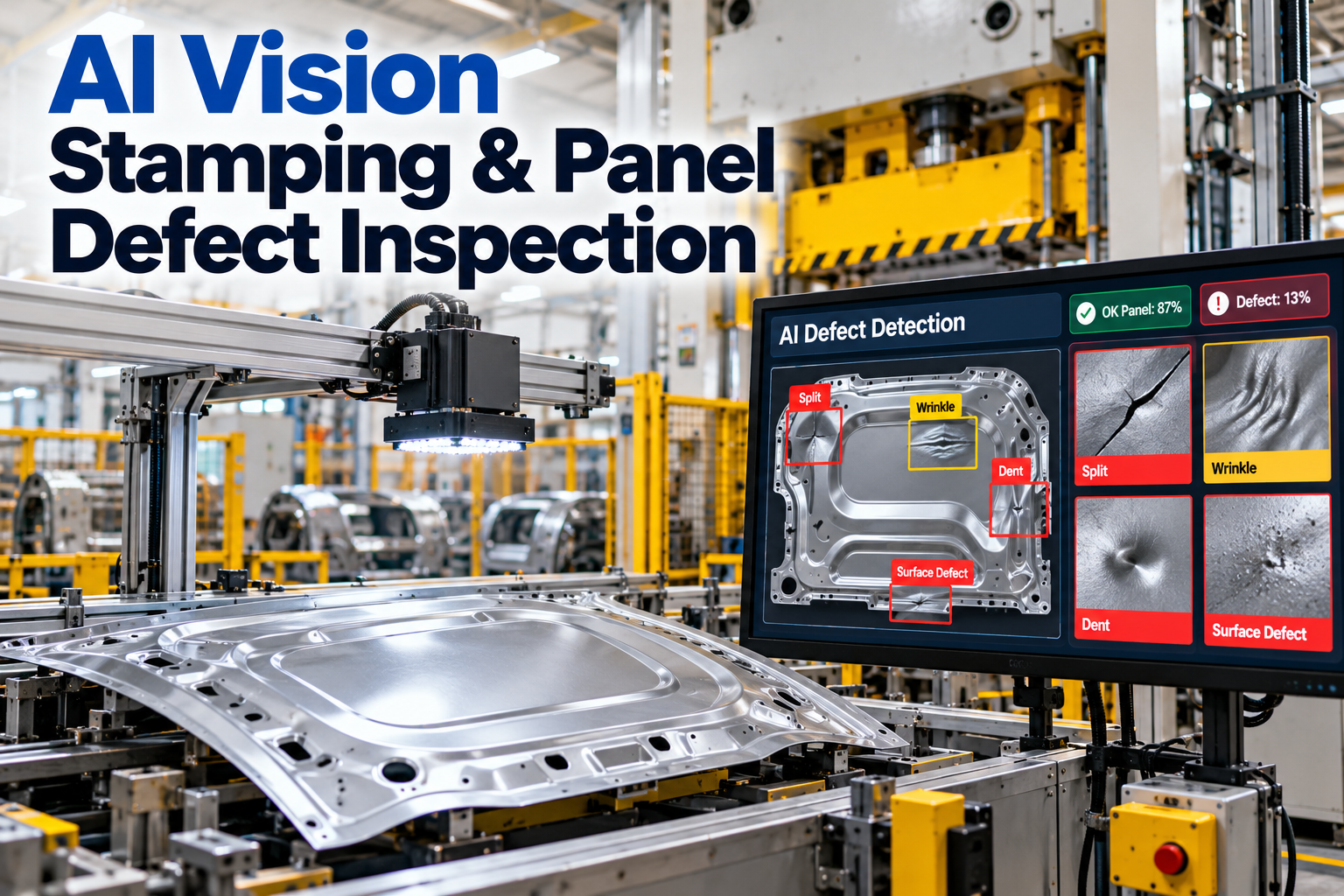
Press shops and stamping lines in automotive manufacturing face relentless pressure to deliver defect-free body panels at high line speeds. Traditional manual inspection cannot keep pace with the rate of production — splits, wrinkles, dents, and surface imperfections slip through, leading to costly rework, scrap, and downstream assembly disruptions. iFactory's AI Vision Camera brings deep learning-based visual inspection directly to the press shop, detecting stamping defects in real time as panels move through production. By analyzing each panel against trained defect models, the system catches cracking from upstream material inconsistencies, identifies subtle surface deformations invisible to the human eye, and provides immediate pass/fail feedback at line speed. This transforms stamping quality control from reactive sampling to continuous, automated assurance. Procurement and quality teams evaluating AI-driven panel inspection solutions are encouraged to Book a Demo with iFactory to assess how AI vision reduces press shop scrap rates and improves first-pass yield.
Deploy Deep Learning Defect Detection Across Your Press Shop
iFactory AI Vision Camera detects splits, wrinkles, dents, and surface defects on stamped panels in real time — eliminating manual inspection bottlenecks and catching upstream material flaws before they reach downstream assembly.
Why AI Vision Must Replace Manual Inspection in Automotive Stamping
Stamped body panels represent the first visual impression of vehicle quality, and defects at this stage cascade through painting, assembly, and final fit. Manual inspection — even with skilled quality technicians — misses up to 20 percent of surface defects due to fatigue, lighting variation, and the subtle nature of early-stage splits and wrinkles. iFactory's AI Vision Camera solves this by applying trained deep learning models that inspect every panel at full line speed, detecting cracking from upstream coil material defects, classifying dent severity, and flagging wrinkle formation before it becomes a structural reject. The system integrates directly with press line controls and generates real-time quality dashboards that give production managers immediate visibility into defect trends by tool, shift, and material lot. Quality engineers building AI-driven stamping inspection programs can evaluate how iFactory's edge AI platform operates within existing press shop workflows. Book a Demo to see how automated panel inspection reduces scrap and improves OEE.
Split & Crack Identification
AI models trained on thousands of stamped panels detect split initiation and crack propagation as they occur, enabling immediate press stop or material lot quarantine before defective parts accumulate.
Wrinkle & Dent Classification
Deep learning vision distinguishes acceptable surface texture from rejectable wrinkles and dents, applying consistent pass/fail criteria regardless of operator shift, experience level, or ambient lighting conditions.
Upstream Defect Correlation
Every detected defect is linked to coil ID, press tool number, and timestamp — enabling quality teams to trace cracking patterns back to specific material batches and adjust supplier specifications.
Press Shop Connectivity
iFactory AI Vision Camera mounts directly over press lines and conveyors, integrating with PLC controls for automatic part rejection, press stop signals, and real-time quality data streaming to plant MES systems.
Stamping and Panel Defects Detected by iFactory AI Vision in 2026
Developing a reliable AI vision inspection system for automotive stamping requires models trained on the specific defect types that occur in press shop operations. iFactory's AI Vision Camera applies specialized deep learning architectures for each defect category, ensuring that split detection, wrinkle identification, dent classification, and surface anomaly detection all operate at the accuracy levels required for production release. The following table maps the primary defect classes to their root causes, inspection approach, and the quality impact of automated detection.
| Defect Type | Root Cause | AI Inspection Method | Quality Impact |
|---|---|---|---|
| Splits & Cracks | Material thinning, coil inclusions, high blanking force, upstream rolling defects | Semantic segmentation models trained on crack morphology; detects initiation at sub-millimeter width | Prevents structural failures in formed panels; reduces press die damage from jammed cracked parts |
| Wrinkles | Incorrect blank holder pressure, material flow variation, lubrication inconsistency | Surface gradient analysis using depth-estimation CNNs; classifies wrinkle severity against acceptable texture thresholds | Eliminates surface rework in painting and reduces downstream fitment issues in body shop |
| Dents & Dings | Material handling impacts, conveyor debris, stacking pressure, tool marks | Shape-from-shading reconstruction identifies depth anomalies below 0.1 mm at full line speed | Eliminates manual dent repair stations; improves first-pass yield through paint and assembly |
| Surface Anomalies | Rolling marks, coating defects, oxide inclusions, die wear patterns | Anomaly detection autoencoders flag non-conforming surface regions without requiring labeled defect examples | Catches novel quality issues before they become systematic; feeds back into preventive die maintenance schedules |
| Edge & Trim Defects | Shear burrs, incomplete trimming, camber variation from coil set | Edge profile analysis using contour detection algorithms against CAD nominal geometry | Ensures consistent panel fit in downstream welding and assembly fixtures |
How iFactory AI Vision Camera Enforces Defect Detection at Press Line Speed
Deploying deep learning vision in a stamping environment requires more than accurate models — it requires a hardware and software architecture designed for the thermal, vibration, and speed constraints of a press shop. iFactory's AI Vision Camera pairs industrial-grade edge inference hardware with purpose-built stamping inspection models that execute at full production rate without requiring a cloud connection. Each camera captures high-resolution images of every panel at multiple lighting angles, applies trained defect detection models locally on the edge processor, and outputs pass/fail decisions within milliseconds to the press line PLC. Defect images, classification metadata, and panel-level quality records are saved to the plant network for traceability and continuous model improvement. This edge-first architecture eliminates network latency, maintains inspection continuity during plant connectivity interruptions, and keeps sensitive panel geometry data within the facility. Stamping and quality managers combining AI vision inspection with press shop automation can Book a Demo and see how edge AI transforms their press shop quality metrics.
AI Vision for Stamping and Panel Inspection — Frequently Asked Questions
What stamping defects can AI vision detect?
iFactory AI Vision Camera detects splits, cracks, wrinkles, dents, surface anomalies, and edge/trim defects on stamped metal panels — covering the full range of press shop quality issues from material-induced cracking to handling damage.
How fast can AI vision inspect stamped panels?
The system operates at full press line speed — processing each panel in milliseconds using edge inference hardware mounted directly at the press line, without requiring cloud connectivity or introducing inspection cycle delays.
Does AI vision require labeled defect images for every defect type?
For known defect classes like splits and dents, supervised models are trained on your panel images. For novel or rare surface anomalies, anomaly detection autoencoders flag non-conforming regions without requiring labeled examples.
Can AI vision distinguish acceptable surface texture from rejectable wrinkles?
Yes — depth-estimation CNNs classify wrinkle severity against configurable thresholds, so subtle surface texture within specification passes while wrinkles exceeding the reject limit are flagged automatically.
How does iFactory AI Vision Camera integrate with existing press line controls?
The camera outputs pass/fail decisions via digital I/O and industrial protocols to press line PLCs, enabling automatic part rejection, press stop triggers, and real-time quality data streaming to plant MES and historian systems.
Transform Your Press Shop Quality with Real-Time AI Defect Detection
iFactory AI Vision Camera delivers deep learning inspection for splits, wrinkles, dents, and surface defects at full stamping line speed — converting every panel into a verifiable quality record with full material traceability.