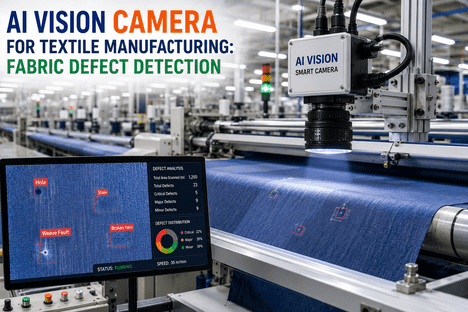
Six hundred meters of fabric leave the loom every hour. A human grader can inspect roughly four hundred. The math has been broken for decades — mills run rolls back through offline frames, catch what they can, downgrade what they cannot defend, and ship the rest with fingers crossed. This is the story of a 240-loom weaving mill that removed the manual grading table entirely, replaced twelve inspectors with three exception-handlers, and started detecting 35 percent more faults with AI vision. To scope the same for your mill, book a fabric-grading assessment.
Textile Mill Eliminates Manual Fabric Inspection With AI Grading Across 120 Fault Points
A 240-loom export weaving mill migrated from offline four-point grading tables to on-loom AI vision inspection — recovering meters, margin, and shift capacity in a single quarter.
Why Manual Fabric Grading Was Bleeding Margin
Before the deployment, the mill ran the standard playbook — twelve trained graders across three shifts working offline inspection frames after the fabric came off the loom. It was the same setup used across the industry for forty years. It was also the reason the mill's second-quality rate had never dropped below eight percent, no matter how hard the grading team worked. Research is unambiguous on why.
Published textile-inspection research puts human defect-catch rates at 60–70 percent even for trained, well-rested graders. Eye fatigue, distraction, and shift-end drift account for the gap. The missed faults leave the mill and become customer claims.
A roll that fails four-point grading and gets classified as "second quality" sells for 45 to 65 percent less than first-quality. Every meter downgraded because a defect was caught too late — instead of at the loom — is margin that never returns.
Manual grading tables move fabric at roughly 400 meters per hour. Modern looms produce at 600 meters per hour or more. That mismatch means grading is always chasing the line, and rolls sit in staging waiting for a frame to open up.
Where AI Vision Beats a Trained Grader — Defect by Defect
The mill's baseline audit compared fault-catch rates across the twelve most common defect categories in cotton and denim weaving. Every category was measured over 60,000 meters of fabric under production conditions — same lighting, same speed, same graders. AI vision won every category. Below is the comparison the operations team took to the board.
The Inspection Frame, Reinvented — On-Loom vs Offline
The mill's original workflow moved every roll off the loom, staged it, then unrolled it back through an offline four-point grading table under fluorescent light. The AI vision retrofit moved the entire inspection function to the moment the fabric leaves the beam — so defects are caught at their source, in the same shift, on the same operator's watch.
Want to see how the on-loom retrofit fits your specific loom type — rapier, air-jet, projectile, or shuttleless? Book a loom-compatibility call.
Every Meter of Fabric Downgraded Is Margin That Never Comes Back
iFactory retrofits AI vision to your existing looms — no new frames, no downtime, no operator retraining. Real-time four-point grading, MES-linked defect logs, and roll-level fault imagery from day one. Start with one loom line and prove the yield delta on your own fabric.
The 4-Point Grading Math — Where the Downgrade Losses Actually Live
ASTM D5430 assigns 1 to 4 penalty points per defect based on defect length. Points are summed per 100 square yards. Cross a threshold, and the roll drops a grade — and the price with it. The AI vision system calculates the point score continuously, in real time, so a mill supervisor knows the moment a roll is heading for a downgrade and can intervene at the loom rather than write off the meters later.
Want the AI vision system configured for your specific buyer's grading contract — Kohl's, Zara, Uniqlo, Levi's, technical-textile spec? Book a grading-spec workshop.
Deployment Journey — Six Milestones in Twelve Weeks
The mill committed to a twelve-week window from contract to plant-wide live grading across all 240 looms. iFactory's field team broke it into six milestones, each with a hard exit criterion. No milestone advanced until the previous one was signed off by the plant manager — the same production owner who was on the hook to run the system after go-live.
Fabric Audit & Baseline Fault Sampling
Sixty thousand meters of production fabric graded manually and photographed. Baseline catch rates by defect category locked. Downgrade cost per shift quantified against contract price sheets.
Camera & Illumination Engineering
Line-scan camera positions specified for every loom width. LED illumination engineered for cotton, denim, and technical fabrics separately. Optical validation completed on the smallest recorded defect from the baseline sample.
Pilot Loom Bank & Model Training
Ten pilot looms retrofitted first. Deep learning model trained on the mill's own defect images across all product categories. Baseline accuracy validated against manual grading calls in parallel for two weeks.
MES Integration & Rollout to All Looms
API integration built against the mill's MES for per-roll point scores, defect codes, and operator alerts. Remaining 230 looms retrofitted across staggered maintenance windows with zero production stoppage.
Grader Team Transition to Exception Handling
Nine of twelve graders redeployed to yarn-supplier quality, loom-operator training, and buyer-facing quality reporting. Three retained as AI-vision exception handlers — reviewing borderline calls and edge cases.
Impact Report & Contract-Grade Certification
Twelve-week impact report certified by the mill's largest buyer against their four-point grading contract. The +35% fault detection, -80% labor, and -45% downgrade loss figures were all measured against pre-deployment baselines.
Where the Money Came Back — Savings by Category
The financial case landed harder than the operations case. The mill's CFO tracked five savings categories through the first two quarters after go-live. The cumulative first-year recovery paid for the platform investment 3.1 times over — and that number excludes the buyer-retention upside from a cleaner audit trail.
Fewer rolls dropping from first to second quality — direct margin recovery on 720,000 meters that would have been downgraded under the old workflow.
Nine of twelve graders redeployed to higher-value quality functions — the direct labor line for offline grading effectively went to zero.
Faults caught at the loom never leave the mill. Buyer chargebacks for missed defects dropped from monthly to twice-per-quarter within one shipping cycle.
Real-time defect alerts let operators stop and correct issues at the loom instead of running through hundreds of defective meters — recovering productive shift hours.
The staging area for rolls awaiting offline grading was reclaimed for finished-goods dispatch — no more warehouse rental for peak shipping months.
Curious what these numbers look like against your own contract prices and defect mix? Book a mill-specific ROI walkthrough.
Frequently Asked Questions
Does the AI vision system work on all loom types — rapier, air-jet, projectile, shuttleless?
Yes. iFactory has retrofitted line-scan camera systems onto every major loom architecture — rapier, air-jet, projectile, water-jet, and shuttleless — as well as circular knitting and warp-knitting machines. The camera bracket, illumination housing, and inference cabinet are engineered per loom width and beam configuration. Nothing about your existing looms needs to change. For loom-specific compatibility, book a compatibility call.
Can the system apply our specific buyer's four-point grading contract?
Yes. Every buyer contract has its own accepted point threshold, penalty scoring, and edge-case rules — Kohl's, Levi's, Zara, Uniqlo, and technical-textile buyers all differ. The AI vision grading engine is configurable per SKU and per buyer, so the four-point score is calculated against the exact contract you have with that customer. This is what makes the roll-level score defensible during buyer audits and chargeback disputes.
What happens to our existing grading team? Do we have to lay them off?
Most mills that deploy AI vision inspection do not lay off graders — they redeploy them. Trained graders have irreplaceable knowledge of your fabric, your buyer specifications, and your loom quirks. In this case study, nine of twelve graders were redeployed to yarn supplier quality, loom-operator training, buyer audits, and exception handling. Three remained on the vision system for edge cases. The value of that knowledge went up, not down.
How does the system handle multiple fabric types and yarn colors on the same loom?
The deep learning model is trained on your mill's actual fabric mix — cotton, denim, technical textile, and any pattern or color variation you produce. Model switching between SKUs is automatic based on the production schedule pulled from your MES, so an operator does not need to manually reconfigure the system when the loom changes over. Retraining for new fabric introductions is included in the standard support contract.
How long before we see measurable ROI on our mill?
Most weaving and knitting mills with 100 or more looms see full platform payback in four to eight months. The dominant drivers are downgrade-loss recovery and inspection-labor reallocation. This case-study mill crossed break-even at month five and hit 3.1× first-year return by month twelve. For a mill-specific projection using your contract prices and defect baseline, reach the iFactory team.
Turn Every Loom Into a First-Quality Grading Station
The playbook that migrated this mill from twelve offline graders to three exception handlers — 240 looms retrofitted, four-point grading in real time, MES-linked defect imagery, twelve weeks end-to-end — is available for your mill on a fixed price. Prove the fault-detection delta on one loom bank, then scale.