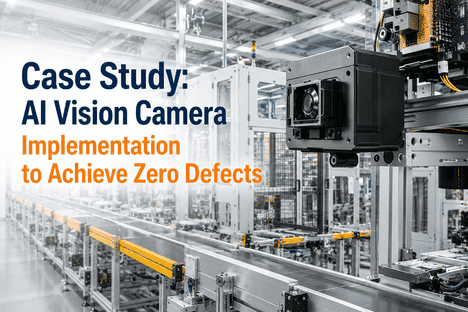
Achieving zero defects in high-volume manufacturing is no longer a theoretical ambition — it is an operational standard that leading facilities are reaching today through AI vision camera technology. iFactory's AI Vision Camera platform has been deployed across multi-line production environments where manual inspection was creating defect escape rates of 25% or higher, recall exposure running into millions of dollars, and quality teams spending thousands of hours on inspection labor that still failed to catch critical flaws. The case studies documented here represent real outcomes from manufacturers who replaced legacy visual inspection with iFactory's edge AI vision system — and measured the results rigorously, line by line, lot by lot.
The Manufacturing Quality Problem That AI Vision Solves
Manual visual inspection — even with experienced quality personnel — carries an irreducible error rate. Human inspectors fatigue, disagree on borderline defects, and cannot maintain consistent throughput across multi-shift operations. Traditional rule-based machine vision systems require hardcoded defect libraries, struggle with lighting variation, and generate false positives that erode operator trust until the system is routinely overridden. The result is a quality architecture that looks controlled on paper but leaks defects into finished goods at a rate that only becomes visible when warranty claims accumulate or a recall is triggered.
iFactory's AI Vision Camera platform replaces this architecture with real-time edge AI inspection that runs continuously across every production line, captures every unit, and makes pass-fail decisions in under 50 milliseconds with 99.4% accuracy. The system does not require cloud connectivity, does not introduce latency into production flow, and generates an annotated digital evidence record for every inspected unit — creating an inspection-grade audit trail that satisfies quality, regulatory, and customer traceability requirements simultaneously.
Multi-Line Electronics Sub-Assembly Manufacturer: From 1-in-3 Missed Defects to Near-Zero Escape Rate
A high-volume electronics sub-assembly manufacturer supplying automotive OEM customers was experiencing a defect escape rate that manual inspection consistently failed to control. Internal audits confirmed that roughly one in three critical surface and solder joint defects were passing through final inspection undetected — generating warranty return costs, OEM penalty clauses, and accelerating toward a contract review that would have removed the facility from the approved supplier list.
iFactory's AI Vision Camera was deployed across nine production lines in a phased rollout. Lines one through seven used existing industrial camera hardware that met the 2MP minimum resolution threshold — no infrastructure replacement was required. Lines eight and nine, handling micron-level solder joint inspection, received NVIDIA Jetson-based edge compute units with upgraded optics installed during scheduled maintenance windows without halting production. Within the first 90 days of full deployment, the defect escape rate had dropped from the baseline of approximately 33% to under 2%. At the 16-month mark, the escape rate measured at 0.2% — a 98.5% reduction — and the facility had recorded zero product recalls across more than 19 million units shipped.
The automated work order generation capability proved particularly significant in this deployment. When the AI Vision Camera flagged a defective unit, an annotated work order — including the camera frame, bounding box overlay, confidence score, and defect classification — was automatically created and routed to the relevant technician via push notification. This eliminated the inspection-to-action delay that had allowed defective units to continue accumulating on the line while paper-based escalation processes completed. Rework cycles were shortened by an average of 40%, and the quality team redirected over 60% of previously inspection-dedicated labor hours to root cause analysis and process improvement activities.
Food and Beverage Packaging Line: PPE Compliance and Label Verification Achieving Zero Traceability Errors
A multi-site food and beverage manufacturer operating eight packaging lines across two facilities had a dual quality challenge: inconsistent PPE compliance among production personnel creating a safety and regulatory exposure, and recurring label verification failures that had resulted in two mislabeled product incidents requiring partial market withdrawals in a 36-month period. The manual inspection approach — periodic floor audits for PPE and visual label checks at end-of-line — was insufficient to maintain compliance at the throughput rates the facilities required.
iFactory's AI Vision Camera was configured across both facilities for simultaneous PPE detection and label verification. The PPE detection model monitored safety helmet, gloves, and protective footwear compliance continuously across all active production zones, generating automated alerts to supervisors within seconds of a violation rather than at the next scheduled audit. The label verification module cross-referenced every finished unit's label — lot code, expiry date, allergen declarations, and weight statement — against the active production order in real time, flagging mismatches before the unit reached the palletization stage. In the 18 months following full deployment across both facilities, PPE compliance rate moved from a documented audit average of 71% to a continuous monitored rate above 97%, and label verification errors dropped to zero across more than 24 million units processed.
Steel and Metal Processing Facility: Surface Defect Detection Replacing 100% Manual Visual Inspection
A steel processing facility producing structural components for the construction and heavy equipment sectors was running 100% manual visual inspection at end-of-line for surface defects including cracks, corrosion pitting, and dimensional non-conformances. The inspection team of fourteen personnel across three shifts was generating an inconsistency rate — where the same unit would receive different pass-fail verdicts depending on the inspector and shift — that quality management estimated at 18%. The facility was also operating with no thermal monitoring for hotspot detection on continuous casting and rolling equipment, creating a predictive maintenance gap that had contributed to two unplanned shutdowns in the prior 12 months.
iFactory's AI Vision Camera was deployed with a combined RGB and thermal imaging configuration. The RGB inspection models were trained on facility-specific defect examples — cracks, surface pitting, edge tears, and dimensional deviations relevant to the specific material grades and tolerances in production — rather than generic training datasets. The thermal imagers were positioned at key heat-generating equipment locations to detect thermal hotspots consistent with early-stage bearing failure, lubrication breakdown, and electrical overload conditions. Within six months of deployment, surface defect detection consistency reached 99.1% — eliminating the inspector-to-inspector variance that had previously made first-pass yield statistics unreliable. The thermal monitoring system detected three equipment anomalies in the first six months that, based on the progression rate and equipment history, maintenance engineers estimated would have resulted in unplanned shutdowns within 4–8 weeks without intervention.
Core Detection Capabilities That Drive Zero-Defect Outcomes
The defect types and detection scenarios documented in these case studies represent a subset of the inspection workloads that iFactory's AI Vision Camera platform is configured to handle across manufacturing environments. The platform's edge AI architecture — running YOLOv8, EfficientNet, and Vision Transformer models on on-premise NVIDIA GPU hardware — supports custom model training on facility-specific defect libraries, meaning the system learns to detect the exact defect types relevant to your production tolerances rather than relying on generic pre-trained classification.
AI Vision Camera vs. Manual Inspection: Performance Comparison
The performance differential between AI-driven visual inspection and manual or legacy rule-based systems has widened substantially as edge AI hardware and model architectures have matured. The following comparison reflects documented outcomes from manufacturing deployments across the case studies and broader iFactory implementation data.
| Inspection Metric | Manual Visual Inspection | Legacy Rule-Based Vision | iFactory AI Vision Camera | AI Advantage |
|---|---|---|---|---|
| Defect Detection Accuracy | 60–75% on fatigued shifts | 80–88% on trained defect types | 99.4% across defect types | 30–40% accuracy improvement |
| Inspection Speed per Unit | 3–12 seconds per unit | 200–800ms per unit | Under 50ms per unit | 10× throughput at minimum |
| Inspector-to-Inspector Consistency | 70–85% agreement rate | 95%+ on in-library defects | 99.1%+ consistent classification | Eliminates human variance |
| Coverage — 24/7 Operation | Shift-limited, fatigue-affected | Continuous but limited defect scope | 100% continuous, all defect types | No gaps in coverage |
| Defect Evidence Documentation | Manual log, retrospective | Partial — event logs only | Annotated frame + work order, automated | Audit-ready evidence per unit |
| Time-to-Action on Defect Detection | Minutes to hours (escalation process) | Seconds (alert only, no work order) | Automated work order in seconds | Immediate, assigned response |
| ROI Realization Window | N/A (cost center) | 12–24 months | 6–12 months documented | Fastest documented payback |
How iFactory AI Vision Camera Deploys Without Disrupting Production
A consistent concern among quality and operations managers evaluating AI vision platforms is deployment disruption — the risk that implementing a new inspection system requires production line shutdowns, infrastructure overhaul, or extended commissioning periods that erode the business case before the system generates its first accurate defect detection. The deployment patterns documented in these case studies demonstrate that iFactory's AI Vision Camera is designed specifically to avoid this scenario.