The true cost of manual inspection is rarely visible in a single line item. Wages, overtime, error-related rework, warranty claims, and the compounding losses from defects that escape to customers — together they erode 15 to 20 percent of total annual revenue for the average manufacturer. Against that baseline, AI vision camera implementation is not a capital expenditure. It is a cost-structure correction. This analysis breaks down exactly what each approach costs, where the numbers diverge, and what the ROI evidence from 2024–2026 deployments shows for manufacturers making this decision today.
A definitive cost and efficiency comparison — real implementation figures, documented ROI benchmarks, and a clear-eyed look at where AI vision cameras outperform manual inspection teams on every financial metric that matters.
The Hidden Cost Architecture of Manual Inspection
Manual inspection appears inexpensive on a payroll sheet. The real cost structure is layered across four categories that most finance teams never consolidate into a single figure. Direct labour is only the first layer — inspectors working at line speed across thousands of units per shift, subject to fatigue, shift variation, and the cognitive limits of sustained visual attention. Human inspection accuracy caps at 80 to 85 percent under production conditions, meaning 15 to 20 percent of defects pass through regardless of inspector experience or training investment.
The second layer is rework and scrap. Every defect that escapes inspection becomes significantly more expensive to address downstream — a defect caught at the inspection station costs a fraction of a defect caught during customer return or recall processing. The third layer is the cost of consistency: manual inspection results vary between shifts, between inspectors, and across fatigue cycles in a single shift. Audit records based on manual inspection introduce variability that creates compliance exposure. The fourth layer is opportunity cost — inspection bottlenecks constrain throughput. Manual checkpoints that cannot keep pace with production speed become the rate-limiting step on line output.
What AI Vision Camera Implementation Actually Costs
The implementation cost of an AI vision camera system has three components: hardware, software and integration, and deployment services. Hardware includes the cameras themselves — industrial-grade units operating across RGB, thermal infrared, and 3D depth spectrums — along with edge processing hardware. iFactory's AI Vision Camera solution runs on on-premise NVIDIA GPU infrastructure using YOLOv8, EfficientNet, and Vision Transformer models, processing at sub-50ms latency with no cloud dependency and no data leaving the facility.
Software and integration costs cover model training, PLC and SCADA connectivity, CMMS integration, and API connections to existing MES or ERP systems such as SAP or Oracle. These are one-time costs, not recurring labour costs — once the model is trained and the integration is live, the per-unit inspection cost trends toward zero. Deployment services for a facility using pre-built templates and existing camera infrastructure deploy in one to two weeks. The total cost of implementation is a fixed asset that depreciates over time; manual inspection is a recurring cost that grows with headcount, wage inflation, and volume increases.
Industrial cameras covering RGB, thermal infrared, LiDAR, and 3D depth spectrums. On-premise NVIDIA edge compute. ONVIF and RTSP compatible — integrates with existing camera infrastructure where available, reducing upfront hardware cost.
AI model training for facility-specific defect types — cracks, corrosion, misalignment, PPE violations, thermal hotspots, belt tears. Continuous learning capability means the model adapts to new defect types without full recalibration.
iFactory connects AI vision outputs to work order management, inspection logs, OEE analytics, and compliance records via open API. SAP PM, OPC-UA, MQTT, and REST protocols supported. Inspection results enter immutable audit records automatically.
Camera placement assessment, model configuration, integration testing, and go-live support. iFactory's 90-day implementation support is included. Deployment to first inspection output typically achieved within one to two weeks on standard facility configurations.
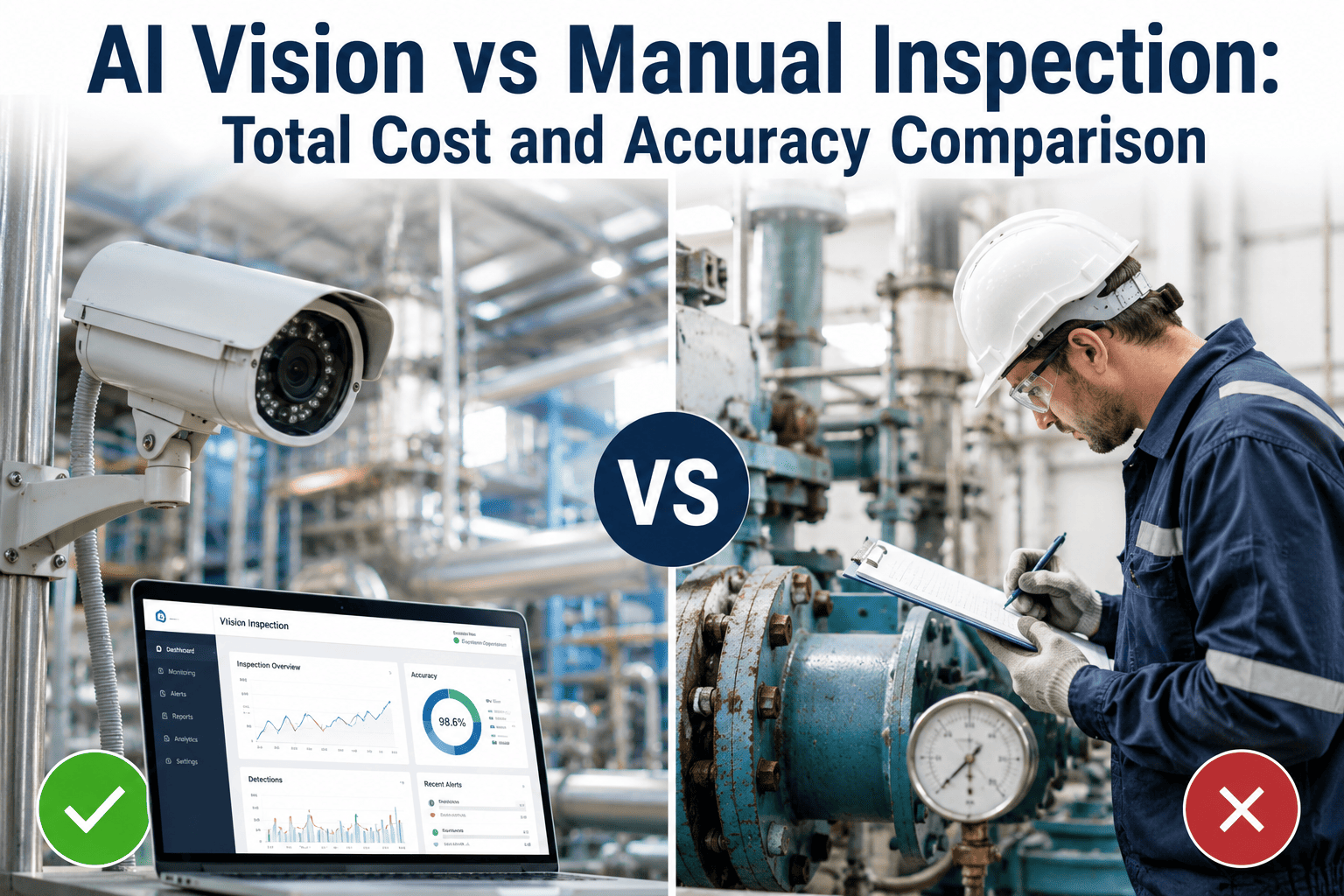
Direct Cost Comparison: AI Vision vs. Manual Inspection
The comparison that plant engineers and CFOs need is not the hardware sticker price against monthly payroll. It is total cost of quality over a three-year horizon, accounting for every cost layer that manual inspection generates and every cost layer that AI vision eliminates or reduces. The numbers documented across 2024 and 2025 deployments are consistent: manufacturers typically recover full implementation cost within 6 to 12 months and report ongoing annual savings of $100,000 to $300,000 from labour reduction alone, before accounting for scrap reduction, recall avoidance, and throughput gains.
| Cost Category | Manual Inspection | AI Vision Camera (iFactory) | Difference |
|---|---|---|---|
| Inspection accuracy | 80–85% (fatigue-dependent) | 99.4% (consistent, 24/7) | 15–20 percentage point gain |
| Labour cost structure | Variable — scales with volume, wages, and shifts | Fixed asset — cost per inspection falls with volume | AI converts variable to fixed cost |
| Defect escape rate | 15–20% of defects pass through uninspected | Sub-1% escape rate with trained models | Recall, rework, and returns cost avoided |
| Inspection throughput | Rate-limited by human speed and shift coverage | Matches or exceeds line speed — no bottleneck | Line throughput unconstrained by inspection |
| Audit traceability | Manual logs — variable, gap-prone, non-immutable | Timestamped, immutable digital records — FDA 21 CFR Part 11 ready | Compliance exposure eliminated |
| ROI payback period | N/A — ongoing rising cost | 6–12 months (industry benchmark) | Full cost recovery within first year |
| Scrap and rework reduction | No systematic reduction — defect rates stable | 15–20% scrap cost reduction documented | Direct margin recovery |
| PPE and safety monitoring | Requires dedicated safety personnel | Automatic PPE violation detection — same camera infrastructure | Safety compliance at no additional inspection cost |
What iFactory AI Vision Camera Detects — And What That's Worth
iFactory's AI Vision Camera is deployed across six critical factory inspection scenarios. Each one corresponds to a specific cost category that manual inspection either misses entirely or addresses inconsistently. Understanding what the system detects is the fastest way to calculate the value case for a specific facility.
Surface and subsurface cracks detected across metal, composite, and polymer components using multi-spectral imaging. Detects defects at tolerances human vision cannot resolve at production throughput speeds, converting escape-to-recall cost into catch-at-station cost.
Early-stage corrosion, oxidation, and coating failures identified before structural integrity is compromised. Predictive detection converts expensive reactive repair into scheduled preventive action — a direct maintenance cost reduction on top of quality savings.
Thermal infrared cameras identify temperature anomalies indicating bearing failure, electrical faults, or fluid leaks. Manual inspection cannot detect thermal anomalies without dedicated thermal imaging equipment and trained personnel — AI vision integrates this into the standard inspection pipeline.
Real-time detection of PPE violations — hard hats, high-visibility vests, gloves, and eye protection — across all monitored zones. Documented deployments report up to 54% reduction in recordable safety incidents. Safety compliance monitoring adds no incremental inspection cost once camera infrastructure is live.
Belt tears, misalignment, and wear patterns identified before failure. Unplanned conveyor downtime costs an average of $30,000 per hour across food and manufacturing facilities. Early detection converts emergency stoppages to scheduled maintenance — a maintenance cost that AI vision pays for multiple times over in its first year.
Component misalignment, incorrect assembly, and packaging errors detected at line speed. False positive rates significantly lower than traditional AOI systems — AI reduces unnecessary line stops that manual re-inspection triggers, improving available production time without compromising catch rate.
The ROI Case: Documented Benchmarks Across Industries
The business case for AI vision camera implementation is not theoretical. Across 2024 and 2025 deployments, the financial evidence is consistent enough to establish reliable benchmarks for facilities evaluating implementation today. Intel's AI vision deployment generates $2 million annually in scrap avoidance. Medical device manufacturers report $18 million in annual savings. Semiconductor producers recover $75 million in revenue from 0.1% yield improvements enabled by AI inspection accuracy. For manufacturers not at enterprise scale, the proportional savings are equally significant — a $10 million revenue facility reducing its Cost of Poor Quality from 20% to 10% recaptures $1 million annually without touching production volume.
iFactory AI Vision Camera deployments show a 9-month average payback period across 2024 and 2025 implementations. The drivers are labour savings of $100,000 to $300,000 annually, scrap reduction of 15 to 20%, throughput gains from eliminating inspection bottlenecks, and safety compliance improvements that reduce incident-related costs. The platform's integration with iFactory's CMMS means inspection outputs automatically trigger work orders, log into compliance records, and feed OEE analytics — eliminating the manual data transcription overhead that erodes the value of standalone inspection systems.
Across 2024–2025 iFactory AI Vision deployments, facilities recover full implementation cost within 9 months on average.
Documented annual labour cost reduction from eliminating or redeploying manual inspection headcount — upper range across 2025 benchmarks.
Direct scrap and rework cost reduction from 99.4% detection accuracy catching defects at station before they compound downstream.
Reduction in recordable safety incidents from real-time PPE violation detection — documented across industrial manufacturing deployments.
Implementation Considerations: What Determines Your Cost and Timeline
Implementation cost for an AI vision camera system varies by facility size, existing camera infrastructure, defect type complexity, and the number of integration points required. Facilities with existing ONVIF or RTSP-compatible cameras can integrate with iFactory's AI Vision system without full hardware replacement — a significant cost reduction on the hardware component. Facilities running SAP or Oracle ERP benefit from pre-built integration templates that reduce software integration time. The number of defect types the model must detect affects training time but not the ongoing per-inspection operating cost once deployed.
Frequently Asked Questions
iFactory AI Vision Camera integrates with existing PLC and SCADA systems. 99.4% accuracy. Sub-50ms latency. 1 to 2 week deployment. No infrastructure replacement required.