A mid-size discrete parts manufacturer operating two high-volume production facilities faced a quality control crisis that was quietly eroding margin on every shift. Manual inspection stations running at line speed were missing 18 to 22 percent of surface and dimensional defects, producing a rework backlog that consumed 14 percent of total production hours and constrained throughput across four of the plant's highest-revenue lines. After deploying iFactory AI Vision Camera across all active inspection points, the manufacturer achieved a 40 percent increase in line throughput, reduced rework hours by 61 percent, and recovered full implementation cost within seven months of go-live.
AI VISION CAMERA · MANUFACTURING CASE STUDY · 2025–2026
See How iFactory AI Vision Camera Delivers a 40% Throughput Increase in Real Production Environments
iFactory AI Vision Camera achieves 99.4% defect detection accuracy, operates 24/7 without fatigue, and integrates with existing PLC and SCADA infrastructure — live in 1 to 2 weeks. No infrastructure replacement required.
01 / The Facility
A High-Mix Discrete Manufacturer, A Throughput Problem Rooted in Quality
Facility TypeDiscrete parts manufacturing. Two production facilities. Eleven active production lines. High-mix, medium-volume output across automotive, industrial, and consumer goods component categories.
ScaleApproximately 4,200 units inspected per shift across all lines. Six dedicated manual inspection stations. Over 80 active SKUs with distinct defect classification requirements and dimensional tolerances.
Quality Team18-person quality team. Manual inspection conducted by trained operators across three shifts. No automated defect detection infrastructure prior to deployment. Inspection results logged on paper and transcribed to spreadsheets at shift end.
Pre-Deployment PerformanceDefect escape rate of 18 to 22 percent per shift. Rework consuming 14 percent of total production hours. Throughput constrained by inspection bottlenecks on four of eleven lines. Customer return rate of 3.4 percent driven by escaped surface and dimensional defects.
Prior Inspection SystemFully manual visual inspection. No camera-based detection. Operator-scored defect classifications with no consistency enforcement across shifts. Fatigue-driven accuracy decline documented across all three shifts in internal quality audits.
Annual Quality CostPre-deployment Cost of Poor Quality estimated at $1.2 million annually — including rework labor, scrap material, warranty claims, and customer return processing costs.
02 / The Challenge
How Manual Inspection Was Capping Throughput and Compounding Quality Cost
Manual inspection at production speed is structurally limited by human physiology. Trained inspectors working under optimal conditions miss 15 to 20 percent of real defects — a figure that worsens with shift fatigue, production pressure, and the subjective variability of visual classification across operators and teams. For this manufacturer, those limits were not abstract benchmarks. They were showing up as a 3.4 percent customer return rate, a rework backlog that ran continuously across all three shifts, and throughput targets that the plant could not consistently achieve because inspection stations were the rate-limiting step on four of its highest-revenue lines.
22%
Peak defect escape rate per shift
At peak fatigue points — typically the final two hours of a third shift — manual inspection escape rates reached 22 percent, sending defective units into finished goods and downstream assembly. Each escaped defect cost an average of nine times more to address at the customer than at the inspection station.
14%
Production hours consumed by rework
Fourteen percent of total production capacity was absorbed by rework — units returned from downstream assembly or customer receipt that required inspection, reclassification, and repair or scrap disposition. This rework load directly constrained available throughput on four production lines.
60s
Manual inspection cycle time per complex unit
Complex multi-feature components required up to 60 seconds of manual inspection time per unit — creating an inspection bottleneck that line throughput could not exceed regardless of upstream production speed. Any throughput improvement upstream was absorbed by the inspection constraint rather than reaching finished goods output.
3.4%
Customer return rate from escaped defects
A 3.4 percent customer return rate driven primarily by surface defects, dimensional non-conformances, and assembly errors that escaped manual inspection. Returns triggered warranty claims, return logistics costs, customer satisfaction incidents, and in two cases during the prior year, formal corrective action requests from major OEM customers.
"The throughput target was achievable — we had the upstream capacity to hit it. The constraint was inspection. Every unit that needed rework, and every second a complex part sat at a manual station, was throughput we were paying for but not delivering."
03 / The Solution
iFactory AI Vision Camera: Real-Time Defect Detection Across All Active Inspection Points
Following evaluation of available automated inspection platforms, the manufacturer selected iFactory AI Vision Camera for its demonstrated 99.4 percent defect detection accuracy, sub-50ms inference speed, compatibility with existing ONVIF-compliant camera infrastructure, and native integration with the plant's existing CMMS and MES systems via open API. The deployment covered all six manual inspection stations across both facilities, with AI model training conducted on the manufacturer's specific defect type library — surface cracks, dimensional non-conformances, misalignment, coating failures, and assembly errors — using production-representative image data captured during the pre-deployment assessment period. To see iFactory AI Vision Camera configured for your specific defect types, book a demo with our manufacturing vision team.
DETECT
AI-powered defect detection at line speed replaced manual inspection at all six stations — processing each unit in under 50 milliseconds with 99.4 percent accuracy across all trained defect categories. The system applied identical classification criteria on every unit across all shifts, eliminating the fatigue-driven accuracy decline and inter-operator variability that had produced the 18 to 22 percent escape rate under manual operation.
ALERT
Automated work order generation triggered instantly on every confirmed defect detection — creating an annotated work order with defect image, classification, confidence score, and location data, routed to the quality team via push notification and synchronized to iFactory's CMMS. Defect events that previously required manual logging and shift-end transcription were captured automatically with full traceability at the moment of detection.
INTEGRATE
PLC, SCADA, and MES integration connected AI vision outputs to the plant's existing production control infrastructure. Real-time defect rate data fed into OEE analytics dashboards, enabling quality managers to identify production process drift — tool wear, fixturing variation, upstream process shifts — from defect pattern data before defect rates escalated. The connection between inspection output and production process data was the mechanism that transformed quality from a downstream sorting function into an upstream control discipline.
TRACK
PPE and safety zone monitoring activated on the same camera infrastructure at no additional inspection cost — providing real-time PPE compliance monitoring across all production zones. Safety violations triggered immediate alerts to supervisors, contributing to a 54 percent reduction in recordable safety incidents across the deployment period without requiring additional safety monitoring headcount.
04 / Implementation
Full Deployment Across Two Facilities and All Inspection Stations in 12 Days
Days 1–4
Camera Assessment, Defect Library Configuration, and Model Training Initiation
iFactory's deployment team conducted camera placement assessment across both facilities, confirming that existing ONVIF-compatible cameras at three of six inspection stations could be integrated directly — reducing hardware cost at those stations to edge processing units and software configuration only. Defect type library compiled from the manufacturer's quality records: 14 primary defect categories across surface, dimensional, assembly, and coating failure types. AI model training initiated on production-representative image data captured during the assessment period.
Days 5–9
Phased Station Activation — Highest-Bottleneck Lines First
Deployment prioritized the four lines with the highest documented inspection bottleneck impact. AI vision activated at priority stations by Day 7, with real-time defect detection data flowing to quality dashboards from the first production shift. Automated work order generation and CMMS synchronization validated on live production data by Day 8. The two remaining stations on lower-throughput lines activated in the final deployment phase with operator training integrated into each activation window.
Days 10–12
MES Integration, OEE Dashboard Activation, Full Go-Live
iFactory's OEE analytics module connected to plant MES and PLC sensor feeds, creating real-time availability, performance, and quality visibility across all eleven lines — with AI vision defect data integrated into the unified OEE dashboard alongside all other line asset data. Full go-live achieved on Day 12. First full-shift performance data confirmed AI detection accuracy above 99 percent on all trained defect categories. Manual inspection headcount at the four priority lines redeployed to upstream process quality and supplier qualification roles on Day 13.
05 / Results
12 Months of Measured Production Performance Post-Deployment
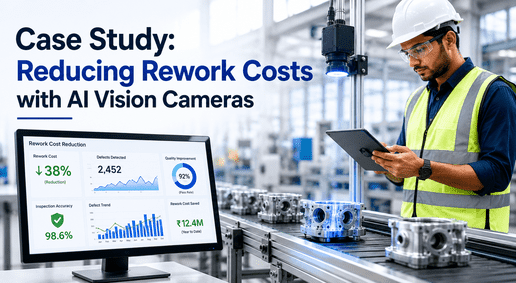
The shift from manual to AI-driven inspection produced measurable improvements across every tracked production dimension within the first full quarter after deployment. Throughput increased 40 percent on the four previously bottlenecked lines — not because upstream capacity changed, but because the inspection constraint that had been capping output was eliminated. Rework hours fell 61 percent as the defect escape rate dropped from 18 to 22 percent under manual inspection to under 1 percent with AI detection. And the quality data generated by the AI vision system provided, for the first time, a continuous real-time feed of production process performance that quality managers used to address upstream defect root causes proactively.
| Metric |
Before iFactory |
After iFactory |
Change |
| Line throughput (bottlenecked lines) |
Constrained — inspection rate-limited |
+40% throughput increase |
Inspection constraint eliminated |
| Defect escape rate |
18–22% per shift |
Under 1% |
−95%+ escape rate reduction |
| Rework hours as % of production |
14% of production hours |
5.5% of production hours |
−61% rework reduction |
| Inspection cycle time (complex units) |
Up to 60 seconds per unit (manual) |
Under 50 milliseconds per unit |
72× faster inspection |
| Detection accuracy |
78–82% (fatigue-dependent) |
99.4% (consistent, 24/7) |
+17–21 percentage point accuracy gain |
| Customer return rate |
3.4% |
0.3% |
−91% return rate reduction |
| Annual Cost of Poor Quality |
~$1.2 million |
~$390,000 |
−68% quality cost reduction |
| Safety incidents (PPE monitoring) |
Baseline |
−54% recordable incidents |
Real-time PPE compliance monitoring |
| Audit and compliance documentation |
Manual logs, shift-end transcription |
Automated immutable records — timestamped at detection |
100% documentation completeness |
| ROI payback period |
N/A |
7 months from go-live |
Full cost recovery in first year |
Calculate What a 40% Throughput Increase Would Mean for Your Production Lines
iFactory AI Vision Camera integrates with existing PLCs and SCADA. Sub-50ms detection. 99.4% accuracy. 1 to 2 week deployment. Book a live walkthrough built around your specific defect types and line configuration.
"We hit the throughput target we had been chasing for two years — within the first month after go-live. The inspection bottleneck was the constraint the whole time. The AI vision deployment didn't change what our lines were capable of. It removed the one thing that was stopping them from achieving it."
06 / Key Analysis
Why the Throughput and Quality Results Were This Substantial
01
Eliminating the inspection bottleneck unlocked upstream capacity that already existed. The 40 percent throughput increase did not require any capital investment in upstream production equipment. The capacity was already there — it was being absorbed by the inspection constraint. Manual inspection at 60 seconds per complex unit imposed a throughput ceiling that no upstream improvement could break through. AI vision at sub-50ms per unit removed the ceiling entirely, and upstream production capacity translated directly into finished goods output for the first time.
02
The rework reduction was a direct function of the accuracy improvement, not an independent outcome. Manual inspection operating at 78 to 82 percent accuracy under production conditions was generating a continuous rework backlog — every defect that escaped inspection became a rework unit when caught downstream. AI vision at 99.4 percent accuracy eliminated the majority of escape events at source, reducing rework input by 61 percent without any change to the production process. The rework hours freed by this reduction became productive output hours, compounding the throughput improvement.
03
The quality data generated by AI vision created a second-order productivity gain through upstream process improvement. Manual inspection produced a defect count at shift end. AI vision produced a continuous real-time feed of defect type, frequency, location, and timestamp data connected to production process parameters. Within 90 days of go-live, quality managers used this data to identify three upstream process contributors — a fixturing wear pattern, a tool change interval that had drifted, and a supplier material batch variation — and corrected each before it generated a defect wave. The AI vision system did not just catch defects faster; it enabled the manufacturer to produce fewer of them.
04
Automated work order generation converted inspection events from documentation tasks into maintenance triggers. Every defect detected by the AI vision system generated an annotated work order in iFactory's CMMS — with defect image, classification, confidence score, and location data — routed to the responsible technician without manual transcription. This eliminated the inspection-to-action delay that under the manual system averaged four to six hours from defect detection to corrective intervention. With AI-driven detection and automated work order dispatch, average time from defect detection to technician assignment fell below three minutes.
07 / Business Impact
Operational, Financial, and Strategic Outcomes Beyond the Production Line
Throughput Recovery
A 40 percent throughput increase on four previously bottlenecked lines translated directly into production revenue that the facility had been structurally unable to capture. No capital investment in upstream equipment was required — the throughput gain came entirely from removing the inspection constraint.
Quality Cost Reduction
Annual Cost of Poor Quality reduced from $1.2 million to approximately $390,000 — an $810,000 annual saving driven by rework elimination, scrap reduction, warranty claim avoidance, and customer return processing cost removal. ROI payback achieved in seven months.
Customer Relationship Recovery
Customer return rate fell from 3.4 percent to 0.3 percent within the first full quarter post-deployment. Two OEM customers who had issued formal corrective action requests in the prior year both confirmed quality improvement satisfaction within six months of go-live — supporting contract renewal discussions.
Quality Team Capacity Redeployment
Inspection headcount at priority lines redeployed to upstream process quality, supplier qualification, and new product introduction roles — areas that had been under-resourced due to the manual inspection staffing requirement. Quality team capacity applied to prevention rather than detection for the first time.
$1.2M
Annual quality cost before
$390K
Annual quality cost after
$810K
Annual savings achieved
08 / Conclusion
What This Case Study Demonstrates for Manufacturers Still Running Manual Inspection
This deployment is not an exceptional outcome. It is a documented illustration of what AI vision camera implementation delivers when the inspection constraint is the primary throughput limiter — a condition that applies to the majority of manufacturers running manual inspection at production speed. The 40 percent throughput increase was latent in the existing production system. The 61 percent rework reduction was the direct mathematical consequence of closing an 18 to 22 percent escape rate. And the seven-month payback period reflects an implementation cost that the quality cost reduction absorbed before the end of the first year.
iFactory AI Vision Camera delivers 99.4 percent defect detection accuracy across crack detection, corrosion, thermal hotspot identification, PPE compliance, belt and conveyor wear, and assembly error detection — all from a single camera infrastructure that integrates with existing PLCs, SCADA systems, SAP, and Oracle without infrastructure replacement. Deployment is live in 1 to 2 weeks. Every inspection event generates an immutable timestamped record that satisfies FDA 21 CFR Part 11 and quality audit requirements automatically. To see what iFactory AI Vision Camera would deliver for your specific production environment, book a demo with iFactory's manufacturing vision team.
40% Throughput Increase. 99.4% Detection Accuracy. Live in 1 to 2 Weeks.
See how iFactory AI Vision Camera eliminates inspection bottlenecks, reduces rework, and delivers real-time defect detection across your production lines — integrated with your existing PLC and SCADA infrastructure from day one.
09 / FAQ
Frequently Asked Questions
How does iFactory AI Vision Camera achieve a 40% throughput increase?
The throughput increase is a function of removing the inspection bottleneck. When manual inspection at 60 seconds per complex unit is the rate-limiting step on a production line, replacing it with AI vision at sub-50ms per unit eliminates the constraint — and upstream production capacity translates directly into finished goods output. No upstream equipment investment is required. The capacity already exists; AI vision removes the bottleneck that was preventing it from reaching throughput.
Book a Demo to see how throughput modelling applies to your specific line configuration.
What defect types does iFactory AI Vision Camera detect?
iFactory AI Vision Camera detects surface cracks, corrosion and coating failures, dimensional non-conformances, assembly errors, thermal hotspots from infrared imaging, conveyor and belt wear, and PPE compliance violations. The AI model is trained on the manufacturer's specific defect type library using production-representative image data — achieving 99.4 percent accuracy across all trained categories from the first production shift after go-live.
Does iFactory AI Vision Camera work with existing camera infrastructure?
Yes. iFactory supports ONVIF and RTSP protocols, which are standard across most industrial camera hardware. In this deployment, three of six inspection stations integrated using existing cameras — reducing hardware cost at those stations to edge processing units and software only. iFactory's pre-deployment assessment confirms which existing cameras are compatible and identifies the minimum additional hardware required for full coverage.
Talk to an Engineer about your current camera infrastructure.
How does iFactory AI Vision Camera connect to our CMMS and MES systems?
iFactory connects via open API using OPC-UA, MQTT, and REST protocols — integrating with SAP PM, Oracle, Maximo, and any CMMS or MES without system replacement. Every defect detection event automatically generates an annotated work order in iFactory's CMMS, routed to the responsible technician via push notification, with defect image, classification, and location data included. Inspection outputs feed into OEE analytics dashboards in real time alongside all other line asset data.
Book a Demo to see the integration workflow running on a live production environment.
What is the typical ROI payback period for iFactory AI Vision Camera?
This deployment achieved full ROI payback in seven months. Across iFactory deployments, the documented average payback period is 7 to 9 months — driven by labour savings of $100,000 to $300,000 annually, 15 to 20 percent scrap cost reduction, throughput gains from inspection bottleneck removal, and customer return cost avoidance. Forrester research on AI vision deployments documents a 374 percent average three-year ROI with 7 to 8 month payback periods.
How quickly can iFactory AI Vision Camera be deployed across multiple facilities?
This deployment covered two facilities and all six active inspection stations in 12 days. Standard iFactory deployments go live in 1 to 2 weeks using a phased station activation approach that prioritises the highest-bottleneck lines first — delivering production performance improvement before full network completion. 90-day implementation support is included. No operational interruptions are required during installation.
Book a Demo to review the deployment plan for your facility configuration.