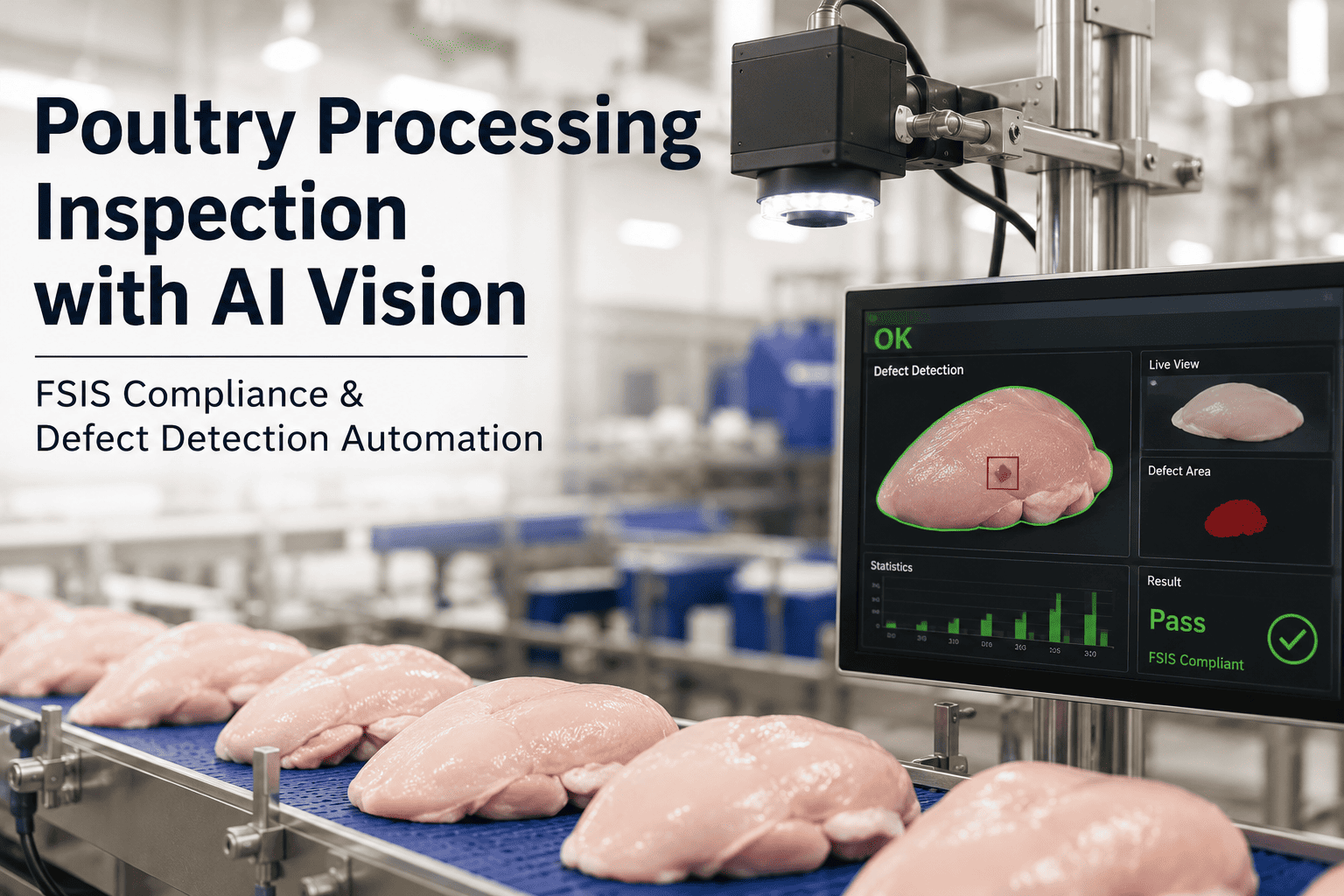
Poultry quality managers operate inside one of the most stringently regulated environments in food manufacturing. FSIS inspectors are physically present on the line, and a single failure to detect fecal contamination on a carcass can trigger a regulatory action that ranges from a written non-compliance record to a full suspension of inspection authority — which effectively shuts the plant down. The stakes are not theoretical. In fiscal year 2023, FSIS issued over 5,000 non-compliance records related to carcass dressing defects and contamination across the poultry sector, and every single one began with a defect that was not caught at the point of inspection. The question for quality managers is whether the human eye at 140 birds per minute is still the most reliable tool available, or whether AI vision inspection offers a defensible, auditable alternative that holds up under regulatory scrutiny.
The FSIS Regulatory Reality That Drives Inspection Investment
The FSIS regulatory framework for poultry inspection operates on a principle that has no equivalent in other food sectors: a government inspector is stationed on the production line during every operating shift, and that inspector has the authority to stop the line, hold product, or suspend inspection entirely if they observe systemic deficiencies in the plant's own inspection processes. Under the New Poultry Inspection System, plants have taken on greater responsibility for sorting and removing carcasses with defects, but FSIS inspectors still verify that the plant's sorting criteria are being applied correctly. The moment an FSIS inspector catches a defect that the plant's sorters missed — particularly fecal contamination — the plant is on record. Repeated misses accumulate into a pattern that FSIS interprets as a failure of the plant's HACCP plan, the sanitation standard operating procedures, or both.
For a quality manager, this creates a dual accountability problem. You are accountable to your plant leadership for maintaining throughput and yield, and you are accountable to FSIS for maintaining defect detection rates that prevent non-compliance records. The tension between those two accountabilities is where AI vision inspection becomes strategically relevant — not because it replaces the FSIS inspector, but because it gives the plant a detection capability that runs at the same line speed as production, applies the same criteria to every carcass, and produces a timestamped image log that documents exactly what the plant saw and how it responded. That log is what a quality manager hands to the FSIS inspector during a non-compliance discussion to demonstrate that the plant's system is functioning, even when an individual defect slips through.
The HACCP requirement compounds this pressure. Every poultry plant must identify critical control points where hazards are monitored, and carcass inspection post-evisceration is almost always one of those CCPs. HACCP records must demonstrate that monitoring is happening at the defined frequency, that corrective actions are taken when deviations occur, and that verification activities confirm the system is working. Manual inspection records — paper logs, operator checkmarks, end-of-shift summaries — are inherently weak evidence in an HACCP verification audit because they cannot be linked to individual carcasses or specific moments in time. AI vision changes that evidence base entirely by generating a per-carcass record that includes the image, the defect classification, the confidence score, and the disposition action, all timestamped to the millisecond.
Five Critical Defect Categories That AI Vision Catches at Line Speed
Not all defects carry the same regulatory weight or the same economic consequence. FSIS treats fecal and ingesta contamination as zero-tolerance hazards that require immediate carcass reprocessing or condemnation. Other defects — bruising, retained organs, skin tears — do not trigger the same regulatory response but directly impact yield, grade classification, and downstream rework costs. A comprehensive AI vision system must address all five categories below, because a system that only catches contamination while missing bruising leaves significant value on the table, and a system that only catches visual defects while missing contamination leaves the plant exposed to the exact regulatory risk that drove the investment in the first place.
Detected using hyperspectral imaging at specific wavelengths where fecal material reflects differently from muscle tissue and fat. The system must distinguish feces from bile, ingesta, and normal skin coloration under variable lighting conditions. Hyperspectral sensors capture data across 50 to 200 narrow wavelength bands, producing a spectral signature for each pixel that is compared against a trained fecal reference library. Detection sensitivity down to 0.5 millimeter spots at line speeds of 140 BPM is the baseline performance threshold that plants should specify.
Ingesta from the crop and proventriculus has a different spectral signature than fecal material because it contains partially digested feed with chlorophyll and carotenoid pigments. AI models trained on ingesta samples can differentiate it from feces, bile, and normal greenish discoloration from bile staining. Missed ingesta carries the same FSIS zero-tolerance consequence as fecal contamination, but it is visually harder for human inspectors to distinguish from bile stains at line speed, which is where AI consistently outperforms manual sorting.
Bruises downgrade carcasses from Grade A to B or lower depending on size, location, and severity. Each grade reduction costs between $0.50 and $2.00 per bird depending on size class and market conditions. AI vision classifies bruise severity by analyzing color intensity, surface area, and tissue displacement in the affected region. Consistent bruise detection also serves as an upstream process indicator — a sudden increase in bruise rate on the AI dashboard points to catching, hanging, or stunning equipment issues before they generate a large volume of downgraded product.
Lungs, kidneys, reproductive organs, or portions of the intestine left in the body cavity after evisceration represent a food safety hazard that can trigger automatic reprocessing or condemnation. AI vision systems with cameras positioned to view the opened cavity detect retained organ tissue by color, shape, and texture contrast against the clean interior body wall. Detection rates for retained organs are significantly higher with AI than with manual cavity inspection because the camera views the cavity from a consistent angle and distance every time, whereas manual inspectors vary in their viewing position and access.
Mechanical damage from picking, evisceration, or transfer equipment creates skin tears and cuts that reduce carcass presentation grade and can expose underlying tissue to contamination. Broken bones from rough handling are a yield loss that compounds into further damage during downstream cutting and deboning. AI vision using 2D and structured light 3D imaging maps the carcass surface and flags discontinuities, lacerations, and abnormal contour deformations that indicate underlying skeletal damage. Early detection allows maintenance to address the specific equipment causing the damage before an entire shift of product is affected.
Contamination Detection: How the Technology Actually Works
The three contamination categories that matter most on a poultry line — fecal, ingesta, and process-related defects — require fundamentally different detection approaches. Fecal and ingesta detection relies on spectral analysis that sees beyond the visible light spectrum, while process defect detection relies on structural analysis of the carcass surface. Understanding the difference matters because it affects camera selection, lighting design, and the specific AI models that need to be trained for each defect type.
Hyperspectral cameras capture light across narrow, contiguous wavelength bands rather than the three broad bands of a standard RGB camera. This produces a spectral curve for each pixel that acts as a chemical fingerprint. Fecal material contains bilirubin breakdown products, undigested feed residues, and bacterial metabolites that produce a distinct spectral reflectance pattern in the visible and near-infrared range. The AI model compares each pixel's spectral signature against a trained reference library that includes fecal samples from multiple flock sources, diets, and ages. When a pixel or cluster of pixels matches the fecal signature above a defined confidence threshold, the system flags the carcass and triggers the reject actuator. The critical advantage over RGB-based detection is that hyperspectral imaging can distinguish feces from visually similar materials like bile stains, rust from equipment, and normal skin pigmentation variations that cause false positives in simpler systems.
Ingesta detection requires a model that can distinguish crop and proventriculus contents from fecal material, bile, and normal discoloration. The presence of chlorophyll and carotenoid pigments in ingesta gives it a spectral signature that overlaps with but is distinct from feces. AI models trained on ingesta-specific sample sets, combined with spatial analysis of the contamination pattern — ingesta tends to appear in clusters near the crop and vent area rather than the distributed pattern typical of fecal contamination — improve both detection rate and false-positive rejection. Plants that process birds with high feed intake or variable crop fill rates benefit most from dedicated ingesta detection because the volume of ingesta-related contamination is higher and the visual similarity to bile makes manual sorting particularly unreliable.
Process defects — bruising, skin tears, cuts, and broken bones — are structural rather than chemical in nature and are best detected using high-resolution 2D imaging supplemented by structured light 3D profiling. The 2D cameras detect color anomalies associated with bruising and hemorrhaging, while the 3D sensor maps surface topography to identify tears, lacerations, and contour deformations that indicate skeletal damage beneath the skin. The combined 2D plus 3D approach produces a defect map for each carcass that classifies the type, location, and severity of each defect, which feeds directly into grade classification decisions and upstream equipment health monitoring.
Manual Sorting vs. AI Vision on a High-Speed Evisceration Line
| Inspection Dimension | Manual Plant Sorting at 140 BPM | AI Vision at 140 BPM |
|---|---|---|
| Fecal contamination detection | Relies on inspector visual acuity; sensitivity drops significantly after 30 minutes of continuous monitoring | Hyperspectral detection at 0.5mm spot size with consistent sensitivity across the full shift |
| Ingesta identification | Often confused with bile staining; high false-negative rate for small ingesta spots | Chlorophyll signature analysis differentiates ingesta from bile with 95 percent plus accuracy |
| Bruise severity grading | Subjective classification; varies between inspectors and shifts; no recorded severity score | Automated 3-grade severity classification with logged area and intensity measurements |
| Retained organ detection | Limited by viewing angle and access; inconsistent cavity inspection across carcasses | Consistent camera angle and distance for every cavity; higher detection rate for lungs and kidneys |
| Skin tear and cut detection | Larger tears caught; small lacerations under 5mm frequently missed at line speed | Surface mapping detects discontinuities down to 2mm with consistent sensitivity |
| Carcass grade classification | Based on spot-check samples; not every carcass graded individually | Every carcass scored against Grade A criteria with recorded pass-fail rationale |
| FSIS documentation | Paper logs and end-of-shift summaries; no per-carcass record available | Timestamped image and classification log for every inspected carcass |
| HACCP record generation | Manual entry into HACCP logs; verification requires separate audit activity | Automatic CCP monitoring record with deviation alerts and corrective action triggers |
| Line speed capability | Detection accuracy degrades above 100 BPM; unreliable above 140 BPM | Maintains rated detection accuracy up to and above 180 BPM with appropriate hardware |
| Washdown durability | Human inspectors leave the line during sanitation; no equipment exposure concern | IP69K-rated enclosures, stainless steel housings, and sealed optical windows required |
How AI Vision Integrates into the Evisceration Line
Deploying vision inspection on a running poultry evisceration line requires coordination between the quality team, the maintenance team, the sanitation team, and the FSIS inspector-in-charge. The physical installation — camera mounts, lighting fixtures, reject actuators, and network cabling — must be completed during a scheduled downtime window, but the system calibration, model training, and validation all happen while the line is running. The four-stage process below represents the standard deployment model that has been validated across multiple poultry processing facilities operating under NPIS protocols.
The stage that determines long-term success is shadow mode validation, not installation. During shadow mode, the system inspects every carcass and logs its decisions, but no reject actions are taken. The quality team compares every AI flag against what the human sorters caught and what the FSIS inspector observed, building a confusion matrix that quantifies true positives, false positives, false negatives, and true negatives. This matrix is what determines whether the model's thresholds need adjustment before going live, and it is also the documentation that supports the FSIS pre-approval notification. Plants that skip or compress this stage to accelerate go-live almost always experience a credibility problem within the first month, when either a false-positive surge generates excessive reprocessing costs or a false-negative event produces a non-compliance record that undermines the entire investment case.
A high detection rate is necessary but not sufficient for FSIS compliance defense. What turns a vision system from a useful tool into a regulatory asset is the per-carcass audit trail — the timestamped image, the defect classification, the confidence score, and the disposition action all linked to a specific carcass at a specific time. When an FSIS inspector writes a non-compliance record for a missed defect, the quality manager's first response is to demonstrate that the plant's inspection system was functioning correctly at that moment. A paper log saying "inspection performed" provides no evidence of what was actually seen. A timestamped image showing the carcass as it passed the inspection point, with the system's classification logged, provides defensible evidence that the plant's HACCP monitoring was active and that the specific defect in question fell below the system's detection threshold — which then becomes a threshold tuning discussion rather than a systemic failure discussion. That distinction is often the difference between a single NR and a regulatory pattern that escalates to increased inspection intensity or suspension.
Margin Protection Through Defect Prevention, Not Just Defect Detection
The financial case for poultry vision inspection is frequently framed around regulatory risk avoidance — avoiding recalls, avoiding NRs, avoiding inspection suspension. Those are real costs, but they are also probabilistic and hard to quantify in a capital budget request. The more immediately defensible financial case is built on the margin impact of consistent defect detection: fewer downgraded carcasses, less reprocessing labor, lower rework costs, and earlier detection of upstream equipment problems that would otherwise generate defects across an entire shift before anyone noticed.
Deployment Realities in a Washdown Environment
Poultry processing plants are among the most hostile environments for precision optical equipment. High-pressure, high-temperature washdown cycles happen one to three times per day depending on the facility's sanitation schedule. Caustic and acid sanitizers attack optical coatings, cable jackets, and connector seals. Rapid temperature changes from ambient to steam-clean conditions cause condensation inside optical enclosures that degrades image quality within minutes if the enclosure is not properly sealed and purged. Any vision system deployed on a poultry evisceration line must be engineered for this environment from the outset — retrofitting a standard industrial vision system with a washdown cover is not equivalent to a purpose-built food-grade installation.
Every camera enclosure, lighting fixture, junction box, and cable connector must carry an IP69K rating, which means tested to withstand high-pressure water jets at 80 to 100 bar at 80 degrees Celsius from multiple angles. Standard IP67 or NEMA 4X ratings are not sufficient for the direct impact zones of poultry line sanitation. Housings should be 316L stainless steel or food-grade polymer with no exposed threads, no crevices that trap organic material, and optical windows made of sapphire or tempered borosilicate glass that resists chemical etching from caustic sanitizers over thousands of wash cycles.
The system must survive repeated exposure to caustic cleaners at pH 12 to 13, acid rinses at pH 2 to 3, and quaternary ammonium sanitizers without optical degradation. This means sealed optical paths with positive air or nitrogen purge to prevent condensation, chemical-resistant cable jackets rated for repeated cleaning exposure, and connector systems that maintain their seal rating after hundreds of mating cycles. The lighting system must maintain stable color temperature and intensity output across temperature swings from 5 degrees Celsius pre-sanitation to 60 degrees Celsius during steam cleaning, because any drift in lighting directly affects the spectral signatures the contamination models rely on.
Before a vision system can influence carcass disposition on an NPIS line, the plant must notify the FSIS District Office and provide documentation covering system capabilities, validation data, operator training records, and the planned integration with the plant's HACCP plan. The FSIS does not formally approve or reject the system, but the notification and response process creates a record that defines how the system will be used and what happens when the system and the inspector disagree. Quality managers should expect this process to take 30 to 60 days and should initiate it during the shadow mode validation stage so that the validation data itself supports the notification package.