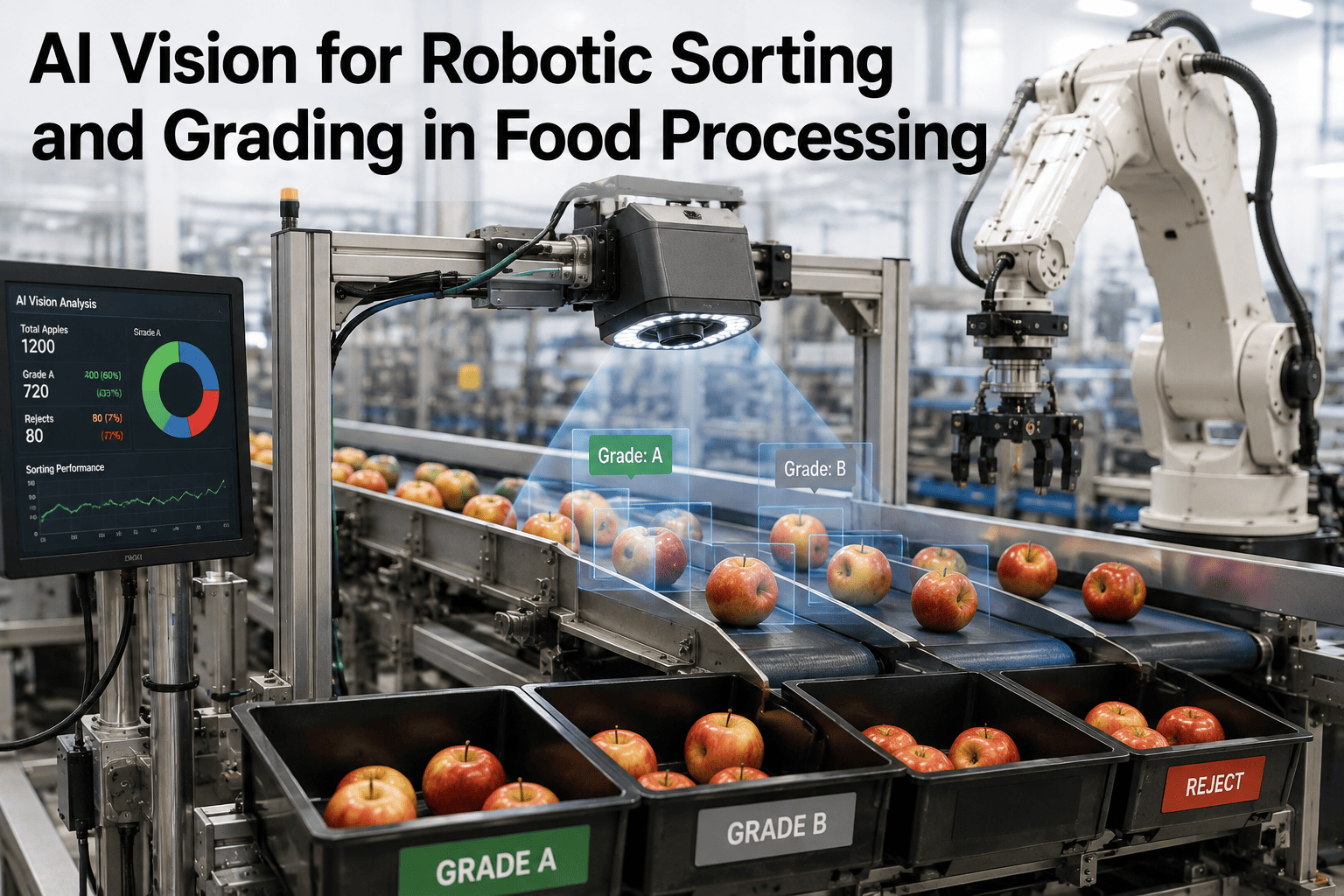
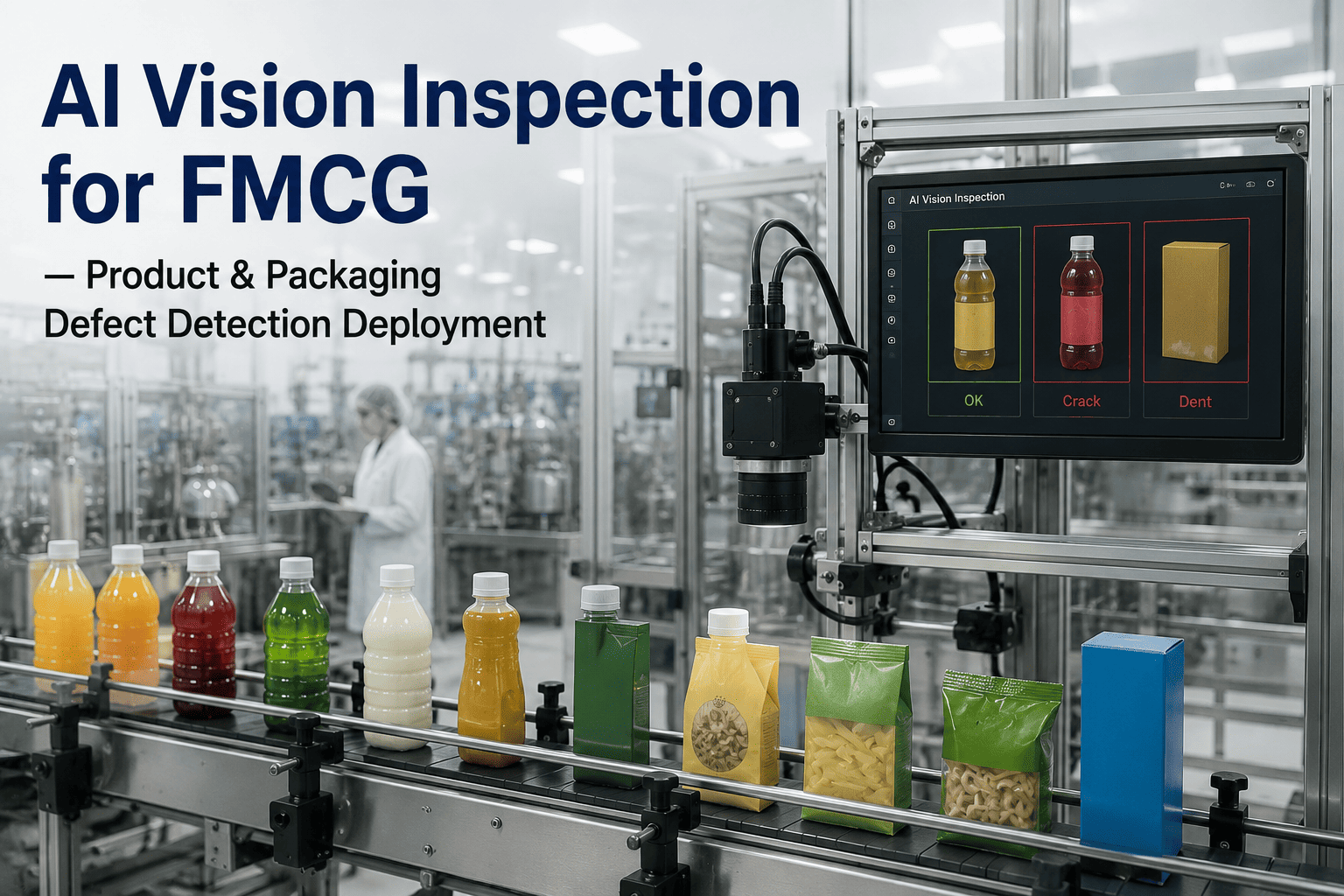
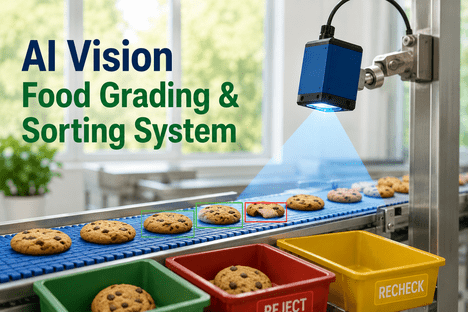
A grade-one apple and a grade-two apple can differ by a bruise smaller than 8mm, a color patch covering less than 10 percent of the surface, or a shape deviation invisible at line speed to a human grader four hours into a shift. That is not a measurement problem, it is a consistency problem, and it is the reason food grading has stayed labor-intensive even as nearly every other stage of processing has automated around it. Deep learning classification models built on CNN and YOLO architectures now grade fruits, vegetables, meat, and baked goods by color, shape, and size at full line speed, with published classification accuracy exceeding 95 percent on standard produce datasets. This page breaks down how that grading actually works and what it looks like running on a live production line.
Production QC — Food Grading
Grade Every Unit by Color, Shape, and Size at Full Line Speed
AI vision replaces manual spot-checking with per-unit grading across produce, meat, and bakery lines, applying the same grade standard to the first unit of the shift and the last.
95%+classification accuracy demonstrated by CNN and YOLO models on standard produce grading datasets
100%of units graded at full line speed, no sampling or manual spot-check dependency
<10msper-frame inspection time for color, shape, and defect classification
Why Manual Grading Cannot Hold a Consistent Line
Manual grading has one structural weakness that no amount of training fixes: it depends on a human maintaining identical judgment for hours at a time, item after item, at a pace set by the conveyor rather than by the grader. Two experienced inspectors examining the same batch will routinely arrive at different grade decisions, and the same inspector will grade differently at the start of a shift than at the end of it. That is not a training failure, it is what sustained visual attention does to anyone doing repetitive inspection work.
The line-speed tradeoff makes it worse. Present product too quickly and the inspector cannot examine each unit properly, so defects get missed and grades get mixed. Slow the line down to let inspection keep pace and labor cost per unit rises while throughput falls. There is no manual staffing configuration that solves both problems at once, because the constraint is the person, not the process around them.
Peak season compounds the staffing side of the problem further. Grading volume spikes seasonally for most fresh produce categories, and the trained graders needed to hold quality standards during that spike are the hardest labor to find and the most expensive to retain temporarily. A grading approach that depends on adding skilled headcount every peak season is structurally fragile in exactly the periods when consistent quality matters most for retail commitments and export specifications.
The Three Attributes AI Vision Grades on Every Unit
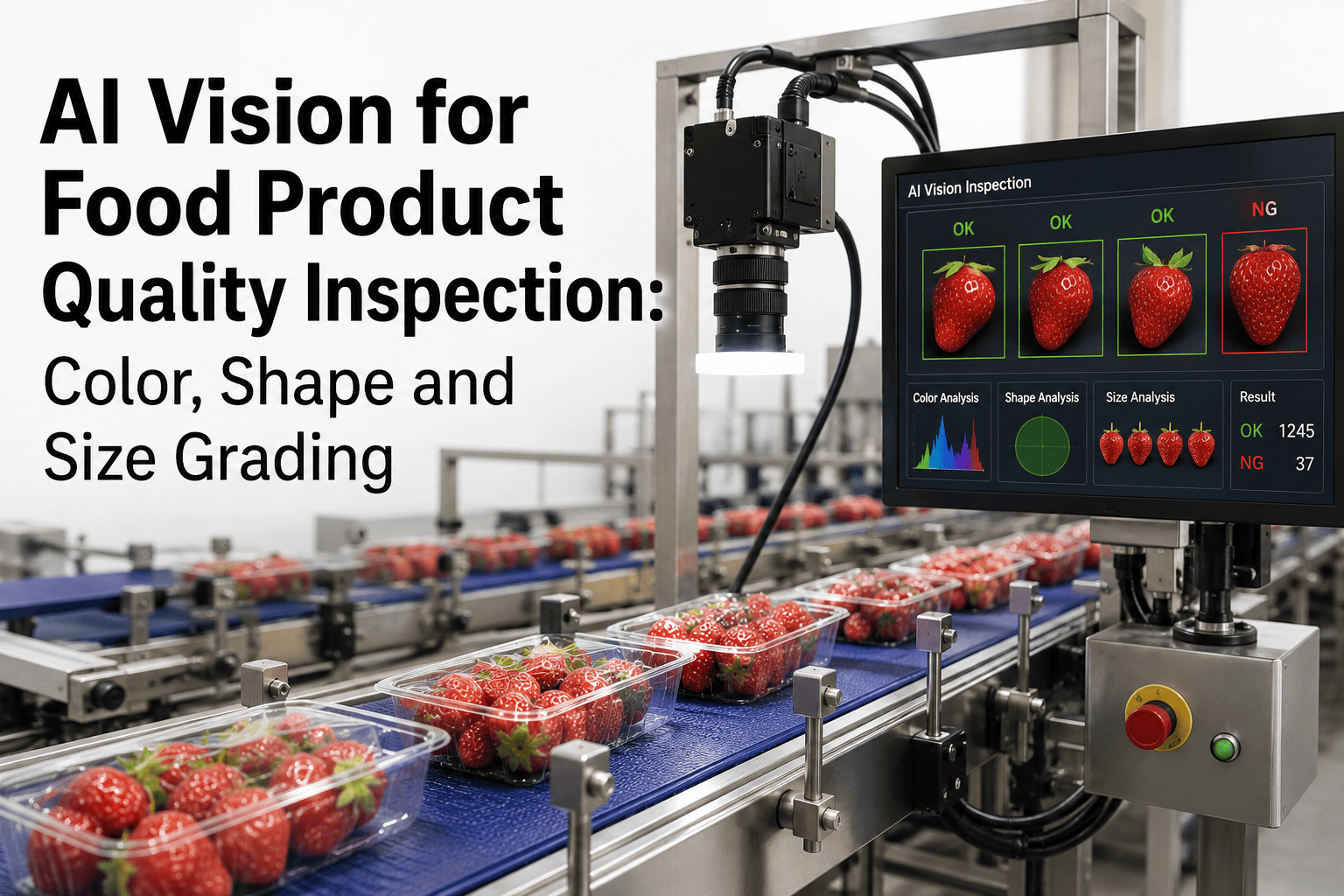
Food grading standards are built around three physical attributes that, together, determine market grade, retail specification, and price. AI vision evaluates all three simultaneously on every single unit rather than sampling a subset of a batch.
Attribute 01
Color Uniformity
Surface color is mapped across the full visible area of each unit, catching patches, discoloration, and ripeness variation that fall outside the configured grade tolerance, even where the deviation covers a small fraction of total surface area.
Attribute 02
Shape Consistency
Contour analysis compares each unit's outline against the expected shape profile for its product type, flagging deformities, asymmetry, or growth irregularities that affect grade classification and packaging fit.
Attribute 03
Size Classification
Dimensional measurement sorts each unit into precise size bands without physical calipers or weight cells, routing product to the correct size-based channel at the same speed the color and shape checks run.
How Grading Applies Across Product Categories
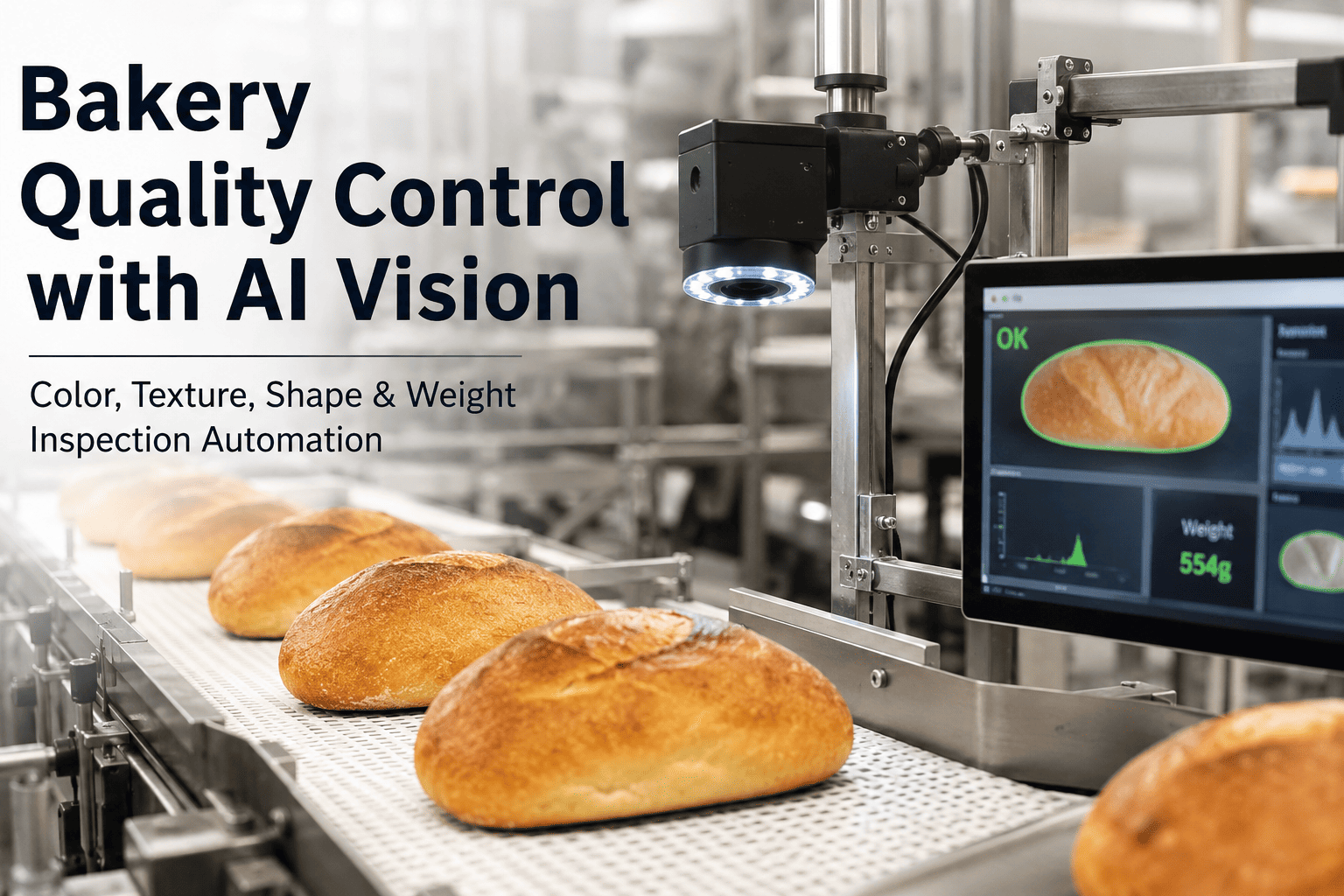
Color, shape, and size grading do not mean the same thing on a tomato line as they do on a bakery line. The underlying vision approach is the same, but what counts as a defect and what tolerance band applies is configured per category and per SKU.
How a Unit Moves From Camera to Grade Decision
1
Camera Captures Every Unit
Vision cameras positioned above the line capture a full-surface image of each unit as it passes, at the same speed the line is already running.
2
Model Scores Color, Shape, Size
The deep learning model evaluates all three attributes against the configured grade specification for that SKU in under 10 milliseconds per frame.
3
Grade Assigned Automatically
Each unit receives a grade classification based on where it falls within the tolerance bands, with no manual judgment call required in the loop.
4
Divert Signal Triggers in Real Time
The grade decision fires a physical divert signal that routes the unit to the correct channel, whether that is a retail-grade line, a processing-grade line, or a reject bin.
5
Per-Unit Record Logged
Grade, timestamp, and image evidence are logged for every unit, building an auditable quality record without a separate manual documentation step.
What Changes on the Line Once Grading Is Automated
Grade Boundaries Stop Drifting
A configured tolerance band applies identically at minute one and minute four hundred of a shift, removing the fatigue-driven drift that separates two graders' judgment of the same batch.
Giveaway From Over-Grading Drops
Manual graders tend to round conservatively when uncertain, pushing borderline units into a lower grade than they warrant. Precise per-unit measurement recovers that margin instead of giving it away.
Every Unit Gets Checked, Not a Sample
Sampling protocols exist because full manual inspection at line speed is not physically possible. Vision grading removes that constraint, so 100 percent of product is checked rather than a statistical subset.
Compliance Documentation Builds Itself
A per-unit grading record with timestamp and image evidence exists automatically for every item that runs the line, replacing manual logbooks assembled after the fact for an audit.
Grading accuracy at full line speed is not a future capability, it is the current baseline for processors competing on quality and cost. See where your current sampling approach is leaving margin on the table.
Where the Return Actually Comes From
The financial case for automated grading is often framed narrowly around labor cost, but labor is usually the smaller piece. The larger return sits in the grading decisions themselves, specifically the ones a manual process gets wrong in a direction that costs money without anyone noticing until the numbers are reviewed at the end of a quarter.
01Recovered over-grading margin — borderline units that a cautious manual grader rounds down to a lower grade get classified correctly instead, recovering price difference across thousands of units per shift.
02Reduced false rejects — rule-based legacy vision systems and overly conservative manual grading both reject acceptable product at a higher rate than a properly tuned deep learning model, and every false reject is product that gets sold at a lower channel or discarded entirely.
03Lower customer complaint and rework rate — consistent grading at the source reduces the downstream cost of a retail buyer rejecting a shipment or a customer complaint tracing back to a grade that should not have passed.
04Peak season stability — throughput no longer depends on finding and training enough skilled graders for a seasonal volume spike, removing one of the most unpredictable cost variables in produce and protein processing.
Frequently Asked Questions
How does the system handle natural variation between individual pieces of produce?
Every unit of produce is biologically unique, which is exactly the challenge grade specifications are built to accommodate. The classification model is trained on a wide range of examples for each product type, so it learns the acceptable range of natural variation within a grade rather than expecting a fixed template match. Grade tolerance bands are configured per SKU, season, and even supplier where specifications differ, so the system reflects the same nuance a trained grader would apply, just applied identically on every single unit.
Book a demo to see tolerance configuration for a specific product line.
Can grading tolerances be adjusted for different customers or retail specifications?
Yes. Grade specifications commonly differ by retail buyer, export market, and processing channel, and the same physical line often needs to run different tolerance configurations depending on which order is being fulfilled. Color, shape, and size thresholds are configured per SKU and per specification, so a changeover between a premium retail run and a processing-grade run does not require re-training a model, only switching the active configuration profile.
What happens when the system encounters a defect type it has not seen before?
Units that fall outside all configured confidence thresholds are flagged for manual review rather than force-classified into an existing grade category, which keeps ambiguous cases from being silently misgraded. Confirmed and corrected classifications from that review process feed back into the model, so accuracy on emerging or rare defect types improves the more the system runs in production rather than staying static after initial deployment.
Does this replace our existing weight-based sorting equipment?
Not necessarily. Many lines already run weight cells or mechanical size sorters that handle one dimension of grading well, and vision grading is commonly layered alongside that existing equipment to add the color and shape evaluation those systems cannot perform, rather than replacing hardware that is already working correctly.
Contact support to review how vision grading integrates with equipment already installed on a specific line.
How long does it take to calibrate the system for a new product line?
Calibration timelines depend on product complexity and how well-documented the existing grade specification is, but most single-product lines reach a validated grading model within a few weeks of camera installation, including a shadow-mode period where classifications are checked against manual grading before the system takes over the divert decision. Lines with multiple SKUs sharing similar physical characteristics can often reuse a substantial part of the base model rather than starting calibration from zero for each new product.
Grade Every Unit the Same Way, Every Time
See AI vision grading configured against your own color, shape, and size specifications on a live production line.