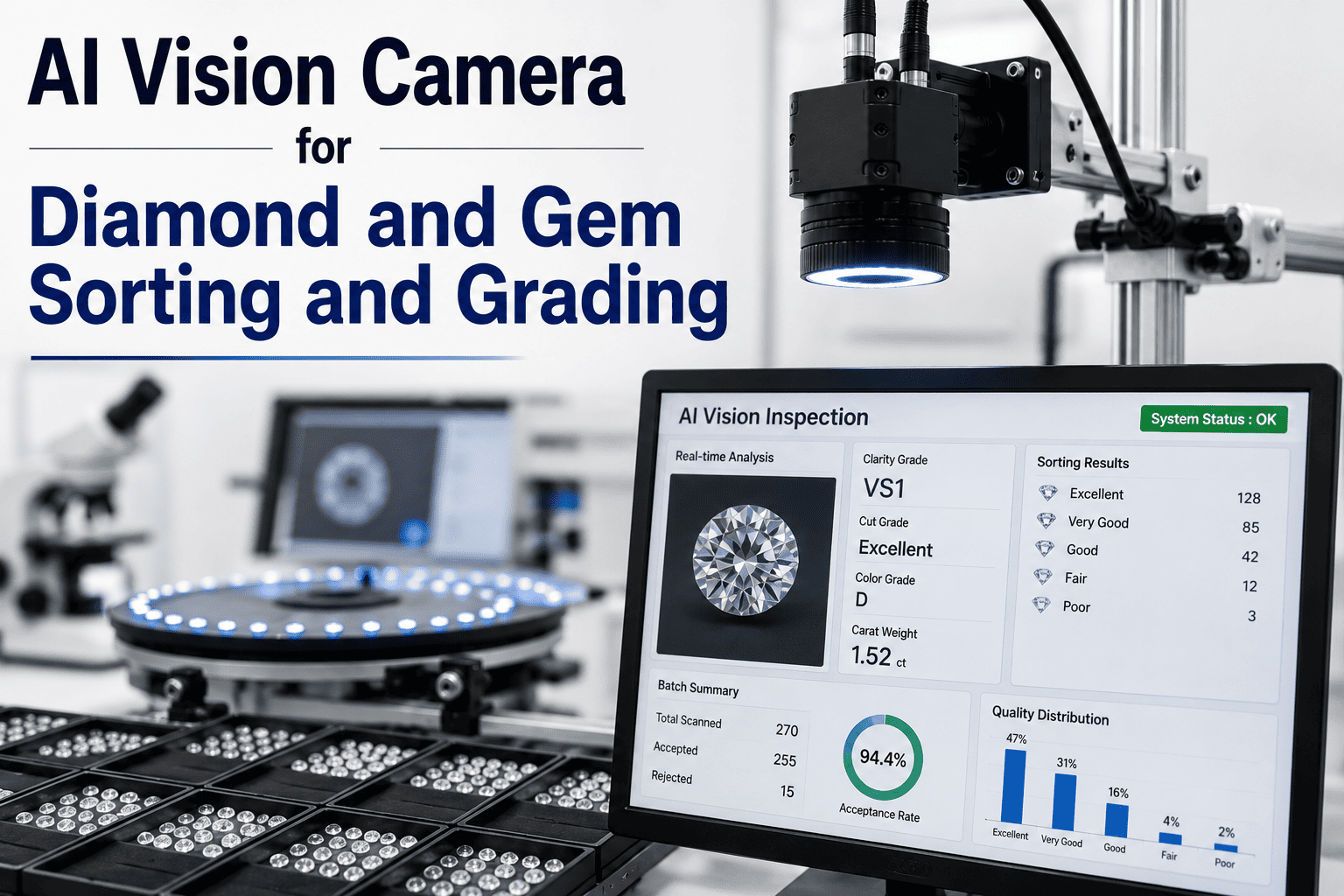
Hand two certified gemologists the same diamond and ask them to grade its clarity, and there's a real chance you get two different answers — not because either grader is wrong, but because reading the size, position, and visibility of a microscopic inclusion has always involved a degree of human judgment. Color grading carries the same risk: it shifts with lighting conditions, viewing angle, and how tired the grader's eyes are by the fiftieth stone of the day. The four Cs — cut, color, clarity, and carat — have been the industry's grading language since GIA formalized it in the 1940s, but applying that language consistently, stone after stone, is where traditional grading has always strained. Book a demo to see AI vision grade your own stones against the 4Cs.
AI Vision Camera · Diamond & Gem Sorting
The Same Stone Shouldn't Get a Different Grade Depending on Who's Looking
AI vision classifies cut, color, clarity, and carat weight using high-resolution multi-angle imaging — bringing the consistency of measurement to a grading process that has relied on expert human judgment for a century.
4Cs
Cut, color, clarity, and carat scored on every stone
Multi-angle
High-resolution imaging captures every facet and inclusion
Consistent
Same measurement standard applied to stone one and stone ten thousand
Why the Same Stone Can Get Two Different Grades
Diamond grading criteria are well documented, but applying them by eye, consistently, at volume, is a different problem than defining them on paper.
Clarity Is the Industry's Known Gray Area
Reading inclusion type, size, position, and visual impact involves interpretation. Two experienced graders examining the same stone can reasonably land on adjacent grades — a variance that compounds at scale.
Color Grading Shifts With Conditions
Lighting, viewing angle, and grader fatigue all influence how a hue reads against a master stone set — variables a camera and a calibrated light source don't have.
Manual Grading Doesn't Scale With Volume
A skilled gemologist can only examine so many stones per day at the level of care grading requires — a hard ceiling on throughput that a growing parcel of rough or polished stones runs into fast.
The Four Cs, Measured Rather Than Estimated
Cut, color, clarity, and carat each require a different kind of visual analysis — and AI vision applies a dedicated measurement approach to each one, on every stone.
C
Cut
Proportions, symmetry, and polish are measured directly from multi-angle imaging — the same automated proportion analysis approach that transformed cut grading from a visual estimate into a computed measurement.
C
Color
Hue, saturation, and tone are analyzed across the entire stone under calibrated lighting and compared against a reference scale, removing the lighting and fatigue variables that affect a human grader's perception.
C
Clarity
Inclusions are detected, classified by type — crystal, feather, cloud, pinpoint — measured for size, and mapped for position, building a consistent basis for a clarity grade rather than a single visual impression.
C
Carat
Precise weight and dimensional measurement confirm carat classification alongside the proportion data already captured during cut analysis, keeping every measurement tied to the same imaging pass.
Where a Stone Lands on the Grading Scale
Color and clarity are both graded on an established industry scale. AI vision places each stone precisely on that scale using measured data rather than a side-by-side visual comparison.
Color Scale — Colorless to Light Yellow
D–FColorless
G–JNear Colorless
K–MFaint Yellow
N–RVery Light
S–ZLight Yellow
Clarity Scale — Flawless to Included
FL–IFFlawless
VVS1–VVS2Very Very Slight
VS1–VS2Very Slight
SI1–SI2Slight
I1–I3Included
What's Actually Capturing the Data
Imaging
Capture methodHigh-resolution multi-angle imaging
Depth mapping3D surface and inclusion mapping
LightingCalibrated, consistent across every stone
Analysis
Color modelReference-scale hue comparison
Clarity modelInclusion detection and classification
Cut modelAutomated proportion and symmetry scoring
Output
Grade report4Cs score with confidence value
TraceabilityFull image record tied to stone ID
Sorting integrationGrade feeds directly into sort bins
Manual Grading vs. AI Vision Grading
See AI Vision Grade a Parcel of Your Own Stones
Bring a sample parcel to a walkthrough and see the imaging pipeline score cut, color, clarity, and carat live, with the full inclusion map and confidence data behind every grade.
How a Stone Moves Through the Grading Pipeline
1
Stone Placement & Capture
The stone is positioned under calibrated lighting and imaged from multiple angles to capture facets, proportions, and internal characteristics in a single pass.
2
Model Analysis
Dedicated models score cut proportions, compare color against the reference scale, and map clarity characteristics from the captured imagery.
3
Grade Report Generated
A 4Cs score is produced with a confidence value for each attribute, alongside the full image and measurement record for the stone.
4
Automated Sort or Expert Review
High-confidence grades route directly to sort bins by grade tier; borderline stones are flagged for expert gemologist review rather than an automatic call.
Frequently Asked Questions
Grade Every Stone Against the Same Standard
Bring your grading process the consistency of measurement, without losing the expert review that ambiguous stones still deserve.
Cut
Color
Clarity
Carat