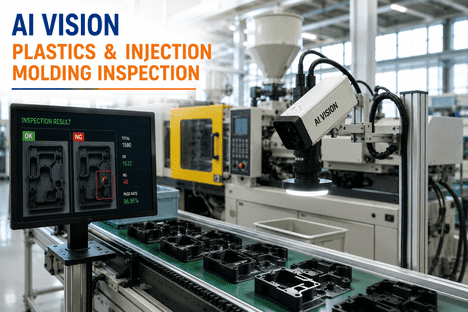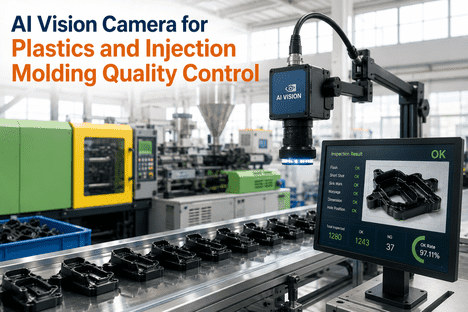
Injection molding runs on cycle times measured in seconds, which means a single press can eject thousands of parts per shift — far more than any end-of-line inspector can examine one at a time. The defects that reach assembly lines and customers are rarely catastrophic; they are the subtle ones that slip past sampling-based visual checks: a sink mark hidden under factory lighting, a hairline flash along a parting line, a short shot in one cavity of a sixteen-cavity mold that sampled parts from other cavities never reveal, or a color shift that drifts across a run before anyone notices. Global losses from injection molding defects exceed $20 billion annually, and traditional manual inspection misses up to 30% of micro-defects — a gap that compounds quickly through scrap, rework, and downstream assembly failures traced back to a defect that was present from the first shot of a bad run. iFactory's AI Vision Camera platform is purpose-built for plastics and injection molding lines — inspecting every shot for flash, short shots, sink marks, warpage, burn marks, and color variation at the press, with per-cavity traceability and automated reject actuation that prevents defective parts from reaching downstream assembly. Quality engineers and process managers evaluating inline AI inspection can Book a Demo to see how the platform performs on their specific mold tooling and part geometry.
Stop Defects at the Press — Before They Reach Downstream Assembly
iFactory AI Vision Camera inspects every injection molded shot for flash, short shots, sink marks, warpage, and color variation — with per-cavity traceability and automated reject actuation built for high-volume plastics lines.
Why Sampling-Based Inspection Cannot Protect Plastics Quality — and What AI Vision Changes at the Press
A technical guide to inline AI vision inspection for injection molding lines — covering defect class detection, per-cavity traceability, multi-cavity mold monitoring, and how iFactory's platform prevents defective parts from reaching downstream assembly at any production volume. Book a Demo to see iFactory in action on your specific mold tooling and part program.
Six Injection Molding Defect Types iFactory AI Vision Camera Catches at the Press
Injection molding defects fall across a well-documented set of failure modes, each with distinct visual signatures and distinct downstream risk profiles. iFactory's AI Vision Camera detection models are trained specifically on these plastics defect classes — not on generic surface anomaly data — ensuring accurate classification at production speed across a wide range of part geometries, materials, and surface finishes. Process engineers can Book a Demo to evaluate detection performance on their specific part profile and historical defect modes.
Short Shots
Incomplete cavity fill due to insufficient material reaching one or more cavities — producing parts with missing sections, thin walls, or incomplete features. Particularly destructive in multi-cavity tooling where one underperforming cavity can contaminate an entire shot. AI Vision detects incomplete fill geometry against trained part profiles on every cycle.
Flash
Excess material that escapes through parting lines, vent locations, or ejector pin interfaces — creating thin fins of plastic that cause assembly interference, injury risk, and cosmetic rejection. Flash develops progressively as tooling wears and can be present at sub-millimeter thickness before becoming visible under standard lighting. AI Vision detects hairline flash at parting lines that manual inspection misses at production speed.
Sink Marks
Surface depressions that form when thick wall sections cool unevenly and the skin contracts inward — producing subtle topographical depressions that are difficult to detect under factory lighting. Sink marks are a primary cosmetic rejection cause in consumer electronics, automotive interior, and medical device molding. AI Vision uses specialized dome and structured lighting to detect sink depth deviations as small as 0.1mm.
Warpage & Dimensional Distortion
Dimensional distortion caused by differential shrinkage rates during cooling — particularly in glass-filled resins, thin-walled parts, and multi-gate designs. Warped parts create assembly failures that are not detected until the part reaches the assembly station, multiplying the cost of a defect that was present at ejection. AI Vision analyzes part silhouette and critical feature geometry to flag dimensional deviations before the part leaves the press area.
Color Variation & Discoloration
Color shifts, streaking, and discoloration from resin degradation, contamination, colorant inconsistency, or processing temperature variation. Color defects compound across long runs and are particularly consequential in consumer-visible parts where color matching to design specifications is a contractual requirement. AI Vision monitors color consistency shot-by-shot and flags deviation before a full batch drifts out of specification.
Burn Marks & Surface Contamination
Discolored surface areas caused by trapped gas burning at venting locations, degraded resin, or excessive mold temperature. Surface contamination from lubricant migration, mold release agent residue, and foreign material introduces cosmetic and functional failure. AI Vision detects burn discoloration signatures and surface contamination patterns that standard end-of-line sampling misses on high-volume commodity parts.
AI Vision vs. Sampling Inspection: Plastics Quality Control Benchmark
Replacing sampled manual inspection with 100% inline AI vision produces measurable improvements across every quality metric that plastics manufacturers track — from scrap rate and downstream assembly rejects to inspection labor cost and audit traceability.
| Quality Metric | Sampling-Based Manual Inspection | iFactory AI Vision Inline | Impact |
|---|---|---|---|
| Inspection Coverage | 5–15% of output sampled per shift | 100% of parts inspected at press speed | Complete defect exposure |
| Micro-Defect Detection Rate | ~70% (30% missed per NIST data) | 95%+ accuracy across trained defect classes | Near-zero escape rate |
| Response Time to Defect | 50+ minutes (sampled detection lag) | Under 5 minutes (inline real-time flag) | ~90% faster response |
| Per-Cavity Traceability | None — cavity source not linked to inspection records | Every part linked to cavity, shot, timestamp, and batch | Full digital audit trail |
| Scrap Rate | 8–12% industry average | Reductions of 30–40% documented in production deployments | Significant yield improvement |
| Downstream Assembly Rejects | Defective parts reach assembly — high cost of discovery | Automated reject actuation at press — defects blocked at source | Eliminated downstream escape |
Per-Cavity AI Inspection: The Coverage Gap That Sampling Cannot Close
Multi-cavity molds are the productivity engine of high-volume injection molding — but they introduce a quality risk that sampled inspection is structurally unable to address. When a sixteen-cavity tool has one underperforming cavity producing short shots or flash, sampling from other cavities will not catch it. The defective cavity continues producing through an entire shift, and the defective parts scatter throughout a mixed batch where they are indistinguishable from conforming output. iFactory's AI Vision Camera solves this with per-cavity inspection — assigning every part to its source cavity and building cavity-specific defect records that identify underperforming tooling before it produces an entire batch of mixed-quality output. Quality managers gain a live view of which cavities are producing within specification and which are drifting toward defect modes, enabling targeted mold maintenance decisions based on real production data rather than periodic tooling audits.
100% Inline Inspection at Press Speed
iFactory AI Vision Camera captures images of every ejected part immediately after demolding — at cycle times measured in seconds — without slowing or interrupting the production cycle. Every part from every cavity is inspected on every shot, eliminating the sampling gaps where subtle defect modes accumulate undetected across full production runs.
AI Defect Classification by Type and Severity
Deep learning models classify detected anomalies by defect type — distinguishing flash from sink marks, warpage from dimensional deviation, burn discoloration from color shift — and by severity level, enabling quality teams to make risk-based disposition decisions rather than binary pass/fail on ambiguous results.
Automated Reject Actuation at the Press
Defective parts are rejected automatically at the point of detection — before entering the conveyor, bin, or downstream transfer that mixes them with conforming output. Reject actuation eliminates manual sorter stations and the human error that allows defective parts to pass during high-volume or fatigue-prone inspection shifts, and prevents costly sorting operations downstream.
Per-Cavity Digital Traceability Record
Every inspected part generates a digital record linked to its source cavity, shot number, production timestamp, material batch, and defect classification result — creating the traceability data that quality audits, customer complaints, and corrective action investigations require. Cavity-level defect trend data feeds directly into mold maintenance scheduling, connecting inspection outcomes to tooling decisions.
See Per-Cavity AI Inspection on Your Mold Tooling
iFactory configures AI Vision Camera detection models for your specific part geometry, defect history, and cavity layout — delivering 100% inline inspection coverage from the first production shift.
Where iFactory AI Vision Camera Delivers the Highest Impact in Plastics Manufacturing
Injection molding supplies components across industries where defect tolerance ranges from extremely tight to zero — and where the downstream cost of a defect reaching assembly or end-use vastly exceeds the cost of the part itself. iFactory's AI Vision Camera is deployed across four primary plastics manufacturing sectors where inline 100% inspection delivers the clearest quality and financial return.
Automotive Plastics
Interior trim, bumper components, connector housings, and fluid system parts require dimensional accuracy and cosmetic consistency that sampled inspection cannot guarantee at volume. A study by the Society of Plastics Engineers found that 45% of defects in automotive plastic parts traced to undetected machine wear — a failure mode that per-cavity AI vision catches in real time before defective parts ship to OEM assembly lines.
Medical Device Components
Syringe bodies, catheter connectors, and device housings operate under zero-defect requirements where post-production sampling cannot guarantee part integrity. Medical device manufacturers using AI inline inspection aim for zero-defect production on critical molded components, with 100% part traceability required for regulatory compliance and field failure investigation.
Consumer Electronics
Enclosures, display bezels, and structural components for electronics carry strict cosmetic and dimensional tolerances where sink marks, color variation, and flash create immediate customer-visible rejection. AI Vision monitors color consistency shot-by-shot and flags cosmetic deviations before they propagate through a full production batch that reaches packaging.
Packaging & Consumer Goods
High-cavitation commodity molding for caps, closures, containers, and consumer product components runs at volumes where small defect rates translate to large absolute numbers of defective units. AI Vision provides the per-cavity monitoring that ensures consistent output across every cavity in high-cavitation tooling without the throughput penalty of manual inspection at high production volumes.
Frequently Asked Questions
Q: Can iFactory AI Vision Camera detect defects at typical injection molding cycle times?
Yes — iFactory's AI Vision Camera captures and classifies images within the cycle time of the press, inspecting every ejected part without introducing a bottleneck or requiring the press to slow. The system processes images at the speed required by your specific cycle time, whether that is 8 seconds or 45 seconds, and delivers a pass/fail result before the next shot is ejected.
Q: How does per-cavity inspection work for multi-cavity molds?
iFactory's AI Vision Camera assigns every inspected part to its source cavity using part position tracking as parts exit the mold. Each cavity receives its own defect history record — tracking defect type, frequency, and severity independently — enabling quality teams to identify which specific cavity is producing outside specification and flag it for maintenance without halting the entire tool.
Q: What defect types does the system detect on injection molded plastic parts?
iFactory detects short shots, flash, sink marks, warpage and dimensional distortion, burn marks, surface contamination, color variation, and gate vestige anomalies. Detection models are configured for each specific part number and material — accounting for the acceptable surface variation of that resin and geometry before flagging deviations as genuine defects.
Q: How is iFactory different from a rule-based machine vision system for plastics inspection?
Rule-based systems define defect detection through fixed pixel thresholds and geometric filters — an approach that generates high false rejection rates on the natural surface variation of injection molded plastics, or misses genuine defects when thresholds are loosened to control false rejects. iFactory's deep learning models learn the full distribution of acceptable part appearance from real production data, distinguishing genuine defects from material texture, gloss variation, and gate marks without the binary threshold limitations of rule-based systems.
Q: What ROI timeline do plastics manufacturers typically see with iFactory AI Vision deployment?
Most plastics manufacturers achieve positive ROI within 6–12 months, driven by scrap and rework reduction, elimination of downstream assembly rejects, and inspection labor reallocated away from manual sorting. High-cavitation tooling operations and facilities with documented multi-cavity variation history typically see faster payback, since per-cavity inspection catches defect modes that sampled inspection structurally cannot address.
Q: Does the inspection system generate traceability records for quality audits?
Yes. Every inspected part generates a timestamped digital record including defect classification result, source cavity identification, material batch number, image evidence, and production run context. This traceability data satisfies customer audit requirements, supports PPAP documentation, and enables root cause analysis when field failures or customer complaints require production history investigation.
Deploy 100% Inline AI Inspection Across Your Injection Molding Lines
iFactory AI Vision Camera stops flash, short shots, sink marks, warpage, and color defects at the press — with per-cavity traceability and automated reject actuation that protects every downstream assembly operation from defective plastic parts.