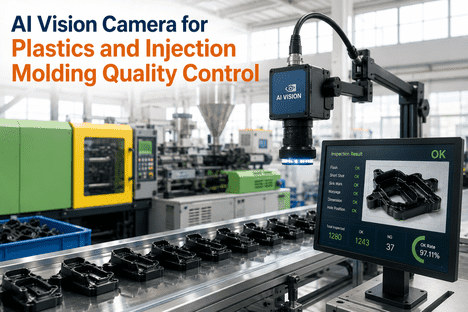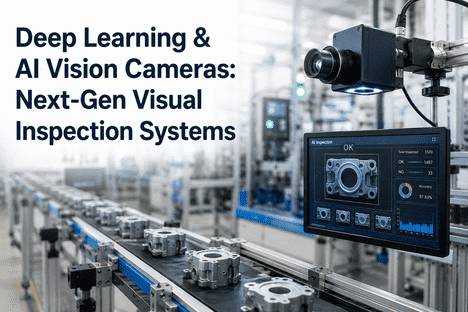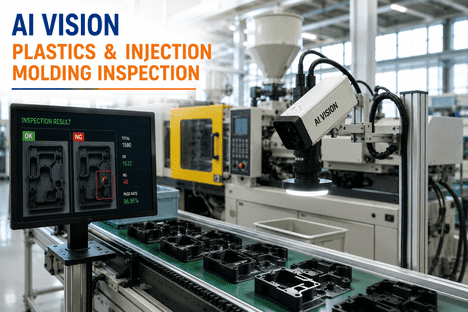
Injection molding runs on cycle times measured in seconds, which means a single press can eject thousands of parts in a shift — far more than any end-of-line inspector can physically examine one at a time. The defects that actually reach assembly lines and customers are rarely catastrophic; they are the subtle ones that slip past sampling-based visual checks: a sink mark hidden under factory lighting, a hairline flash along a parting line, a short shot in one cavity of a sixteen-cavity mold that the sampled parts from other cavities never reveal. Manual inspection programs built around spot-checking a fraction of output cannot close this gap, and the cost compounds quickly through scrap, rework, and downstream assembly failures traced back to a defect that was present from the first shot of a bad run. AI vision cameras purpose-built for plastics manufacturing inspect every molded part as it leaves the mold, catching flash, short shots, sink marks, burns, and contamination at the speed the press actually runs.
What AI Vision Cameras Deliver in Injection Molding Quality Control
AI vision cameras for injection molding use deep learning models trained on mold- and material-specific defect libraries to identify quality deviations directly off the press, rather than relying on the fixed thresholds that older rule-based vision systems require for every new part number or color. Because the models learn from labeled defect imagery instead of hard-coded rules, they adapt to color changeovers, resin substitutions, and new mold tools without manual reprogramming — a meaningful advantage in plastics operations where the same press can run a dozen different part numbers across a production week. For multi-cavity tooling, this means every cavity position is inspected individually rather than averaged across a sampled batch, so a flow imbalance affecting one or two cavities out of sixteen gets caught on the shot it first appears rather than after a pallet of mixed-quality parts has already been boxed. Plastics quality managers ready to see this applied to their own mold tooling can Book a Demo with iFactory's molding inspection specialists.
Why Molded Part Defects Still Reach Assembly and Customers
Plastics manufacturers invest heavily in process control — cavity pressure monitoring, melt temperature regulation, mold maintenance schedules — and defects still escape to assembly and to customers often enough to be a recurring line item in the scrap report. The reason is structural: the inspection step at the end of the process is still built around sampling and human visual judgment, neither of which scales to the volume and speed that modern molding presses actually produce. iFactory's AI vision cameras address each of these structural gaps directly.
Sink marks, light flash, and burn discoloration are often subtle enough that detection depends heavily on lighting angle and inspector attentiveness — conditions that vary part to part on a manual line. AI vision cameras use calibrated, fixed illumination — dome lighting for surface topography, directional lighting for flash and edge defects — applying the same detection sensitivity to the first part of a run and the ten-thousandth.
When a mold runs sixteen, thirty-two, or more cavities, sampling a handful of parts per cycle for visual check cannot represent every cavity's condition. A short shot developing in one cavity or excess flash building on another goes undetected for shots at a time because the sampled parts simply did not come from the affected cavity position.
Many molding cycles complete in well under thirty seconds, ejecting parts faster than a manual inspector can examine each one without becoming the line's bottleneck. The practical result is that most operations inspect a sample and trust process stability for the rest — a trust that fails the moment a mold wears, a hot runner drifts, or a resin lot varies.
Cosmetic acceptance — what counts as an acceptable flow mark versus a rejectable one — is inherently subjective when judged by eye, and that judgment shifts between operators and across a shift as fatigue sets in. AI vision applies the same calibrated acceptance criteria to every part, regardless of who is running the press or what time the shift started.
Five Core Defect Categories iFactory's AI Vision Camera Detects on Molded Parts
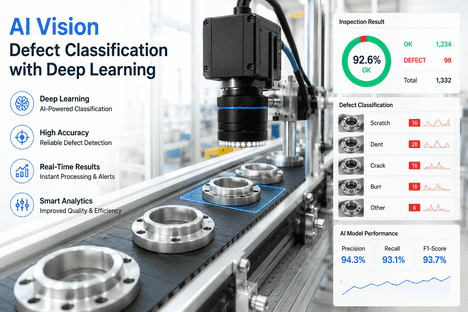
iFactory's Vision Defect Detection module for plastics manufacturing is built around the defect categories that drive the majority of molding scrap and field returns. Each detection model is trained on part- and material-specific imagery and tuned to the cavity layout of your specific tool, so the system reflects how your mold actually runs rather than a generic plastics defect library. Plastics quality teams who want to see these capabilities demonstrated on their own parts can Book a Demo with iFactory's molding validation team, or explore the iFactory AI Vision Camera directly to see the hardware and configuration options built for press-side deployment.
The system detects flash at parting lines, ejector pin locations, and vent positions — excess material escaping the cavity that creates thin fins along part edges. Detection covers both gross flash that fails dimensional checks and fine flash that fails cosmetic acceptance, flagged at the exact location on the part so mold maintenance teams know precisely where wear or clamp tonnage drift is developing.
Every part is compared against a golden template to confirm complete cavity fill, catching incomplete ribs, unfilled creepage features, thin-wall sections, and rounded edges that indicate hesitation marks from material that did not fully pack the cavity. Because inspection runs per cavity, a short shot developing in a single cavity position of a multi-cavity tool is caught immediately rather than averaged out by parts from healthy cavities.
Calibrated dome and directional lighting highlights the subtle topographical depressions that form where thick sections cool and shrink unevenly — defects that are notoriously difficult to see under standard production floor lighting. Sink marks are classified by location, depth estimate, and severity, giving process engineers the data needed to correlate the defect back to packing pressure or cooling time settings.
The system identifies burn marks and discoloration caused by material degradation or localized overheating, along with splay and silvery flow marks caused by moisture or shear in the melt stream. Trend reporting on burn and splay frequency by cavity position and shift helps process teams correlate cosmetic defects back to barrel temperature profiles, screw speed, or material drying conditions before they escalate into a full production hold.
Black specks and foreign particulate introduced by contaminated resin, regrind, or environmental sources are detected against the part's base color and flagged at the exact location on the part surface. For medical device components and food-contact packaging where contamination is a critical-to-quality defect rather than a cosmetic one, every detection event is logged with image evidence for traceability back to the resin lot in use at the time.
AI Vision vs. Manual Inspection: Injection Molding Performance Comparison
The following benchmark compares molding quality inspection programs operating under manual sampling, rule-based machine vision, and fully AI-driven inspection. The performance ranges reflect deployment patterns observed across single-cavity precision molding and high-cavitation commodity molding operations alike.
| Inspection Metric | Manual Visual Inspection | Rule-Based Machine Vision | AI Vision Camera System | AI Advantage |
|---|---|---|---|---|
| Defect Detection Accuracy | 70–85% (fatigue-dependent) | 85–93% (threshold-limited) | 95–99% consistent | 10–15% accuracy gain |
| Inspection Coverage Per Run | Sampled, often 1 cavity checked | Sampled or single fixed station | 100% of shots, every cavity | Full per-cavity coverage |
| Inspection Speed | Limited by inspector capacity | Matched to cycle, fixed thresholds only | Matched to cycle, adaptive models | No throughput impact |
| Multi-Cavity Variation Detection | Rarely caught — sampling blind spot | Limited without per-cavity setup | Per-cavity detection by default | Cavity-level traceability |
| Scrap & Rework Rate | Baseline | 10–20% reduction vs. manual | 30–50% reduction vs. manual | 2–3x greater scrap reduction |
| Changeover Reconfiguration | N/A — visual judgment only | Manual threshold reset per part | Model switch, no manual rework | Faster SKU changeover |
| Root Cause Identification Speed | Post-batch, delayed | End-of-run analysis only | Real-time, per-shot trending | Immediate corrective action |
Deploying AI Vision Cameras on Your Injection Molding Lines: A Phased Approach
Most plastics manufacturers start with a focused pilot on a single high-priority press or mold tool rather than a plant-wide rollout, proving scrap reduction and inspection coverage on real production data before expanding further. The following roadmap reflects the deployment pattern iFactory uses across single-cavity precision tooling and high-cavitation commodity molding lines alike.
Review the dominant defect modes for the priority mold and part number — flash locations, historical short shot positions, sink mark-prone wall sections — and build the initial defect image library from sample parts spanning the normal production range. Map current scrap rate, inspection coverage, and the cavity layout of the target tool to define the camera and lighting configuration for the pilot.
Install the AI Vision Camera press-side, positioned to capture every cavity at ejection, and calibrate detection thresholds against the defect library built in Phase 1. Run the system in shadow mode alongside existing inspection for a defined validation window to confirm detection accuracy and false-reject rate before activating automatic rejection on the line.
Expand deployment to additional presses and mold tools using the validated configuration template, with each new part number onboarded through the same guided defect library workflow. Activate MES integration so scrap classification, cavity-level defect trends, and rejection counts flow automatically into existing production reporting rather than requiring manual data entry.