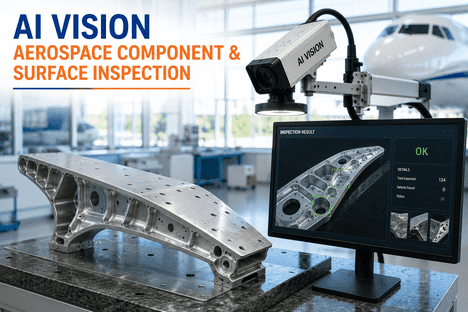
Aerospace component manufacturing operates under a tolerance for defects that no other industry shares: a missed crack on a structural fitting, an undetected delamination indicator on a composite skin panel, or a porosity defect in a critical weld can compromise flight safety and trigger a non-conformance that halts an entire production lot. AS9100 Rev D and NADCAP special process requirements were built around this reality, demanding objective, statistically defensible inspection evidence for every part released to a prime contractor or tiered supplier — evidence that manual visual inspection, however experienced the inspector, cannot generate consistently at production throughput against tolerances measured in thousandths of an inch and defect indicators measured in fractions of a millimeter. AI Vision Camera systems built specifically for aerospace component and surface inspection close that gap, giving machine shops, composite fabricators, and assembly suppliers the detection accuracy and audit-ready documentation their quality systems and customers require.
Why Standard Machine Vision Is Not Built for Aerospace Component Tolerances
Aerospace component inspection is structurally different from general industrial quality control, and that difference defines what an AI Vision Camera system must be capable of detecting and documenting — not just what it claims to detect. A structural fitting machined to a tight positional tolerance, a composite skin panel laid up across dozens of plies, and a welded titanium bracket each carry defect modes — cracks, delamination indicators, porosity, surface finish deviation — that must be caught at a resolution and a documentation standard that general-purpose vision systems were never engineered to meet. This is the environment where AI vision inspection moves from a quality improvement to an operational necessity for maintaining supplier status with prime contractors and defense customers.
Five Critical Inspection Challenges Facing Aerospace Component Manufacturers
The inspection challenges that define aerospace component manufacturing in 2026 are shaped by the same forces driving every tier of the supply chain: tightening prime contractor documentation requirements, growing composite content, skilled inspector scarcity, and persistent cost pressure from offshore machining and layup suppliers. iFactory's AI Vision Camera deployments across aerospace component manufacturers have consistently identified the same five challenge categories as the highest-value targets for AI vision deployment.
AS9100 First-Article & NADCAP Documentation: From Manual Logs to Real-Time Evidence
The most consistent inspection challenge for aerospace machine shops and component fabricators is not detection capability — it is documentation defensibility. AS9100 Rev D Clause 8.5.1.1 requires objective first-article inspection evidence for every new part number and every engineering revision, and NADCAP special process audits require statistical proof that the inspection method applied is capable of detecting the defect types it claims to catch. Paper travelers and spreadsheet-based inspection logs routinely fail this standard during prime contractor and NADCAP audits because they cannot demonstrate consistent inspection execution across operators and shifts. iFactory's AI Vision Camera generates time-stamped, per-unit inspection records automatically, with model validation data that directly satisfies the FAI documentation gap auditors most frequently cite. Book a Demo to see iFactory's AS9100 first-article documentation framework.
Composite Surface Defects: Catching the Visible Precursors to Subsurface Failure
Composite delamination, fiber misalignment, and voids are ultimately confirmed by ultrasonic or thermographic NDT — but the precursor indicators that determine where that follow-up inspection needs to focus are often visible at the surface first: ply wrinkling, resin pooling or starvation, impact witness marks, and foreign object debris trapped during layup. Manual visual inspection of large composite panels at production speed misses a meaningful share of these indicators, particularly on night shifts and at the end of long layup cell runs. iFactory's AI Vision Camera screens every panel surface at full layup cell speed, flagging these precursor indicators and narrowing full-panel NDT scanning to the regions where it actually matters — complementing your existing NDT program rather than replacing it.
High-Mix Production: Dozens of Part Numbers and Revisions on One Line
Aerospace machine shops and structures fabricators are disproportionately high-mix, low-volume — running dozens of part numbers, fixtures, and engineering revision levels through the same inspection cell within a single week. This production pattern creates an AI vision deployment requirement that fixed-configuration vision systems cannot meet: the inspection model must switch between part-specific defect profiles instantly, without requiring an AI engineer at every changeover. iFactory's multi-model library supports up to 20 simultaneously active inspection profiles with work-order-triggered automatic switching, so quality engineers manage changeovers themselves and AI vision coverage extends across the full part mix rather than just the highest-volume runners. Book a Demo to see iFactory's multi-part-number model switching for aerospace machine shops.
Prime Contractor Audit Pressure: Real-Time Quality Data as a Supplier Requirement
Aerospace primes and Tier 1 structures and engine suppliers are increasingly requiring real-time production quality data access, lot-level certificates of conformance with statistical process evidence, and documented proof of inspection method validation as conditions of preferred supplier status. Most suppliers' manual inspection programs cannot assemble this documentation within the contractual response window a prime contractor audit demands. iFactory's inspection records are structured to satisfy AS9100 Rev D and NADCAP documentation requirements simultaneously, giving suppliers a searchable inspection database rather than a filing cabinet to search through when an audit request arrives.
Cost Competitiveness vs. Offshore Machining and Layup Suppliers
Domestic aerospace component manufacturers face persistent price pressure from offshore machining shops and composite layup facilities operating at lower labor cost structures. The competitive response is differentiation through quality performance — but that strategy only works if the quality advantage is measurable and auditable, not simply claimed. AI vision deployment generates the objective data — defect escape rate, inspection coverage percentage, first-pass audit compliance, customer rejection frequency — that quality and program management teams use to justify domestic sourcing decisions over lower-cost offshore alternatives whose quality performance is harder to document at this standard.
AI Vision Camera Applications Across Aerospace Component Manufacturing
The specific inspection applications that deliver the fastest return depend on the component type, the dominant defect modes, and the consequence of a defect escape at that stage of the supply chain. The following application profiles reflect iFactory's deployment experience across aerospace machine shops, composite fabricators, and assembly suppliers.
Dimensional & Surface Finish Verification
Structural fittings, brackets, and housings machined to tight positional and geometric tolerances are inspected for dimensional feature accuracy, surface finish, tool marks, and burrs — generating the per-feature measurement record that AS9100 first-article inspection requires without manual CMM transcription for every characteristic.
Surface Ply Defect & FOD Screening
Composite skin panels and bonded structures are screened at each layup stage for ply wrinkling, resin pooling or starvation, surface porosity, and foreign object debris — catching layup-stage issues before autoclave cure locks them into the part.
Blade Surface Crack & Coating Inspection
Turbine blades and engine components are inspected for surface crack indication, pitting, coating thickness variation, and cooling hole geometry — providing rapid visual pre-screening that prioritizes which components require full fluorescent penetrant or NDT follow-up.
Thread Form & Countersink Verification
Fasteners, inserts, and precision hardware are inspected for thread form, countersink geometry, plating coverage, and correct part identification — defect modes that are difficult for a manual inspector to catch consistently at the volumes hardware suppliers run.
Weld Surface & Porosity Inspection
Welded titanium, aluminum, and exotic alloy assemblies are inspected for surface porosity, incomplete penetration indicators, weld bead geometry, and undercut — flagging structural integrity concerns at the point of fabrication rather than at final assembly.
Coating Coverage & Corrosion Indicator Detection
Primer and topcoat coverage, coating thickness uniformity, and early corrosion indicators are inspected across structural and exterior components — protecting the long-term durability commitments that aerospace coating specifications require.
The iFactory AI Vision Platform: Engineered for Aerospace Quality Requirements
The technical requirements that aerospace component inspection places on a vision system exceed what general manufacturing AI vision platforms are built to handle. The combination of AS9100 and NADCAP documentation depth, ITAR data security obligations, and high-mix production variability defines a performance standard that requires a platform architected specifically for precision aerospace deployment.
iFactory's edge-deployed AI Vision Camera processes every inspection decision on local hardware in 8 to 22 milliseconds, without cloud latency or wireless dependency in the rejection signal path. The platform's AS9100-aligned documentation architecture generates per-unit inspection records with timestamp, model version identification, and statistical performance data that satisfy first-article and special process audit evidence requirements automatically, as a byproduct of production inspection rather than a separate documentation task. For ITAR-restricted and classified programs, fully on-premise deployment configurations keep component imagery on the facility network at all times — no production image is ever transmitted off-site.
| Aerospace Inspection Requirement | Standard Vision System Limitation | iFactory AI Vision Capability | Compliance Benefit |
|---|---|---|---|
| AS9100 First-Article Documentation | Manual dimensional measurement records | Automated FAI documentation generation per Clause 8.5.1.1 | Audit-Ready FAI Records |
| NADCAP Special Process Evidence | Spot-check visual inspection logs | Per-unit records with statistical performance data | Special Process Defensibility |
| Composite Surface Defect Screening | Operator-fatigue-limited panel inspection | Full-panel surface screening at layup cell speed | Targeted NDT Follow-Up |
| Sub-Millimeter Crack Detection | Visual acuity limits at production speed | High-resolution optical inspection at sub-mm resolution | Flight-Critical Defect Coverage |
| High-Mix Part Number Changeover | Manual model reconfiguration per part | Automatic work-order-triggered model switching | Zero Changeover Overhead |
| ITAR / Classified Program Data Security | Cloud-dependent vision platforms | 100% on-premise edge processing, no off-site transmission | ITAR-Compliant Deployment |
AI Vision ROI for Aerospace Component Manufacturers
The financial case for AI vision deployment in aerospace component manufacturing is reinforced by the consequence profile of the parts involved — a defect escape on a flight-critical component carries rework, scrap, and customer non-conformance costs that far exceed equivalent costs in general industrial manufacturing. The following figures reflect the outcome ranges iFactory deployments report across machine shop, composite, and assembly applications.
Frequently Asked Questions: AI Vision Cameras for Aerospace Component Inspection
How does iFactory's AI Vision Camera support AS9100 Rev D first-article inspection documentation?
The platform generates per-unit inspection records with timestamps, model version identification, and statistical performance data that demonstrates inspection method capability — directly addressing AS9100 Rev D Clause 8.5.1.1 first-article inspection evidence requirements. This model validation documentation provides the objective proof auditors look for that the inspection method is capable of detecting the defect types it claims to catch, which is the most commonly cited gap in manual first-article documentation packages.
Can AI vision detect composite delamination, or is that only possible with ultrasonic NDT?
Confirmed subsurface delamination is identified through ultrasonic or thermographic NDT, not optical vision alone. iFactory's AI Vision Camera screens the surface for the visible precursor indicators — ply wrinkling, resin pooling or starvation, impact witness marks, and FOD trapped during layup — that signal where delamination risk is concentrated. This screening runs at full layup cell speed across every panel, narrowing your NDT program's scanning effort to the regions that actually warrant it, rather than replacing your NDT process.
How does the system handle high-mix, multiple part-number production typical of aerospace machine shops?
The multi-SKU model library supports up to 20 simultaneously active inspection profiles per production cell, with work-order-triggered automatic switching that activates the correct defect profile for each part number without requiring an AI engineer at changeover. New part number onboarding uses a guided data collection and validation workflow designed for quality engineers without AI development backgrounds, completing commissioning for a new part in days rather than weeks.
What is the data security approach for ITAR-restricted and classified aerospace programs?
iFactory's edge-deployed architecture processes all inspection images and decisions on local hardware installed at the production facility — component imagery never leaves the facility network during the inspection process. Cloud connectivity, where used, transmits only compressed summary data and alerts to enterprise dashboards, never production imagery. For ITAR-restricted and classified programs, fully on-premise deployment configurations eliminate cloud connectivity entirely, keeping all inspection records within the manufacturer's existing IT and security controls.
What is the typical implementation timeline for an aerospace manufacturer deploying AI vision for the first time?
A single-cell deployment covering the primary inspection points for the highest-priority part family typically reaches validated production operation in 8 to 12 weeks from hardware installation, covering imaging environment assessment, model development and validation for the priority part set, shadow mode validation, and live rejection commissioning. The phased approach — deploying on priority parts first and expanding the part number library progressively — allows quality benefits to begin within the first phase regardless of total part variety.