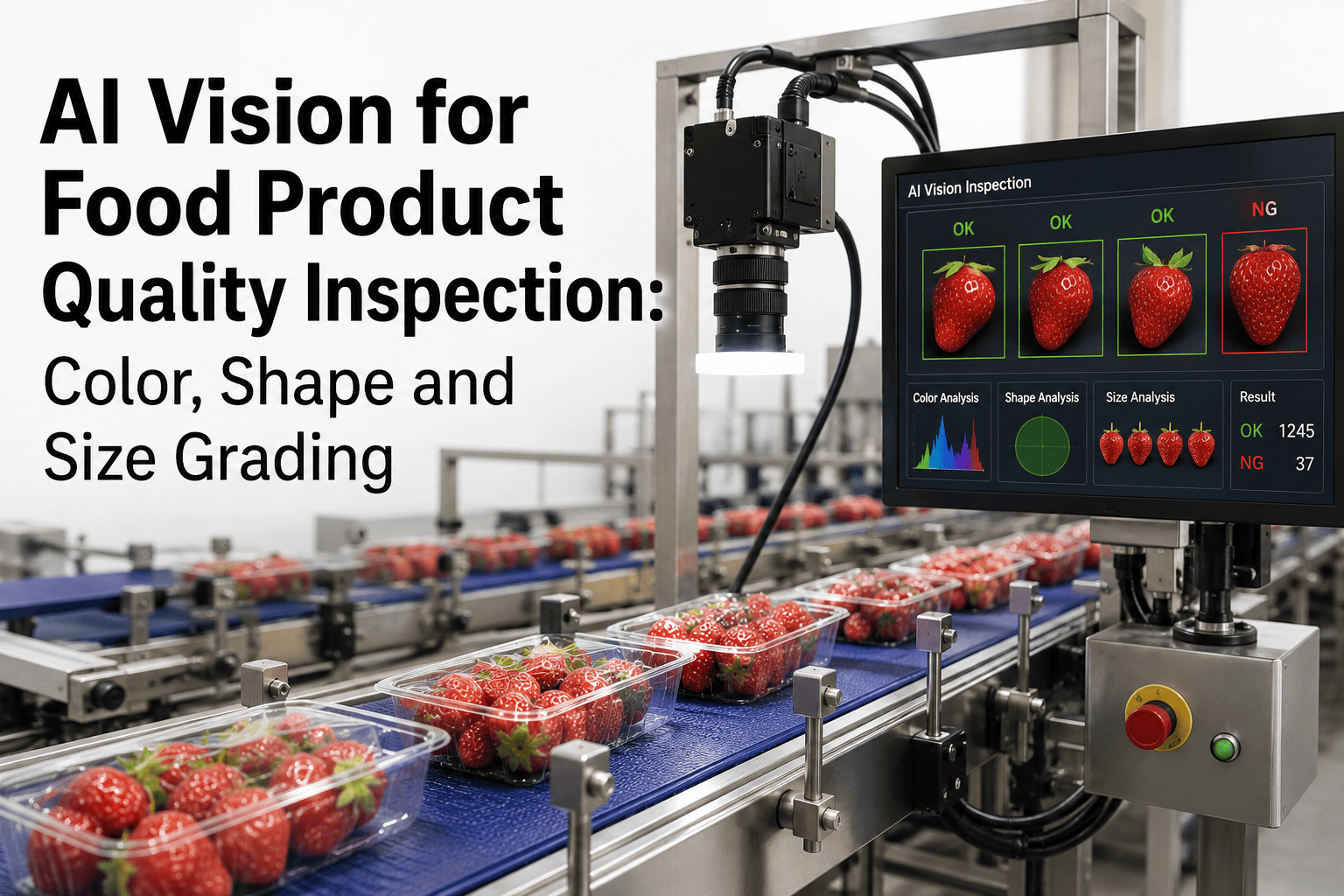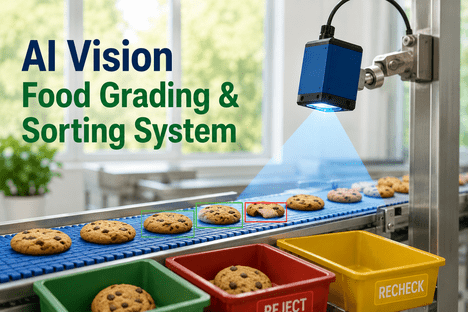
No two apples on a packing line are identical, and neither are any two chicken breasts, bread loaves, or tomatoes coming down a conveyor. Size, color, shape, and surface condition vary unit to unit, and the acceptable range for every one of those attributes shifts by season, supplier, and which retail buyer the pack is destined for. A human grading team manages this variability reasonably well at modest speed, but delta and SCARA robots running at 200 or more cycles per minute need a decision made in milliseconds, consistently, on every single unit, which is a job no manual grading station was ever built to keep pace with. AI vision cameras solve the decision problem, reading size, color, shape, and surface quality against a configurable grade spec and handing the result straight to the robotic arm before the unit reaches the divert point, a workflow our vision integration team now deploys across produce, meat, and bakery lines running at full production speed.
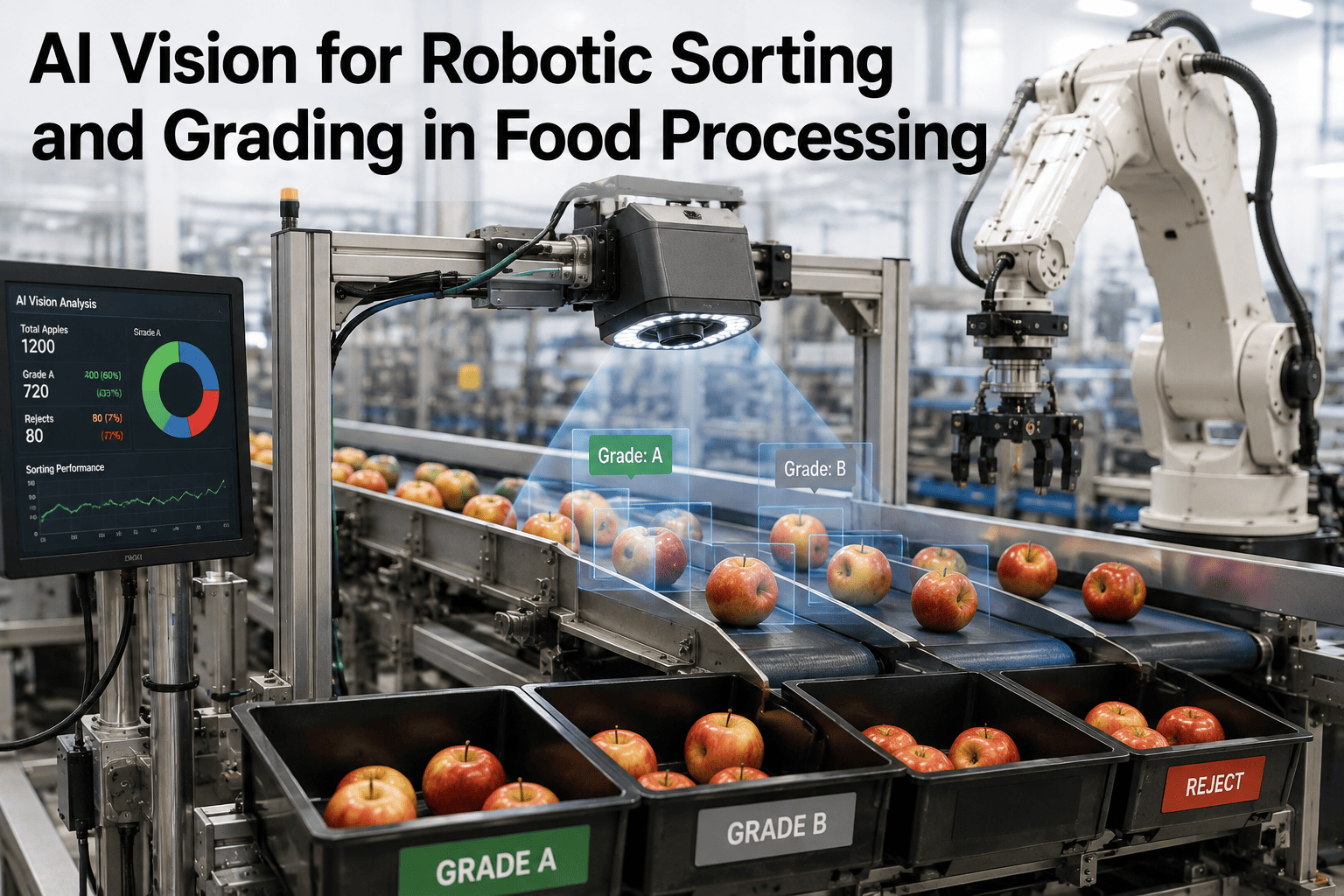
AI Vision for Robotic Sorting and Grading in Food Processing
Cameras classify every item by size, color, shape, and quality grade, then guide delta robots and SCARA arms to sort produce, meat, and bakery items without slowing the line.
The Grading Problem Every Food Line Shares
Grading is not a single yes-or-no inspection, it is a multi-attribute decision made against a specification that varies by SKU and buyer. A retail contract might require apples above a certain diameter with no more than a small percentage of surface blemish, while a processing contract for the same fruit accepts a wider size range and tolerates cosmetic defects a retail buyer would reject outright. Running both specifications through the same line, with human graders switching mental criteria mid-shift depending on which order is running, is where manual grading consistency breaks down fastest, and it is exactly the scenario where a vision system configured with per-SKU grade profiles holds its accuracy steady regardless of how often the spec changes.
The other half of the problem is speed. A human grader working carefully can evaluate a limited number of units per minute before fatigue and pace start trading off against accuracy. Delta robots paired with vision guidance operate in a completely different speed class, with parallel kinematic architectures achieving over 200 cycles per minute on light individual units, three to five times faster than a comparable SCARA robot on the same task. That speed is only useful if the grading decision behind each pick keeps up with it, which is the specific gap AI vision closes.
There is also a consistency dimension that speed alone does not capture. Two graders working the same shift will disagree on borderline cases more often than either one would like to admit, and the same grader will disagree with their own earlier decisions across an eight hour shift as fatigue and attention shift. This inter-grader and intra-grader variability is well documented in food quality research, and it is a genuine cost even when overall throughput looks acceptable, because inconsistent grading means some retail-worthy product gets routed to a lower-value stream while some product that should have been downgraded slips through into a premium pack, creating exactly the kind of customer complaint and buyer relationship risk that a documented, consistent grading standard is meant to prevent.
Size and Dimension
Diameter, length, and weight-correlated size estimated from camera geometry, sorting units into size classes that map directly to packaging formats and retail size specifications.
Color and Ripeness
Color distribution across the visible surface, used both for cosmetic grading and as a practical proxy for ripeness stage in produce, informing shelf-life-based routing decisions.
Shape and Symmetry
Deviation from expected shape profile, catching misshapen units that meet size and color specs but fail cosmetic standards buyers apply at the retail shelf.
Surface Quality
Bruising, blemishes, discoloration, and surface defects specific to the product category, graded against configurable severity thresholds rather than a single pass or fail cutoff.
From Camera to Robotic Pick: How the Cell Actually Works
Detecting a grading issue is only half the engineering problem, removing or routing that specific unit without slowing the line is the harder half, and it is where a lot of vision-only systems fall short. The workflow below is the sequence running inside a working vision-guided sorting cell, from the moment a unit enters the camera's field of view to the moment it lands in the correct destination.
Capture
The camera captures each unit as it moves through the inspection zone, with lighting tuned to expose color and surface detail consistently regardless of product orientation.
Grade
A trained model scores the unit against every configured attribute simultaneously, assigning a grade tier and flagging any defect category present, all within milliseconds of capture.
Locate
The unit's precise position and orientation on the belt is calculated and tracked as it continues moving, so the robot knows exactly where to intercept it at pick time.
Pick
The delta or SCARA arm executes the pick, calculated to intercept the unit at its current belt position, using a food-grade vacuum cup or soft gripper suited to the product's fragility.
Route
The unit is placed into the tray, lane, or bin corresponding to its assigned grade tier, completing the sort without any reduction in line speed for the units around it.
Matching the Robot to the Product
Not every sorting task calls for the same robot architecture, and choosing correctly at the design stage avoids paying for speed you do not need or under-specifying payload you do. The three platforms below cover the large majority of food sorting and grading applications, and the right choice comes down to unit weight, required speed, and the physical footprint available on the line.
Delta Robots
The standard choice for high-speed, light-payload sorting under roughly one kilogram per unit, delta robots achieve the highest cycle rates of any parallel kinematic platform and are the dominant architecture for individual produce, confectionery, and bakery item sorting on fast-moving conveyors.
SCARA Robots
Better suited to side-entry configurations and tighter physical footprints where overhead delta mounting is not practical, SCARA arms trade some top-end speed for flexibility in constrained line layouts and are commonly used for placement tasks alongside sorting.
Articulated Arms
Reserved for heavier payloads, case-level rejection, or full-tray handling rather than individual light units, articulated six-axis arms handle the heavier end of food handling tasks where delta and SCARA payload limits fall short.
See Which Robot and Camera Combination Fits Your Line
Product weight, line speed, and available footprint all shape the right robot and vision configuration. Book a session and iFactory will walk through your specific line and product mix.
Grading Standards Across Produce, Meat, and Bakery
While the underlying vision and robotics workflow is consistent, the specific attributes that define a grade differ meaningfully across product categories, and a serious deployment configures the model differently for each one rather than applying a single generic quality score across an entire facility. The table below outlines how grading criteria shift by category and what typically drives the routing decision in each case.
| Category | Primary Grading Attributes | Typical Grade Tiers | Routing Driver |
|---|---|---|---|
| Produce | Size, color, shape, surface blemish | Retail, processing, juice or waste | Buyer specification and shelf-life stage |
| Meat and Poultry | Weight, marbling, color, defect presence | Premium, standard, further processing | Weight-matched packaging and portion consistency |
| Bakery | Shape symmetry, surface color, structural defects | Retail-ready, seconds, rework or discard | Cosmetic standard for packaged retail presentation |
Handling the Product Variability a Fixed Sorter Cannot
Traditional mechanical sorting equipment, weight-based sizers, color sorters tuned to a narrow reflectance band, or fixed-geometry chutes, works reasonably well for a single attribute on a stable product, but food products rarely present a single, stable attribute in isolation. A tomato that passes a weight-based sizer can still fail a cosmetic standard for shape or surface blemish, and a color sorter calibrated for one variety often misgrades a different variety with a naturally different baseline hue. Stacking multiple single-purpose mechanical sorters in sequence to catch every attribute adds equipment, floor space, and additional handling steps that increase bruising risk on delicate produce with every extra transfer point.
A vision system evaluates every configured attribute from a single image capture, which collapses what used to require several sequential mechanical stages into one inspection point. This matters more than it might first appear for delicate products specifically, since every additional mechanical handling step in a sorting line is another opportunity for bruising or surface damage before the product ever reaches packaging. Reducing the number of physical touchpoints between field or intake and final pack is itself a quality improvement, independent of how much more accurate the grading decision becomes.
Seasonal and Supplier Variation Without Retraining From Scratch
Produce grading in particular has to contend with a moving target that mechanical equipment and rigid rule-based vision systems both struggle with: the same variety looks measurably different depending on growing season, region of origin, and even the specific supplier's harvest practices. A Honeycrisp apple in early season carries a different baseline color distribution than the same variety later in the season, and a rule-based system calibrated once at the start of a season can drift out of tolerance as the crop changes without anyone touching a setting.
Deep learning based grading models handle this differently than the rule-based optical sorters common a decade ago, since they learn the boundary between acceptable and unacceptable from labelled examples rather than a fixed set of hand-coded thresholds. When a new supplier or a new point in the season introduces a shift in the baseline appearance of an otherwise acceptable product, the practical response is adding labelled examples from the new conditions to the training set, a data exercise measured in days, rather than re-engineering the sorting logic from the ground up. Facilities running multiple suppliers or long growing seasons should specifically ask any vision vendor how retraining works in practice, since this is one of the areas where the gap between systems is largest and least visible until the season actually changes.
Manual Grading Versus Vision-Guided Robotic Sorting
The operational difference between a manual grading line and a vision-guided robotic cell shows up across more dimensions than speed alone. The comparison below reflects the pattern reported across documented deployments, and the gap tends to widen further during peak season, exactly when manual grading consistency is under the most pressure from added seasonal staff and extended shift lengths.
Manual Grading
- Throughput capped by grader speed and fatigue
- Grading criteria drift between shifts and graders
- Seasonal staffing swings affect consistency
- No per-unit digital record of the grading decision
- Grade spec changes require retraining staff
- Peak season strains accuracy most when it matters
Vision-Guided Robotic Sorting
- Throughput matched to robot cycle rate, 200+ per minute
- Identical criteria applied to every unit, every shift
- Consistent grading regardless of staffing levels
- Every unit logged with grade, image, and timestamp
- Grade spec changes are a configuration update
- Performance holds steady through peak volume
The Traceability Record Buyers Are Starting to Expect
Beyond the sorting decision itself, every graded unit generates a timestamped digital record, grade tier, attribute scores, defect classification, the captured grading image, line speed, and shift code, stored in a structured quality database. This record answers a question that manual grading has historically struggled to document: exactly why a specific unit received a specific grade, backed by the actual image evaluated rather than a grader's memory of the decision hours or days later.
That traceability increasingly matters commercially, not just operationally. Retail buyers and food safety auditors are asking processors for documented grading evidence more frequently than they were even a few years ago, and a facility that can produce a per-unit grading record on demand is in a stronger position during both routine audits and any dispute over a specific shipment's quality claims. A production quality dashboard built on this data also gives operations visibility into real-time grade distribution and defect type frequency across a shift, turning what used to be a retrospective quality report into a live operating signal.
What the Business Case Looks Like
The financial case for a vision-guided sorting cell rests on several distinct value streams, and the strongest business cases quantify each one separately rather than leaning on a single blended savings figure. Documented deployments combining AI vision with a delta robot sorting arm have reported detection rates above 99 percent, full automated removal of defective units without slowing the line, and a return on investment inside fourteen months, driven by a combination of eliminated rework, reduced liability exposure from misgraded product reaching a buyer, and recovered throughput that manual grading had previously capped.
Recovered throughput deserves particular attention because it is frequently underweighted in a first-pass business case. A manual grading line that caps throughput at the pace of its slowest grader is leaving production capacity on the table every single shift, not just occasionally, and that capped capacity has a real opportunity cost even when nobody is actively tracking it as a line item. When a facility replaces that bottleneck with a robot cell running at two hundred or more cycles per minute, the throughput gain compounds against every shift the line runs, which is often the largest single number in the return calculation once it is actually measured rather than assumed away.
Deployment on an Existing Sorting Line
Most food processing facilities are not building a sorting line from scratch, they are adding vision-guided grading and robotic sorting to a line that already has conveyors, packaging equipment, and existing sorting mechanisms in place. The rollout below reflects the typical sequence for integrating a vision and robot cell without a full line rebuild.
Line and Product Assessment
Engineers evaluate line speed, available footprint for robot mounting, product fragility, and current sorting bottlenecks to determine the right camera placement and robot configuration for the specific product mix on the line.
Grade Specification Configuration
Grading attributes and tier thresholds are configured per SKU based on the facility's existing buyer specifications, with reference imagery captured from real product runs rather than a generic dataset.
Camera and Robot Installation
Cameras, lighting, and the delta or SCARA robot are installed at the inspection and pick point, configured for washdown-ready hygienic operation where the product category requires it.
Parallel Validation and Go-Live
The system runs alongside existing manual or mechanical grading for a validation period, comparing grading decisions directly before full authority is handed to the vision-guided cell.
Frequently Asked Questions
Can the same vision system grade multiple different products on the same line?
Yes, grading criteria are configured per product SKU rather than fixed at the hardware level, so a line running apples in the morning and pears in the afternoon simply loads a different grade specification profile rather than requiring any physical reconfiguration. This is one of the clearest advantages over building fixed mechanical sorting equipment tuned to a single product, since a vision-based grade specification is a software configuration that can be updated as buyer requirements change or as new SKUs are added to the line, without touching the underlying camera or robot hardware. Our integration team typically configures the initial grade profiles directly from a facility's existing buyer specification documents.
How fast can a vision-guided robot actually sort compared to manual grading?
Delta robots paired with vision guidance commonly achieve over two hundred cycles per minute on light individual units, a speed class that is three to five times faster than a comparable SCARA robot on the same task and far beyond what manual grading can sustain at consistent accuracy. The complete cycle from camera detection through robot pick and divert typically completes in under three hundred milliseconds, which is fast enough to intercept units within normal product spacing at full line speed without requiring the conveyor to slow down for the sorting decision to catch up.
Is the camera and robot system safe for food-grade production environments?
Yes, vision and robotic sorting equipment intended for food production is specified with washdown-ready, hygienic-design housings and food-grade end effectors, vacuum cups or soft grippers rated for direct product contact, built to withstand the sanitation cycles food processing environments require. This is a standard specification requirement discussed at the assessment stage of any food sorting deployment, not an afterthought, since the product category and the facility's existing sanitation protocol both directly shape which hardware configuration is appropriate for a given line.
What happens to grading staff once robots take over the physical sorting?
Most facilities redeploy grading staff toward exception handling, quality oversight, and the tasks that still require human judgment, spot audits, unusual product batches, and calibration checks against the vision system's grading decisions, rather than eliminating the roles outright. Grading is also a physically repetitive task with real fatigue-related consistency challenges, and shifting the repetitive sorting decision to a system that holds steady accuracy through an entire shift, while keeping trained staff in a supervisory and quality assurance capacity, is the pattern most processors describe as the more sustainable long-term staffing model.
How long does it take to deploy a vision-guided sorting cell on an existing line?
Timelines vary with line complexity and the number of grade tiers required, but adding a vision and robot cell to an existing sorting line, rather than building a new line from scratch, typically moves from initial assessment to validated go-live within a matter of weeks. Grade specification configuration and the parallel validation period, where the system runs alongside existing grading before taking full authority, are usually the stages that most affect the overall timeline. Reviewing your specific line and product mix with an engineer on a short call gives the most accurate estimate for your facility.
Stop Letting Grading Inconsistency Cap Your Line Speed
Manual grading was never built to hold consistent accuracy at robot-class speeds. iFactory's AI vision cameras grade every unit against your buyer specifications and guide delta and SCARA robots to sort it correctly, without slowing the line down.