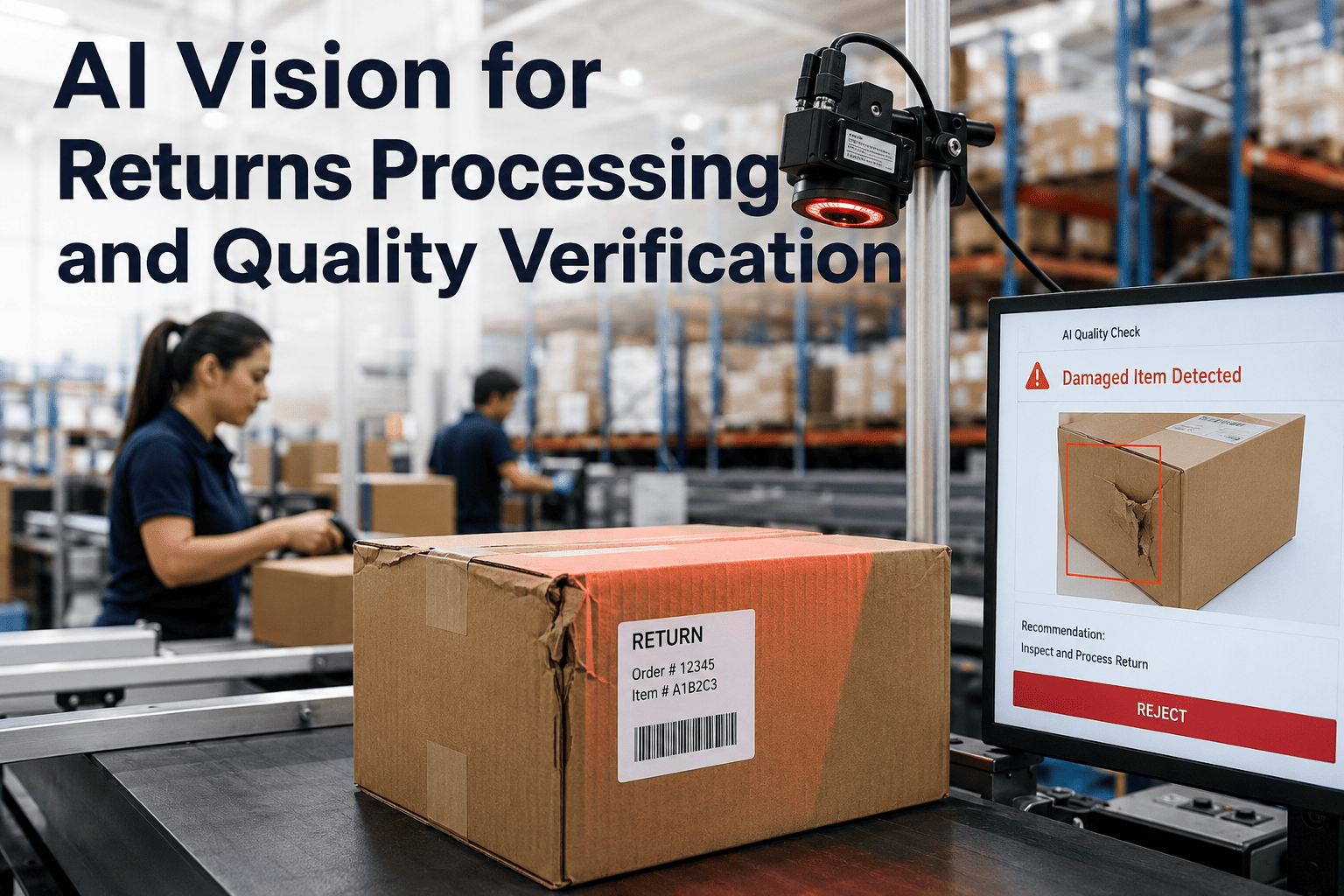
A returned item lands on the receiving bench, and a warehouse worker has seconds to decide: resellable, refurbish, or write off. Multiply that decision by hundreds of returns a day, and it becomes clear why reverse logistics is one of the most expensive, least standardized parts of the fulfillment operation. Industry data puts the all-in cost of processing a single return between $17 and $29 once freight, labor, and inventory depreciation are counted, and manual grading alone can run $10 to $15 per item in labor. Human inspectors working at volume also make inconsistent calls — one worker's "resellable" is another's "refurbish," and that inconsistency quietly erodes margin on every batch. AI vision changes the economics by inspecting every returned item automatically, grading it against a consistent standard, and routing it back to inventory without a manual review queue. Book a Demo to see how iFactory automates return inspection end to end.
Every Return Inspected. Every Grade Consistent. Every Decision Instant.
iFactory's AI vision cameras inspect returned items for damage, completeness, and condition automatically — cutting processing time by up to 60% and putting resellable inventory back on the shelf same-day.
Why Returns Quietly Drain More Margin Than Any Other Warehouse Process
Reverse logistics has become one of the most expensive line items in ecommerce fulfillment without most operators fully pricing it out. Return rates across categories now average close to 20% of online orders, and apparel runs significantly higher, often landing between 30% and 40% depending on the retailer and product mix. Every one of those returns triggers a chain of manual steps — receiving, unpacking, visual inspection, condition grading, a disposition decision, and either restocking or write-off — and every step in that chain currently depends on a person making a judgment call under time pressure. When that judgment call is wrong in either direction, the cost compounds: a damaged item mistakenly restocked becomes a second return and an unhappy customer, while a genuinely resellable item mistakenly written off is pure lost revenue that never shows up as an obvious line item anywhere. The bar comparison below shows how the cost stacks up once every component of a manual return is counted, next to what the same return costs once inspection and grading are automated.
The Returns Bottleneck — From Dock to Disposition
A returned item does not become sellable inventory the moment it arrives at the dock. It has to move through a sequence of manual checkpoints, and in most warehouses, each checkpoint adds queue time because it depends on an available inspector rather than a continuous process. During peak return seasons, items can sit for days between arrival and final disposition simply because the inspection team cannot keep pace with incoming volume, and every day an item sits in that queue is a day it is not generating revenue on the shelf. The funnel below shows the typical stages a return passes through and where the process actually slows down in a manual operation.
Receiving and Unboxing
Item arrives at the returns dock, is matched to its original order record, and is unpacked for inspection — usually the fastest stage in the chain.
Visual Condition Check
An inspector manually examines the item for damage, missing components, and signs of use — the single biggest source of queue time in most returns operations, especially when volume spikes and inspectors are working through a backlog under time pressure.
Grading and Disposition Decision
The item is assigned a condition grade and routed to a disposition path, a step where inconsistent judgment between inspectors creates downstream inventory accuracy problems and makes performance nearly impossible to benchmark across shifts or locations.
Inventory Re-Entry or Write-Off
Approved items are relisted and returned to available inventory, while items graded unsellable are routed to liquidation, refurbishment, or disposal.
What AI Vision Actually Checks on Every Returned Item
AI vision inspection does not just take a photo of the returned item — it runs the image through models trained specifically to recognize the categories of defect and condition that determine a resale decision. Each returned item is scanned from multiple angles the moment it crosses the inspection point, and the system evaluates it against several independent criteria simultaneously rather than a single pass-fail check. This matters because a real disposition decision almost never comes down to one factor — an item might have perfect packaging but a clear sign of use, or intact components but a damaged box that changes its resale category even though the product itself is fine.
Physical Damage Detection
Identifies dents, tears, cracks, scuffs, and structural damage on the product itself, distinguishing cosmetic wear that does not affect resale from damage that affects function or genuinely disqualifies the item from being relisted as new.
Packaging Condition
Evaluates whether original packaging, tags, and seals are intact, since packaging condition alone often determines whether an item can be relisted as new versus open-box, regardless of the condition of the product inside it.
Completeness Verification
Confirms all expected components, accessories, and included parts are present by comparing the returned item against the reference image for that SKU.
Signs of Use
Detects wear patterns, discoloration, and use indicators that separate a genuinely unused return from one that has been worn or tested beyond a simple try-on.
SKU and Variant Match
Verifies the returned item actually matches the size, color, and model recorded on the original order, catching wardrobing and wrong-item returns before restocking.
Contamination and Hygiene Flags
Flags items with stains, odors, or hygiene concerns for categories where resale eligibility depends on strict condition standards, such as apparel and personal care.
From Scan to Shelf — How a Grading Decision Gets Made in Seconds
Once the vision system completes its scan, the item does not sit in a queue waiting for a human disposition call. The grading engine applies your rules automatically and routes the item to the correct path, with a supervisor only pulled in for genuinely ambiguous cases rather than every single return.
No damage, complete packaging, no use indicators detected — automatically re-entered into sellable inventory as new or open-box.
Light cosmetic wear or packaging damage detected — automatically routed to a discounted or refurbished-condition listing.
Significant damage, missing components, or contamination detected — routed automatically to liquidation, repair, or disposal workflows.
Ambiguous condition or a SKU mismatch that needs human judgment — sent to a supervisor queue with full image evidence attached.
What Changes When Grading Moves From a Person to a Vision System
Manual grading is not just slower — it is also inherently inconsistent, because the same item can receive a different grade depending on which inspector handles it, how busy the shift is, and how much attention a given item gets under volume pressure. This inconsistency is one of the least visible costs in reverse logistics, because it does not show up as a single obvious line item — it shows up as a slow drip of misgraded items, secondary returns, and inventory value that never gets fully recovered. The comparison below shows what actually changes once AI vision takes over the inspection and grading step.
| Factor | Manual Inspection | AI Vision Inspection |
|---|---|---|
| Inspection Time per Item | 1–3 minutes, varies by inspector | Under 5 seconds, consistent |
| Grading Consistency | Varies between inspectors and shifts | Same standard applied every time |
| Documentation | Often none beyond a grade code | Timestamped image evidence per item |
| Detection Accuracy | 60–75%, declines with fatigue | 88–97%, stable across shifts |
| Restock Speed | Batched, often next-day or later | Same-day inventory re-entry |
Why Return Grading Standards Change Completely by Product Category
A grading standard that works for one product category can be entirely wrong for another, which is a big part of why manual grading struggles at scale across a mixed catalog. Apparel returns hinge on wear indicators and fit, electronics returns hinge on functional damage and completeness of accessories, and general merchandise often comes down to packaging integrity alone. Training a single inspector to hold all of these standards consistently across hundreds of items a day is genuinely difficult, and it is exactly the kind of task where a vision system trained per category maintains accuracy that a generalist human reviewer cannot match at volume.
Apparel and Footwear
Highest return volume of any category, often 30% or more of orders. Grading hinges on wear marks, odor, tag attachment, and whether an item shows signs of having been worn outside a simple try-on.
Electronics
Lower return volume but higher per-unit value at risk. Grading focuses on functional damage, screen condition, cable and accessory completeness, and whether original seals are intact.
General Merchandise
Packaging condition often determines the entire grading outcome, since the product itself is frequently undamaged but the retail-ready packaging is not intact enough to relist as new.
Rack It, Plug It In, and Every Return Gets Graded Automatically.
iFactory ships as a complete hardware-and-software bundle — a pre-configured NVIDIA AI server arrives racked and ready with the grading models pre-loaded. Connect power and Ethernet, and inspection is live. We handle camera placement at the returns conveyor, WMS integration for automatic inventory re-entry, staff training, and 24×7 remote monitoring, so your returns team manages exceptions, not every single item.
Why Inspection Accuracy Matters More Than Inspection Speed Alone
Speed gets most of the attention in returns automation conversations, but accuracy is what actually protects margin. A fast inspection that misgrades items still costs money — either by sending damaged goods back into sellable inventory and creating a second return from an unhappy customer, or by writing off resellable items that could have generated revenue. Human inspectors operating under volume pressure and fatigue typically achieve accuracy in the 60 to 75 percent range, while vision models trained on category-specific defect data consistently reach 88 to 97 percent depending on the product type and the quality of training data behind the model. That gap compounds fast across thousands of monthly returns, which is why accuracy improvement alone often justifies the investment before processing speed is even factored in. A facility processing 5,000 returns a month at even a 15-point accuracy improvement is correcting hundreds of misgraded items every single month, each one representing either lost resale revenue or a preventable customer complaint that never should have happened.
Live in 6 to 12 Weeks — Not a Year-Long Integration Project
Returns automation projects stall when they are treated as ground-up software builds tied to a full WMS replacement. iFactory's deployment follows a fixed three-phase roadmap so your returns line gets automated inspection fast, without months of downtime.
Grading Rules and Camera Placement
Our team documents your current grading standards for each product category and maps camera placement at the returns conveyor or inspection bench to match your actual line layout, using your existing disposition categories as the baseline for the automated rules.
Weeks 1–3Install, Train Models, and Calibrate
Hardware is racked, vision models are trained on your specific SKU catalog and defect patterns, and staff are trained on the exception-review workflow for flagged items.
Weeks 4–8Go-Live With WMS Integration
Grading goes fully live with automatic inventory re-entry through your WMS, while iFactory's remote monitoring team validates accuracy and tunes thresholds during the first weeks.
Weeks 9–12What Returns and Operations Teams Ask Before Automating Grading
Does AI vision inspection work across different product categories, or is it built for one type of item?
The vision models are trained per product category rather than as a single generic detector, because a damage pattern that matters for apparel — a stain or a pull in fabric — looks completely different from a damage pattern that matters for electronics, such as a cracked casing or a missing cable. During onboarding, iFactory trains detection models against your specific SKU catalog and the defect types that actually affect resale value in each category you carry. This is why accuracy stays high across mixed-category returns operations rather than dropping off outside of a narrow product set. Facilities running apparel, electronics, and general merchandise through the same returns line typically run separate model profiles per category, all managed from the same dashboard. The iFactory Support team can walk through which categories are already well covered by existing training data for your specific catalog.
What happens when the system cannot confidently grade an item?
Not every return is a clean case, and the system is designed to recognize when it is not confident rather than force a grade it cannot support. Ambiguous items — a SKU mismatch, an unusual damage pattern, or a condition that falls between two grading tiers — are automatically routed to a supervisor review queue with the full image evidence attached, so the human reviewer starts with visual context instead of having to unpack and inspect the item from scratch. This keeps the automation focused on the roughly two-thirds to three-quarters of returns that are genuinely straightforward, while preserving human judgment for the cases that actually need it. Over time, the flagged-case rate typically declines as the model is exposed to more of your specific return patterns and edge cases.
How does automated grading integrate with our existing warehouse management system?
iFactory's grading engine pushes disposition decisions directly into your WMS or ERP platform as soon as a grade is assigned, so approved items are automatically re-entered into available inventory without a manual data-entry step. This is one of the biggest time savings in the whole process, because in a manual operation, the gap between an inspector grading an item and that item actually becoming purchasable inventory again is often the largest single source of lost resale window, sometimes stretching to several days during busy periods. Integration is configured during the onboarding phase to match your specific inventory system's field structure and disposition categories, so the routing logic reflects how your business already classifies resellable, refurbished, and write-off inventory rather than forcing your team to adopt a new classification scheme on top of the one they already use.
Will this replace our returns processing staff entirely?
No — AI vision inspection removes the repetitive, high-volume grading decisions from your team's workload, not the team itself. What changes is the nature of the work: instead of manually inspecting and grading every single return under constant time pressure, staff shift toward managing the exception queue, handling flagged items that genuinely need human judgment, and overseeing the physical movement of items through the disposition paths the system assigns. Most facilities find that the same team can handle a significantly higher return volume once the repetitive grading work is automated, which matters most during peak return seasons when volume spikes without a corresponding increase in staffing. This shift also tends to improve retention among returns staff, since the work becomes less repetitive and more focused on judgment calls that actually require a person's attention.
How quickly can we expect to see a return on investment after deployment?
Most facilities see measurable impact within the first full month of operation, driven primarily by two factors — the reduction in manual labor cost per item and the recovery of resale value from items that reach the shelf faster instead of sitting in a grading queue. Because the all-in cost of a manually graded return often runs well above what automated inspection costs per item, the labor savings alone can offset a meaningful share of the platform cost early on, before even accounting for the improved accuracy that prevents damaged items from being restocked or resellable items from being written off. Book a Demo to get a facility-specific ROI estimate based on your current return volume and category mix.
Stop Letting Manual Grading Slow Down Your Returns Line.
Every day a return sits in a manual inspection queue is lost resale value and a slower path back to available inventory. Talk to iFactory about automating inspection and grading across your returns line in as little as six weeks.