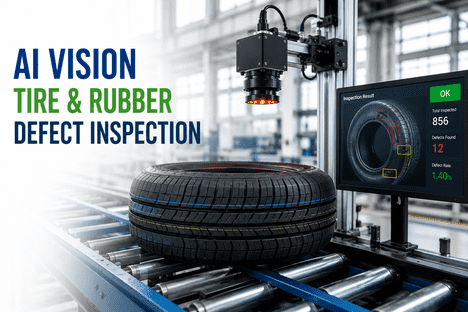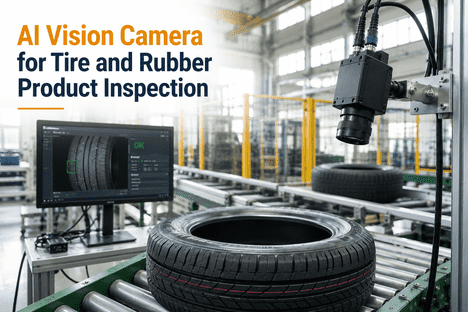
Tires are one of the few manufactured products where a defect invisible to a quick glance can directly cause a road failure, which is why tire quality standards are among the strictest in industrial manufacturing — and why manual visual inspection has never fully solved the problem. A tire's curved sidewall, deep tread grooves, and circumferential surface mean a human inspector standing at one fixed viewing angle simply cannot see the entire surface in the few seconds allotted per unit on a production line. Sidewall bubbles, embedded foreign objects, cord overlap, and fine surface cracks frequently sit in low-contrast regions or in tread zones with intentional design patterns that make distinguishing a defect from a deliberate tread feature genuinely difficult for the human eye working at speed. AI Vision changes this by applying deep learning models trained specifically on tire and rubber defect imagery — models that learn to tell a manufacturing flaw apart from a normal design element across the full curved surface, at every point in the rotation, every time. To see how iFactory's AI Vision Camera performs against your specific tire and rubber product lines, Book a Demo with our inspection engineering team.
Why Tire and Rubber Inspection Is Harder Than Most Surface Quality Problems
Tire manufacturing presents a defect detection problem that is structurally more difficult than flat-surface inspection. A tire's geometry is fully circumferential, meaning every defect-prone surface — sidewall, tread, bead, shoulder — wraps around a curve that no single fixed camera angle can capture in one frame. Tread patterns themselves compound the difficulty: with hundreds of distinct tread designs across a manufacturer's product range, an inspection system has to distinguish an actual defect from an intentional groove, lug, or sipe pattern that varies by every SKU. Many of the most safety-relevant defects — sidewall bubbles from internal layer separation, small embedded foreign objects, fine cord cracking — present low visual contrast against the surrounding rubber surface, which is exactly the kind of subtle anomaly that a tired inspector working a fast-moving line is statistically likely to miss during at least some portion of a shift.
This is also a domain where rubber compounding itself introduces variability that a rigid inspection rule cannot accommodate. Surface texture, sheen, and color shift batch to batch with compound formulation and cure conditions, so a detection threshold calibrated against one production run frequently misfires on the next. AI Vision models trained on labeled tire and rubber defect data learn the underlying pattern of a defect — what a bubble, a foreign object, or a cord crack actually looks like — rather than a brittle pixel rule, which allows detection accuracy to hold steady across the surface curvature, tread design variation, and compound texture differences that defeat older inspection approaches.
The Defect Classes AI Vision Is Trained to Catch on Tires and Rubber Components
How Full-Surface Coverage Solves the Curved Geometry Problem
The single biggest limitation of fixed-angle inspection on a curved, circumferential product like a tire is coverage — a stationary camera simply cannot see the entire sidewall and tread surface from one position. iFactory's AI Vision Camera is deployed in multi-camera and rotational imaging configurations specifically for this geometry: as the tire rotates through the inspection station, the camera system captures the complete surface across the full circumference rather than a single static view, eliminating the blind zones that a fixed-angle setup leaves on the far side of the tread or the lower sidewall curve. This matters because defect location is not predictable — a bubble or foreign object can occur anywhere along the circumference, and a coverage gap is simply a defect that escapes inspection entirely regardless of how accurate the underlying model is.
Lighting configuration is tuned specifically to rubber's surface properties — its matte sheen, dark base color, and tread shadow patterns — which differ substantially from the metallic and painted surfaces most industrial vision systems are originally calibrated for. Structured lighting set to the correct angle and intensity makes the shadow and contour signatures of bubbles, cracks, and dimensional deviations visible to the model in a way that standard ambient lighting does not, particularly on a low-contrast defect against black or dark-compound rubber.
| Inspection Zone | Primary Defects Targeted | Detection Method | Coverage Approach |
|---|---|---|---|
| Sidewall | Bubbles, blisters, surface cracks, rim line cracks | Shadow & contour anomaly classification | 360° rotational imaging |
| Tread Pattern | Foreign objects, incomplete fill, mold defects | SKU-specific pattern model comparison | Multi-angle synchronized capture |
| Bead & Shoulder | Cord overlap, dimensional deviation | High-resolution geometric measurement | Fixed-station rotational scan |
| Internal Cord Structure (surface-visible) | Cord cracking, sparse cord, slender defect lines | Fine texture & grayscale deviation analysis | High-magnification zone capture |
From Defect Detection to Audit-Ready Quality Records
Tire and rubber product quality is governed by some of the strictest safety inspection standards in manufacturing, and that regulatory weight means a detected defect has to come with documentation, not just a reject signal. Every unit inspected by the AI Vision Camera generates a record containing product identification, defect classification, severity, location on the unit, and a timestamped image of the detection event. When a sidewall bubble or embedded foreign object triggers a reject, that image evidence is immediately available to support the quality decision — without a technician needing to recall or recreate what was seen on a unit that has already moved further down the line.
This same record set supports the kind of traceability that tire manufacturers are expected to maintain for safety-critical product lines: a batch-level history connecting raw material lot, cure cycle, and inspection outcome that can be retrieved immediately if a field issue or warranty claim requires investigation. It also surfaces upstream process drift before it becomes a wider quality problem — a rising rate of bubbles on a specific compound batch, for instance, points directly at a curing or mixing variable worth investigating before an entire production run is affected, rather than discovering the pattern only after a stack of rejected units has already accumulated.
Deploying AI Vision on an Active Tire or Rubber Production Line
Tire and rubber manufacturing lines run at high volume with little tolerance for production interruption, so the AI Vision Camera is designed to integrate at existing inspection stations — post-cure, post-trim, or final inspection before packaging — without requiring changes to line speed or conveyor layout. Camera placement and rotational imaging setup are configured around where the product is already accessible and properly positioned in the existing production flow, and the platform connects to existing quality and ERP systems through standard integration methods.
The most effective deployments start narrow: a pilot on a single high-volume SKU or the defect class generating the most rework, run alongside existing manual inspection so model accuracy is validated against real inspector judgment before manual checks are scaled back. This lets a manufacturer confirm detection performance on their own compounds, tread designs, and historical defect patterns before expanding coverage to additional product lines — building trust in the system's calls from its own production data rather than a vendor's general claims.