Nobody plans for a stack to collapse. It happens because a stack that was compliant on Monday drifted out of tolerance by Thursday — a pallet placed two inches past the rack edge, a tier stacked one row higher than the height marking allows, an aisle that narrowed as inventory crept outward during a busy shift. None of these individually looks like a hazard. A supervisor walking the floor might not even notice. But OSHA's core storage rule is unambiguous: materials stored in tiers must be stacked, blocked, interlocked, and limited in height so they stay stable and secure against sliding or collapse, and the industry's collapse incidents overwhelmingly trace back to exactly this kind of gradual, unnoticed drift rather than a single dramatic error. AI vision cameras catch the drift while it's still a marking on the floor tape, not after it's become an insurance claim. iFactory's warehouse safety vision team can map camera coverage to your specific storage zones and compliance rules.
Environmental Safety · Storage Compliance
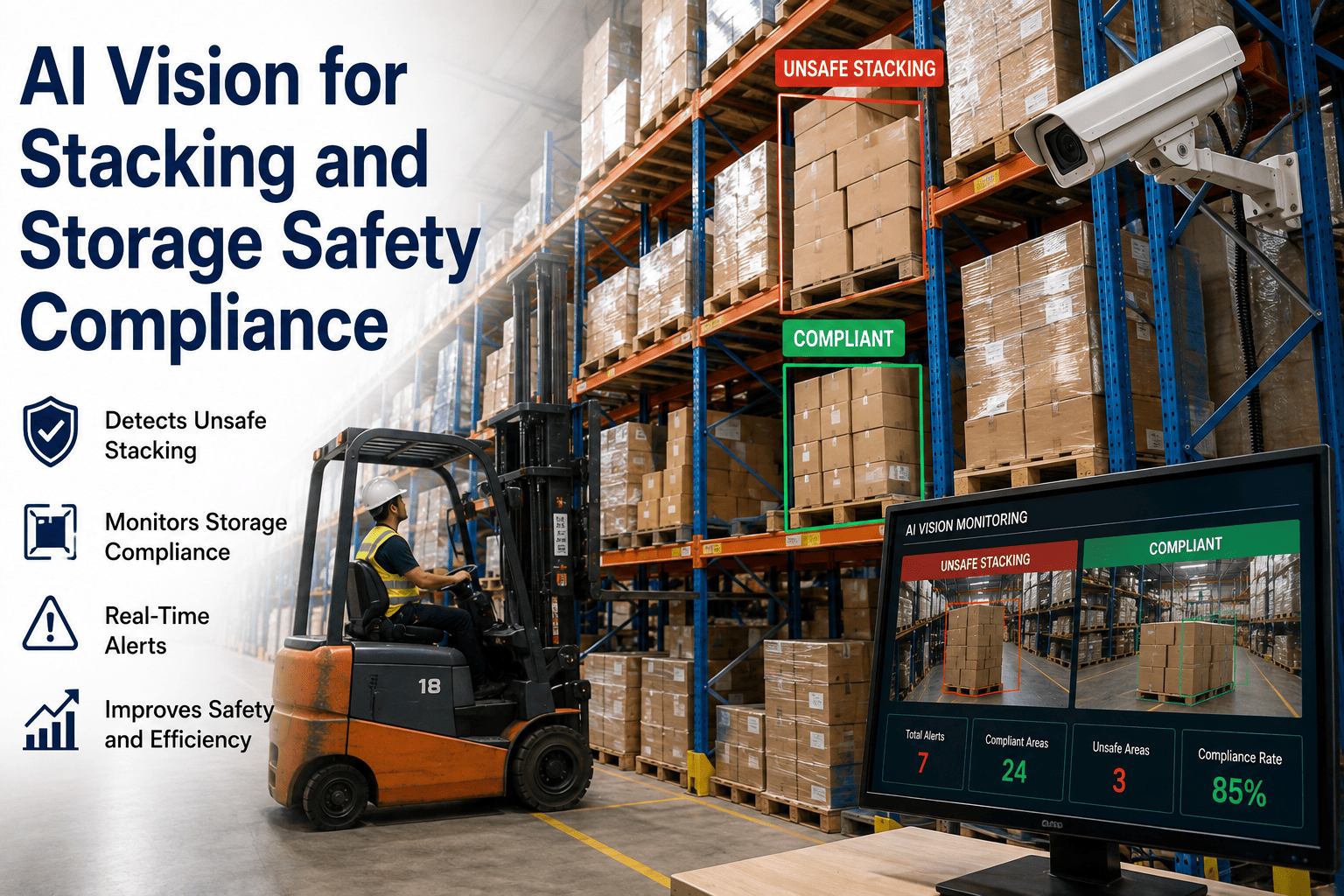
AI Vision for Stacking and Storage Safety Compliance
AI cameras continuously verify stacking heights, aisle widths, storage zone boundaries, and pallet stability against your posted limits and OSHA storage requirements. Drift gets caught the shift it happens — not during the next scheduled walkthrough, and not after a collapse.
The Cost of Getting This Wrong
$36B
Annual U.S. rack collapse cost estimate
30,000+
Pallet-related incidents yearly
$165K
Max OSHA fine per willful violation
$250–500K
Typical single collapse cost
Why Drift Goes Unnoticed
Storage Violations Rarely Look Like Violations Until They Fail
Ninety percent of rack failures trace back to forklift impacts and gradual overload conditions rather than sudden catastrophic causes, and the pattern with stacking, aisle, and zone violations is nearly identical. A pallet stacked one tier too high doesn't announce itself — it looks like efficient use of vertical space until the load-to-depth ratio crosses the point where a bump, a gust from a dock door, or normal settling is enough to bring it down. An aisle that's narrowed by six inches of creeping inventory still lets forklifts through most of the time, right up until a wider load or a tighter turn turns a narrow aisle into a collision.
The regulatory reality compounds the operational one. OSHA's 29 CFR 1910.176(b) requires that materials stored in tiers be stacked, blocked, interlocked, and limited in height so they remain stable — but it doesn't specify a single universal height number, which means every facility has to define, post, and actually enforce its own limits based on load type, pallet condition, and rack rating. A posted limit that nobody is actively verifying is a compliance gap waiting for an inspector or an incident to expose it, and periodic manual walkthroughs — even conscientious ones — sample a facility at one moment in time while conditions keep shifting between checks.
A documented case from a Missouri packaging facility shows how this plays out in practice: more than thirty pallets of glass bottles collapsed, three workers were hospitalized, and the resulting investigation produced eleven violations and over one hundred thousand dollars in proposed fines — the kind of outcome that a continuous monitoring layer, rather than a periodic walkthrough, is specifically built to prevent. What makes cases like this especially frustrating in hindsight is how ordinary the precipitating conditions usually are — nothing about an over-height stack or a narrowed aisle looks dramatic in the moment it forms, which is exactly why it survives long enough to become dangerous.
Compliance Dimensions
The Four Conditions AI Vision Verifies Continuously
Storage safety compliance isn't one measurement — it's a set of related conditions that all have to hold simultaneously for a storage area to actually be safe. A stack can be within its height limit and still be unsafe if it's leaning. An aisle can be technically wide enough and still create a hazard if a zone boundary next to it has been quietly encroached on. The categories below map to the core OSHA storage provisions and the operational rules most facilities layer on top of them, and a mature deployment checks all four together, on every pass, rather than treating them as separate inspection tasks with separate schedules.
01
Stacking Height
Cameras measure stack height against posted limits and sprinkler clearance requirements — OSHA 1910.159(c)(10) requires a minimum 18-inch vertical clearance between stored material and sprinkler heads. Every stack is checked against both the height marking and the fire code clearance simultaneously.
02
Aisle Width and Clearance
Aisle boundaries are verified against minimum clearance requirements for one-way and two-way forklift traffic. Encroachment from creeping inventory, misplaced pallets, or temporary staging gets flagged before it narrows a working aisle into a collision hazard.
03
Storage Zone Boundaries
Designated zones — hazmat segregation areas, pedestrian walkways, fire equipment access, emergency exit paths — are monitored for encroachment. Material stored in a zone it doesn't belong in is one of the most common and most preventable violation types.
04
Pallet and Stack Stability
Leaning stacks, tilted top-tier pallets, and uneven load distribution are detected visually the same way a trained safety officer would spot them on a walkthrough — except continuously, across every monitored aisle, instead of during the one pass a manual check allows for.
See Compliance Monitoring on Your Floor
Watch AI Flag a Height Violation and an Aisle Encroachment in Real Time
iFactory's warehouse safety team walks you through a live demo — stacking height verification, aisle clearance checks, and zone boundary monitoring running against real storage floor footage. Bring your posted limits and rack layout and we'll map the camera coverage together.
How Detection Actually Works
From Camera Feed to Floor-Level Alert
The value of AI vision for storage compliance isn't the camera — it's the sequence that turns a continuous video feed into a specific, actionable alert before a condition becomes a hazard. A raw video stream by itself tells a supervisor nothing they didn't already have access to through the security system; the detection, measurement, and rule-comparison layers on top of that stream are what turn footage into a compliance signal someone can actually act on. The steps below are the standard sequence a mature deployment runs on every monitored zone, continuously, for every frame that matters.
01
Fixed Cameras Cover Storage Zones and Aisles
Cameras positioned at aisle intersections, rack ends, and zone boundaries provide continuous overhead or angled coverage of the areas where height, width, and boundary compliance matter most — the same vantage points a safety walkthrough would target, monitored constantly instead of periodically.
↓
02
Deep Learning Measures Height and Position
Object detection models identify pallets, stacks, and rack structures within the frame, then measure stack height and aisle width against calibrated reference points in the camera's field of view — the rack upright spacing, the floor marking, or a fixed reference distance established during setup.
↓
03
Stability and Lean Analysis
The same detection layer analyzes stack geometry for leaning, tilting, or uneven load distribution — the visual signals that precede a collapse. A top-tier pallet leaning a few degrees more than its neighbors is exactly the kind of early warning sign a fixed camera catches that a periodic walkthrough usually misses.
↓
04
Rule Comparison Against Posted Limits
Every measurement is compared against the specific limits configured for that zone — height limit, sprinkler clearance, minimum aisle width, zone restriction — rather than a generic industry default. Different storage areas can carry different rules, matching how real facilities actually operate.
↓
05
Alert Routing to Supervisors
Violations route immediately to floor supervisors or safety managers with the location, the specific rule violated, and a reference image — turning a condition that might otherwise sit undetected for days into a same-shift correction, before it accumulates into a documented compliance gap or an actual incident.
↓
06
Compliance Log and Audit Trail
Every check and every violation is logged with timestamp, location, and resolution status, building the documented inspection record that OSHA's General Duty Clause references and that demonstrates active due diligence rather than a paper trail assembled after an incident already happened.
Regulatory Reference
The OSHA Provisions Behind Each Compliance Check
Storage safety monitoring isn't a generic camera application — it's built around specific, citable regulatory provisions. The reference below maps common violation types to the rule that governs them and what the vision system is actually checking for.
| Violation Type |
Governing Provision |
What Gets Verified |
| Unstable Tiered Stacking |
29 CFR 1910.176(b) |
Stack blocked, interlocked, secure against sliding |
| Sprinkler Clearance |
29 CFR 1910.159(c)(10) |
18-inch minimum vertical clearance below sprinklers |
| Aisle Obstruction |
General Duty Clause + facility policy |
Minimum clearance for one-way / two-way forklift traffic |
| Excess Bulk Stack Height |
29 CFR 1926.250(h) |
Material-specific height limits (brick, block, lumber) |
| Blocked Emergency Exit |
29 CFR 1910.36 / 1910.37 |
Exit routes clear of stored material |
| Rack Overload / Leaning Stack |
General Duty Clause, ANSI MH16.1 reference |
Load geometry, lean angle, weight distribution |
Configuring the system against your facility's specific posted limits — not a generic default — is what makes the compliance log defensible during an actual OSHA inspection or insurance review.
Turnkey Deployment
Live Compliance Monitoring in 6–12 Weeks
iFactory ships storage safety monitoring as a pre-configured turnkey bundle — pre-racked NVIDIA AI server, cameras matched to your facility layout, software pre-loaded with height, aisle, and zone detection models. Rack it, plug in power and Ethernet, and compliance monitoring is live against your posted limits.
Weeks 1–4
Facility Mapping and Rule Configuration
Storage zones, aisle standards, and height limits documented per area of the facility. Camera placement mapped to aisle intersections, rack ends, and zone boundaries. Turnkey AI server shipped racked and network-ready.
Weeks 5–8
Calibration and Shadow Validation
System calibrated against each zone's specific rule set and run in shadow mode alongside existing safety walkthroughs. Detected violations compared against manual audit findings to validate accuracy before alerts go live.
Weeks 9–12
Go-Live and Supervisor Training
System takes over continuous monitoring with live alert routing to floor supervisors and safety managers. Compliance dashboards and audit-trail reporting go live, and 24×7 remote monitoring by the iFactory support team begins.
1000+Clients on iFactory platform
99.9%Platform uptime SLA
24×7Remote AI monitoring
6–12wkLive deployment timeline
What Facilities Actually Gain
Continuous Monitoring Changes the Compliance Posture, Not Just the Paperwork
The real shift isn't from non-compliant to compliant on paper — it's from a facility that finds out about drift during the next scheduled walkthrough to one that catches it the same shift it happens. Safety managers who have run both models describe the difference less in terms of violation counts and more in terms of what kind of surprise they're dealing with: a flagged aisle encroachment that gets corrected in twenty minutes, versus an incident report that takes weeks to close out and a fine that takes months to resolve. The gap between those two outcomes is almost entirely a function of how quickly drift gets noticed, and that's the specific problem continuous monitoring is built to solve.
Same-Shift Correction
Violations get flagged and routed to supervisors within the shift they occur, instead of surfacing at the next scheduled walkthrough — often days later, after the condition has had time to worsen or an incident has already happened.
Defensible Audit Trail
Continuous, timestamped compliance logs demonstrate active due diligence during an OSHA inspection or insurance review — a materially stronger position than periodic manual checklists that only capture a single moment in time.
Full Coverage, Not Sampling
Every monitored zone is checked continuously rather than sampled during a walkthrough that can only cover a fraction of the facility in the time available, closing the coverage gap where most violations currently go unnoticed.
Reduced Collapse and Injury Risk
Catching height, stability, and clearance drift before it compounds is the direct mechanism for reducing the incident category that OSHA lists among the leading causes of warehouse injury and property loss.
Common Questions
Frequently Asked Questions
Does the system replace our required manual rack and safety inspections?
No — annual qualified inspections under RMI and ANSI MH16.1 standards, along with monthly in-house visual checks, remain a separate compliance requirement that continuous camera monitoring doesn't replace. What the vision system adds is the coverage between those scheduled inspections, catching stacking, aisle, and zone drift as it happens rather than waiting for the next walkthrough to surface it. Facilities typically use both together — scheduled qualified inspections for structural rack integrity, and continuous vision monitoring for the day-to-day operational compliance that changes shift to shift.
Talk to warehouse safety vision about how this fits alongside your existing inspection program.
How does the system know what our specific height and aisle limits are?
Every facility configures its own rule set during deployment — the specific height limits posted for each storage area, the minimum aisle clearances for one-way versus two-way forklift traffic, and the boundaries of restricted zones like hazmat segregation areas or emergency exit paths. The system checks against these facility-specific rules rather than a generic industry default, which is what makes the compliance log meaningful during an actual inspection — it demonstrates that your posted limits are being actively enforced, not just displayed on a wall.
What happens when a violation is detected — does it stop operations automatically?
The system routes an alert to the designated floor supervisor or safety manager with the location, the specific rule violated, and a reference image, so a person makes the call on how to respond — correcting the condition, investigating further, or escalating if warranted. The system doesn't automatically halt operations or equipment, which keeps the response proportionate to the actual severity of each specific violation rather than triggering blanket stoppages for every flagged condition, while still ensuring nothing goes unnoticed until the next scheduled walkthrough.
Can this cover outdoor storage yards as well as indoor racking?
Yes, the same detection principles apply to outdoor storage yards — stacking height, aisle and access clearance, and zone boundary compliance are relevant wherever material is stored in tiers, whether that's indoor pallet racking or outdoor bulk material stacks. Outdoor deployments account for weather-related lighting and visibility variation in the camera and model configuration, and the underlying compliance logic — comparing measured conditions against posted limits — works the same way across both environments.
Book a demo to discuss your specific yard layout and material types.
How does this data get used to demonstrate compliance during an OSHA inspection?
Every check performed and every violation detected is logged with a timestamp, location, and resolution status, building a continuous compliance record rather than a periodic checklist that only captures a single moment. This kind of documented, ongoing monitoring is exactly the sort of active due diligence that OSHA's General Duty Clause references and that strengthens a facility's position during an inspection or an insurance review, since it demonstrates the storage rules were actively enforced day to day rather than posted and forgotten between scheduled walkthroughs.
Catch Drift Before It Becomes a Collapse
Turnkey Storage Compliance Monitoring, Live in 6–12 Weeks
iFactory's storage safety vision platform ships as a pre-configured turnkey bundle — hardware racked and ready, height and aisle detection models pre-loaded, rule configuration scoped to your facility, and 24×7 remote monitoring included. Get a turnkey AI quote with the twelve-week delivery timeline, or start with a focused pilot on your highest-traffic storage zones to prove the coverage before scaling facility-wide.