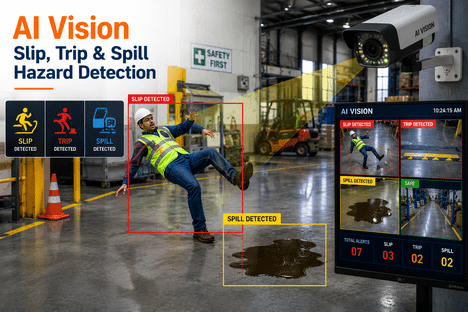
AI vision technology is redefining how organizations identify and respond to slip, trip, and spill hazards before they escalate into injuries, regulatory violations, or costly litigation. Traditional safety monitoring relies on periodic inspections, manual walkthroughs, and incident reporting — all of which are reactive by nature. By the time a hazard is documented, it has already put workers at risk. iFactory's AI vision safety monitoring platform continuously analyzes live camera feeds across facilities to detect floor spills, blocked walkways, obstructed emergency exits, and trip hazards in real time — automatically dispatching cleanup and corrective action orders without waiting for a human to notice the problem. This closed-loop approach to hazard detection reduces incident response time from hours to seconds and creates an auditable safety record that supports compliance documentation across industries from warehousing and logistics to food processing, manufacturing, and healthcare.
Why AI-Powered Hazard Detection Outperforms Manual Safety Inspections
Workplace slip, trip, and fall incidents account for a significant share of recordable injuries across nearly every industry. OSHA data consistently ranks slips, trips, and falls among the top causes of worker injury and fatality, and the associated costs — medical expenses, lost productivity, regulatory fines, and increased insurance premiums — run into billions of dollars annually across the U.S. alone. The fundamental limitation of manual safety programs is their dependence on human presence and human attention. A spill that occurs at 2:00 AM in a distribution center corridor, a wet floor near a loading dock that forms after a refrigeration unit condenses, or a pallet that blocks an emergency exit between shift changes are all hazards that exist in the gap between scheduled inspections. AI vision safety monitoring eliminates this gap by providing continuous, always-on hazard detection across every monitored area of a facility. iFactory's AI vision camera platform uses deep learning models trained specifically on floor hazard classification to distinguish between normal operational conditions and actionable safety risks — reducing false positives that cause alert fatigue while ensuring genuine hazards trigger immediate response workflows. Organizations that deploy AI vision hazard detection reduce mean time to hazard remediation by 70% or more compared to inspection-based programs, and document a corresponding reduction in incident frequency rates within the first operating year.
What iFactory's Vision Safety System Detects
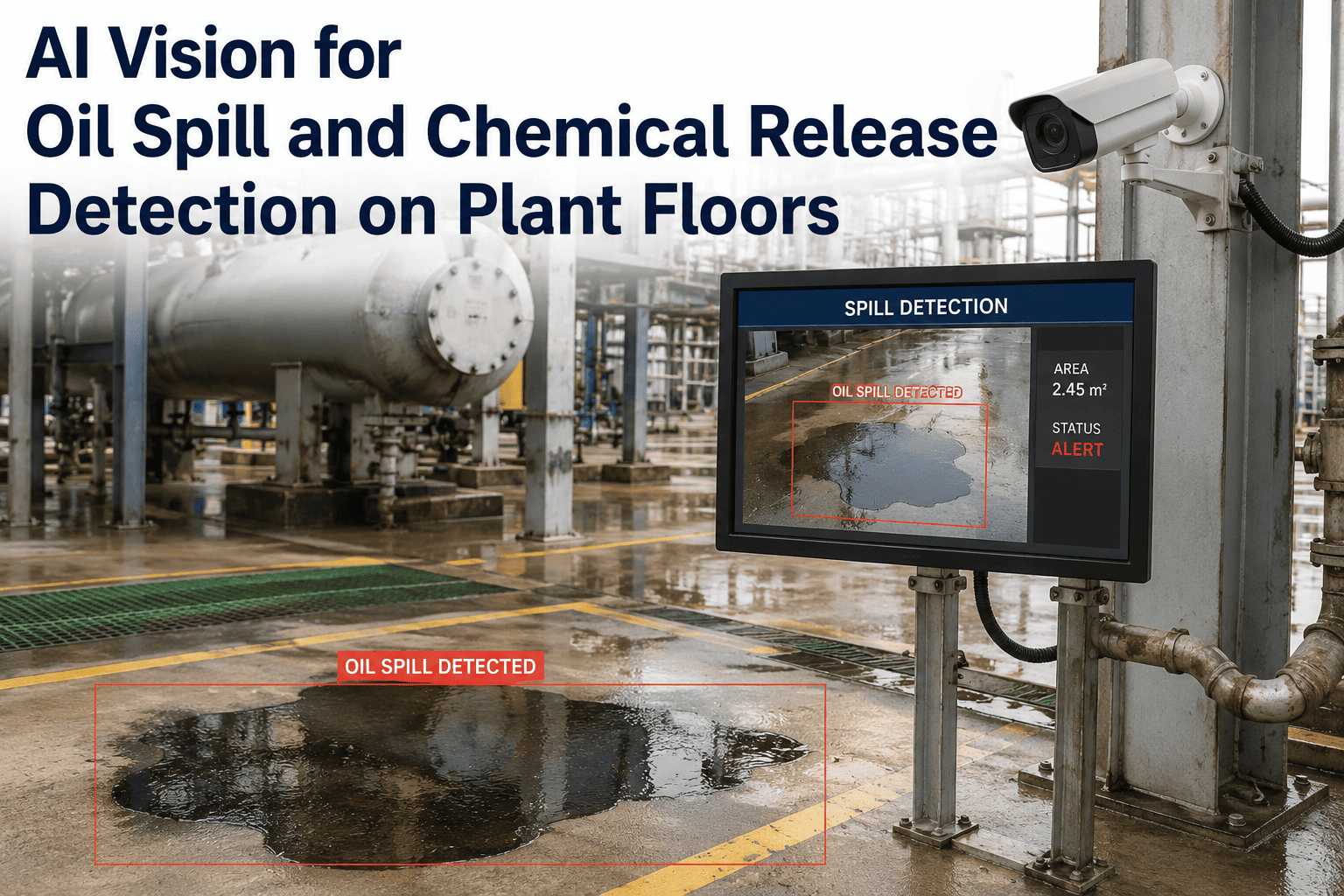
iFactory's AI vision safety monitoring platform is trained to identify the full spectrum of floor-level and walkway hazards that drive slip, trip, and fall incidents. The detection engine continuously processes camera feeds and classifies hazard conditions against a library of trained defect categories, generating alerts and work orders the moment a condition exceeds the configured risk threshold. The platform covers liquid spill detection on hard floors and wet surfaces, including water, oil, and product contamination events common in food processing and light manufacturing environments. It identifies trip hazard objects such as loose cables, misplaced equipment, open floor grates, and debris accumulation in pedestrian walkways and production aisles. Emergency exit and egress route monitoring ensures that required clearances are maintained continuously, flagging blocked exits, propped fire doors, and obstructed aisle markings that create both safety and compliance risks. The system also monitors housekeeping conditions at a facility-wide level, tracking accumulation trends that precede more serious hazard events and enabling predictive cleaning schedules rather than reactive response. Each detection event is time-stamped, geolocated within the facility map, and attached to an automatically generated corrective action record in the connected CMMS or safety management system — creating a complete, defensible audit trail for regulatory inspections and incident investigation. Facilities looking to see this detection capability in action can Book a Demo with iFactory's safety engineering team for a live walkthrough of the detection-to-response workflow.
Core Detection Capabilities at a Glance
The platform's detection capabilities are organized across four primary hazard categories, each with configurable sensitivity thresholds and response workflows tailored to the specific risk profile of the monitored environment.
| Hazard Category | Detection Examples | Typical Environment | Auto-Response Action |
|---|---|---|---|
| Liquid Spill Detection | Water, oil, product overflow, condensation pools | Food processing, warehousing, manufacturing | Cleanup work order dispatch, wet floor alert |
| Trip Hazard Identification | Cables, debris, displaced equipment, open grates | Distribution centers, production floors | Housekeeping alert, hazard isolation notification |
| Blocked Exit & Egress | Pallets, equipment, propped doors, aisle obstruction | Warehousing, retail, healthcare, manufacturing | Immediate safety alert, compliance event log |
| Housekeeping Monitoring | Clutter accumulation, waste buildup, unmarked spills | Cross-industry | Scheduled cleaning trigger, trend reporting |
Detection sensitivity and alert thresholds are configurable per camera zone, allowing facilities to apply higher sensitivity standards in high-traffic pedestrian areas, emergency egress routes, and zones with elevated slip risk due to process conditions. All detection events feed into the integrated safety dashboard for real-time monitoring and post-incident trend analysis.
Automated Hazard Response: From Detection to Corrective Action
The value of AI vision hazard detection is only fully realized when detection events automatically trigger corrective action — not when they generate alerts that wait for a human to notice and act. iFactory's platform is designed around a closed-loop response architecture: when the AI model classifies a hazard condition above the configured confidence threshold, the system immediately initiates the response workflow mapped to that hazard type. For liquid spills, this means a cleanup work order is automatically created in the facility's CMMS or safety management system, with the camera image of the spill, the precise floor location, and the detection timestamp attached to the record. The nearest available maintenance or housekeeping resource receives a mobile notification with the work order details. When the cleanup is completed, the technician closes the work order in the system, and the camera confirms clearance — creating an end-to-end response record without manual documentation at any stage. For blocked emergency exits, the response workflow escalates immediately to the safety supervisor on duty, logs the event as a compliance record, and continues monitoring to confirm the obstruction is removed within the required response window. iFactory's AI vision camera platform integrates with CMMS platforms, EHS management systems, and facility communication tools through OPC-UA and REST API connections — enabling organizations to route hazard response through the operational workflows already in place rather than building parallel safety notification systems.
Deployment Across Industries and Environments
Slip, trip, and spill hazards are not confined to a single industry — they exist wherever people move through facilities, wherever liquids are handled, and wherever materials are stored and moved. iFactory's AI vision safety monitoring platform is deployed across a wide range of operational environments, with detection models and response configurations adapted to the specific hazard profile of each setting. In food and beverage processing, liquid spill detection is the primary use case, with the AI model trained to identify water, oil, and product contamination against wet process floors where background moisture is normal — distinguishing actionable spills from expected surface conditions. In warehousing and distribution, trip hazard and blocked exit detection is the priority, with the system monitoring high-traffic pedestrian aisles, dock areas, and emergency egress routes across large floor areas where manual inspection coverage is impractical. In healthcare facilities, the platform monitors patient corridors, clinical areas, and staff-only zones for liquid spills and floor obstructions that create fall risk for both patients and staff — a regulatory and liability priority in acute care environments. In electronics and semiconductor manufacturing, housekeeping monitoring supports cleanroom compliance and ESD floor condition standards in addition to general safety hazard detection. Organizations in any of these environments that want to evaluate the platform against their specific hazard profile can Book a Demo with iFactory's team to review camera placement, detection configuration, and integration options for their facility.
Measuring the Impact of AI Vision Safety Monitoring
The business case for AI vision hazard detection is supported by measurable improvements in safety performance metrics, compliance posture, and operational efficiency. Organizations that deploy iFactory's vision safety monitoring platform track outcomes across four key performance dimensions.
Organizations that connect AI vision hazard detection directly to their corrective action and CMMS workflows achieve materially better safety outcomes than those using detection-only systems that still require manual dispatch. When a spill is detected, classified, and a cleanup work order is generated and acknowledged within two minutes — without any human in the loop except the technician who performs the cleanup — the window of injury exposure is reduced by an order of magnitude compared to periodic inspection programs. iFactory's AI vision camera platform is built for this closed-loop architecture, with native integrations to the CMMS, EHS, and facility management platforms that maintenance and safety teams already operate. The result is a safety program that is faster, more consistent, and more auditable than any manual alternative — and one that improves continuously as the AI models learn from facility-specific conditions over time. Safety managers and operations leaders who want to see the full detection-to-response workflow demonstrated in a live environment can Book a Demo with iFactory's engineering team.
Frequently Asked Questions About AI Vision Hazard Detection
iFactory's deep learning models are trained on environment-specific baseline conditions during the initial deployment calibration period. In wet process environments such as food processing, the model learns the normal appearance of the floor surface under operating conditions and classifies deviations — pooling liquid, spreading contamination, or surface reflectivity changes that indicate a spill — against that baseline rather than against a generic spill template. This environment-specific training significantly reduces false positives in challenging floor conditions while maintaining sensitivity to genuine hazard events. Detection thresholds are also configurable per camera zone, so areas with known moisture variability can be tuned to require stronger signal confidence before triggering a corrective action dispatch.
Yes. iFactory's platform includes dedicated egress monitoring capability that tracks emergency exit doors, required clearance zones, and marked aisle paths against defined compliance boundaries. When an obstruction — a pallet, equipment, or other object — is placed within the clearance perimeter of an emergency exit or blocks a marked egress route, the system immediately generates a compliance alert and logs the event with a timestamped image. The event record is retained in the safety management system database and is accessible for regulatory inspections, internal audits, and incident investigation. Response time tracking is also built in: the system logs when the obstruction is detected and when it is cleared, providing documentation of corrective action timeliness that supports OSHA and fire code compliance reporting.
iFactory's platform integrates with CMMS platforms, EHS management systems, and facility communication tools through OPC-UA and REST API connections. Common integration targets include Maximo, SAP PM, eMaint, Fiix, and similar maintenance management systems for corrective action work order generation, as well as EHS platforms for compliance event recording. For facilities without a formal CMMS, iFactory's own work order module can receive and track hazard response tasks directly within the platform. Mobile notification delivery to maintenance and housekeeping staff is supported through SMS, email, and in-app notification channels. Integration configuration is handled during deployment and does not require ongoing IT involvement for day-to-day operation.
Deployment timelines depend on the number of camera zones, integration complexity, and the extent of environment-specific model calibration required. For facilities with existing IP camera infrastructure, iFactory's edge AI processing units can be connected to existing cameras without full camera replacement, and the software deployment and initial model calibration can be completed within two to four weeks. For greenfield camera installations, the timeline extends to four to eight weeks including camera placement planning, cabling, and edge device installation. Full model calibration — the period during which the AI learns the normal baseline conditions of each monitored zone — typically requires two to four weeks of live observation before detection thresholds are locked for production use. iFactory's engineering team manages the full deployment process and provides on-site support during commissioning.
iFactory's platform generates an automated, time-stamped audit trail for every hazard detection event, including the camera image at the moment of detection, the hazard classification, the corrective action work order created, the response time from detection to acknowledgment, and the confirmation of hazard clearance. This documentation is retained in the system database and exportable in formats compatible with safety management system records and regulatory reporting requirements. For OSHA recordable incident investigations, the platform provides contemporaneous photographic evidence of floor conditions and corrective action response, which supports both incident defense and root cause analysis. Facilities subject to fire code egress compliance requirements benefit from continuous exit monitoring logs that demonstrate proactive compliance management rather than point-in-time inspection records.