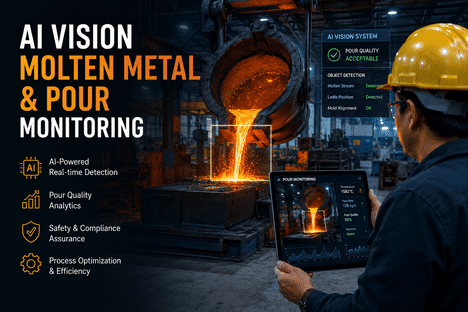
Molten metal processes — pouring, tapping, ladle transfer, and continuous casting — generate extreme thermal conditions where traditional contact sensors fail and human inspection is dangerous. Infrared pyrometers drift, thermocouples erode, and operators cannot maintain continuous visual attention across multiple pour stations running 24/7. iFactory's AI Vision Molten Metal & Pour Monitoring platform combines long-wave thermal imaging with deep learning inference on NVIDIA edge hardware to track metal levels, detect pour stream anomalies, and identify slag carryover in real time — all within the facility firewall with sub-50ms latency and zero cloud dependency. Foundry and steel plant operations teams committed to reducing breakout risk and improving yield choose to Book a Demo to evaluate iFactory's thermal vision performance on their specific ladle, tundish, and mold configurations.
AI Vision for Molten Metal Level and Pour Stream Monitoring
Thermal Deep Learning Models Trained on Foundry and Steel Mill Operational Data
Molten metal level monitoring has historically relied on radioactive level sensors, laser profilometers, and manual visual inspection — each with fundamental limitations in extreme thermal environments. iFactory's AI vision approach uses high-dynamic-range thermal cameras paired with deep convolutional neural networks trained on thousands of hours of operational footage from foundries and steel mills. The model tracks the molten metal meniscus position in real time, detecting level deviations as small as 3 mm across the full stroke of ladle, tundish, and mold filling cycles. For pour stream monitoring, the system evaluates stream continuity, diameter consistency, and trajectory alignment — identifying partial stream blockage, nozzle clog onset, and asymmetric flow patterns that produce casting defects. The inference runs entirely on NVIDIA edge hardware positioned within the facility firewall, processing every thermal frame with sub-50ms latency and communicating detected anomalies directly to the plant CMMS for automated work order generation. Reliability, safety, and operations leaders evaluating their thermal monitoring infrastructure can review how iFactory's deep learning models perform on their specific furnace, ladle, and caster configurations through a personalized platform assessment.
Slag Detection and Carryover Prevention with AI Thermal Vision
Deep Learning Segmentation of Slag from Molten Metal in Real Time
Slag carryover from ladle to tundish and from tundish to mold is one of the most costly quality defects in steel and metal casting operations. Traditional detection methods rely on electromagnetic slag detection systems mounted below the ladle slide gate — sensors that require direct contact with the molten stream and must be replaced every 8-12 heats. iFactory's AI vision approach uses thermal imaging and semantic segmentation models to distinguish slag from molten metal optically, detecting the slag boundary at the ladle nozzle exit and triggering automated gate closure within milliseconds of slag appearance. The same model architecture applies to tundish slag detection, monitoring the surface for slag island formation and predicting slag entrainment into the mold stream. The system achieves 99.4% slag detection accuracy on edge hardware with no sensor contact, no consumable replacement cost, and no mechanical maintenance requirement. Each slag event is timestamped, classified by severity, logged with thermal imagery for root cause analysis, and automatically linked to the CMMS for quality disposition and process parameter review.
Automated Pour Control and Casting Optimization
Closing the Loop Between Thermal Vision and Pouring Actuator Control
Beyond detection and alerting, iFactory's platform supports closed-loop pour control integration. The thermal vision system communicates directly with ladle slide gate actuators, tundish stopper rods, and mold level control systems — adjusting pour parameters based on real-time visual feedback from the metal stream and meniscus position. When the system detects stream thinning indicative of nozzle clog onset, it signals the stopper rod control system to execute a predefined clearing sequence. When slag is detected at the ladle nozzle, the gate closure signal fires within the same inference cycle. This closed-loop architecture reduces human operator cognitive load during critical pour operations, eliminates the reaction time delay between detection and corrective action, and provides a complete audit trail of every pour event with associated thermal imagery, control actions, and quality outcomes. Each pour is logged with anomaly events, control system responses, and operator overrides — all accessible through the CMMS integration layer for continuous process improvement analysis.
Edge AI Architecture for Extreme Thermal Environments
NVIDIA GPU Edge Inference with Zero Cloud Dependency Inside the Facility Firewall
Molten metal environments impose unique constraints on computing infrastructure — ambient temperatures exceeding 60°C, conductive and radiant heat loads, particulate contamination, and electromagnetic interference from induction furnaces and arc melters. iFactory's edge inference hardware is purpose-built for these conditions, deploying NVIDIA GPU compute modules in IP65-rated enclosures with passive thermal management and no moving parts. All AI inference — thermal frame processing, semantic segmentation, anomaly scoring, and CMMS event generation — executes on-premise with zero cloud round-trip dependency. Raw thermal data never leaves the facility firewall; only structured anomaly events, severity scores, and diagnostic image snapshots are transmitted to plant servers for historian storage and long-term trend analysis. This architecture ensures continuous casting monitoring operation during WAN outages, eliminates the data transmission bandwidth requirements of streaming raw thermal video to cloud infrastructure, and supports deployment in classified and ITAR-restricted production environments. iFactory's platform operates at 99.4% detection accuracy across all monitored pour stages with sub-50ms inference latency.
Integration with CMMS and Quality Systems
Automated Work Order Generation from Every Thermal Anomaly Event
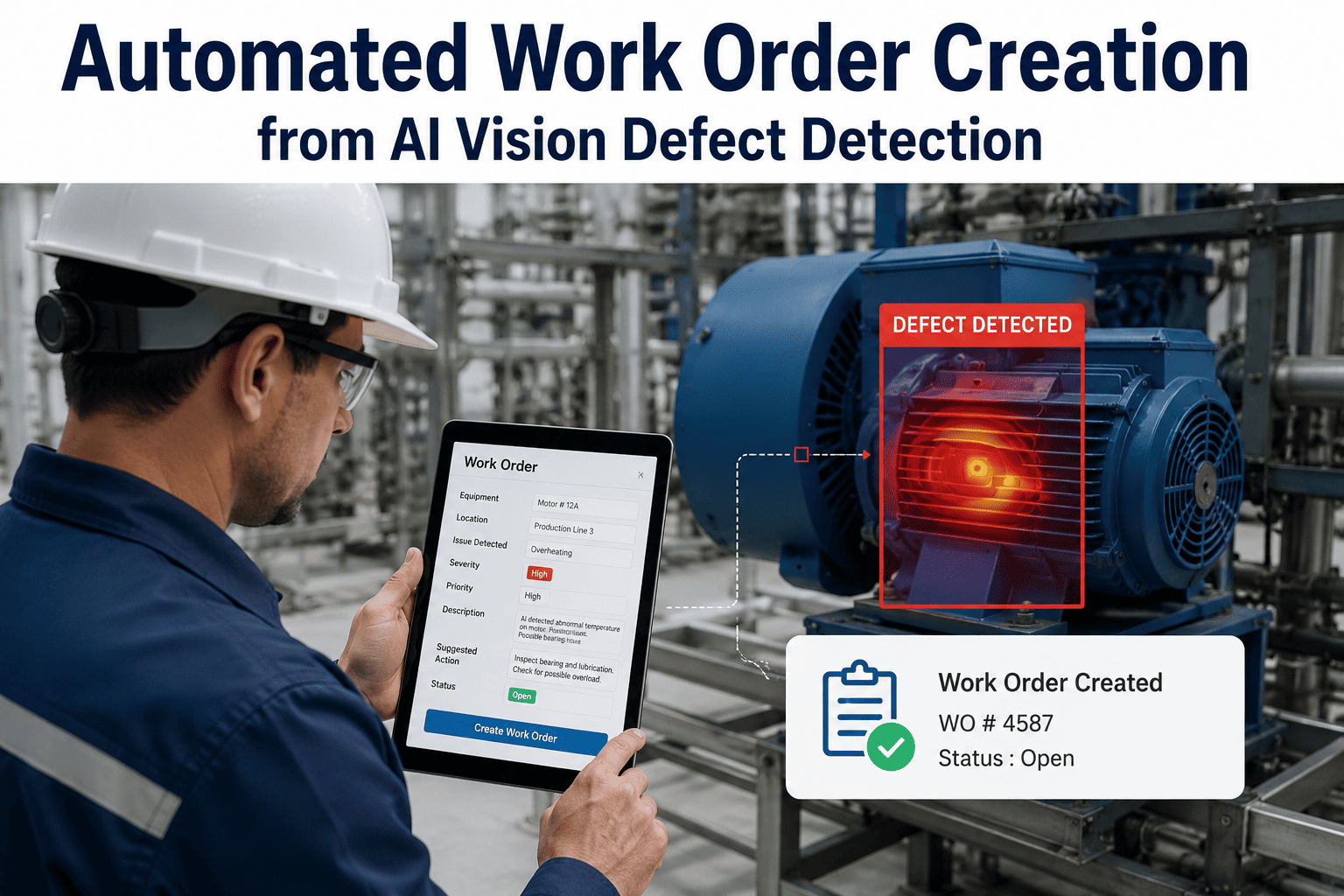
Every thermal anomaly detected by iFactory's AI vision platform — molten metal level deviation, pour stream interruption, slag carryover, nozzle clog onset, or tundish surface contamination — generates a structured event record that propagates automatically to the connected CMMS layer. The event record includes the asset identifier (ladle ID, tundish position, mold zone), anomaly classification, severity score, confidence level, thermal image snapshot, and recommended corrective action. Configurable severity thresholds determine whether the event triggers an informational notification, a preventive maintenance work order, or an emergency corrective work order with priority dispatch. Trend analytics available through the platform dashboard identify recurring anomaly patterns across specific ladles, nozzle types, steel grades, and operator shifts — enabling reliability engineering teams to target root cause improvements rather than responding to individual events in isolation. Quality and maintenance directors evaluating end-to-end thermal monitoring integration should Book a Demo to review how iFactory's detection-to-action pipeline integrates with their existing CMMS and quality management infrastructure.
Key Applications Across Foundry and Steel Production Stages
Where Thermal AI Vision Delivers Measurable Safety and Yield Impact
In electric arc furnace tapping operations, iFactory's thermal vision monitors the tapping stream for slag detection and alerts operators to tap-end conditions that reduce slag carryover into the ladle. During ladle refining and transfer, the system tracks ladle slag layer thickness, monitors argon stir patterns, and detects ladle glaze failures before refractory breakthrough. At the continuous caster, mold level monitoring detects SEN (submerged entry nozzle) clog, argon bubble entrainment, and mold flux disturbance — all critical quality events that produce slab surface defects. For foundries producing sand castings, the system monitors pour cup level consistency, detects flashover events, and verifies complete mold fill before the pour sequence terminates. Across every pour stage, the thermal AI model adapts to varying metal grades, casting speeds, and mold geometries without requiring retraining — deploying zero-shot anomaly detection that identifies novel failure modes without prior examples.
Frequently Asked Questions
How does AI thermal vision detect molten metal level and slag differently from traditional sensor methods?
Traditional methods rely on radioactive level sensors requiring regulatory compliance programs, electromagnetic slag detectors requiring contact with the molten stream and replacement every 8-12 heats, and laser profilometers that drift under steam and particulate conditions. AI thermal vision uses non-contact thermal cameras with deep learning segmentation models that distinguish molten metal from slag optically at the nozzle exit and tundish surface. The system achieves higher accuracy than contact methods, eliminates consumable replacement costs, and requires no regulatory permits for radioactive source management.
Can iFactory's platform integrate with existing ladle and caster control systems?
Yes. iFactory's thermal vision platform supports OPC UA, Modbus TCP, and REST API communication with ladle slide gate actuators, tundish stopper rod control systems, and mold level automation controllers. The system outputs structured anomaly events with control recommendations that existing PLC and DCS infrastructure can consume directly for closed-loop pour control integration. Pouring operations teams evaluating control system compatibility can review integration requirements for their specific automation architecture through a platform assessment.
What thermal camera specifications are required for iFactory's molten metal monitoring models?
The platform supports long-wave infrared thermal cameras with spectral response in the 8-14 micron range, minimum 640x480 resolution, and frame rates of 30 Hz or higher. For dual-spectrum applications, the system can fuse visible and thermal streams for improved contextual analysis. iFactory provides fully integrated thermal camera and edge compute packages optimized for each pour stage application, including protective housings rated for the ambient thermal conditions found in EAF tapping areas, ladle treatment stations, and caster platforms.
How does iFactory ensure model accuracy across different steel grades, casting speeds, and mold geometries?
iFactory's deep learning models are trained on multi-site operational data spanning carbon steel, stainless steel, aluminum, copper, and specialty alloy production across a range of casting speeds and mold configurations. The continuous learning pipeline refines model weights using each facility's production data without requiring manual retraining or labeled data curation. This zero-shot deployment capability means the same model architecture adapts to different metal grades and casting parameters without additional training cycles, enabling rapid deployment across multiple pour stages within the same facility.
What is the typical deployment timeline and ROI for iFactory's molten metal monitoring platform?
Initial deployment on critical pour stages — typically ladle slag detection and tundish level monitoring — is operational within 1-2 weeks of camera installation and network configuration. Baseline model calibration requires approximately 2-4 weeks of operational data collection for the continuous learning pipeline to establish facility-specific normal distributions. Measurable improvements in slag carryover reduction and breakout prevention are typically observed within the first quarter of operation. Most facilities achieve full payback within 12 months driven by reduced breakout events, eliminated contact sensor consumable costs, decreased defect-related scrapping, and improved yield from optimized pour control.