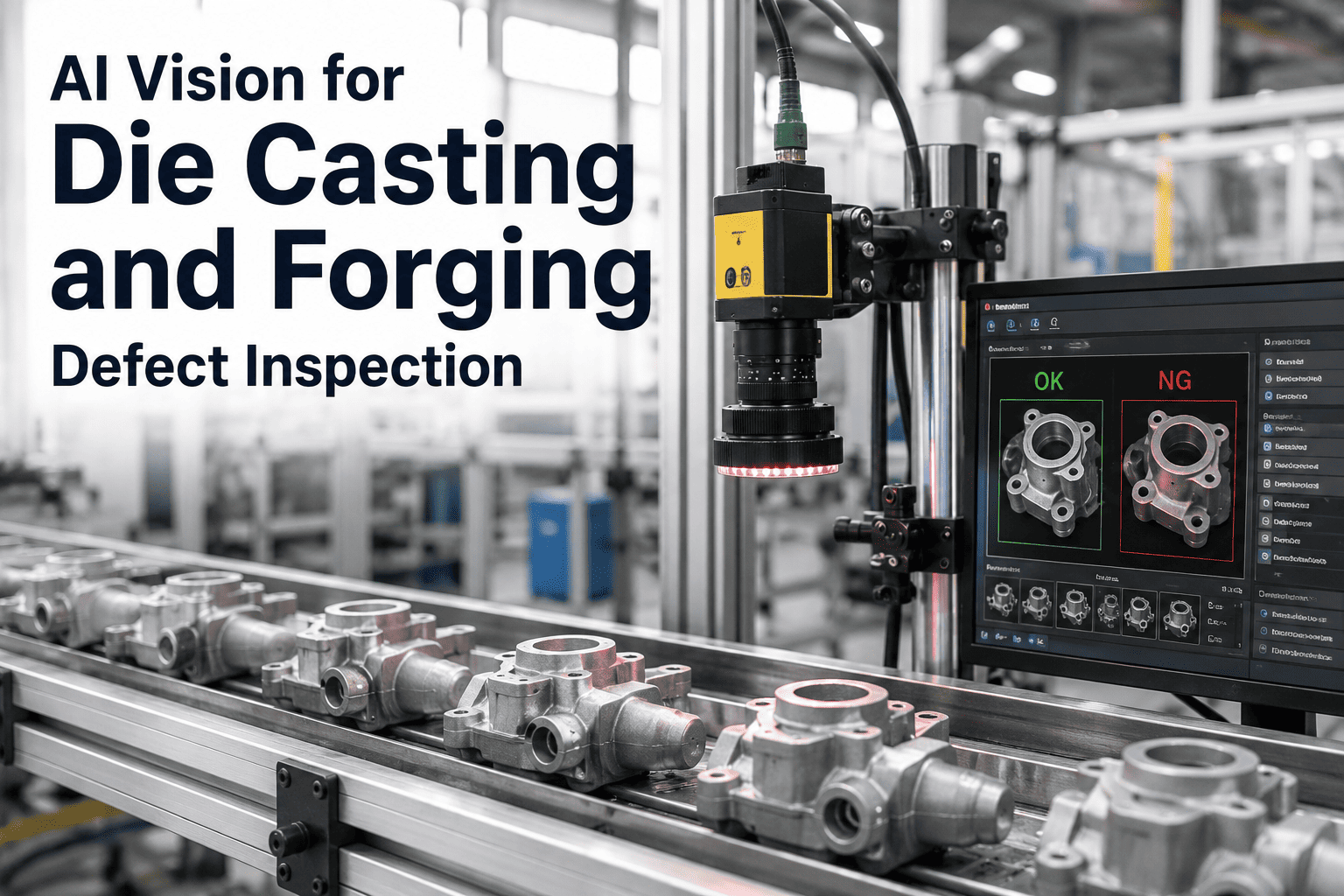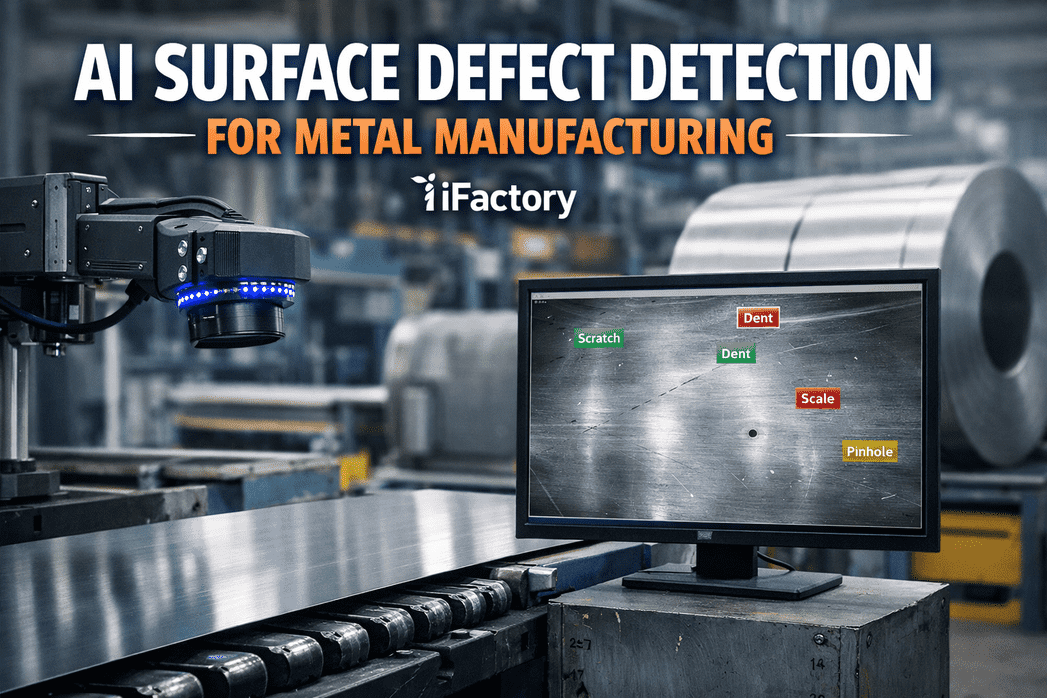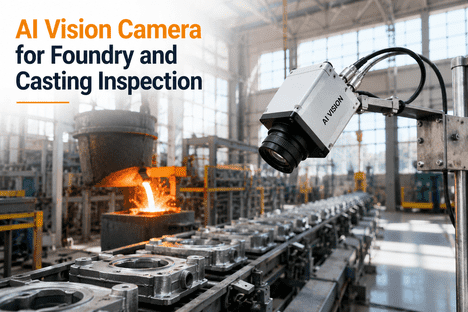
Foundries lose more castings to invisible defects than to visible ones. Porosity buried beneath a machined surface, a shrinkage cavity hiding under a core print, a cold shut along a parting line where two metal fronts failed to fuse — these defects do not announce themselves to a human inspector standing under foundry lighting, scanning a casting for a few seconds before it moves to the next station. Manual visual inspection in foundries and casting operations consistently misses a significant share of surface and near-surface defects, and the miss rate climbs sharply on complex geometries: cored passages, undercuts, ribbed structures, and curved surfaces where a fixed-angle human glance simply cannot cover every plane. Rule-based machine vision systems, the first generation of automated inspection, do not solve this problem either — they were built on fixed thresholds and edge-detection logic that breaks down the moment a casting's geometry, surface texture, or lighting condition varies even slightly from the calibration sample. AI Vision changes the inspection model entirely. Deep learning models trained on actual casting defect imagery learn the visual signature of porosity, shrinkage, cold shuts, and inclusions the way an expert metallurgist would — by pattern, not by rigid rule — and they apply that judgment consistently across every casting, every shift, every geometry variation, at production line speed. To see how iFactory's AI Vision Camera performs against your specific casting defects, Book a Demo with our inspection engineering team.
Why Rule-Based Vision Systems Fail on Real Casting Geometry
The Gap Between Fixed Thresholds and the Variability of Cast Metal
Traditional machine vision inspection on casting lines relies on fixed thresholds: a pixel intensity range, an edge gradient, a contour template calibrated against a small set of reference parts. This approach works only as long as every casting that passes under the camera matches the calibration condition closely enough — consistent surface oxidation, consistent lighting angle, consistent part orientation. Cast metal does not behave this way. Surface texture varies batch to batch with sand composition and pour temperature, oxidation color shifts with cooling rate, and complex geometries present different faces to a fixed camera position depending on how the part settles on the conveyor. A rule calibrated to catch a shrinkage cavity on a flat boss face will frequently miss the same defect on a curved rib, and just as often flag a harmless surface texture variation as a false reject — forcing quality teams to choose between an inspection system that misses real defects or one that floods the line with false rejects nobody trusts.
AI Vision replaces fixed thresholds with learned representations. Instead of asking "does this pixel pattern match a stored template," a deep learning model trained on thousands of labeled casting images asks "does this region of the casting resemble porosity, cold shut, or inclusion patterns the model has seen before — regardless of the surface angle, lighting variation, or part orientation in this specific frame." This is the same shift that allowed computer vision to move from license plate readers to autonomous driving: pattern recognition that generalizes across real-world variation, rather than logic that only works inside a narrow calibration envelope. For foundries running multiple part numbers, frequent tooling changes, or castings with cored internal passages and ribbed external structures, this difference determines whether automated inspection actually replaces manual eyes or simply becomes another station that gets bypassed because nobody trusts its calls.
The Five Casting Defect Classes the AI Vision Camera Is Trained to Catch
From Surface Porosity to Internal Shrinkage — What the Model Looks For
Casting defects fall into a well-documented set of categories, and each one has a distinct visual signature that a properly trained model learns to recognize at the surface and near-surface level. Porosity appears as small, often clustered voids where trapped gas or shrinkage prevented full metal fill — visually distinct from surface dirt or oxide staining once a model has seen enough labeled examples of each. Cold shuts show up as a visible line or seam where two streams of metal met without fully fusing, typically along parting lines or at the junction of thin and thick sections. Shrinkage defects present as sunken or cavity-like surface depressions concentrated at the last-to-solidify regions of a casting — usually near risers, thick sections, or junctions. Surface inclusions appear as foreign material — sand, slag, or oxide — embedded in or protruding from the casting surface, often with an irregular shape and color contrast that differs from the base metal. Cracks, the most safety-critical defect class, present as thin linear discontinuities that can originate from thermal stress during cooling or from mechanical handling after shakeout, and are flagged at high sensitivity given their direct link to in-service part failure.
iFactory's AI Vision Camera is trained specifically on casting defect imagery, not generic industrial surface-defect data, which matters because the visual signature of porosity in cast aluminum differs meaningfully from porosity in cast iron, and a cold shut on a thin-wall die casting looks different from one on a heavy sand-cast component. Models are fine-tuned against the customer's own part library and defect history during deployment, so detection accuracy improves specifically for the geometries, alloys, and defect patterns that actually occur on that foundry's production lines — rather than relying on a one-size-fits-all model trained on unrelated part types.
| Defect Class | Visual Signature | Typical Cause | Detection Approach |
|---|---|---|---|
| Porosity | Small clustered surface or near-surface voids | Trapped gas, dissolved gas release during solidification | Pattern-trained void detection at sub-millimeter scale |
| Shrinkage | Sunken cavities at last-to-solidify regions | Insufficient feed metal during solidification, riser undersizing | Geometry-aware depression and contour analysis |
| Cold Shuts | Visible seam where metal fronts failed to fuse | Low pour temperature, interrupted metal flow, poor gating | Linear discontinuity classification along flow-front zones |
| Surface Inclusions | Embedded foreign material with color/texture contrast | Sand erosion, slag carryover, oxide entrapment | Texture and color-contrast anomaly classification |
| Cracks | Thin linear discontinuities, often at stress concentration points | Thermal stress during cooling, post-shakeout handling | High-sensitivity linear feature detection at full line speed |
Inspecting What Rule-Based Systems Cannot: Complex Casting Geometry
Cored Passages, Undercuts, and Curved Surfaces Are Where Fixed-Rule Vision Breaks Down
The hardest casting inspection problems are not the simple flat-face defects that early machine vision systems were built to catch — they are the defects that occur on geometry a fixed camera angle and a fixed rule set were never designed to handle. Internal cored passages create shadow zones and reflective interior surfaces that confuse threshold-based systems entirely. Undercuts and ribbed external structures present different faces to the camera depending on minor variations in how the part settles, which means a rule calibrated for one orientation simply does not fire correctly on the next. Curved and contoured surfaces, common on impellers, manifolds, and structural automotive castings, scatter light unpredictably across the surface, creating false contour signals that rule-based edge detection cannot distinguish from genuine defect boundaries.
From Defect Detection to Quality Documentation: How the Inspection Loop Closes
Every Detection Event Becomes a Traceable, Audit-Ready Record
Detecting a defect is only half the inspection problem — the other half is documenting it in a way that supports quality decisions, supplier audits, and OEM traceability requirements without manual report compilation. Every casting that passes under the AI Vision Camera generates an inspection record that includes part identification, defect classification, severity, and a timestamped image of the detection event. When a casting is rejected for porosity or a cold shut, that record carries the visual evidence needed to support the rejection decision immediately, rather than requiring a quality engineer to reconstruct what was seen after the fact. When a batch trend emerges — a rising rate of shrinkage on a specific part number, for instance — the same data surfaces that pattern early enough to correct the upstream process condition, whether that is pour temperature, gating design, or sand moisture, before an entire production run is affected.
This traceability matters most for foundries supplying automotive, industrial equipment, and capital goods OEMs where supplier quality audits require documented inspection history for every batch. An immutable, automatically generated inspection record — correlated to batch, part serial number, and cast or furnace identification — satisfies that audit requirement as a byproduct of normal inspection operation, removing the manual report preparation that quality teams currently absorb as overhead. The same record set also gives engineering and operations a direct view into which defect types are trending upward, which part numbers carry the highest rejection risk, and where a process correction would have the largest impact on scrap reduction.
Deploying AI Vision on an Active Casting Line Without Disrupting Production
Integration With Existing Shakeout, Finishing, and Quality Stations
Foundries do not have the production margin to take a casting line down for an extended inspection system installation, which is why the AI Vision Camera is designed to integrate at existing inspection or finishing stations — post-shakeout, post-shotblast, or pre-shipment — without requiring changes to conveyor layout, cycle time, or upstream process equipment. Camera placement is determined by where the casting's relevant surfaces are accessible and well-lit in the existing production flow, and the platform connects to existing quality management and ERP systems through standard integration methods so that defect records flow into the systems quality teams already use rather than creating a parallel reporting tool.
A typical deployment begins narrow: a pilot on the highest-scrap-rate part number or the defect class causing the most rework, run in parallel with existing manual inspection so that model accuracy is validated against real inspector judgment before manual inspection is reduced or reassigned. This phased approach lets a foundry confirm detection accuracy on its own parts, alloys, and defect history before expanding coverage to additional part numbers or production lines — building confidence in the system's calls based on its own production data rather than a vendor's general performance claims.
Conclusion
Casting defect inspection has a structural problem that neither more inspectors nor stricter manual procedures can fully solve: human attention degrades with fatigue and shift length, and rule-based machine vision was never built to handle the surface variability and complex geometry that real cast metal parts present. AI Vision closes both gaps at once — applying consistent, pattern-based defect classification across every casting, every shift, and every geometry variation, while generating the traceable inspection record that quality audits and OEM relationships increasingly require as a baseline expectation rather than a differentiator.
The foundries that move first on AI-driven inspection are not doing so because the technology is unproven — casting defect classification using deep learning has a substantial body of applied research and production deployment behind it. They are moving first because every shift spent on manual-only or rule-based-only inspection is a shift where some percentage of porosity, shrinkage, cold shuts, and inclusions escape into the next process step, into machining, into assembly, and eventually into a customer claim that costs far more to resolve than the inspection that would have caught it. The first pilot on the highest-scrap part number is the proof point that turns this into an operating decision rather than a pending evaluation.