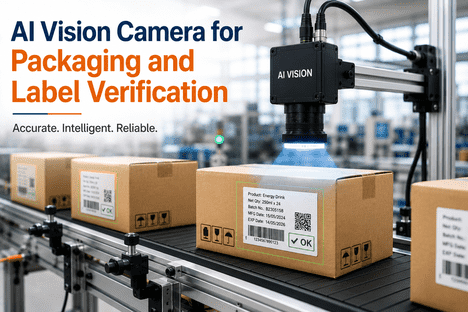
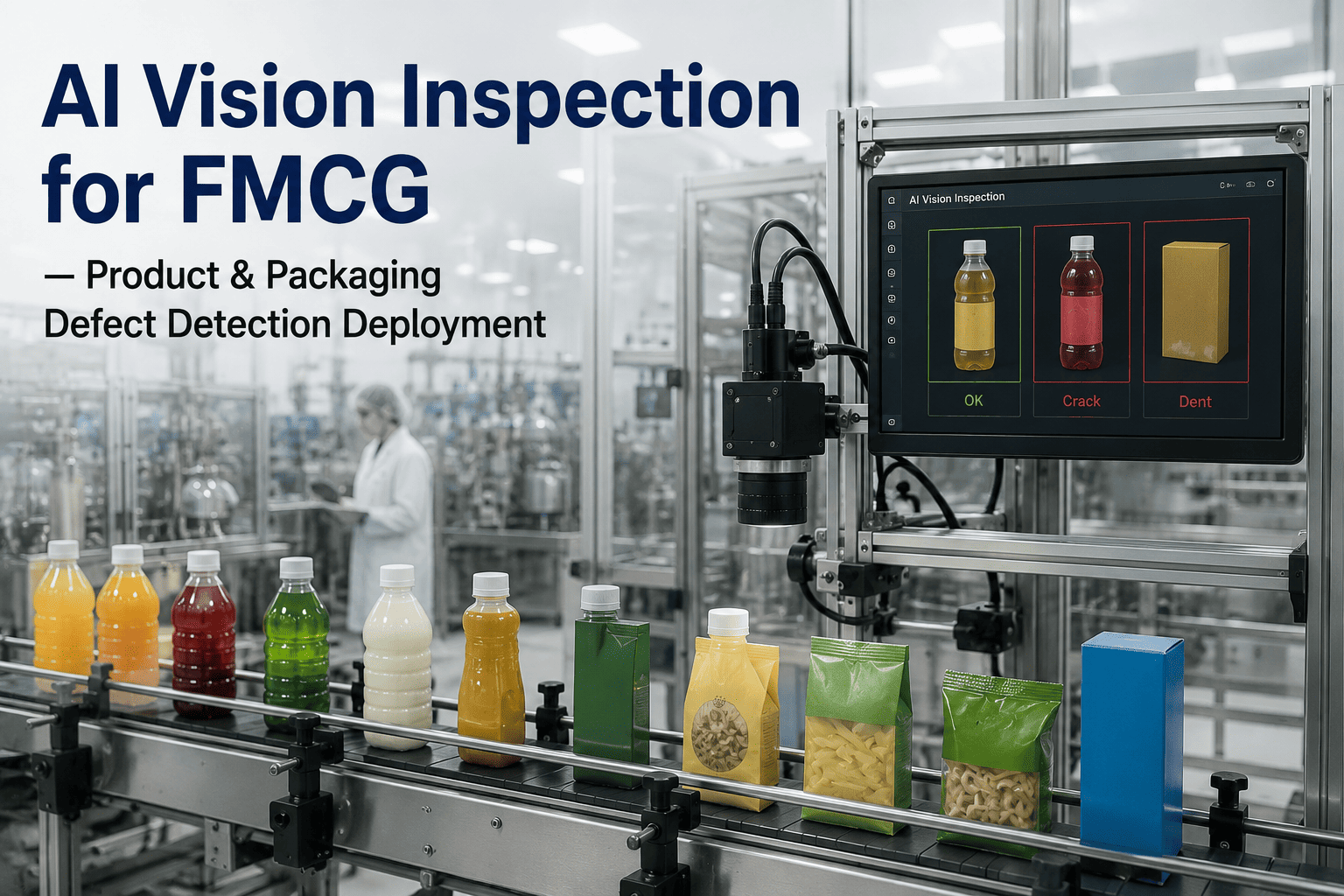
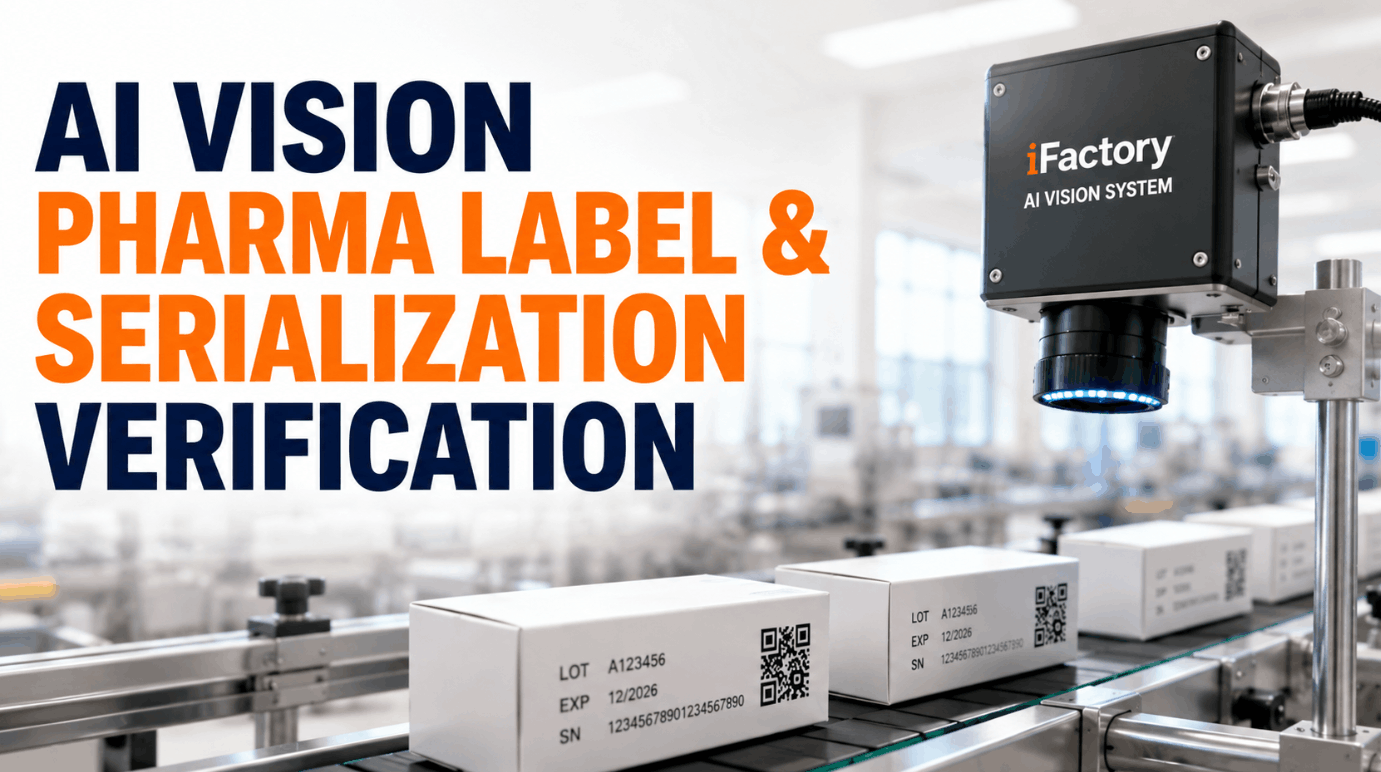
Packaging and label errors are not edge-case quality failures — they are the leading cause of product recalls across food, pharmaceutical, and consumer goods manufacturing. In 2024, label errors caused 45.5% of all US food recalls, costing the industry an estimated $1.92 billion in a single year, and more than half of pharmaceutical recalls trace back to labelling or packaging defects. The average recall reaches $10 million before brand damage and lost trust are counted. Yet the root cause is rarely a process failure — it is that manual sampling cannot catch label errors consistently on lines running over 1,000 units a minute, where human eyes process only 10 to 12 images a second. AI vision inspection closes that gap by verifying every unit at line speed. To see it on your line, book a demo.
QUALITY & COMPLIANCE · PACKAGING LINES · AI VISION INSPECTION
Verify Every Label, Code, and Seal — On Every Unit, at Full Line Speed
Sampling inspection lets label errors compound across a production run before anyone finds them. The iFactory AI Vision Camera inspects 100% of units inline — verifying labels, grading barcodes, validating date codes, and checking seals in milliseconds, with automated rejection and audit-ready records.
THE RECALL COST PROBLEM
Why Packaging Errors Drive the Majority of Recalls
45.5%
Of all US food recalls in 2024 were caused by label errors
$1.92B
Estimated single-year cost of label-error food recalls to the industry
$10M
Average cost per recall event before brand damage is counted
10–12
Images per second a human inspector processes — against 1,000+ units per minute
A single unit with a missing allergen declaration or a transposed lot code is not one defective product — it is systemic exposure across an entire run that may have shipped before the error is found. Inspecting 100% of units removes the sampling gap that lets these errors compound.
SIX VERIFICATION FUNCTIONS, ONE INSPECTION EVENT
What the AI Vision Camera Checks on Every Unit
Manual sampling asks one inspector to catch every kind of packaging error on a fraction of units. AI vision runs six verification functions simultaneously on every unit, at line speed, with no fatigue and no shift-to-shift drift.
Label Content & Artwork Verification
Deep-learning models trained on approved artwork verify label placement, orientation, allergen declarations, ingredient lists, and net weight on every unit — catching misprints, missing text blocks, and wrong-label-for-SKU errors that rule-based systems miss when tolerances shift.
Barcode Reading & Grade Verification
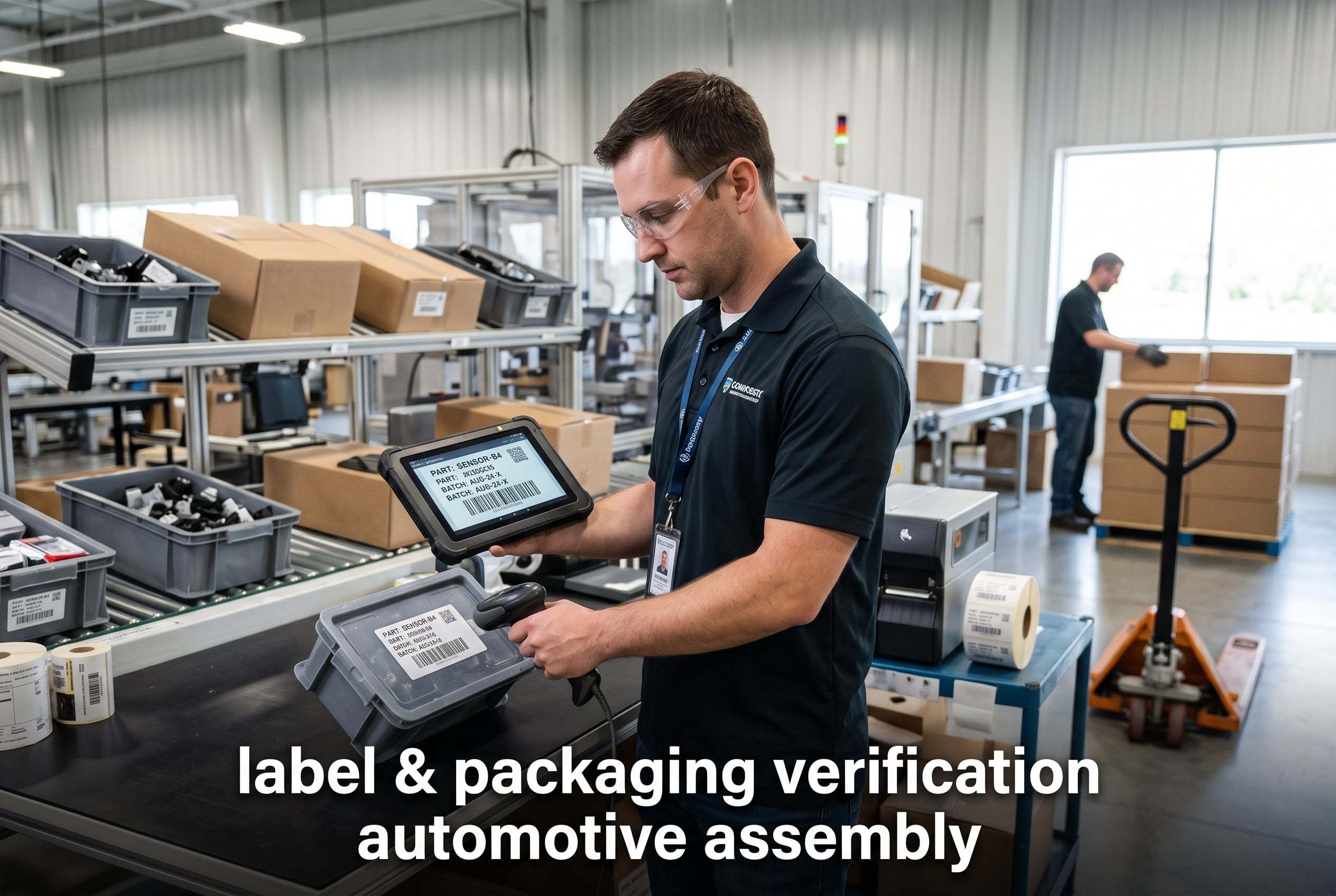
1D and 2D codes — Code 128, EAN/UPC, DataMatrix, QR — are read, decoded, and graded for ISO/IEC readability on every unit. Advanced decoding reads damaged, low-contrast, and shrink-wrapped codes handheld scanners fail on, flagging unreadable or incorrect codes before they ship.
Date Code & Lot Number OCR
OCV and OCR engines validate inkjet date codes, best-before dates, and lot numbers against the production system's live values — catching the transpositions, missing characters, and day-month inversions that are the most common mislabelling failure on high-speed coders.
Seal Integrity Inspection
Depth sensing and precision illumination reveal broken induction seals, missing tamper bands, incomplete heat seals, and cap misalignment invisible under standard lighting — a product-safety and compliance failure caught at sub-100ms per unit with direct PLC rejection.
Print Quality & Defect Detection
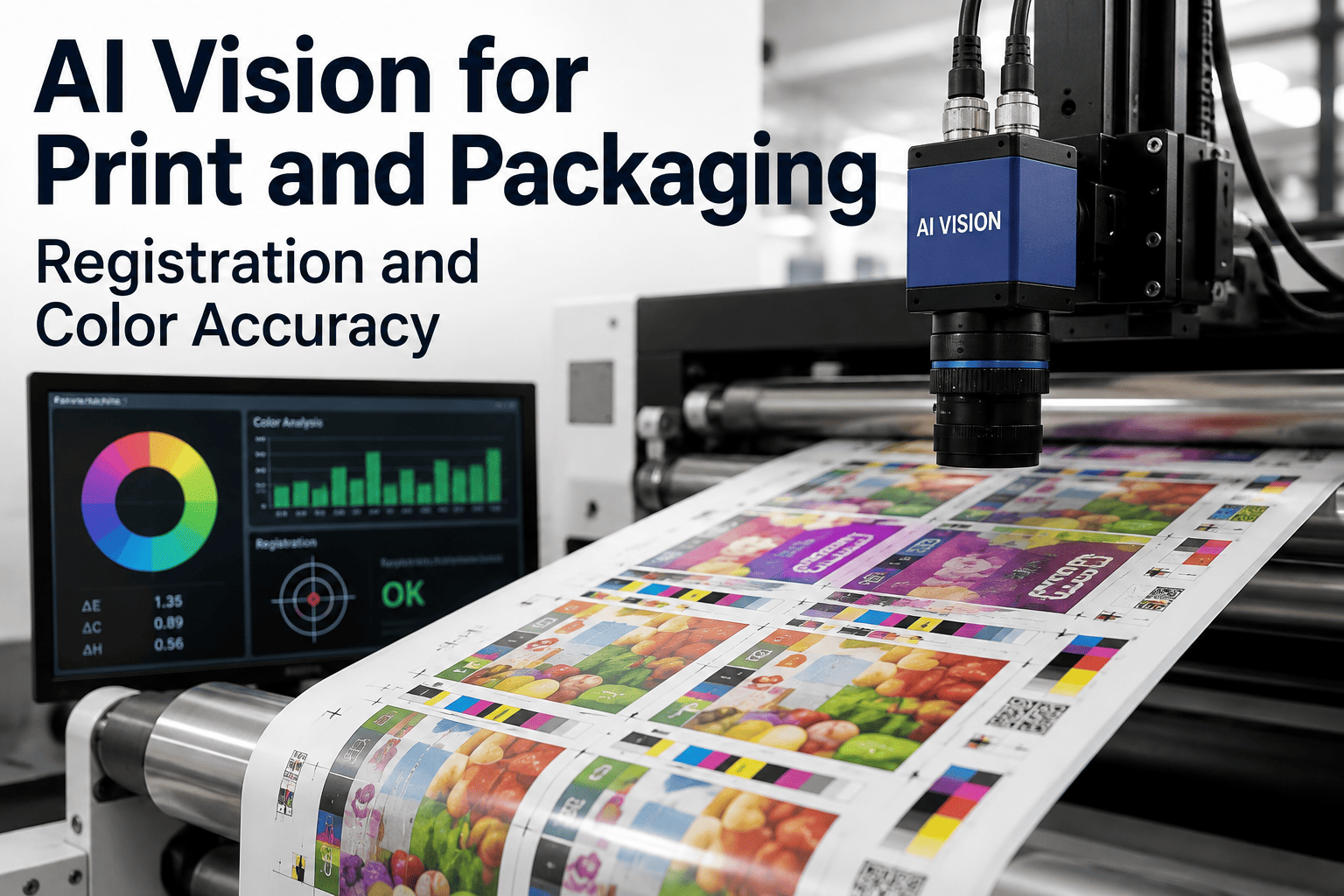
High-resolution area-scan and line-scan cameras with strobed lighting detect smeared ink, faded print, colour inaccuracy, and contamination without glare or shadow. Pattern matching verifies print registration and artwork integrity — defects OCR engines never evaluate.
Serialisation & Compliance Traceability
For regulated lines, the platform generates EPCIS-compatible serialisation data at unit level — satisfying DSCSA and EU FMD DataMatrix mandates without manual transcription. Every unit produces a timestamped record linked to its serial number, batch ID, and production order.
See how the AI Vision Camera protects your packaging line
iFactory deploys inline in weeks — verifying labels, barcodes, seals, and date codes on every unit at full speed, with automated rejection and audit-ready traceability records.
MANUAL SAMPLING VS. AI VISION INSPECTION
What Changes When Every Unit Is Inspected
Lines that replace manual sampling with AI vision on every unit see measurable improvement across every critical quality, compliance, and throughput metric.
| Inspection KPI |
Manual / Sampling |
AI Vision Camera |
| Unit coverage |
1–5% sampled per batch |
100% of every unit |
| Label error detection |
~60–70%, fatigue-affected |
99%+ at full line speed |
| Barcode verification |
Sample scans, grading not assessed |
100% read plus ISO/IEC grade on every unit |
| Date code / lot accuracy |
Periodic check, transpositions missed |
OCV verification on every unit, every shift |
| Seal defect detection |
Visual sampling, microscopic gaps missed |
Sub-100ms per unit with depth sensing |
| Recall prevention |
Reactive, detected post-distribution |
Proactive, defects stopped at the line |
HOW IT OPERATES ON THE LINE
From Image Capture to Recall-Ready Record
The platform combines area-scan and line-scan cameras, precision lighting tuned to the packaging format, and deep-learning inference running on-premise at sub-100ms per unit — with no cloud dependency and direct PLC integration for automated rejection.
1
Multi-Camera Image Acquisition at Line Speed
Cameras — configured up to 24 per station for 360-degree coverage on cylindrical containers — capture every surface of every unit. Strobed LED lighting tuned to the substrate and label finish eliminates the glare and shadow that cause false positives on foil and transparent packaging.
2
Simultaneous AI Inference Across All Functions
Deep-learning models, OCV/OCR engines, and barcode grading run together on every image, producing label, date-code, barcode, seal, and print-defect results in a single inspection event per unit — all on-premise, with no data leaving the facility.
3
Automated Rejection & MES Integration
Units failing any criterion are rejected via direct PLC signal before downstream packing. The trigger, defect class, unit image, and timestamp are logged to the MES or CMMS, and multi-SKU lines switch inspection profiles automatically at changeover with no manual reconfiguration.
4
Compliance Documentation & Recall-Readiness
Every unit generates a timestamped record — label result, barcode grade, OCR result, seal status, defect image — linked to batch ID and line. The trail satisfies FDA 21 CFR Part 11, EU FMD, and GFSI traceability without manual report assembly.
INSPECTION BY INDUSTRY SECTOR
Verification Priorities and Compliance by Sector
Label verification requirements and regulatory frameworks differ across food, pharmaceutical, cosmetics, and industrial goods. This maps the primary inspection priorities and compliance standards to each context.
| Sector |
Primary Inspection Requirements |
Compliance Framework |
| Food & Beverage |
Allergen declarations, best-before dates, net weight, artwork integrity, seal-leaker detection, fill level |
FSMA, EU FIC 1169/2011, GFSI/BRC, FSSAI |
| Pharmaceuticals |
Lot number, expiry date, serialised 2D DataMatrix, tamper seal, dosage strength, INN name |
FDA 21 CFR Part 11, DSCSA, EU FMD 2016/161, CDSCO |
| Cosmetics & Personal Care |
INCI ingredient list, period-after-opening symbol, batch code, artwork colour, cap alignment |
EU Cosmetics Reg 1223/2009, FDA OTC rules, ISO 22716 |
| FMCG / Consumer Goods |
Barcode readability, SKU-to-label match, promotional print accuracy, retailer compliance labelling |
GS1 grading, retailer mandates, ISO/IEC 15416/15415 |
| Industrial & Chemicals |
GHS hazard pictograms, signal-word verification, UN number, SDS QR code, tamper evidence |
GHS/UN HazCom, EU CLP, OSHA HazCom 2012 |
Verify every unit on your specific format and line speed
Models are trained on your label artwork, barcode specs, and defect library — adapting to each line's real tolerances rather than applying generic thresholds that generate false positives.
DEPLOYMENT ROADMAP
From Packaging Line to Full Inspection in Five Weeks
iFactory's structured deployment is built for live packaging lines — no production stoppage, no infrastructure overhaul, and integration with existing PLCs, MES, and CMMS. Facilities typically recover full platform cost within six to nine months through avoided recalls, eliminated sampling labour, and reduced rework; for serialised pharmaceutical lines, the compliance value alone often compresses payback to three to five months.
Week 1–2
Camera Installation, Lighting & PLC Integration
Cameras are mounted at the inspection station without production shutdown, lighting is tuned to the substrate and label finish, and direct PLC integration establishes the rejection trigger and MES data connection across priority lines.
Week 3
AI Model Training on Artwork, Codes & Defect Library
Models are trained on approved label artwork, barcode formats, date-code character sets, and the facility's tolerance library. Defect thresholds are calibrated against real reject criteria, and OCV templates are set against current code formats per SKU.
Week 4
100% Live Inspection with Automated Rejection
Full inline inspection begins with automated PLC rejection for all failed criteria. Label, barcode, OCR, seal, and print-defect checks run simultaneously on every unit at full speed, with defect rates and images logged from the first run.
Week 5
Full Analytics, Compliance Dashboards & Changeover Library
The complete platform goes live — multi-SKU changeover profiles, compliance dashboards for FDA, GFSI, and serialisation frameworks, per-batch trend analytics, and audit-ready records for every unit inspected since week four.
We were checking about 1 in 50 units on the allergen line. After three complaints about missing "Contains Nuts" declarations in one quarter, we deployed the AI Vision Camera. The first week of full-line inspection found label errors on 0.4% of production — errors that had been shipping for months. Our QA manager estimates we were one complaint away from a full recall. It paid for itself before our first quarterly review, and no label non-conformance has reached a customer since.
FREQUENTLY ASKED QUESTIONS
Common Questions About AI Vision Packaging Inspection
Can the system handle multiple SKUs and label artwork changes on the same line?
Yes. The platform maintains a profile library for each active SKU — approved artwork, barcode format, date-code structure, and seal specs. When a changeover occurs, the system switches to the correct inspection profile automatically, either triggered by the line PLC or by operator selection. No re-training or engineering work is required for standard changeovers between pre-configured SKUs, so a multi-product line keeps 100% inspection running across every run without a reconfiguration gap.
What barcode formats and grading standards does the system support?
The platform reads and grades all major 1D and 2D formats including Code 128, EAN-13, EAN-8, UPC-A, UPC-E, ITF-14, DataMatrix, QR Code, and PDF417. Grading runs against ISO/IEC 15416 for 1D linear codes and ISO/IEC 15415 for 2D matrix codes, producing the letter-grade readability scores that GS1 compliance audits and retailer qualification programmes require. Every barcode grade is logged per unit as part of the inspection record, so no unverified code leaves the line.
How does the OCV system verify date codes and lot numbers?
Optical Character Verification compares the inkjet or laser-marked characters on each unit against the expected value pulled from the production system in real time. It validates character completeness, correct date format, accurate lot number against the active production order, and minimum print contrast for legibility. Any unit with a transposed digit, missing character, or format deviation is rejected at the line before it reaches downstream packing — the exact failure mode that drives most mislabelling recalls.
Does the platform support pharmaceutical serialisation — DSCSA and EU FMD?
Yes. The platform verifies serialised 2D DataMatrix codes carrying GTIN, serial number, batch number, and expiry date against the required EU FMD data elements on every unit. For DSCSA compliance, it outputs structured EPCIS-compatible serialisation data at unit level, satisfying traceability requirements without manual transcription.
Contact our support team to discuss your specific serialisation verification integration requirements.
What is the typical return on investment timeline?
Most facilities recover full platform cost within six to nine months through avoided recalls, eliminated sampling labour, reduced end-of-line rework, and retailer chargeback avoidance from barcode failures. For pharmaceutical facilities where a single labelling recall costs $10 million or more, the case is typically demonstrable within the first quarter. Positive evidence — rejected defective units that would previously have shipped — is usually visible within the first two weeks of full 100% inspection.
Book a demo for a site-specific assessment.
EVERY UNIT, EVERY CODE, EVERY SEAL
Eliminate Your Packaging Recall Risk at the Source
Sampling inspection lets errors compound across a run before they're found. The iFactory AI Vision Camera inspects 100% of units at full line speed, rejects non-conforming units automatically, and generates per-unit records that satisfy FDA, GFSI, DSCSA, EU FMD, and GS1 requirements from day one.