Checklist: AI Vision Cameras for Automated Label Verification

By Austin on May 26, 2026

checklist-ai-vision-automated-label-verification

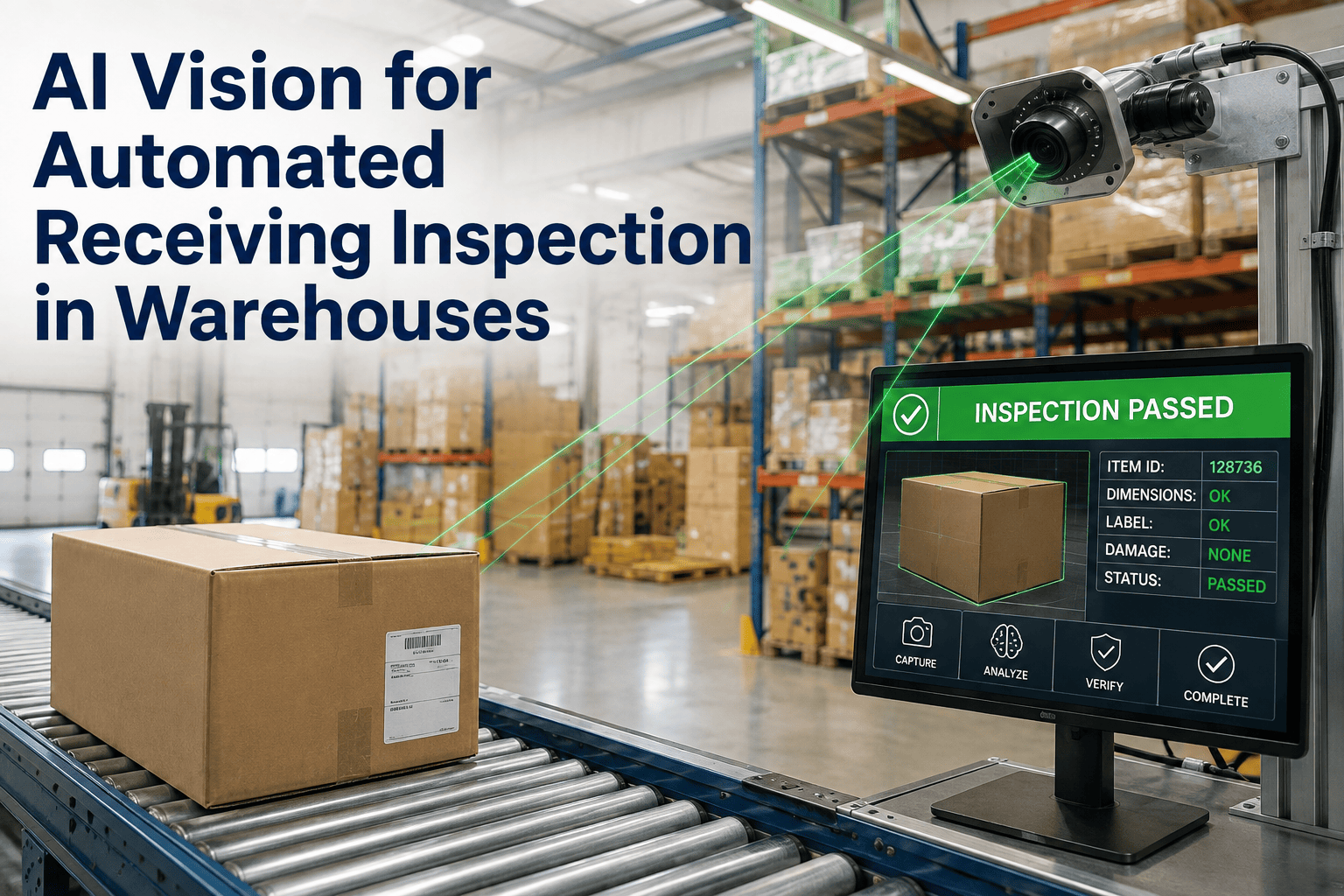
Label verification failures are among the most commercially and regulatorily consequential defect categories in food, beverage, pharmaceutical, and consumer goods manufacturing — yet they remain one of the most common escapes from manual inspection programs. A label applied at 0.5mm horizontal offset from the specification centre, a barcode with a quiet zone violation, an expiry date printed one digit wrong, or a product placed in packaging designed for an adjacent SKU all pass a fatigued human inspector at the end of a long shift while failing every objective quality standard the product must meet before it reaches the customer. AI Vision Cameras eliminate this failure category structurally by verifying every label on every unit at full line speed — checking placement position, print quality, barcode grade, text content, and SKU correctness simultaneously, with consistent accuracy across every shift and every hour of the production day. This checklist provides a zone-by-zone verification framework covering every critical label check that AI Vision Camera systems must perform on a modern production line, structured to the sequence that iFactory's deployment engineers use when commissioning and validating label verification programs across food, pharmaceutical, and consumer goods manufacturing environments. Use it to audit your current label inspection deployment, commission a new AI vision program, or validate that your existing system covers every label defect category that your quality specification and customer requirements demand. Book a Demo to see how iFactory's AI Vision Camera platform performs every check in this list automatically on your current production line.

LABEL VERIFICATION BARCODE VALIDATION SKU ACCURACY

Eliminate Label Escapes Across Every Unit, Every Shift — With AI Vision Verification at Full Line Speed

iFactory's AI Vision Camera platform verifies label placement, print quality, barcode grade, text content, and SKU correctness on every unit simultaneously — replacing the statistical sampling and shift-dependent accuracy of manual label inspection with 100% automated coverage that never fatigues.

Why Label Verification Requires a Structured AI Vision Checklist

Label Defects Are the Leading Cause of Regulatory Recalls in Food and Pharma

Undeclared allergens from wrong-label application, incorrect dosage information from mismatched pharmaceutical labelling, and missing regulatory text from printing failures collectively account for the majority of product recall events in regulated manufacturing sectors. Each of these failures is detectable by AI vision at the inspection point — after the label is applied and before the product leaves the production floor. A structured AI vision label verification checklist ensures that every defect category with recall consequence is covered by a specific, validated inspection check. Book a Demo to see how iFactory's label verification system covers every regulatory-critical check category.

Manual Inspection Misses Systematic Label Defects That AI Vision Catches Structurally

The defect categories that cause the most commercial damage in label verification programs are precisely the ones that manual inspection misses most reliably: label placement drift that develops gradually across a production run as applicator wear progresses, barcode print quality degradation that reduces scan rates in retail environments, and wrong-label application events that occur during changeover when operator attention is divided. These are structural manual inspection failures — not operator errors — and they are eliminated structurally by AI vision systems configured to the checks in this framework.

40%Of all food and beverage recalls attributed to labelling errors — allergen mislabelling the leading cause
8 zonesLabel verification zones covered in this checklist from label application through dispatch readiness
100%Unit inspection coverage achieved by AI vision — replacing statistical sampling at every inspection point
±0.5mmLabel placement accuracy achievable with AI vision — versus ±3–5mm typical manual inspection tolerance

AI Vision Label Verification Checklist — Zone by Zone

1. Label Application Position & Placement Verification
2. Label Presence & Correct Label Confirmation
3. Print Quality & Text Legibility Inspection
4. Barcode & Data Matrix Verification
5. Label Adhesion, Surface Condition & Physical Defects
6. Multi-Label, Promotional & Compliance Label Checks
7. Changeover Validation & SKU Transition Checks
8. Documentation, Traceability & Audit Readiness
100% COVERAGE AUDIT-READY RECORDS

Deploy AI Vision Label Verification Across Every Check in This List — With Complete Inspection Records From Day One

iFactory's AI Vision Camera platform executes every check category in this framework simultaneously on every unit at full line speed — generating per-unit inspection records, defect trending data, changeover validation logs, and lot-level verification certificates that satisfy GFSI scheme requirements and customer audit commitments without additional quality team overhead.

Benefits of AI Vision Label Verification vs. Manual Inspection

100% Unit Coverage at Full Production Speed

Manual label inspection at production speeds above 60 units per minute requires statistical sampling — meaning a percentage of units pass through uninspected even in the most disciplined programs. AI vision inspects every unit at the full line speed with no throughput penalty and no coverage gap, providing the 100% inspection record that increasingly strict retail and pharmaceutical customer requirements demand.

Consistent Detection Accuracy Across All Shifts

Manual inspection accuracy declines measurably with shift length, particularly for high-frequency, repetitive label checks that require sustained concentration. AI vision delivers identical detection accuracy on the last unit of a 12-hour night shift as on the first unit of the morning shift — eliminating the shift-end detection accuracy drop that produces systematic end-of-shift defect escapes in manual programs.

Placement Drift Detection Before Specification Exit

Label placement measurement trending across consecutive units reveals progressive applicator wear and thermal drift that moves placement towards — but not yet beyond — specification limits. Detecting this trend enables corrective maintenance during planned intervals rather than after a specification exceedance event forces an unplanned stop. The maintenance cost saving from planned vs. reactive applicator adjustment is typically 3 to 5 times the inspection cost in facilities with manual-only label monitoring.

Wrong-Label and Mixed-SKU Event Elimination

Wrong-label application events at changeover — the highest-consequence labelling failure category — are caught on the first unit by AI vision SKU reference matching. Without AI vision, a wrong-label changeover event can produce hundreds or thousands of mislabelled units before a downstream operator or a retail customer identifies the failure. The cost of a single wrong-label event involving allergen categories consistently exceeds the total annual cost of an AI vision label verification deployment.

Audit-Ready Documentation Without Manual Assembly

GFSI scheme audits, retail customer quality assessments, and regulatory investigations all require documented evidence of label inspection coverage — lot-level inspection records, defect histories, and changeover validation logs that manual programs can only assemble from paper records at significant quality team labor cost. iFactory's AI vision records are generated automatically, stored with full searchable metadata, and retrievable in the minutes that audit timelines require — not the days that manual record assembly demands.

Barcode Grade Trending for Retail Scanner Performance

Retail scanner failure rates for barcodes that decode in quality lab conditions but fail in-store scanner environments are a significant source of supply chain friction — generating scan failure complaints, re-scanning delays, and manual override entries that reduce retail operational efficiency and damage supplier relationships. AI vision barcode grade trending identifies the print quality decline trajectory that leads to retail scan failures before product reaches the distribution channel — enabling corrective action while the affected units are still on the production floor.
AI Vision Label Verification — Frequently Asked Questions

1. Can AI vision verify labels at the production line speeds typical in food and beverage packaging?
Yes. iFactory's edge-deployed AI Vision Camera system processes inspection decisions in 8 to 22 milliseconds per unit — supporting production line speeds from 30 to over 600 units per minute depending on camera count, field of view configuration, and the number of simultaneous label checks required. The edge processing architecture means there is no network latency in the inspection path — inspection decisions are generated and rejection signals are fired entirely on local hardware regardless of Wi-Fi connectivity conditions.
2. How does iFactory's AI vision system handle multiple label types across different production SKUs?
iFactory maintains a multi-SKU label reference library on the edge inference hardware — a separate approved reference image, placement specification, and verification parameter set for every active SKU. When a product changeover occurs, the correct SKU's verification profile is activated automatically based on the production order, and the first-unit changeover validation check confirms correct label application before full production speed resumes. The library supports up to 20 simultaneously active SKU profiles with instant switching at changeover.
3. What barcode symbologies and quality standards does iFactory's label verification system support?
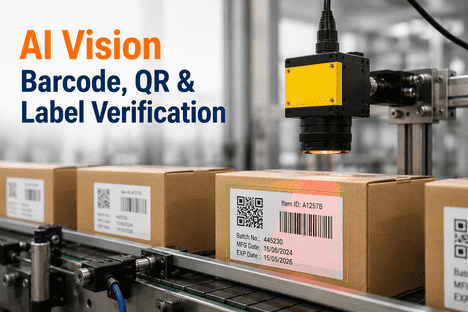
iFactory's barcode verification covers all major 1D symbologies including EAN-13, EAN-8, UPC-A, UPC-E, Code 128, Code 39, and ITF-14, as well as 2D symbologies including QR Code, Data Matrix, PDF417, and Aztec. Quality assessment follows ISO/IEC 15416 for 1D barcodes and ISO/IEC 15415 for 2D symbols, with configurable minimum grade thresholds per SKU and retail customer requirement. All decode and grade results are stored in the per-unit inspection record.
4. Can iFactory's AI vision read and verify variable data fields like use-by dates and batch codes?
Yes. iFactory's OCR module reads variable data fields — use-by date, production date, batch code, and any alphanumeric variable content — and verifies the decoded value against the expected value for the current production period. Expected values are entered into the production order at the start of each run and automatically updated at each changeover. The system flags any unit where the variable data field does not match the expected value — including wrong date format, partial print, missing field, or incorrect batch code — for rejection before it leaves the inspection point.
5. How does iFactory's AI vision handle different container materials and surface textures in label verification?
Container material and surface texture affect label inspection imaging through reflectance variation — metallic surfaces, transparent glass, and high-gloss plastics each create different imaging challenges that require specific lighting configurations to eliminate false positives from surface reflections. iFactory's deployment process includes a container-specific imaging environment assessment that selects the appropriate lighting type, angle, and diffusion configuration for each container format — ensuring that the AI vision model receives consistent, high-quality images regardless of container surface characteristics.
6. What GFSI scheme requirements does AI vision label verification documentation satisfy?
iFactory's AI vision label verification records satisfy the inspection documentation requirements of SQF Edition 9, BRC Issue 9, FSSC 22000 Version 6, and IFS Food Version 8 — providing per-unit inspection records, defect trend analysis, changeover validation logs, and lot-level inspection summaries in the objective, time-stamped format that GFSI scheme auditors require to confirm that label verification controls are operating as designed. The records are exportable in standard formats compatible with common QMS documentation systems.
7. How long does it take to commission an AI vision label verification system on a new production line?
A single-line AI vision label verification deployment covering all eight check categories in this checklist typically reaches validated production operation in 6 to 10 weeks from hardware installation — covering imaging environment assessment, reference image library creation, model calibration, shadow mode validation, and first-unit changeover validation across all active SKUs. The shadow mode validation period — where the system logs inspection results without triggering rejection — is the critical commissioning phase that confirms false positive rates are within operator-acceptable thresholds before live rejection is activated.
8. How does iFactory support label verification specifically for allergen management and food safety programs?
iFactory's AI vision label verification system is configured with allergen-critical check categories as highest-priority rejection classes — ensuring that wrong-label events on allergen-containing to allergen-free changeovers, missing allergen declaration text, and damaged allergen information areas all trigger automatic rejection regardless of the unit's overall label grade. Allergen changeover validation records — confirming that the first unit of each allergen-free run carries the correct label — are stored as a separate audit trail accessible independently of the general inspection record for allergen program documentation purposes.
START TODAY LABEL COMPLIANCE ASSURED

Deploy AI Vision Label Verification Across All Eight Check Categories — Covering Every Unit, Every Shift

iFactory's AI Vision Camera platform executes placement verification, print quality assessment, barcode grading, content correctness, physical defect detection, changeover validation, and audit documentation simultaneously on every unit — eliminating the label defect escapes that generate recalls, customer claims, and retail compliance failures in facilities relying on manual inspection programs.


Share This Story, Choose Your Platform!