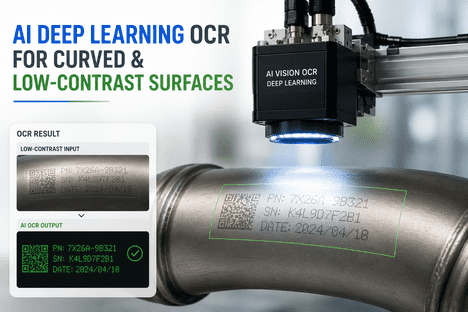
Direct part marks, dot-peened serial numbers, laser-etched lot codes, and embossed characters on cast or molded parts are built to survive the life of the product — but that same durability is what makes them so hard to read. The characters are formed by surface deformation rather than ink, so the contrast between character and substrate is naturally low, and shadows shift unpredictably as the part curves or the lighting angle changes by even a few degrees. Rule-based OCR systems, which depend on fixed thresholds and pre-trained font templates, break down precisely on these surfaces — flat machine vision logic was never designed for curved, reflective, or low-contrast text. AI deep learning OCR solves this differently: instead of matching a rigid template, it learns the visual pattern of each character directly from sample images, adapting to curvature, glare, and surface texture the way a person reading a worn engraving would.
Read Codes Rule-Based OCR Cannot
iFactory Vision OCR Inspection reads dot-peened, laser-etched, embossed, and reflective codes that defeat fixed-threshold machine vision — without retraining a new font for every part change.
AI Deep Learning OCR for Curved & Low-Contrast Surfaces: Reading What Rule-Based Vision Cannot
A technical look at why direct part marks, dot peen codes, and embossed text defeat traditional machine vision OCR — and how deep learning-based reading restores traceability across the toughest marking types on your line. Book a Demo to see iFactory Vision OCR Inspection read your actual parts.
Six Reasons Rule-Based OCR Fails on Curved & Low-Contrast Surfaces
Traditional OCR relies on fixed thresholds and a pre-built font library, which works well on flat, high-contrast, printed labels — and breaks down almost immediately outside that narrow case. iFactory closes that gap with AI Vision Camera technology running deep learning OCR models trained on your specific parts, marks, and lighting conditions rather than a rigid template. You can Book a Demo to see how it performs on your hardest-to-read marks.
Low-Contrast Direct Part Marks
Cast or machined characters share the exact same material and color as the surrounding part, leaving almost no contrast for a fixed-threshold OCR tool to detect — even though the marking itself is perfectly legible to a trained eye.
Curved & Cylindrical Surfaces
Barrels, pipes, bottles, and rounded housings distort character geometry across the read zone, and the angle of reflection changes continuously along the curve — defeating OCR tools built around a single flat reading plane.
Embossed & Raised Characters
Raised text depends entirely on shadow to be visible, so a few degrees of lighting variation between parts or shifts can change the apparent shape of every character — a problem rule-based edge detection cannot reliably correct for.
Dot Peen & Laser-Etched Marks
These marks are formed by physical surface deformation rather than printed ink, so the camera reads a pattern of tiny indentations or burns rather than a solid character outline, requiring feature recognition rather than simple thresholding.
Reflective & Polished Metal
Glare and specular highlights on polished or coated metal surfaces wash out fixed-threshold OCR logic, producing inconsistent reads on the same part depending on exactly where it sits under the light.
Variable Fonts & Print Wear
Inkjet drift, label wrinkles, worn engravings, and skewed or stretched characters from line-speed variation rarely match a single trained font template, causing rule-based systems to reject otherwise valid codes.
Rule-Based OCR vs. iFactory Vision OCR Inspection: Key Benchmarks
Moving from fixed-threshold OCR to deep learning-based reading produces measurable improvements across the metrics that define traceability reliability on difficult marking types.
| KPI | Traditional Rule-Based OCR | iFactory Vision OCR Inspection | Improvement |
|---|---|---|---|
| Read Rate on DPM & Embossed Codes | 40–60% | 95–99% | ~2x improvement |
| Setup Time per New Part or Font | Days of manual font training | Hours, pretrained character library | ~80% faster |
| Performance on Curved Surfaces | Unreliable, frequent re-reads | Consistent single-pass read | Eliminates re-read loops |
| False Reject Rate | High on low-contrast or reflective parts | Low, model adapts to lighting variance | Fewer manual overrides |
| Traceability Record Accuracy | Manual verification often required | Automated, image-linked, audit ready | Full automated traceability |
iFactory Vision OCR Inspection: Four Steps From Raw Image to Verified Read
iFactory does not require a new font template or a lighting redesign for every part variant. Deep learning OCR adapts to curvature, contrast, and marking type directly from sample images, so the same camera setup keeps reading as your part mix changes.
AI Vision Camera Captures the Mark
iFactory's AI Vision Camera captures the read zone regardless of part curvature, surface finish, or marking method — dot peen, laser etch, cast, embossed, or printed — using lighting and exposure tuned for low-contrast and reflective surfaces.
Deep Learning OCR Decodes the Character
A pretrained character library recognizes most alphanumeric text out-of-the-box, requiring only brief upfront training to set the region of interest and character size — and quick retraining on the floor if a new font or supplier change appears.
Validation Against Expected Format
Each decoded result is checked against the expected code structure, lot or serial number pattern, and character confidence grade — flagging low-confidence reads for review instead of silently passing a misread code downstream.
Automated Traceability Logging
The decoded text, match status, confidence grade, and image evidence are written to a single structured record, linking automatically to the relevant work order, batch, or shipment for full audit traceability.
Stop Losing Traceability to Misread Codes
iFactory Vision OCR Inspection connects to your existing line in days — no new lighting rig or font library required. Read every mark, on every surface, the first time.
"We were rejecting nearly a third of our dot-peened engine block serial numbers on the old rule-based OCR system, and every reject meant a manual re-scan or a line stop. iFactory's Vision OCR Inspection read the same marks at 97% on the first pass, including the parts our old system had flagged as unreadable for months. Traceability records that used to require manual verification are now generated automatically with the image attached."
Difficult Surfaces Should Not Mean Unreliable Traceability
Curved housings, reflective metal, and durable direct part marks are not going away — they exist precisely because the marking needs to survive the life of the product. The OCR system reading them needs to be built for that reality rather than fighting against it. By replacing fixed-threshold logic with deep learning models trained on your actual parts, iFactory's Vision OCR Inspection turns dot peen, laser etch, embossing, and reflective surfaces from a recurring traceability problem into a routine, automated read. Facilities looking to eliminate manual OCR overrides and close traceability gaps on their hardest parts can request a live read on their own samples.
Frequently Asked Questions
Q: Why does rule-based OCR struggle with dot peen and laser-etched marks?
Dot peen and laser-etched marks are formed by physical surface deformation rather than printed ink, producing a pattern of tiny indentations or burns instead of a solid character outline. Rule-based OCR depends on fixed contrast thresholds and breaks down on this kind of low-contrast, texture-based marking.
Q: Can deep learning OCR read text on curved or cylindrical parts?
Yes. Because the model learns the visual pattern of each character from sample images rather than relying on a single flat reading plane, it adapts to the changing geometry and reflection angle that occurs as a barrel, pipe, or bottle curves through the read zone.
Q: Does a new part or font require retraining the whole system?
No. A pretrained character library recognizes most alphanumeric text out-of-the-box, so setup typically requires only setting the region of interest and character size. If a supplier or marking method changes, the model can be retrained on the floor with a small new set of sample images.
Q: How does iFactory's Vision OCR Inspection feed into traceability records?
Every decoded read is logged as a structured record containing the decoded text, match status, confidence grade, and the source image, linked automatically to the relevant work order, batch, or shipment for audit-ready traceability without manual data entry.
Q: How fast does the deep learning OCR model return a result?
Decoding typically completes in milliseconds per read, allowing inline verification at full production line speed rather than slowing the line down for end-of-line audits.
Get a Read Rate Assessment on Your Toughest Marks
Send us a sample of your hardest-to-read parts and get a clear picture of how deep learning OCR performs against your current system — no obligation, no pressure.