The single greatest barrier to AI vision adoption in manufacturing has never been the cost of cameras or compute hardware — it has been the assumption that training a deep learning model requires a data science team, thousands of labeled images, months of iteration, and specialized infrastructure that most quality and maintenance organizations simply do not have. iFactory's no-code AI vision model training platform eliminates this barrier entirely: quality engineers and process technicians with no programming experience can train, validate, and deploy a production-ready defect detection model using as few as 200 images, through a guided browser-based interface, in under an hour. The trained model runs on iFactory's pre-configured NVIDIA edge server at the inspection station — delivering sub-100ms real-time inference with no cloud dependency, no coding, and no data science support required. The result is an AI vision deployment timeline measured in days rather than months, and an inspection capability that adapts to new products, new defect classes, and changing process conditions as fast as the quality team can collect representative images. Manufacturing teams evaluating no-code AI vision capabilities regularly choose to Book a Demo to see a model trained live during the demonstration on their own product type.
Why Traditional AI Vision Model Training Blocks Adoption — And What No-Code Changes
The Data Science Bottleneck That Has Kept AI Vision Out of Most Facilities
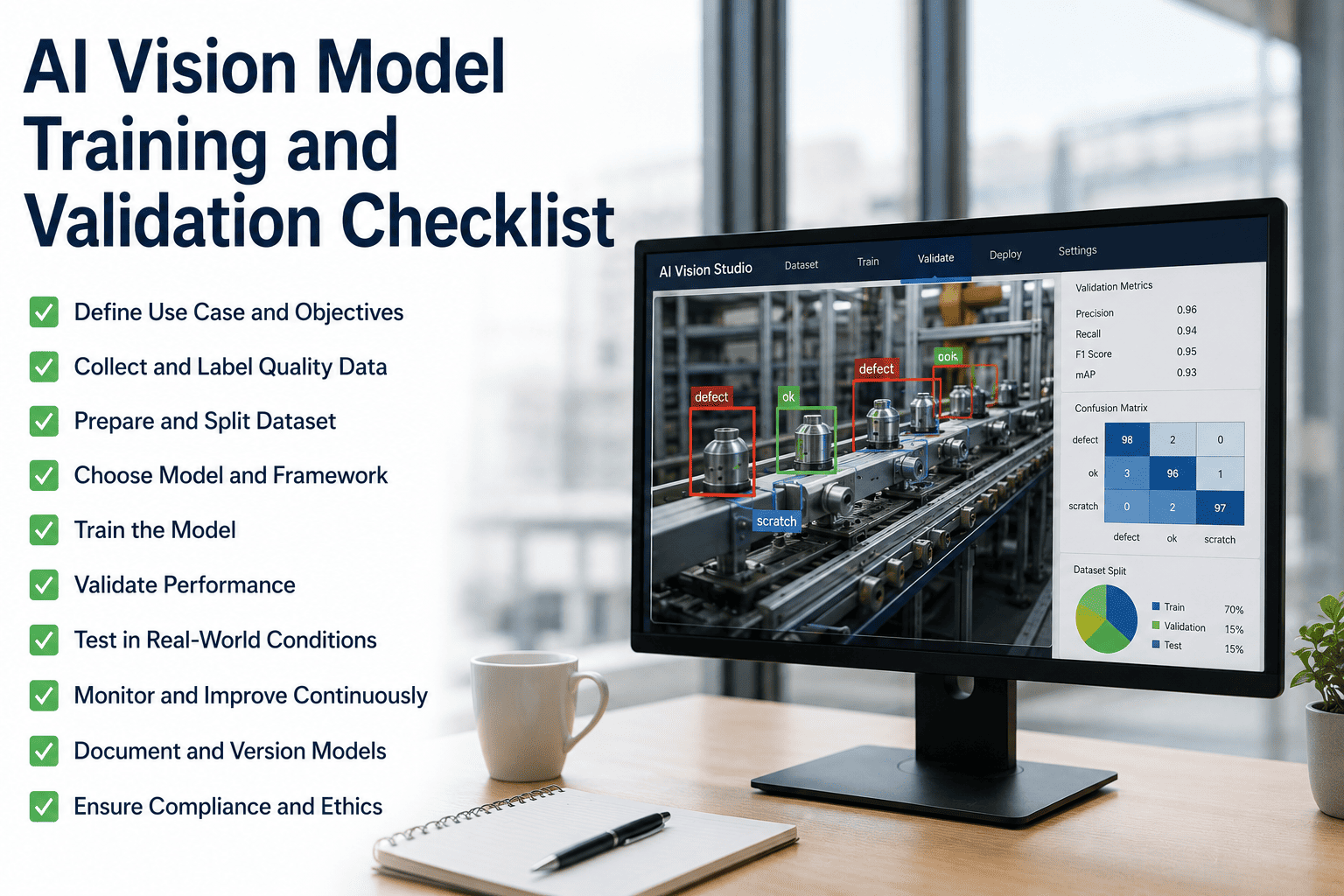
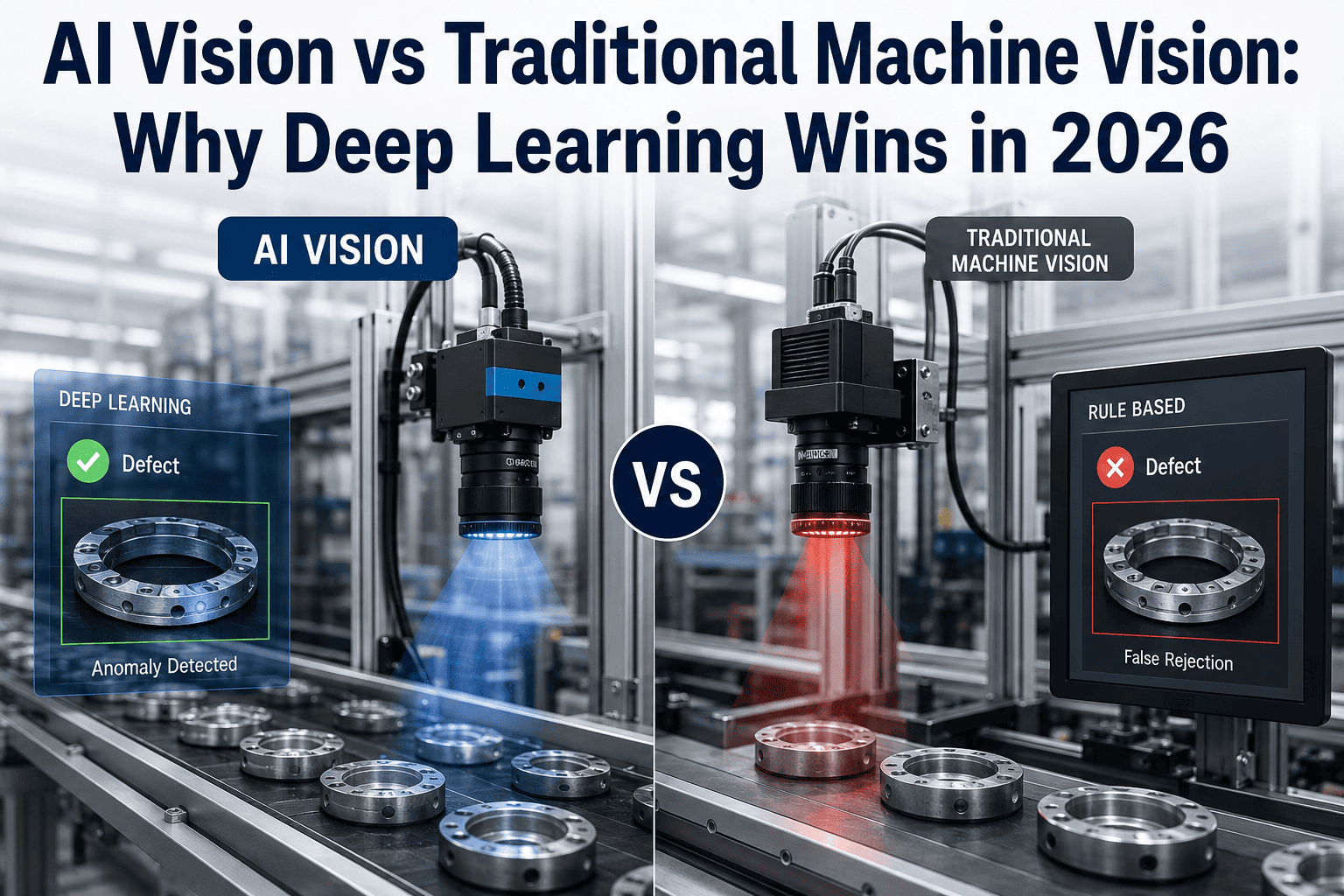
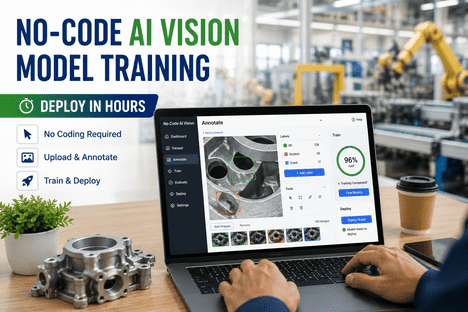
Conventional deep learning model development for industrial vision inspection requires a workflow that most manufacturing organizations cannot sustain internally: collect thousands of labeled defect images per class, hire or contract a machine learning engineer to architect and train the model, configure GPU compute infrastructure for training, iterate through multiple training runs to optimize hyperparameters, validate model performance against held-out test sets, and finally integrate the trained model into an inference pipeline connected to the production camera system. This process typically takes three to six months and costs between $150,000 and $400,000 for a single inspection application when staffing, infrastructure, and integration costs are fully accounted for. For facilities with dozens of product variants, seasonal changeovers, or frequently evolving defect definitions, the traditional model — where each inspection application requires its own development project — is economically impossible to scale. iFactory's AI vision camera platform inverts this entirely. The no-code training interface handles architecture selection, data augmentation, hyperparameter optimization, and model compression automatically — guided by transfer learning from pre-trained industrial vision foundation models that allow accurate classification with far fewer images than training from scratch would require. Quality engineers interact with a visual interface that mirrors familiar workflows: upload images, draw boxes around defects, assign class labels, click train, review validation results, and deploy to the edge server. No command line, no Python, no GPU cluster management.
How iFactory's No-Code Model Training Works: Step by Step
From First Image Upload to Edge Deployment in a Single Session
What No-Code Vision AI Can Inspect: Application Range
Defect Detection, Classification, and Process Monitoring Across Manufacturing
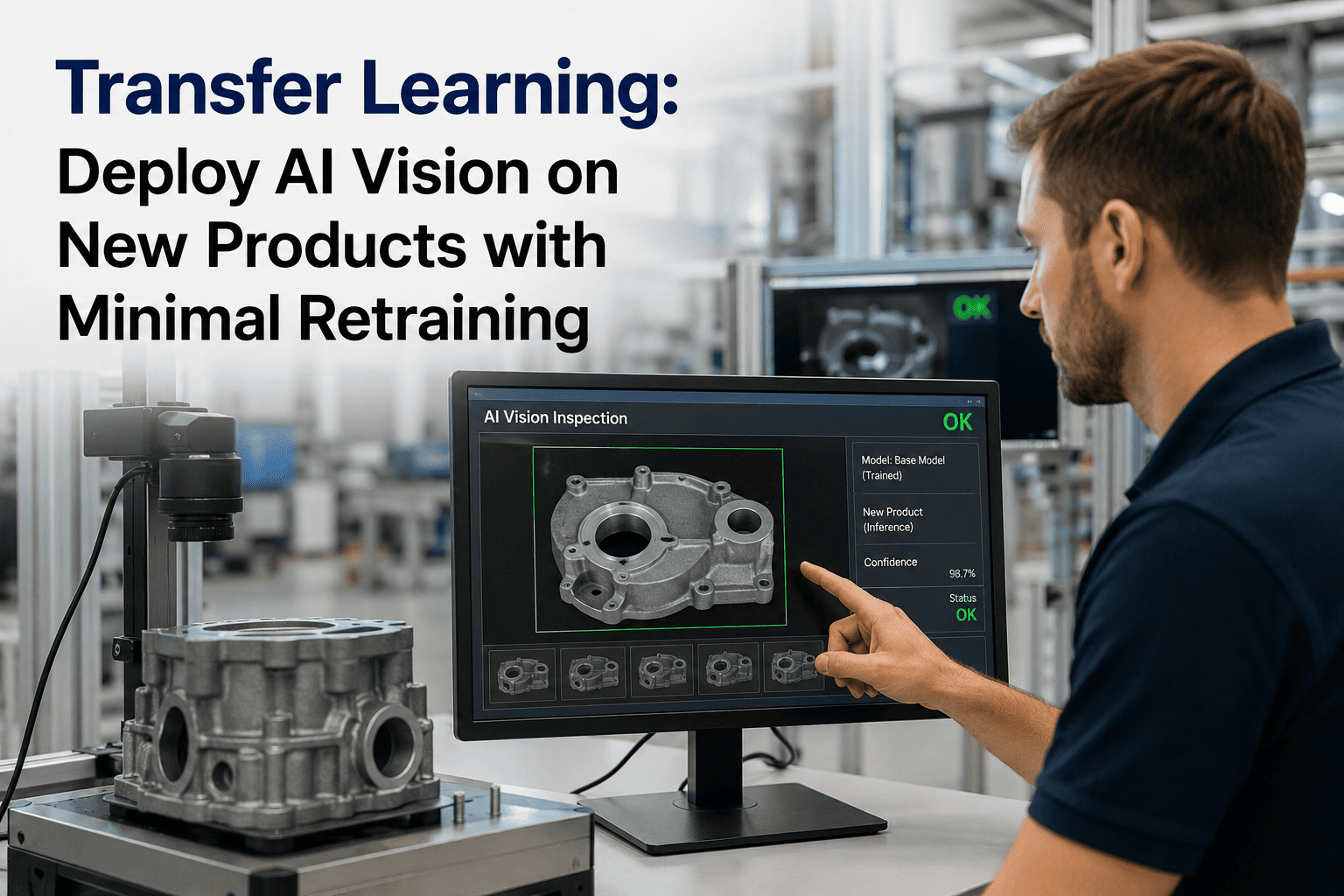
The no-code training approach is not limited to simple pass/fail inspection applications. iFactory's platform supports the full range of industrial vision inspection tasks through the same guided interface, with the model architecture automatically selected based on the inspection task type the quality engineer specifies at the start of the training session. Surface defect detection on metal, plastic, glass, ceramic, and composite materials — including scratches, pits, cracks, discoloration, and contamination — is the most common first application. Component presence and orientation verification for assembly line inspection, dimensional gauging through calibrated camera setups, and label and print quality verification for packaging lines are all supported. PPE compliance monitoring — detecting whether operators are wearing required safety equipment at specific workstations — can be trained in the same no-code environment using positive examples of compliant and non-compliant operator states. For facilities deploying the platform across multiple product lines, models trained on one product variant can be fine-tuned for related variants using a fraction of the original training image count — typically 30–50 additional images per variant — further compressing the time and effort required to extend inspection coverage as the product portfolio evolves.
Surface Defect Detection
Scratch, pit, crack, delamination, discoloration, and contamination detection on any material surface. Typical model training requires 150–300 images per defect class. Bounding box or segmentation annotation locates defects precisely on the part surface for root cause analysis and process correlation.
Assembly Verification
Component presence, correct part type, orientation, and assembly sequence verification. Classification models trained on correct assembly configurations and specific deviation classes detect missing, misaligned, or wrong-part conditions at line speed without fixture-based mechanical gauging.
Print and Label Quality
Label placement, print contrast, barcode readability, date coding, and packaging seal inspection for consumer goods, pharmaceutical, and food and beverage lines. Low-data requirements — often achievable with fewer than 100 images per class — make this an ideal first no-code vision application for facilities new to AI inspection.
PPE and Safety Compliance
Hard hat, safety glasses, high-visibility vest, and glove detection at workstation entry points and high-risk zones. Models trained on facility-specific operator images in the actual workstation lighting conditions deliver higher accuracy than generic PPE models trained on stock photography datasets.
No-Code Model Training Performance: What to Expect
Accuracy, Data Requirements, and Training Time Benchmarks
| Inspection Application | Minimum Images Required | Typical Training Time | Achievable Accuracy | Edge Inference Latency |
|---|---|---|---|---|
| Surface Defect Detection | 200–400 (50–100 per class) | 20–35 minutes | 92–97% mAP on test set | <50ms per frame |
| Assembly Presence / Orientation | 150–300 (50–75 per class) | 15–25 minutes | 95–99% classification accuracy | <40ms per frame |
| Print and Label Quality | 80–200 (40–100 per class) | 10–20 minutes | 96–99% classification accuracy | <30ms per frame |
| PPE Compliance Detection | 200–500 (100–250 per class) | 25–40 minutes | 90–96% detection accuracy | <80ms per frame |
| New Variant Fine-Tuning | 30–80 additional images | 8–15 minutes | Matches base model performance | Same as base model |
These benchmarks represent typical performance on iFactory's pre-configured NVIDIA edge hardware using the no-code training interface. Actual results vary based on defect visual distinctiveness, image quality, lighting consistency, and the complexity of the inspection task. iFactory's application engineers review each pilot use case prior to deployment to confirm that the training data strategy is appropriate for the target accuracy requirements.
Key Benefits of No-Code AI Vision Model Training
Speed, Cost, and Organizational Independence That Traditional AI Development Cannot Match
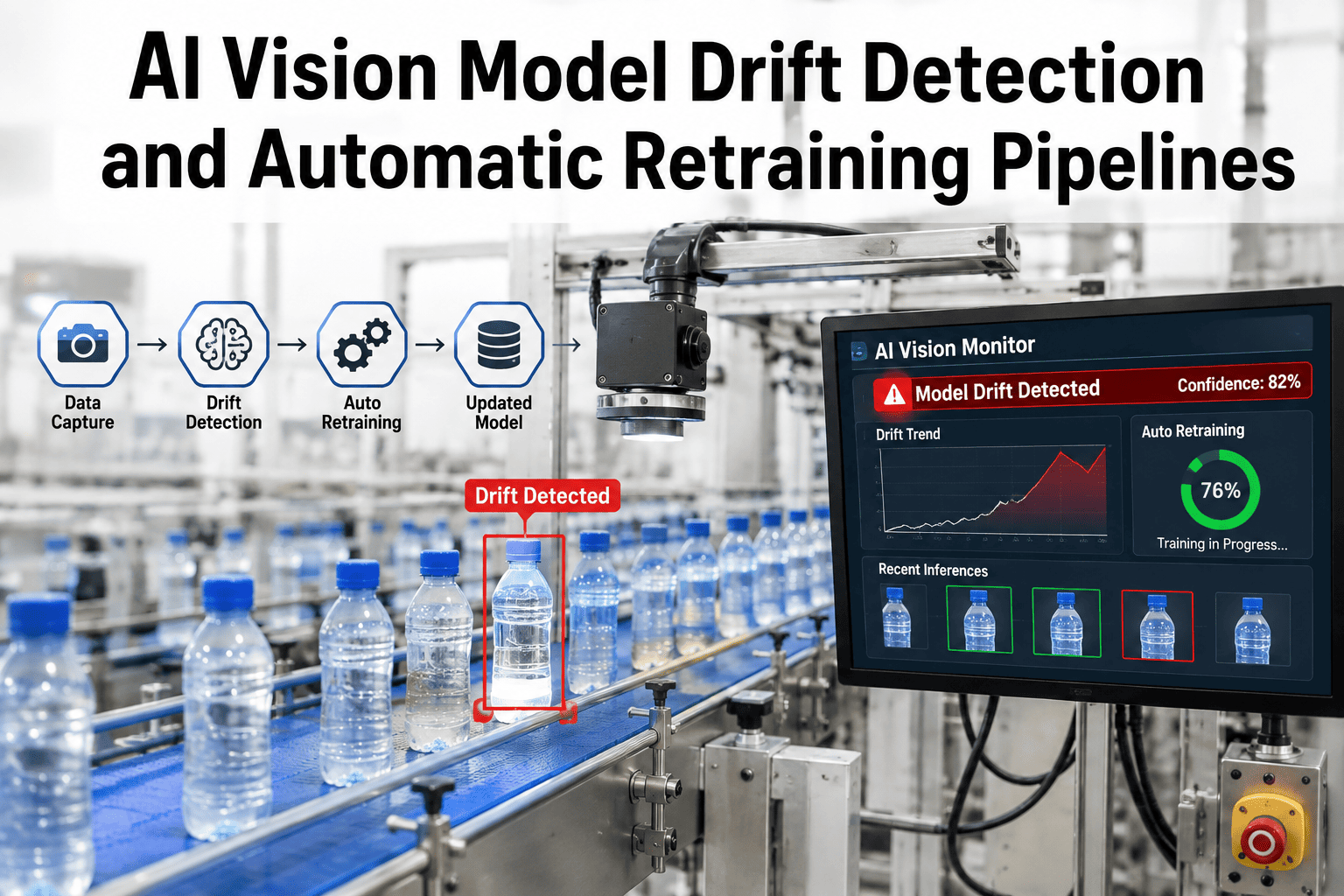
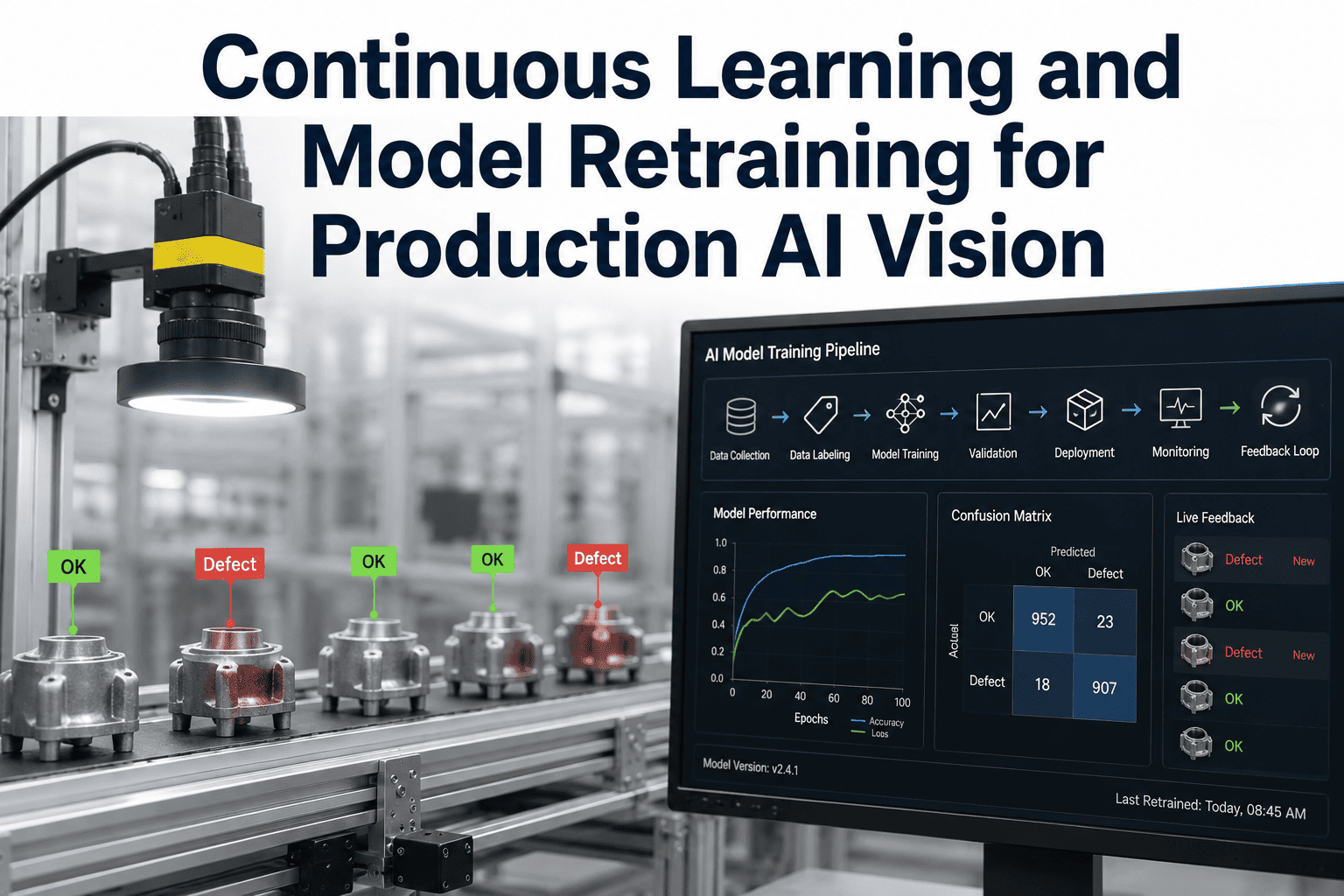
Training a model through iFactory's no-code interface and deploying it to the edge server is only the first half of the value cycle. Once deployed, every detection event from the production inspection session feeds back into the model improvement pipeline — building an image library of real production defects that can be used to retrain the model periodically, improving accuracy as the dataset grows beyond the initial 200-image pilot set. Detection events that cross SPC thresholds automatically generate CMMS work orders with attached defect images, closing the loop between vision inspection and maintenance response without any manual handoff. Quality engineers who want to see this full cycle — from no-code model training through production deployment to CMMS work order generation — demonstrated on their own product images can Book a Demo with iFactory's application engineering team.
Frequently Asked Questions: No-Code AI Vision Model Training
The minimum effective dataset for most industrial inspection applications on iFactory's platform is 200 images total — spread across defect classes and acceptable product examples. This low data requirement is enabled by transfer learning from iFactory's pre-trained industrial vision foundation model, which provides general visual understanding that the new model fine-tunes rather than learning from scratch. Simple binary classification tasks (pass/fail) can achieve production-acceptable accuracy with as few as 80–100 images. More complex multi-class defect detection with fine-grained class distinctions typically benefits from 400–600 images for maximum accuracy. The platform's active learning queue helps identify which additional images will provide the greatest accuracy improvement when the initial model does not meet target performance.
All model training runs on the NVIDIA GPU within the iFactory edge server located at the facility — no training images, annotations, or model weights leave the facility network at any point. The training interface is served locally from the edge server and accessed through the facility intranet from any browser-equipped workstation. This on-premise training architecture satisfies data sovereignty requirements for facilities handling proprietary product IP, regulated inspection data, or classified manufacturing process information. Facilities operating under air-gapped network security mandates can train and deploy new models entirely within the isolated network environment without any external connectivity.
For the vast majority of industrial inspection applications, iFactory's no-code trained models achieve accuracy within 2–4 percentage points of models developed by machine learning engineers with full custom architecture design and hyperparameter optimization — because the automated training pipeline performs the same optimization steps that a data scientist would execute, just without the manual iteration. Applications where the accuracy gap is largest involve extreme class imbalance (very rare defects with fewer than 20 examples), highly subtle visual distinctions that require custom preprocessing, or specialized inspection geometries that benefit from domain-specific model architectures. iFactory's application engineering team reviews each pilot use case before training to identify these situations and recommend appropriate data collection strategies or confirm that the standard no-code approach will meet the target accuracy requirement.
Model updates follow the same no-code workflow as the original training session. The quality engineer opens the training interface, adds new images to the existing annotated dataset — either new defect class examples, product variant images, or corrected annotations for misclassified production images — and initiates an incremental retraining run. Incremental retraining from an existing model checkpoint is significantly faster than training from scratch: most updates complete in 8–15 minutes. The updated model is validated against the combined original and new test set before deployment, ensuring that adding new capability does not degrade performance on the original defect classes. The complete model version history is retained in the platform, enabling rollback to any previous version if an update does not perform as expected in production.
Yes — every model trained and deployed through iFactory's no-code platform is a first-class citizen of the edge AI inference pipeline, which means it automatically participates in the platform's CMMS integration layer. Detection events from no-code trained models trigger the same OPC-UA and REST API work order creation flow as any other iFactory inspection model — generating structured CMMS work orders with attached defect images, asset context, severity classification, and SPC status when configured thresholds are crossed. CMMS integration configuration is completed once during the initial deployment commissioning and applies automatically to all models trained and deployed subsequently. Book a Demo to see a no-code trained defect detection model generating automated CMMS work orders in a live demonstration environment.