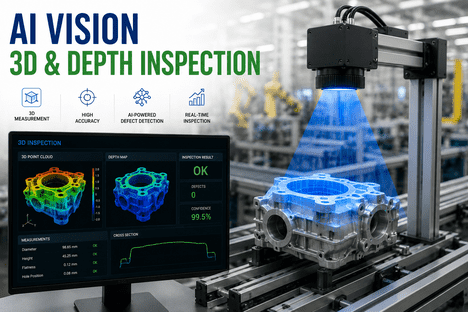
A flat 2D camera reduces every part it inspects to a single plane of pixels — it can compare color, contrast, and edges, but it has no concept of height, depth, or volume. That blind spot lets real defects through: a dent that does not change color, a warped panel that still looks flat from directly above, a gap between two mating parts, or a container that is under-filled by a few millimeters. AI vision 3D and depth inspection closes that gap by adding a third dimension to the inspection data itself. Using structured light and laser triangulation, iFactory's AI Vision Camera captures the actual height, depth, and surface geometry of every part, then runs that point cloud data through deep learning models trained to recognize dimensional defects a flat image was never built to see. Book a Demo to see how Vision Measurement fits into your current inspection line.
What Is AI Vision 3D & Depth Inspection?
AI vision 3D and depth inspection combines structured light or laser triangulation hardware with deep learning analysis to measure the actual physical shape of a part, rather than just its appearance. A calibrated light pattern is projected onto the surface, and a camera captures how that pattern bends and shifts across the part's contours. From that distortion, the system reconstructs a precise height and depth map — and at higher resolutions, a full 3D point cloud — for every inspected unit. Where a standard machine vision camera answers "does this look right," a 3D and depth system answers "is this the right shape, height, and volume," which is a fundamentally different and often more important question for dimensional quality.
The AI layer is what makes that 3D data actionable at production speed. Deep learning models trained on point cloud and depth-map data learn to recognize the specific signature of a dent, a warp, a short fill, or a misaligned assembly within milliseconds, then classify and localize the defect on the part. Because the underlying measurement is geometric rather than purely visual, this approach holds up on surfaces that defeat conventional 2D cameras — polished metal, glass, dark plastics, and other reflective or low-contrast materials where lighting and color variation would otherwise produce false readings.
Why Modern Plants Need 3D & Depth Inspection Now
Tolerances are tighter and lines are faster than they were even a few years ago, and a one-millimeter deviation that used to pass unnoticed now triggers rework, rejection, or a customer complaint. Manual gauging and spot-check sampling cannot keep pace with that level of precision across every unit on a high-speed line, and a 2D camera physically cannot measure depth, volume, or surface flatness no matter how it is configured. 3D and depth inspection answers both pressures at once — full coverage instead of sampling, and a measurement type that 2D vision was never able to provide in the first place.
Core Capabilities of AI-Powered 3D & Depth Inspection
Before vs. After: 2D vs. 3D AI Vision Inspection Impact
The practical difference between a flat 2D inspection camera and an AI-powered 3D and depth system shows up most clearly on the defects and measurements that depend on geometry rather than appearance — dimensional accuracy, volume, and surfaces that 2D lighting struggles to read consistently.
| Performance Area | Traditional 2D Vision Inspection | iFactory Vision Measurement (3D) | Measurable Impact |
|---|---|---|---|
| Defect Visibility | Color and contrast based — misses dents, warpage, depth errors | Full height, depth, and volume data captured via structured light | Catches sub-millimeter deviations 2D misses |
| Dimensional Verification | Manual gauging or periodic sampling | 100% in-line automated dimensional measurement | Eliminates sampling coverage gaps |
| Reflective & Textured Surfaces | Struggles with glare, glass, and polished metal | Laser triangulation unaffected by surface color or reflectivity | Reliable readings on metals, glass, plastics |
| Volume & Fill-Level Checks | Not measurable from a flat 2D image | Real-time volumetric calculation from point cloud data | Prevents under-fill and over-fill shipments |
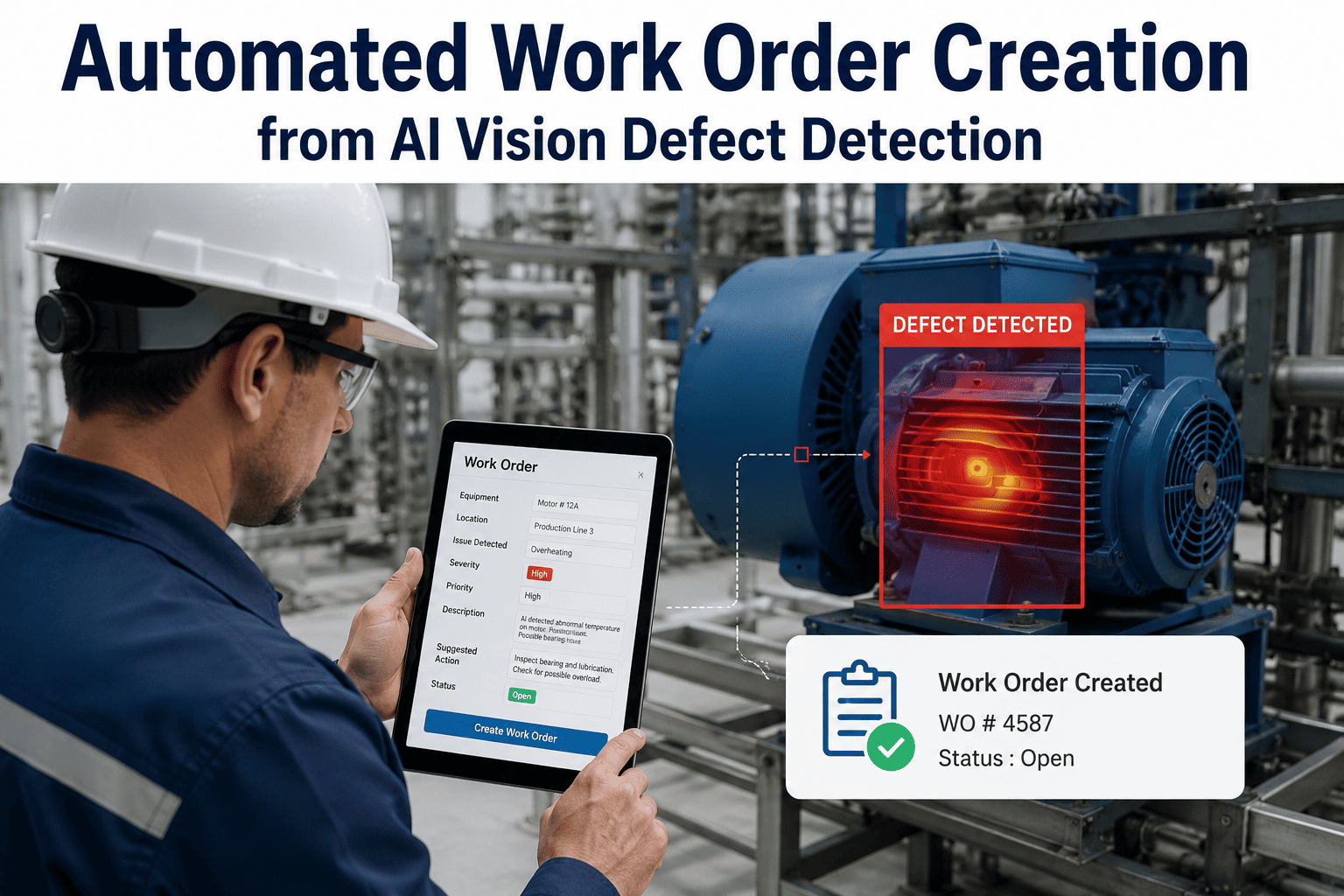
| Out-of-Tolerance Response | Manual flagging and delayed correction | Automatic CMMS work order on geometric deviation | Faster correction, reduced scrap |