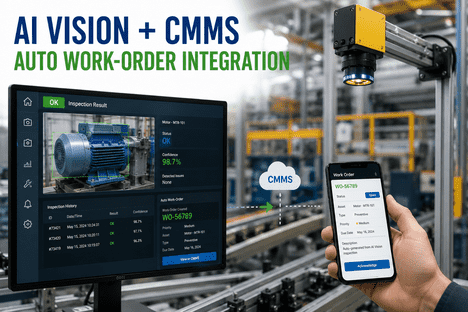
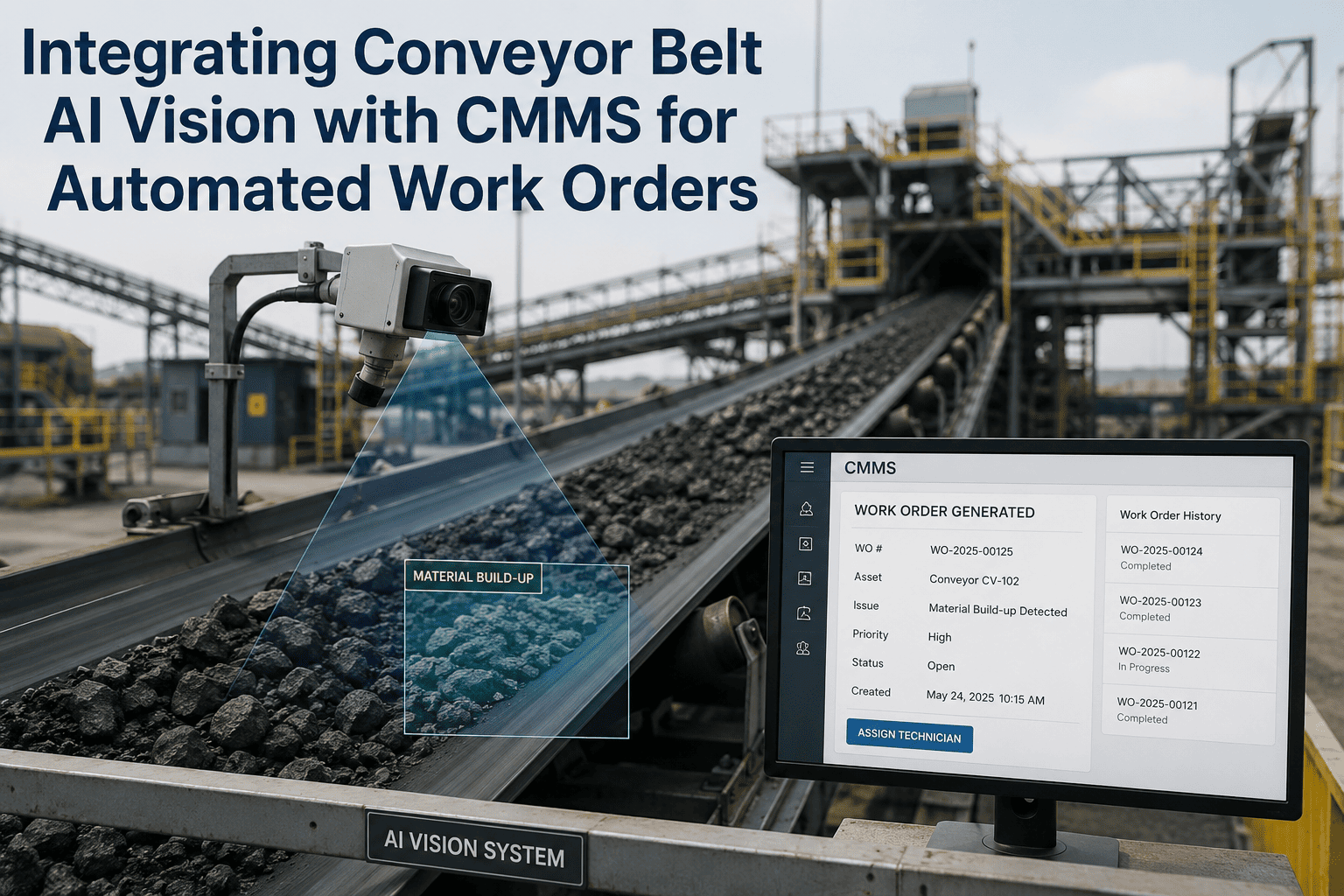
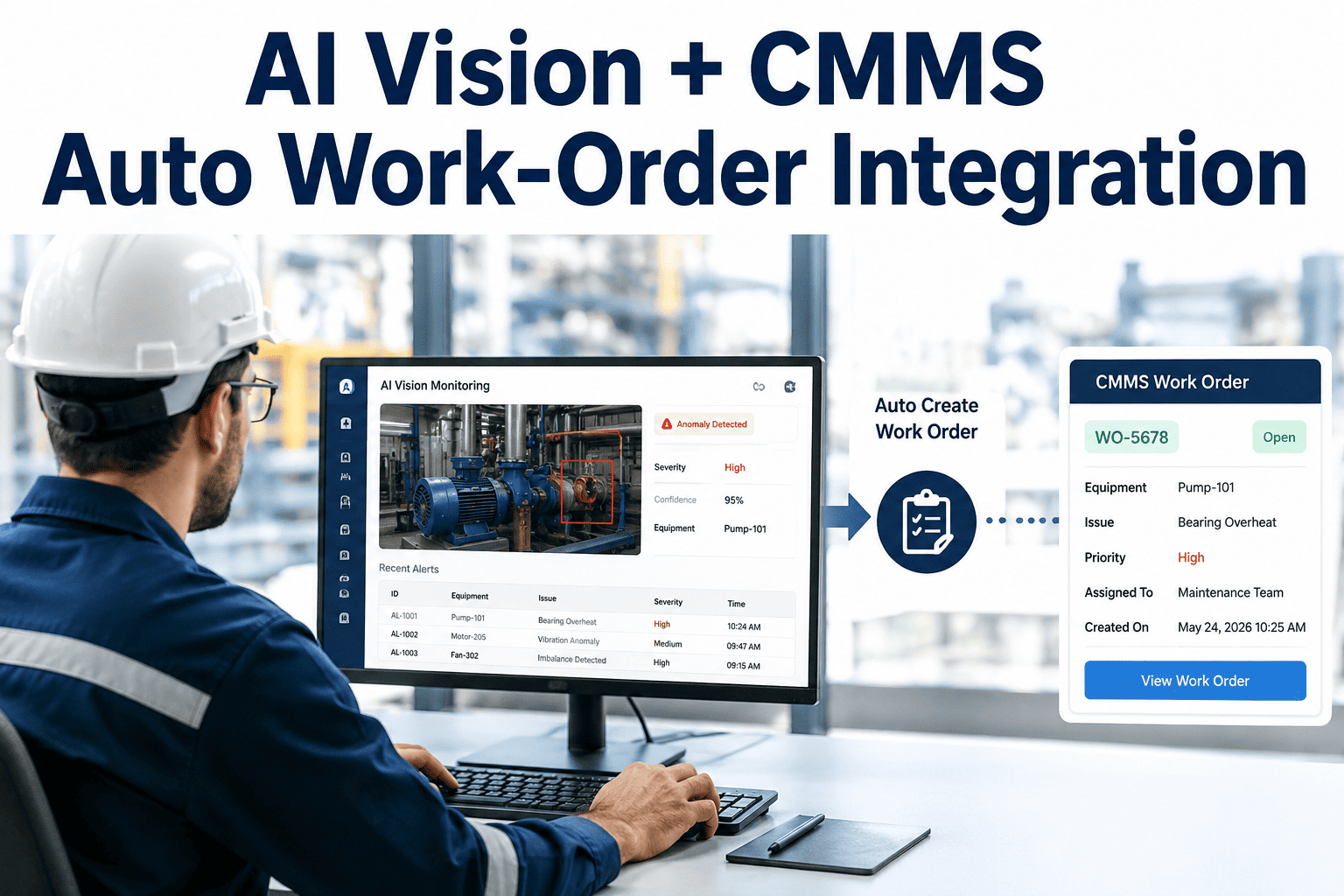
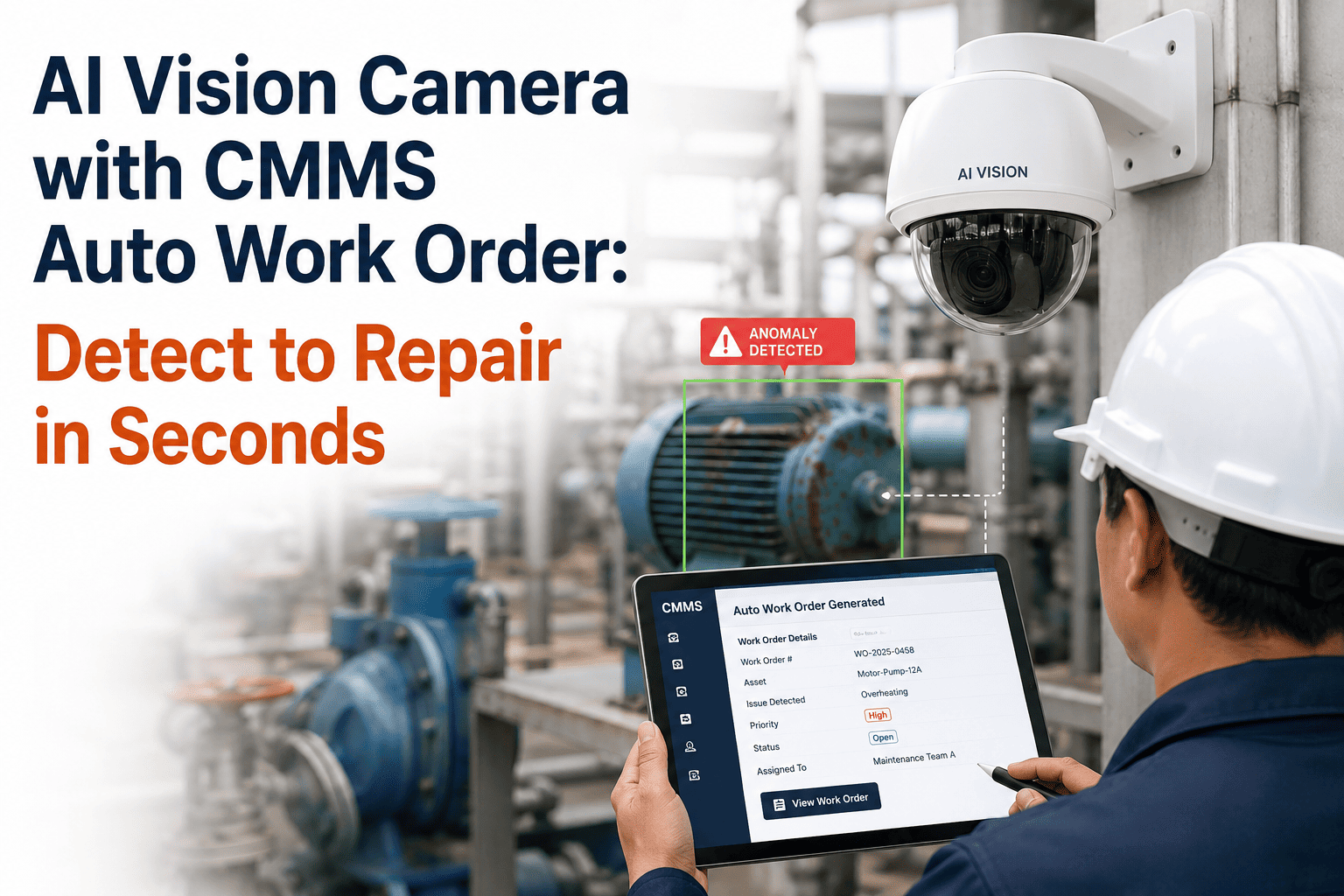
When an AI vision system detects a defect, the inspection event is only valuable if it triggers a documented maintenance response. In most manufacturing facilities today, that connection does not exist automatically — a quality inspector sees a defect alert on a screen, writes a note, sends an email, and a maintenance planner manually creates a work order hours or days later. iFactory's Vision Workflow Automation closes this gap entirely: every defect detection, threshold exceedance, or anomaly classification generated by the AI vision camera platform is automatically converted into a structured CMMS or EAM work order — with defect images, location data, severity classification, and asset correlation attached — without any human data entry in between. The result is a maintenance operation where every vision-detected problem becomes a documented corrective action, every corrective action feeds the audit trail, and the entire inspection-to-maintenance cycle is measurable, traceable, and audit-ready from the moment a defect is first seen. Organizations evaluating this capability regularly choose to Book a Demo with iFactory's integration engineering team to see the full work order automation workflow demonstrated on their CMMS platform.
iFactory Vision Workflow Automation — CMMS & EAM Integration
From Defect Detection to CMMS Work Order — Automatically, Every Time.
iFactory's AI vision platform converts every defect detection, SPC threshold breach, and anomaly alert into a structured CMMS or EAM work order with attached imagery, asset context, and audit trail — through OPC-UA and REST API integration with your existing maintenance management system.
100%
Vision detection-to-work-order conversion rate — no defect alert falls through without a documented maintenance response
<60s
Time from AI vision defect detection to structured CMMS work order creation with attached defect imagery and asset context
40%+
Reduction in mean time to repair when maintenance teams receive AI vision work orders versus manual defect escalation processes
Zero
Manual data entry required between AI vision defect detection and CMMS work order creation in iFactory's integrated workflow
Why the Gap Between Vision Detection and CMMS Work Order Is the Most Expensive Delay in Maintenance
The Manual Handoff That Costs More Than the Defect Itself
The maintenance value of an AI vision system is realized only when a detected defect becomes a completed corrective action in the CMMS — with a timestamped work order, a documented repair, and a closed audit trail. Every hour between detection and documented response is an hour where a defective product may continue shipping, a degrading asset may continue operating, or a regulatory inspection record has a gap that an auditor will find. In facilities running vision inspection systems without CMMS integration, the defect-to-work-order handoff happens through email threads, verbal communication, and manual work order entry by maintenance planners who receive secondhand information about what the vision system detected and where. By the time a technician arrives at the asset, the defect context — the original image, the severity score, the detection timestamp, the SPC position — has been reduced to a brief note in a manually created work order. iFactory's AI vision camera platform eliminates this degradation entirely. The integration layer connects the vision inference engine directly to the CMMS API, passing the full detection record — image, classification, confidence score, asset ID, location map, and SPC context — as structured data fields in the automatically created work order. The maintenance planner sees everything the vision system saw. The technician arrives with complete context. The audit trail is complete from detection to closure.
How iFactory's Vision-to-CMMS Integration Works
Architecture, Triggers, and Work Order Data Structure
01
AI Vision Detection Event and Classification
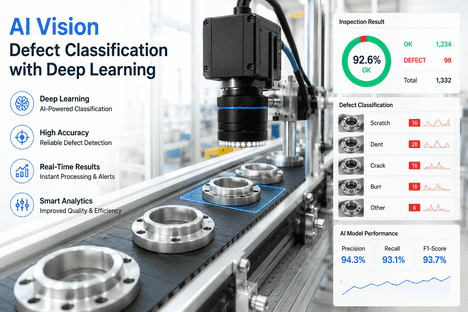
iFactory's edge AI vision platform captures production line imagery at line speed and runs deep learning inference on the NVIDIA edge server, classifying each frame for defect type, severity, location, and SPC position relative to control limits. Detection events that meet configurable severity or frequency thresholds are flagged for work order generation. Thresholds are set per defect class and asset, ensuring that routine process variation within control limits does not generate maintenance noise while true anomalies and degradation signals always produce a documented response. The detection record — including the original defect image, bounding box annotation, defect classification, confidence score, and SPC status — is packaged as a structured payload ready for CMMS transmission.
02
Integration Layer: OPC-UA and REST API Transmission
The iFactory integration layer transmits the detection payload to the target CMMS or EAM system through OPC-UA or REST API, depending on which protocol the target system supports. Pre-built connectors are available for major CMMS and EAM platforms including IBM Maximo, SAP Plant Maintenance, Infor EAM, Fiix, eMaint, and MP2. Custom REST API mappings are developed during commissioning for proprietary or industry-specific CMMS platforms. The integration runs on-premise from the edge server, meaning no detection data traverses external networks — a requirement for facilities operating under ITAR, CMMC, or air-gapped network security mandates. All transmission is logged with timestamp and acknowledgment confirmation, creating an auditable record of every detection-to-transmission event.
03
Automated Work Order Creation in CMMS or EAM
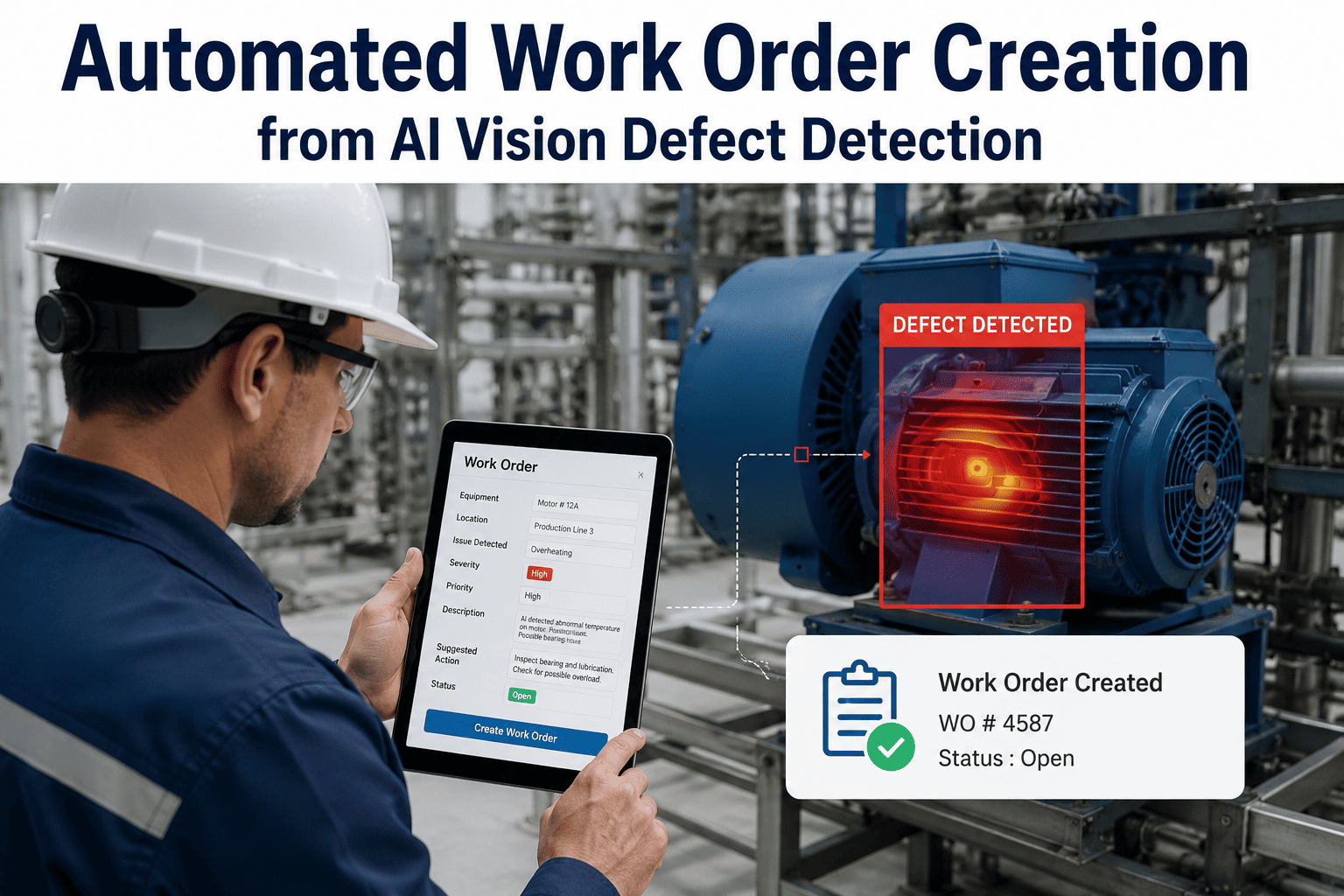
The CMMS receives the detection payload and creates a structured work order with fields populated from the vision detection record: asset ID and location, defect classification and severity, detection timestamp, attached defect image, SPC chart context, and recommended corrective action category based on defect type mapping configured during deployment. Work order priority is set automatically based on defect severity and asset criticality classification in the CMMS asset registry — critical assets with high-severity defects generate priority-1 work orders routed directly to the on-call maintenance technician, while lower-severity findings on non-critical assets enter the standard backlog queue for planning. The automated work order contains more structured context than most manually created corrective maintenance work orders — improving technician first-time-fix rates by providing complete fault context before the technician leaves the maintenance office.
04
Corrective Action Execution and Work Order Closure
The maintenance technician receives the work order, reviews the attached defect imagery and context, executes the corrective action, and closes the work order in the CMMS with labor time, parts consumed, root cause code, and resolution notes. Closure data flows back to iFactory's analytics layer, linking the corrective action outcome to the original vision detection event. This closed-loop data connection enables defect recurrence analysis — identifying patterns where specific defect types recur at specific assets after specific maintenance actions — and informs both vision model refinement and preventive maintenance program optimization. The complete chain from vision detection to work order creation to corrective action closure to outcome analysis is recorded in the CMMS and accessible to quality engineers, maintenance planners, and compliance auditors as a single, traceable maintenance event record.
05
Audit Trail Generation and Compliance Record Export
Every vision-triggered work order — from detection through closure — generates an immutable audit trail record in the CMMS that is retrievable on demand for regulatory and quality audits. The audit record includes the original defect image, detection timestamp, work order creation timestamp, technician assignment, corrective action taken, parts consumed, closure timestamp, and outcome code. For facilities under ISO 9001, ISO 13485, AS9100, or FDA quality management requirements, these records constitute the inspection and corrective action documentation that auditors request as evidence of systematic quality defect response. iFactory's compliance export function packages vision-triggered work order records in the format required by specific audit standards, eliminating the manual record compilation that typically consumes days of quality engineering time before each audit cycle. Compliance and quality engineers building this capability regularly
Book a Demo to see how the audit trail maps to their specific quality management framework requirements.
CMMS and EAM Platform Compatibility
Pre-Built Connectors and Custom API Integration
iFactory's vision-to-CMMS integration layer is designed to connect with any CMMS or EAM platform that exposes a REST API or OPC-UA interface — which covers virtually every enterprise maintenance management system currently deployed in manufacturing environments. Pre-built, tested connectors are available for IBM Maximo, SAP Plant Maintenance, Infor EAM, Oracle EAM, Fiix, eMaint, Limble CMMS, MP2, and Maintimizer, with connector libraries that map iFactory's detection payload fields to each platform's native work order data structure. For proprietary or industry-specific CMMS platforms, iFactory's integration engineering team develops custom REST API mappings during the deployment commissioning phase — typically a two-to-four-week process that produces a tested, production-ready integration alongside the vision system deployment itself. The integration does not require any modification to the existing CMMS configuration, user workflows, or data schema. Maintenance planners and technicians continue working in the same CMMS interface they use for all other work orders — they simply receive additional work orders that were created by the vision system rather than by a human, with richer attached context than manually created work orders typically carry. CMMS administrators see vision-triggered work orders in the same backlog, planning, and reporting views as all other work order types, with a configurable origin tag that identifies the source as AI vision detection for reporting and trend analysis purposes.
| CMMS / EAM Platform |
Integration Method |
Work Order Fields Populated |
Connector Status |
| IBM Maximo |
REST API (Maximo Application Framework) |
Asset ID, location, defect class, priority, description, attached image, SPC status |
Pre-built connector — production ready |
| SAP Plant Maintenance |
REST API / BAPI / RFC |
Functional location, equipment ID, order type, priority, long text, DMS attachment |
Pre-built connector — production ready |
| Infor EAM |
REST API (Infor OS) |
Equipment code, location, work order class, priority, description, attachments |
Pre-built connector — production ready |
| Fiix CMMS |
REST API (Fiix API v3) |
Asset, site, category, priority, description, attached image, custom fields |
Pre-built connector — production ready |
| eMaint / Fluke CMMS |
REST API |
Asset, location, problem type, priority, description, attachments |
Pre-built connector — production ready |
| Oracle EAM / Cloud |
REST API (Oracle Fusion) |
Asset number, organization, work order type, priority, description, DMS document |
Pre-built connector — production ready |
| Limble CMMS |
REST API |
Asset, location, work request type, priority, description, photo attachment |
Pre-built connector — production ready |
| Proprietary / Custom CMMS |
Custom REST API mapping |
Configurable field mapping to any REST-accessible work order schema |
Custom integration — 2–4 week commissioning |
Work Order Data Structure: What AI Vision Sends to Your CMMS
More Context Per Work Order Than Any Manually Created Corrective Action
The quality of a maintenance work order determines the quality of the corrective action it produces. A work order that says "check machine — quality issue reported" sends a technician to an asset without knowing what to look for, where the problem is located, how severe it is, or whether it has been seen before. A vision-triggered work order from iFactory sends the technician with the original defect image annotated with bounding boxes, the defect classification and confidence score, the SPC chart showing where the defect density sits relative to control limits, the asset location map with the camera zone highlighted, the recommended corrective action category based on defect type mapping, and the historical recurrence count for this defect class on this asset over the past 30 days. This level of fault context reduces diagnostic time at the asset, improves first-time-fix rates, and produces better corrective action closure documentation because technicians are responding to a specific, characterized fault rather than an ambiguous symptom report. The structured data payload that iFactory transmits to the CMMS includes detection timestamp, camera ID and zone, asset ID from the plant asset registry, defect classification label, defect severity score, bounding box coordinates, SPC position, lot or batch ID if production traceability is enabled, recommended work order priority based on criticality mapping, and the full-resolution defect image with annotation overlay. Every field is configurable during deployment to match the target CMMS work order schema and the facility's maintenance workflow conventions.
Defect Image + Annotation
The original full-resolution defect image with AI-generated bounding box annotation, defect class label, and confidence score is attached directly to the CMMS work order as a document record — giving the technician a visual reference that eliminates ambiguity about what was detected and where on the asset surface it appeared.
Asset and Location Context
The vision-triggered work order is linked to the specific asset record in the CMMS asset registry, with camera zone and production line location data that maps directly to the facility floor plan. Technicians navigate to the exact location without requiring verbal direction or additional communication from the quality team.
SPC Status and Trend Context
The work order includes the SPC position of the detection event — whether it represents an isolated exceedance or part of a trending shift in defect density — giving the maintenance planner the process context needed to distinguish between a one-time corrective action and an investigation into a developing equipment degradation pattern.
Production Batch Traceability
For facilities with MES integration, the vision-triggered work order includes the lot or batch ID of the production run in which the defect was detected — enabling quality engineers to link the corrective maintenance action to the specific production batch for customer notification, hold, or recall decisions where required by quality management procedures.
The 5 Maintenance Outcomes Vision-to-CMMS Integration Delivers
From Faster Response to Predictive Maintenance Program Intelligence
Outcome 01
Zero Defect Escapes From Detection to Documentation
In manual defect escalation processes, alerts are missed, emails are overlooked, and defects detected on one shift are not communicated to the maintenance team until the next shift meeting. Vision-to-CMMS integration eliminates this class of defect escape entirely — every detection event above the configured threshold generates a work order in the CMMS within seconds, regardless of time of day, shift change, or operator availability. The CMMS work order queue becomes the single source of truth for all detected defects requiring maintenance response, with no dependency on human communication chains to initiate action.
Outcome 02
40%+ Reduction in Mean Time to Repair
Facilities that replace manual defect escalation with automated vision-triggered work orders consistently report mean time to repair reductions of 40% or more within the first six months of integration deployment. The reduction comes from three sources: faster work order creation (seconds versus hours), richer fault context that reduces diagnostic time at the asset, and elimination of the back-and-forth communication between quality and maintenance teams that consumes technician time before a repair even begins. The structured work order with attached imagery and asset context allows skilled technicians to arrive at the asset with a repair hypothesis already formed — reducing exploratory diagnostic time to near zero for known defect classes.
Outcome 03
Audit-Ready Corrective Action Records Without Manual Compilation
Quality management systems under ISO 9001, ISO 13485, AS9100, and FDA 21 CFR Part 820 require documented corrective action records for every quality defect — with evidence of detection, response, root cause, and resolution. Vision-triggered CMMS work orders produce this documentation automatically as a byproduct of the maintenance workflow. The audit record is complete from the moment the vision system detects the defect to the moment the technician closes the work order. Audit preparation for quality management system reviews requires retrieval of existing records rather than manual compilation from multiple disparate sources — typically reducing quality audit preparation time by 50-70% at facilities where vision-triggered work orders replace manual defect escalation processes.
Outcome 04
Defect Recurrence Analysis That Drives Preventive Maintenance Improvement
The closed-loop data connection between vision detection events and CMMS work order closure records enables defect recurrence analysis that was impossible when detection and maintenance records lived in separate systems. iFactory's analytics layer identifies patterns in the linked dataset: which defect classes recur at what frequency on which assets after which corrective actions — revealing whether corrective maintenance is actually resolving the root cause or only addressing symptoms that will recur. This intelligence feeds directly into preventive maintenance program improvement, identifying assets where a PM task frequency should be increased, decreased, or converted from time-based to condition-based scheduling. Maintenance engineers using this capability regularly
Book a Demo to see the recurrence analysis dashboard demonstrated on their defect type portfolio.
Outcome 05
Predictive Maintenance Triggering From Vision-Detected Degradation Signals
Certain defect patterns detected by the AI vision system represent equipment degradation signals rather than product quality failures — a gradual increase in edge chipping defect density indicating tooling wear, a drift in coating thickness variation indicating applicator degradation, an increase in solder joint anomaly frequency indicating reflow profile drift. When these degradation patterns cross configurable trend thresholds, iFactory generates predictive maintenance work orders in the CMMS — scheduling a planned maintenance intervention before the degradation produces a line-stoppage failure. This capability converts the vision inspection system from a product quality tool into an equipment health monitoring tool simultaneously, generating predictive maintenance value from the same camera infrastructure that delivers quality inspection value.
Vision Workflow Automation · CMMS Integration · Corrective Action Automation
See How iFactory Connects Your AI Vision System to Your CMMS in a Live Demo.
iFactory's engineering team will walk through the complete detection-to-work-order workflow on your CMMS platform — showing exactly how defect detection events become structured, audit-ready maintenance records without any manual data entry in between.
Frequently Asked Questions: AI Vision and CMMS Work Order Integration
Which CMMS and EAM platforms does iFactory integrate with out of the box?
iFactory provides pre-built, tested connectors for IBM Maximo, SAP Plant Maintenance, Infor EAM, Oracle EAM, Fiix, eMaint, Limble CMMS, and MP2. These connectors map iFactory's vision detection payload to each platform's native work order data structure without requiring modification to the CMMS configuration. For proprietary or custom CMMS platforms with a REST API, iFactory's integration engineering team develops custom field mappings during the commissioning phase — typically a two-to-four-week process completed alongside the vision system deployment itself.
How quickly does a CMMS work order appear after a defect is detected?
From AI vision detection event to CMMS work order creation takes under 60 seconds in standard integration deployments. The detection payload is generated by the edge inference engine within 100ms of frame capture, transmitted to the CMMS integration layer immediately, and the work order is created in the CMMS within the API response time of the target platform — typically 10–30 seconds. The complete detection-to-work-order timeline depends on CMMS API response latency, but all pre-built connectors are configured to achieve sub-60-second end-to-end timing under normal network conditions within the facility intranet.
Does the integration require modifications to our existing CMMS setup?
No — iFactory's integration layer connects to the CMMS through its existing API endpoints without requiring schema changes, workflow modifications, or configuration changes to the CMMS itself. Maintenance planners and technicians continue working in the same CMMS interface and workflows they use for all other work order types. The only CMMS-side configuration involved is adding the iFactory integration service account with work order creation permissions and, optionally, configuring a work order origin tag to identify vision-triggered work orders in planning and reporting views. All integration logic and field mapping configuration resides on the iFactory edge server side.
What quality management compliance standards does the vision-triggered work order audit trail support?
Vision-triggered work order records from iFactory's integration provide audit evidence for corrective action and inspection documentation requirements under ISO 9001, ISO 13485 (medical devices), AS9100 (aerospace), IATF 16949 (automotive), and FDA 21 CFR Part 820 (medical devices). The audit record — original defect image, detection timestamp, work order creation and assignment record, corrective action taken, parts consumed, and closure timestamp — constitutes the documented quality defect response record that quality management system auditors request as evidence of systematic defect control. Compliance export functions package these records in the format required by specific audit standards.
Can iFactory's integration generate predictive maintenance work orders, not just corrective ones?
Yes — iFactory's integration generates both corrective and predictive maintenance work orders depending on the nature of the vision detection event. Defects that represent immediate product quality failures generate corrective work orders with high priority. Defect patterns that represent equipment degradation signals — tooling wear trends, process drift indicators, increasing anomaly frequency — generate predictive maintenance work orders with scheduled intervention timing based on degradation rate and asset criticality. The distinction between corrective and predictive work order types is configured per defect class during deployment commissioning, and maintenance planners can adjust threshold and classification rules through the iFactory configuration interface without requiring a system update. Book a Demo to see both corrective and predictive work order generation demonstrated on realistic production defect scenarios.
iFactory Vision Workflow Automation — Turnkey CMMS Integration
Turn Every Defect Detection Into a Documented Maintenance Action. Automatically.
iFactory's AI vision platform integrates with your CMMS through OPC-UA and REST API to convert every detection event into a structured work order with attached imagery, asset context, and audit trail — zero manual data entry, zero defect escapes, complete corrective action documentation from day one.