Standard machine vision cameras see the world the same way the human eye does — three color channels, red, green, and blue, reflected off a surface. That is enough to spot a scratch, a misaligned label, or a broken part, but it is blind to what a material is actually made of. Contamination hidden beneath a coating, a foreign plastic fragment the same color as the product around it, moisture variation inside a package, or a subtle shift in chemical composition all pass an RGB camera without a flag. AI hyperspectral vision closes that gap. By capturing light across dozens of narrow spectral bands — well beyond what the human eye or a standard camera can register — and running that data through deep learning models trained for material sensing, hyperspectral inspection identifies contamination, verifies composition, and catches defects that would otherwise reach the next process step or the customer undetected. Book a Demo with iFactory to see how AI-driven hyperspectral vision fits into your existing quality control line.
See Contamination, Composition, and Defects Invisible to Standard Cameras
iFactory's Vision Anomaly Detection pairs spectral sensing with deep learning models to flag contaminants, material variation, and quality defects the moment they appear on the line — not after the batch ships.
Why Hyperspectral Imaging Sees What RGB Cameras Cannot
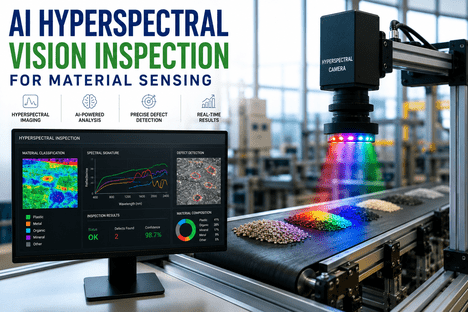
A standard camera reduces every pixel to three values. A hyperspectral camera instead records a full spectral signature for every pixel, spanning visible, near-infrared, and shortwave-infrared light. That signature acts as a chemical fingerprint — water content, fat content, polymer type, active ingredient concentration, and surface chemistry each absorb and reflect light differently across the spectrum, long before any of it is visible to the eye. AI models trained on these spectral cubes learn to recognize the exact signature of a target defect, contaminant, or material class, and apply that recognition to every pixel of every item moving down the line. The result is inspection based on what something is made of, not just what it looks like.
Contamination Detection
Foreign plastics, glass fragments, insect matter, mold, and residues such as grease trapped in a heat-sealed package are flagged by their spectral signature, even when they share the exact same color and shape as the surrounding product.
Material Composition Verification
Moisture content, fat or sugar levels, polymer identity, and active ingredient concentration are measured directly from spectral response, replacing slower lab sampling with inline, non-destructive verification at full production speed.
Hidden Defect Detection
Coating thickness variation, bruising beneath a peel, internal moisture migration, and structural inconsistencies surface in the spectral data well before they become visible bruising, cracking, or surface failure.
Foreign Material Identification
Deep learning classifiers distinguish target material from foreign material pixel by pixel, and can be retrained on new SKUs, packaging changes, or contaminant types without redesigning the camera or lighting hardware.
Core Capabilities of AI-Powered Hyperspectral Vision Inspection in 2026
Hyperspectral inspection moves quality control from statistical sampling toward full, item-by-item coverage. Instead of pulling occasional units for lab testing, every item on the line passes through the same spectral analysis, and AI models classify, accept, or reject in real time at conveyor speed. The table below summarizes the core capabilities iFactory applies across food, pharmaceutical, electronics, and recycling material streams. Book a Demo to walk through which capabilities map to your material and process.
| Capability | What It Detects | Spectral Range | Typical Application |
|---|---|---|---|
| Contamination & Foreign Material Detection | Plastics, glass, stones, insect matter, and residues invisible to RGB cameras | Near-infrared / shortwave-infrared | Food processing, recycling sortation |
| Material Composition Analysis | Moisture, fat, sugar content, and polymer or chemical identity | Visible / near-infrared | Food grading, plastics sorting |
| Coating & Layer Thickness Mapping | Thin-film thickness variation, coating uniformity, and layer defects | Shortwave-infrared | Semiconductor, electronics manufacturing |
| Counterfeit & Substandard Detection | Active ingredient identity and formulation deviation | Visible / near-infrared / shortwave-infrared | Pharmaceutical quality assurance |
| Ripeness & Freshness Grading | Sugar content, water stress, and early-stage spoilage indicators | Near-infrared | Produce, agriculture, fresh food |
How iFactory's Vision Anomaly Detection Brings Spectral-Grade Sensing to the Line
Capturing spectral data is only half the problem — turning hundreds of wavelength bands per pixel into a real-time accept or reject decision is the harder half. iFactory's AI Vision Camera handles that translation through its Vision Anomaly Detection feature, running deep learning classification models directly at the edge so spectral analysis keeps pace with conveyor speed instead of slowing the line down. When a unit's spectral signature deviates from the trained material profile — a foreign object, a contamination event, an out-of-spec coating, or a composition variance — the system flags it instantly and routes an alert to the line supervisor, with the deviation logged against that unit for traceability. As new materials, packaging formats, or contaminant types are introduced, the underlying models are retrained on updated spectral data rather than requiring new sensors or fixtures, keeping inspection accuracy current as your product mix evolves.
Move From Sample-Based Testing to 100% Spectral Inspection
Replace periodic lab sampling with continuous, item-by-item spectral analysis that catches contamination, composition drift, and hidden defects before they leave the line.
AI Hyperspectral Vision Inspection — Frequently Asked Questions
What is hyperspectral imaging in machine vision?
Hyperspectral imaging captures light across dozens of narrow wavelength bands per pixel, well beyond the three channels a standard RGB camera records, producing a spectral signature that reveals chemical and material properties rather than just shape and color.
How does AI improve hyperspectral inspection results?
Deep learning models trained on spectral data cubes classify materials, detect contamination, and flag composition deviations in real time, and can be retrained on new materials or defect types without changing the camera or lighting setup.
What kinds of contamination can hyperspectral vision detect that RGB cameras miss?
Foreign plastics, glass, stones, insect fragments, mold, and residues such as grease sealed inside packaging are detected by their spectral signature even when they visually match the surrounding product in color and shape.
Which industries use AI hyperspectral vision inspection?
Food and beverage, pharmaceutical, semiconductor and electronics, and plastics recycling all use hyperspectral inspection for contamination detection, composition verification, coating analysis, and material sorting.
Does hyperspectral inspection slow down production lines?
With edge AI processing, spectral classification runs at conveyor speed, allowing full, item-by-item inspection coverage in place of slower statistical sampling, without introducing a bottleneck on the line.
Detect What Standard Cameras Were Never Built to See
iFactory connects hyperspectral-informed sensing, deep learning classification, and edge AI processing into a single Vision Anomaly Detection workflow — converting raw spectral data into real-time contamination, composition, and defect alerts across your line.