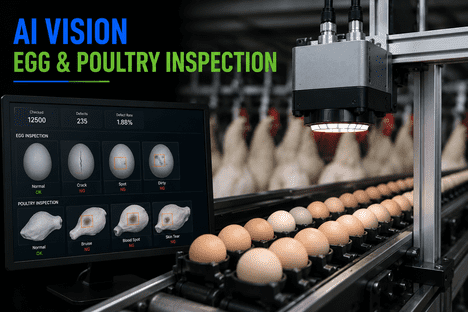
Inspecting eggs for cracks, blood spots, and dirt has long depended on candling — holding an egg in front of a bright light so a human grader can see through the shell — a method that works well in principle but breaks down at the speed modern grading lines actually run. High-speed electronic grading equipment can move more than ten thousand eggs per hour through a single lane, far faster than a human grader can reliably candle and judge each one, and fatigue over a shift only widens the gap between what should be caught and what actually is. AI vision egg and poultry inspection replaces manual candling with cameras and deep learning models that examine every egg or bird at full line speed, classifying shell condition, internal quality indicators, and surface contamination consistently from the first unit of the shift to the last. In 2026, as egg and poultry processors face rising labor costs and tightening retailer quality expectations, this shift from sampled human grading to continuous automated classification is becoming the standard rather than the exception. iFactory's AI-driven EAM platform brings this capability to grading and processing lines through its Vision Classification feature. Quality and operations teams evaluating automated inspection are encouraged to Book a Demo with iFactory to start a 6-week pilot on your own grading line.
Grade Every Egg at Full Line Speed, Not Just a Sample
iFactory's Vision Classification feature detects cracks, blood spots, and dirt, and grades eggs and poultry automatically, reducing labor while improving consistency.
Why Manual Candling Cannot Keep Up With Modern Grading Speed
Candling remains the traditional method for spotting cracks, blood spots, and shell defects, but it was designed around a human grader looking at one egg at a time under a light source. On a high-speed grading line moving thousands of eggs per hour per lane, that pace leaves no room for the careful, sustained attention a grader needs to catch a hairline crack or a faint blood spot — and the smallest defects, the ones most likely to slip past a tired eye late in a shift, are exactly the ones most likely to cause a customer complaint or a downstream packaging failure. AI vision inspection removes the speed constraint entirely by examining every egg with cameras and lighting tuned to reveal shell and internal defects, applying a deep learning model trained specifically on the visual signatures of cracks, blood spots, dirt, and other quality issues rather than relying on a single grader's attention and experience.
Including Hairline Cracks
Deep learning models trained on shell defect imagery catch fine cracks and checks that are difficult for a human grader to consistently spot at line speed.
Blood Spot & Internal Quality
Candling-style imaging combined with classification models identifies internal indicators such as blood spots, helping flag eggs that would fail a quality standard from the inside.
Dirt & Surface Contamination
Surface imaging distinguishes dirt, stains, and contamination from normal shell coloration, supporting consistent washing and grading decisions across every unit.
Full-Speed Throughput
Inspection runs in line with grading equipment moving thousands of units per hour, classifying every egg or bird rather than relying on periodic manual sampling.
How AI Vision Classifies Eggs and Poultry on the Line
A practical egg or poultry inspection system needs to make several distinct classification decisions for every unit on the line, each requiring its own imaging approach and model. The table below summarizes the main classification categories iFactory's Vision Classification feature addresses. Book a Demo to see how this maps to your own grading standards and product mix.
| Classification Category | What Is Identified | Imaging Approach | Why It Matters |
|---|---|---|---|
| Shell Cracks & Checks | Hairline cracks, checks, and breakages in the eggshell | High-resolution surface imaging with crack-pattern classification | Cracked shells risk contamination and are a leading cause of rejection |
| Blood Spots & Internal Defects | Internal quality indicators visible through candling-style imaging | Light transmission imaging combined with defect classification | Internal defects affect grade and consumer acceptance |
| Dirt & Surface Staining | Surface contamination distinguished from natural shell coloration | Color and texture analysis under controlled lighting | Supports consistent washing and grading decisions at scale |
| Size & Weight Grading | Size category and estimated weight class for grading standards | Dimensional analysis combined with weight-class classification | Ensures consistent grade assignment across the full run |
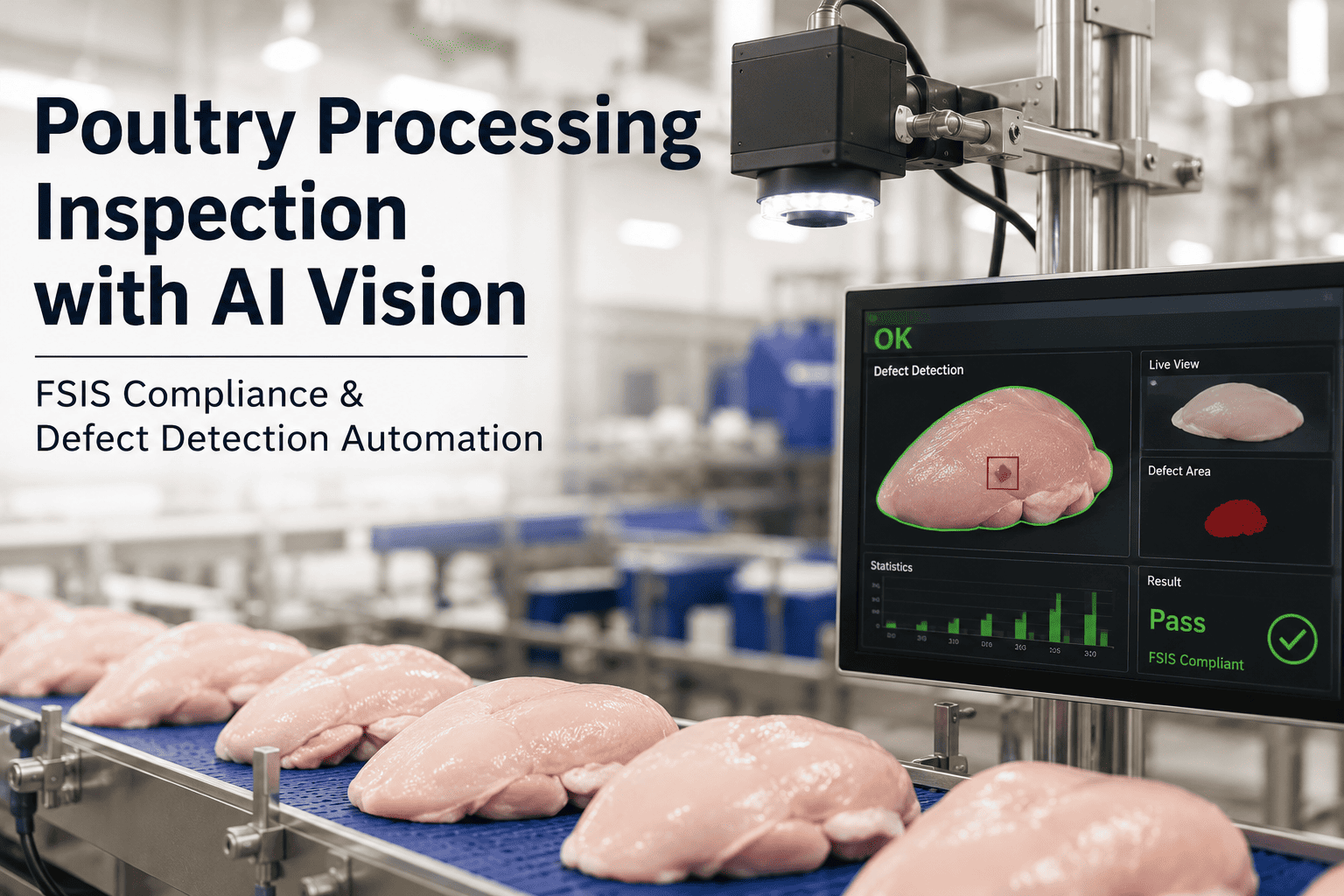
| Poultry Surface Inspection | Bruising, discoloration, and surface defects on processed birds | Surface imaging tuned for poultry-specific defect signatures | Reduces reliance on manual line inspection at processing speed |
How iFactory's AI Vision Camera Reduces Labor and Improves Consistency
Replacing manual candling with automated classification only delivers value if the system can keep pace with the line and classify consistently shift after shift. iFactory's AI Vision Camera applies on-premise edge inference to inspect every egg or bird as it passes, classifying defects by type and severity rather than producing a simple accept or reject decision, and logging each result with an image so quality teams can review borderline cases. Because the classification model applies the same standard to the first unit of the shift and the last, grading consistency no longer depends on a grader's attention level or fatigue, and the labor previously dedicated to manual candling can be redirected to higher-value tasks. When a defect rate on a specific lane or shift begins trending upward, the data feeds back into quality reporting so the cause — equipment, handling, or upstream supply — can be investigated rather than treated as an isolated reject. Most facilities start with a focused pilot on one grading line before expanding coverage. Book a Demo to start a 6-week pilot for your own facility.
AI Vision Egg & Poultry Inspection — Frequently Asked Questions
Why does manual candling struggle on high-speed grading lines?
Manual candling depends on a human grader examining each egg under a light source, which becomes difficult to sustain accurately when lines move thousands of eggs per hour, increasing the chance that fine cracks or faint blood spots are missed, especially later in a shift.
What defects can AI vision detect on eggs?
AI vision systems detect shell cracks and checks, internal indicators such as blood spots, dirt and surface staining, and support size and weight grading, classifying each defect by type and severity rather than producing only a pass or fail result.
Can AI vision inspect poultry as well as eggs?
Yes — the same vision classification approach extends to poultry surface inspection, detecting bruising, discoloration, and surface defects on processed birds using models tuned to poultry-specific visual signatures.
Does AI vision inspection replace human quality staff entirely?
AI vision automates the repetitive, high-speed classification task that manual candling struggles with, allowing quality teams to focus on reviewing borderline cases, investigating defect trends, and managing exceptions rather than candling every unit individually.
What does a 6-week pilot for egg and poultry inspection involve?
A pilot typically installs cameras on one grading or processing line, trains classification models on your specific product and defect types, and validates detection accuracy against your existing quality standards before wider rollout.
Classify Every Egg and Bird With Consistent, Line-Speed Accuracy
iFactory's Vision Classification feature detects cracks, blood spots, and dirt, and grades eggs and poultry automatically — reducing labor and improving consistency, starting with a 6-week pilot.