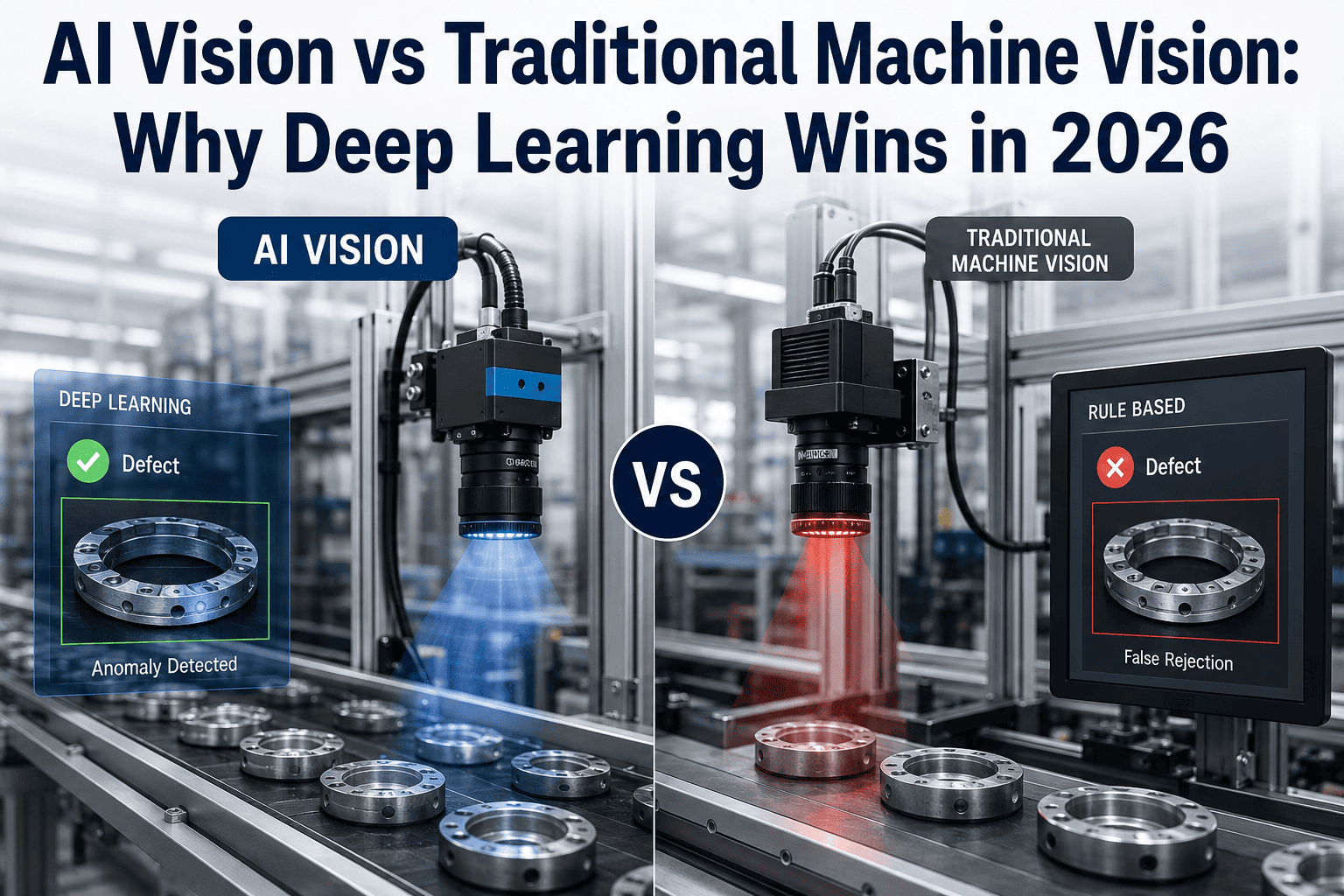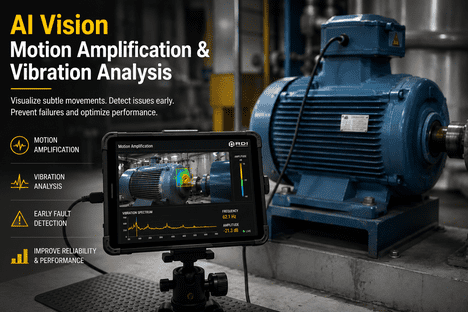
AI vision motion amplification and vibration analysis is transforming how reliability engineers detect, visualize, and diagnose mechanical faults in rotating and reciprocating equipment — delivering a non-contact, full-field vibration measurement capability that traditional contact-based accelerometers and single-point proximity probes fundamentally cannot match. Conventional vibration monitoring requires sensors to be physically mounted at specific measurement points on a machine, providing data from one location at a time and creating the spatial blind spots that cause imbalance, looseness, and misalignment conditions to go undetected until they progress to failure-level severity. iFactory's AI-powered predictive maintenance vision platform applies motion amplification algorithms to high-frame-rate camera feeds, amplifying and visualizing sub-pixel mechanical movements across the entire machine structure simultaneously — revealing imbalance signatures, structural looseness, misalignment in drive trains, and resonance conditions at dozens of measurement points in a single camera view, with no sensor installation, no machine modification, and no production interruption required for the measurement process.
Why Traditional Vibration Monitoring Leaves Mechanical Faults Undetected
Accelerometer-based vibration monitoring has been the cornerstone of rotating equipment condition monitoring programs for decades — but the technology has inherent limitations that become most consequential in the fault conditions that cause the most catastrophic failures. A single accelerometer measures vibration at one point in one or two axes, representing a vanishingly small fraction of the machine surface where mechanical anomalies might manifest. The fault conditions most commonly responsible for premature bearing failure, structural cracking, and catastrophic mechanical breakdown — foundation looseness, resonant structural modes, multi-plane imbalance, angular misalignment in flexible couplings — produce vibration signatures that are distributed across the machine structure in ways that a sparse sensor grid consistently misses or misinterprets. Motion amplification via AI vision cameras eliminates this spatial limitation by treating every pixel of the camera image as a simultaneous measurement point. A single camera positioned in front of a motor-pump assembly captures motion data from the motor frame, end bells, bearing housings, coupling guard, pump casing, baseplate, and foundation mounting points simultaneously — revealing the spatial distribution of vibration that distinguishes a mass imbalance condition (symmetric motion across the rotor plane) from a foundation looseness condition (differential motion between equipment and base) or structural resonance (amplified motion at specific structural locations). iFactory's AI vision camera platform applies this full-field measurement capability continuously and automatically, detecting developing mechanical faults and generating predictive maintenance work orders without requiring a specialist to be present for the measurement. Reliability engineers who want to see this capability applied to their specific equipment portfolio are welcome to Book a Demo with iFactory's engineering team.
How AI Vision Motion Amplification Works
Motion amplification is a signal processing technique that extracts and magnifies subtle periodic motions from video frames that are invisible to the naked eye — amplifying movements measured in microns or fractions of a pixel into visible, analyzable motion patterns. iFactory's AI vision platform extends this capability with deep learning models that automate fault classification, trend tracking, and predictive alert generation — converting what was previously a specialist measurement requiring interpretation by an experienced analyst into a continuous, automated monitoring function.
High-Frame-Rate Video Capture Across the Full Machine Field of View
iFactory's vision cameras capture high-frame-rate video of the target equipment at frame rates calibrated to resolve the frequency range of interest for the specific machine class — covering the shaft rotation frequency, blade pass frequency, bearing defect frequencies, and structural resonance modes relevant to each asset type. The camera's field of view covers the complete machine structure and surrounding support framework, establishing a full spatial map of every structural element for which motion data will be extracted and analyzed simultaneously.
Sub-Pixel Motion Extraction and Frequency-Domain Decomposition
The motion amplification algorithm tracks the displacement of every pixel region across sequential video frames, extracting displacement signals with sub-pixel resolution — detecting motions as small as a few microns in favorable conditions. These displacement signals are transformed into the frequency domain using the same analytical approach as conventional vibration analysis, producing spectra that show the amplitude and phase of motion at shaft rotation frequency, harmonics, and bearing defect frequencies — but for every spatial location in the camera view simultaneously, rather than at isolated sensor positions.
AI-Based Fault Pattern Classification and Severity Scoring
iFactory's deep learning models analyze the spatial and frequency-domain motion patterns extracted from the video to classify fault conditions against a library of mechanical fault signatures. Mass imbalance, angular misalignment, parallel misalignment, foundation looseness, soft foot, structural resonance, and bearing defect patterns each produce characteristic spatial motion distributions that the AI model distinguishes with high accuracy — providing a specific fault diagnosis rather than a generic vibration level alarm that requires further manual investigation to interpret.
Trend Monitoring and Predictive Alert Generation
Motion amplification measurements are recorded continuously for each monitored asset, building a historical trend database of vibration condition at every monitored structural location. iFactory's platform tracks the progression of each fault indicator over time, generating predictive maintenance alerts when trend trajectories indicate approach to failure-level thresholds — providing the maintenance team with early warning days or weeks before the condition would be detectable by conventional accelerometer systems, and enough lead time to plan and schedule corrective maintenance during the next available production window.
Automated Work Order Generation and CMMS Integration
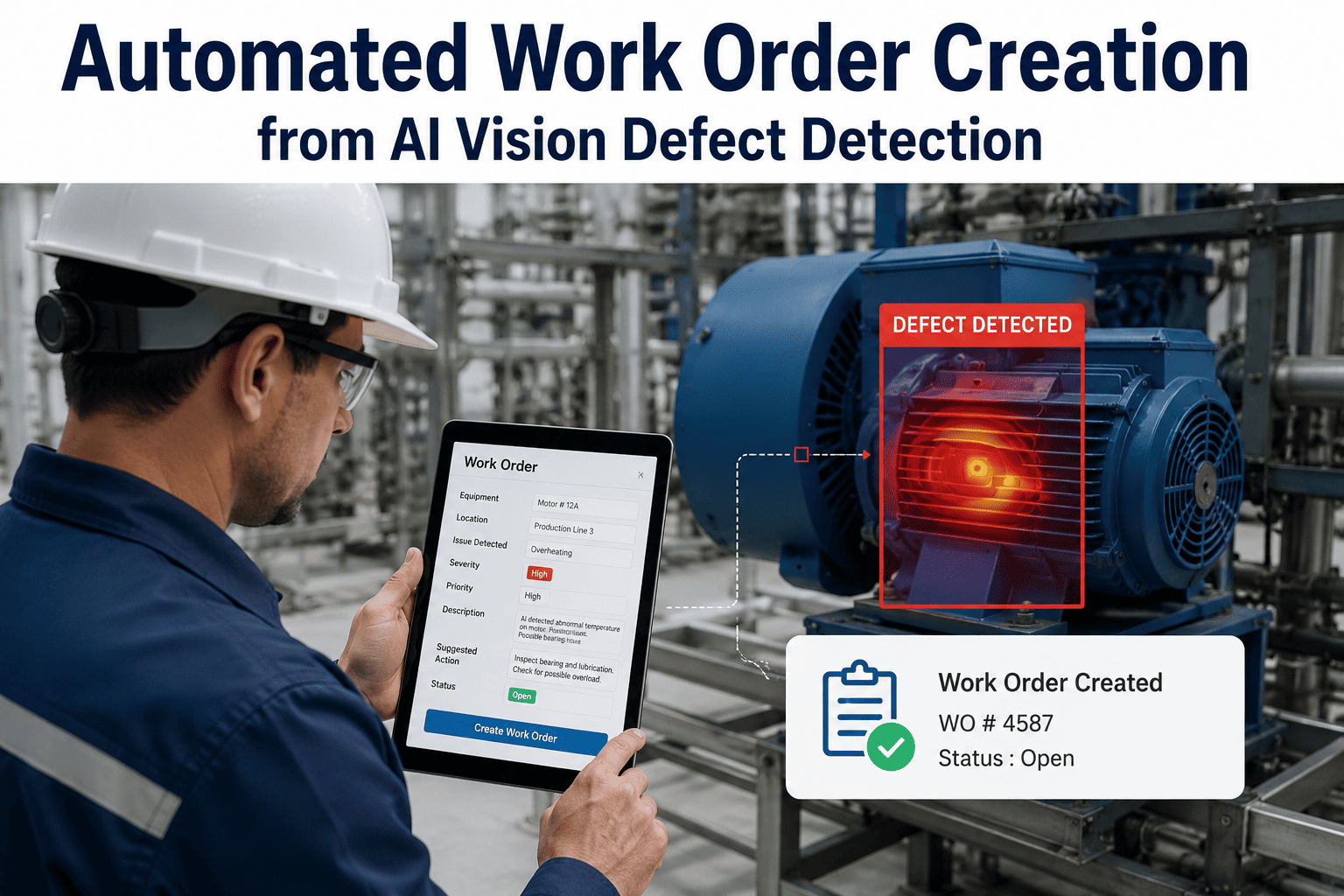
When iFactory's AI model classifies a vibration fault above the configured action threshold, the platform automatically generates a predictive maintenance work order in the connected CMMS — pre-populated with the asset identification, fault type, severity score, amplitude trend data, and the motion amplification visualization that shows the technician exactly where and how the machine is moving abnormally. This visual diagnostic context reduces troubleshooting time significantly and improves the first-time fix rate by ensuring corrective work is targeted at the correct fault location before the technician arrives at the equipment.
Mechanical Fault Conditions Detected by AI Vision Motion Amplification
iFactory's motion amplification platform detects and differentiates the full spectrum of mechanical fault conditions in rotating and reciprocating equipment — providing specific fault diagnoses that guide targeted corrective actions rather than generic vibration severity alarms that require additional manual investigation to interpret.
| Fault Condition | Motion Pattern Detected | Equipment Affected | Corrective Action Triggered |
|---|---|---|---|
| Mass Imbalance | Synchronous radial motion symmetric across rotor plane, 1× shaft frequency dominant | Fans, pumps, compressors, motors, turbines | Balancing work order with specific correction plane identified |
| Shaft Misalignment | Differential axial and radial motion between driver and driven machine, 2× frequency dominant | Motor-pump, motor-compressor, gearbox couplings | Alignment inspection and correction work order |
| Foundation Looseness | Differential motion between equipment casing and baseplate, 0.5× and integer harmonics | Any baseplate-mounted rotating equipment | Foundation bolt inspection and tightening work order |
| Structural Resonance | Amplified motion at specific structural locations coinciding with operating frequency | Fans, heat exchangers, piping systems, structures | Structural modification or speed change engineering review |
| Soft Foot | Asymmetric frame distortion under foot loading, variable with machine load | Baseplate-mounted equipment during alignment | Shim correction and re-alignment work order |
| Bearing Defects | Localized high-frequency motion at bearing housing locations, BPFO/BPFI frequency content | All rolling element bearing applications | Bearing replacement work order with lead time trigger |
AI Vision Motion Analysis Versus Traditional Vibration Monitoring Methods
The decision between AI vision motion amplification and conventional accelerometer-based monitoring is not binary — both have roles in a comprehensive condition monitoring program. Understanding the specific capability advantages of each approach determines how to deploy them most effectively for the equipment types and failure modes that represent the highest risk in a given facility.
Full-Field Spatial Coverage from a Single Measurement Position
A single accelerometer measures one point. A single AI vision camera simultaneously measures motion at every structural element in its field of view — frames, bearing housings, baseplates, piping connections, and supporting structure all measured in the same acquisition. This spatial completeness enables fault conditions that produce spatially distributed motion signatures — foundation looseness, structural resonance, soft foot — to be detected and localized with spatial precision that a sparse accelerometer grid cannot provide without extensive sensor placement planning.
No Machine Modification or Production Interruption for Measurement
Accelerometer installation on operating equipment — particularly in hazardous areas, on hot surfaces, or in confined access locations — requires safety procedures, machine access permits, and often a production pause for sensor mounting. AI vision motion amplification cameras are positioned externally, requiring no machine contact, no permits for sensor mounting, and no production interruption for the measurement. This non-invasive characteristic makes full-fleet vibration assessment achievable in a fraction of the time and cost of accelerometer survey programs.
Visible Motion Output That Communicates Fault Severity to Non-Specialists
Motion amplification produces video outputs where the machine's actual vibration is amplified and visible — a fan with an imbalance condition visibly wobbles, a structure at resonance visibly flexes, a loose foundation visibly rocks. This visible output communicates fault severity and location instantly to maintenance managers, operations supervisors, and capital budget decision-makers without requiring vibration spectrum interpretation skills. It also provides compelling documentation for corrective maintenance approval and post-repair verification that numerical reports alone cannot match.
Continuous Automated Monitoring Without Specialist Availability
Traditional motion amplification analysis with specialist video processing software requires an experienced analyst to acquire, process, and interpret each measurement — constraining analysis to periodic survey events rather than continuous monitoring. iFactory's AI platform automates the entire measurement-to-diagnosis pipeline, running continuously on every monitored asset and generating fault alerts and work orders without analyst intervention. This automation makes the diagnostic depth of motion amplification accessible as a continuous monitoring tool rather than a periodic specialist service.
iFactory's motion amplification platform connects to CMMS systems via REST API and OPC-UA, routing vibration fault detections directly into predictive maintenance work order queues with the fault classification, severity score, and visual evidence attached. When the AI model identifies a developing misalignment condition on a critical pump drive with a severity trajectory that projects to failure within four weeks, a predictive work order is created immediately — pre-populated with the alignment task scope, required tools, estimated labor hours, and the motion amplification visualization that shows the technician exactly how the shafts are moving relative to each other. The maintenance planner receives a fully specified, evidence-backed work order rather than a vibration alarm that requires separate investigation before corrective work can be planned. Reliability teams ready to see this workflow demonstrated on their own equipment types can Book a Demo with iFactory's predictive maintenance engineering team.
Industry Applications and Deployment Environments
AI vision motion amplification delivers its highest value in environments where rotating equipment criticality is high, measurement access is constrained, or the spatial complexity of mechanical faults makes point-sensor monitoring insufficient for reliable fault detection. iFactory's platform is deployed across the following environments where these conditions are most prevalent. Facilities evaluating deployment for their specific equipment portfolio are encouraged to Book a Demo with iFactory's team for a site-specific coverage assessment.
Performance Outcomes from AI Vision Motion Amplification Deployment
The business case for AI vision motion amplification monitoring is documented across multiple industries and equipment categories. The performance improvements below represent outcomes measured at facilities where iFactory's platform has replaced or supplemented conventional periodic vibration survey programs.
"We had been running accelerometers on our large ID fan for two years with no significant findings. When we deployed iFactory's motion amplification camera on the same fan, the AI model identified a foundation looseness condition with differential motion between the fan casing and the baseplate that our accelerometers had classified as normal broadband vibration. We corrected the foundation within three weeks. Eight months later, reviewing what our accelerometer trend had looked like in the months before we corrected it — the broadband elevation had been there for at least six months, building steadily. We were three to four months from a catastrophic failure that our sensor-based program was completely missing."
— Reliability Engineer, Large Industrial Manufacturing Facility, North America
Frequently Asked Questions: AI Vision Motion Amplification and Vibration Analysis
Accelerometers measure vibration at a single point with high precision and broad frequency range — making them well-suited for high-speed rotating equipment where bearing defect frequencies and high-frequency structure-borne signals are the primary diagnostic interest. AI vision motion amplification measures motion at every structural location in the camera field of view simultaneously, with spatial diagnostic capability that accelerometers cannot match for fault conditions like foundation looseness, soft foot, structural resonance, and multi-plane imbalance. The two approaches are complementary in a complete condition monitoring program: vision-based motion analysis provides spatial fault localization and structural health surveillance; accelerometers provide high-frequency bearing condition data at specific shaft positions. iFactory's platform is designed to integrate both data streams into a unified predictive maintenance workflow.
The detectable frequency range for AI vision motion amplification is determined by the camera's frame rate and the sampling theorem — detectable frequencies extend to half the frame rate. iFactory's platform supports camera frame rates from standard industrial rates through high-speed configurations, covering the frequency ranges of interest for most industrial rotating equipment: shaft rotation frequencies from 5 Hz to several hundred Hz, blade pass and vane pass frequencies for fans and pumps, and structural resonance modes from sub-Hz to several hundred Hz. For high-speed machinery where bearing defect frequencies extend into the kilohertz range, vision-based motion analysis is complemented by accelerometer data for the high-frequency diagnostic content that camera systems are not designed to capture.
iFactory offers ATEX-rated camera configurations for direct deployment in Zone 1 and Zone 2 classified areas, as well as external camera configurations positioned outside the classified zone boundary with optical access through existing windows, sight glasses, or purpose-installed optical ports. The external configuration eliminates all classified area access requirements for camera installation, maintenance, and repositioning — significantly reducing the safety permit burden and access complexity associated with conventional contact sensor maintenance in hazardous areas. For facilities with mixed classified and non-classified equipment zones, a combination approach is typically the most cost-effective deployment architecture.
iFactory's deep learning models are trained on a library of mechanical fault motion signatures that encode the characteristic spatial and frequency-domain patterns of each fault type. Mass imbalance produces synchronous radial motion that is symmetric about the shaft rotation axis. Misalignment produces differential axial motion between driver and driven machine elements with strong 2× frequency content. Foundation looseness produces differential motion between the equipment casing and the baseplate or mounting structure, often with sub-synchronous or integer harmonic content. Structural resonance produces amplified motion at specific structural locations when operating frequency coincides with a natural frequency. Each of these spatial motion patterns is distinctly different in the motion amplification output, and the AI model classifies them accordingly — providing a specific fault diagnosis rather than a vibration severity level that requires separate expert interpretation.
Deployment timelines depend on the number of monitored equipment positions, camera configuration type, and the extent of CMMS integration required. For a pilot deployment covering 10–20 equipment positions with standard industrial cameras and REST API CMMS integration, installation and commissioning can be completed in two to four weeks from site survey to live monitoring. The AI model calibration period — during which the system establishes equipment-specific vibration baselines across normal operating conditions and load ranges — typically requires two to four weeks of live operation before fault detection sensitivity is optimized for production use. iFactory's engineering team manages the full deployment and commissioning process, including baseline establishment and alert threshold configuration, and provides post-commissioning support through the initial production monitoring period.