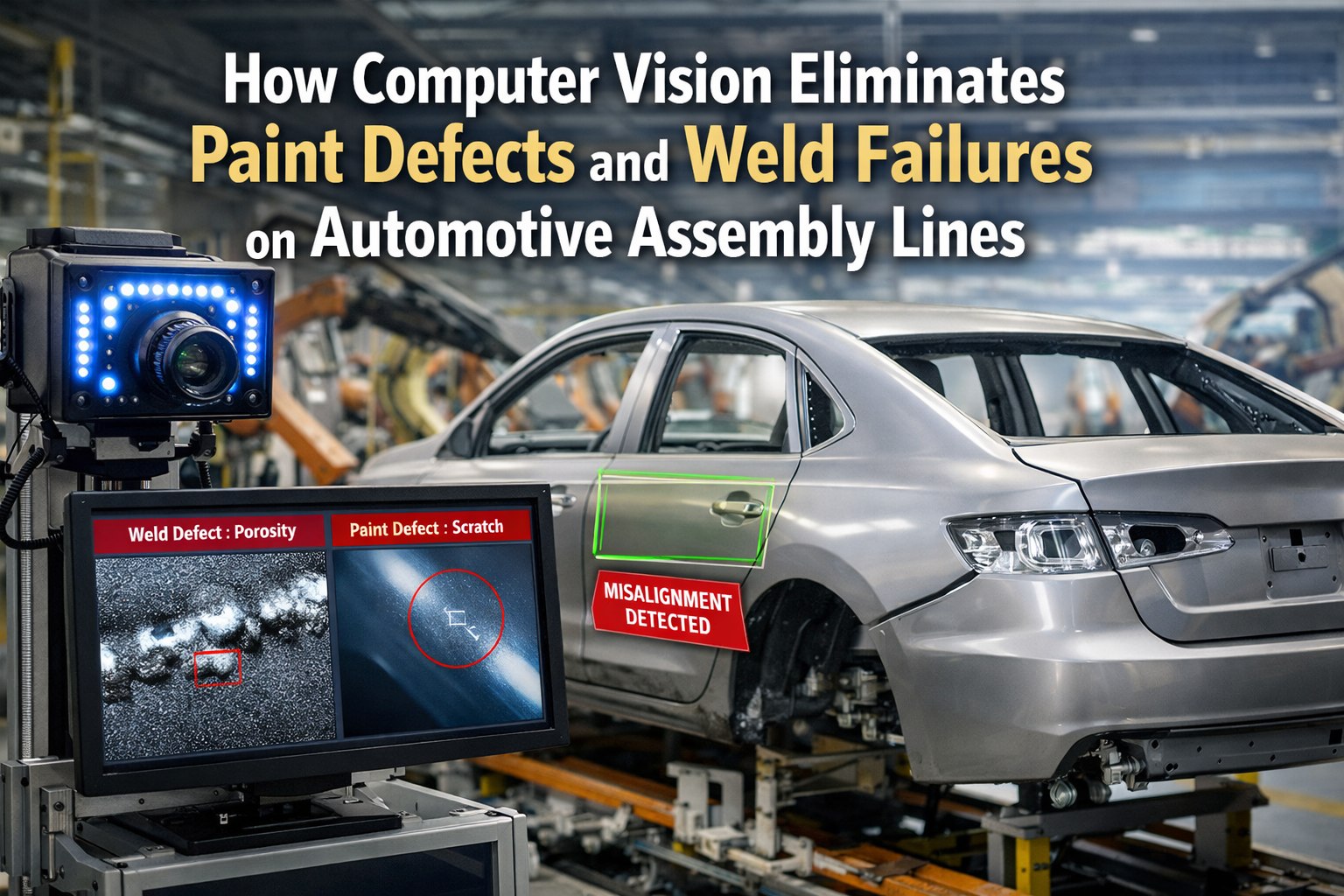
Picking the wrong computer vision task for your manufacturing inspection system is the most common reason AI projects fail to move past the pilot phase. A quality engineer who needs to measure the exact length of a weld crack will get nowhere with a classification model that only outputs a simple pass or fail label. An engineer who just needs to know if a sealed package is intact will waste edge computing resources running a heavy segmentation model that traces pixel-perfect boundaries of the label graphic. Classification, object detection, and image segmentation are not interchangeable technologies. They produce fundamentally different outputs, require different amounts of compute power, and solve completely different inspection problems on the production line. Talk to iFactory support about selecting the right vision architecture for your specific inspection challenge.
Computer Vision Architecture · Inspection Models · AI Task Selection
Object Detection vs Segmentation vs Classification: The Industrial Vision Selection Guide
Choosing between classification, detection, and segmentation determines whether your AI inspection system can count defects, measure defect areas, or simply sort parts into good and bad bins. iFactory deploys the correct architecture based on what your quality standard actually requires.
3
Distinct computer vision tasks that produce completely different outputs for the same production image
10x
Difference in edge compute requirements between lightweight classification and pixel-level segmentation
0
Value in running a complex segmentation model when your quality standard only requires a binary pass or fail decision
Visual Output Comparison
How Each Vision Task Sees the Exact Same Defective Part
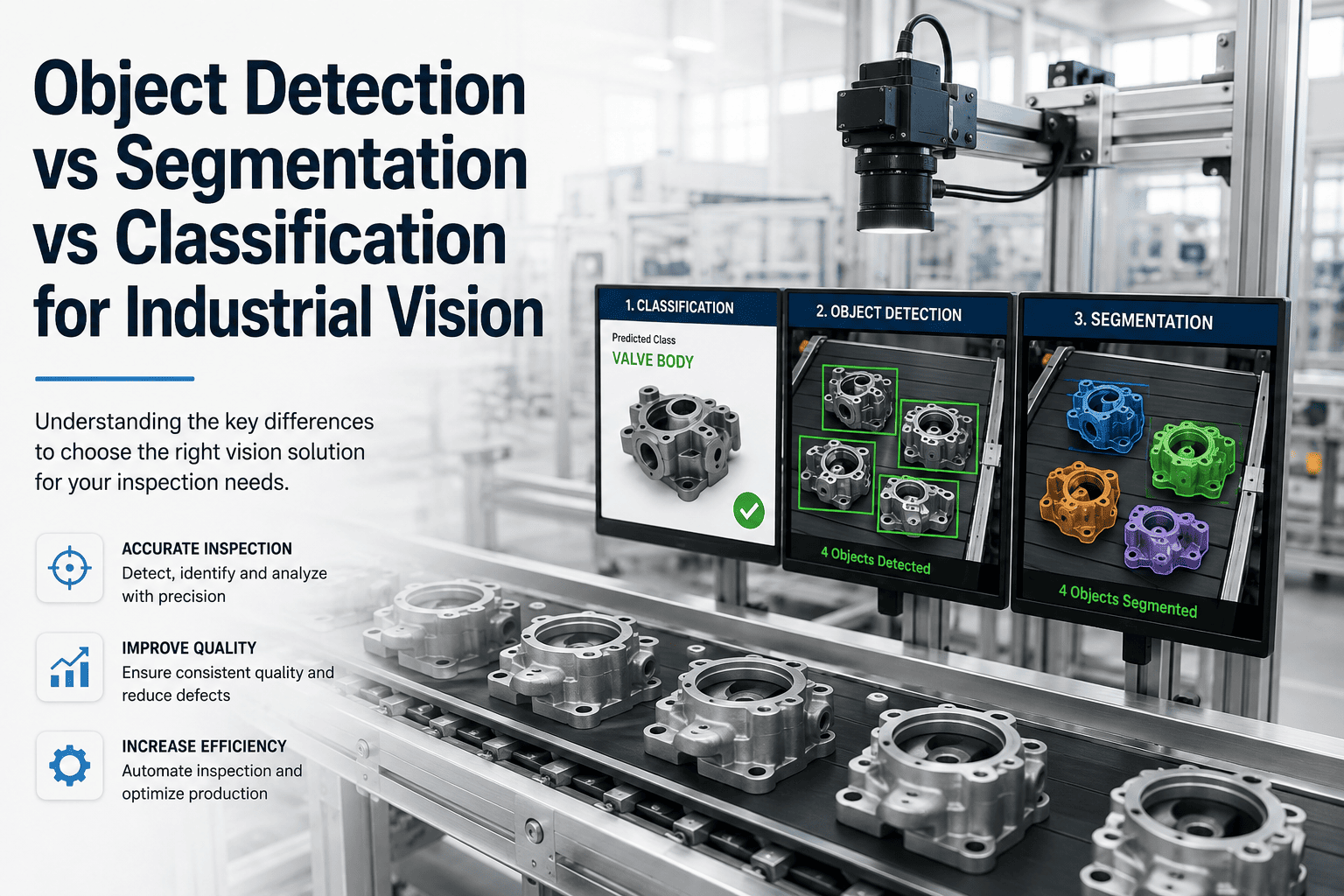
The easiest way to understand the difference between these three tasks is to look at what the AI actually outputs for the same image. The visual grids below represent a camera view of a metal bracket containing a single surface scratch. Notice how the AI's understanding of that scratch changes depending on the architecture running on the edge device.
Classification Output
The entire image receives a single text label. The model knows a defect exists but provides no location, size, or shape information about where it is on the bracket.
Detection Output
A bounding box is drawn around the defect area. The model knows the defect type and its approximate location, but the box includes both the defect and the surrounding clean metal surface.
Segmentation Output
Every individual pixel belonging to the scratch is highlighted. The model provides the exact shape, boundary, and area of the defect, distinguishing it from the background at a pixel level.
Task 1: Classification
Image Classification: What Is the Overall State of This Part?
Classification is the simplest and fastest computer vision task. It takes an entire image as input and outputs a single label assigning the image to a specific category. In manufacturing, this usually means sorting a captured image into bins like Good, Bad, Scratch, Dent, or Missing Component. The model evaluates the global visual features of the entire frame and makes a single decision about what it sees.
What It Outputs
A single text label and a confidence score for the entire image. The output tells you what the dominant condition is but provides no coordinates, no boundaries, and no information about where in the image the deciding feature is located.
Compute Requirement
Lowest among the three tasks. Classification models like efficient nets or lightweight convolutional networks run easily on standard industrial edge devices without requiring dedicated GPUs, making them ideal for high-speed lines where processing time per frame is strictly limited.
Critical Limitation
Classification completely fails when multiple defects are present in the same image. If a part has both a scratch and a dent, a classification model will output only the single label it considers most dominant, hiding the second defect entirely from the quality record.
Task 2: Object Detection
Object Detection: What Defects Are Present and Where Are They?
Object detection combines classification with localization. Instead of outputting a single label for the whole image, it draws a rectangular bounding box around every defect it finds and assigns a label to each box individually. This means a single image can contain multiple bounding boxes for multiple defects, and the quality system knows exactly how many defects are present and their approximate locations on the part.
What It Outputs
A list of bounding boxes, each defined by X and Y coordinates, a width, a height, a defect class label, and a confidence score. The output is a structured data record of every anomaly found in the frame, allowing the system to count defects and map them to regions of the part.
Compute Requirement
Moderate. Models like YOLO or SSD architectures are optimized for real-time edge deployment and can process high-resolution frames fast enough for most production line speeds, though they typically require more memory than classification networks to evaluate multiple regions of the image simultaneously.
Critical Limitation
The bounding box is always rectangular and always includes background pixels that are not part of the actual defect. If your quality standard requires measuring the exact physical area of a defect or tracing an irregular crack shape, the rectangular bounding box does not provide sufficient geometric precision.
Task 3: Segmentation
Image Segmentation: What Are the Exact Pixel Boundaries of This Defect?
Segmentation is the most granular computer vision task. Instead of drawing a box around a defect, it classifies every single pixel in the image, determining whether each pixel belongs to the background, the part, or a specific defect type. The output is a pixel-perfect mask that traces the exact shape and boundary of the defect, providing the highest level of visual detail available from an AI model.
What It Outputs
A pixel-level mask, often the same resolution as the input image, where each pixel is assigned a class label. This allows the system to calculate the exact area of a defect in square millimeters, measure the precise length of a crack, or determine the exact percentage of a surface affected by contamination.
Compute Requirement
High. Segmenting every pixel requires significantly more processing power and memory than drawing a few bounding boxes. Models like Mask R-CNN or U-Net often require dedicated edge GPUs to maintain real-time frame rates on high-resolution industrial cameras, increasing hardware costs per inspection station.
Critical Limitation
Segmentation is highly sensitive to lighting variations, shadows, and noise at the pixel level. A shadow cast by a part feature might be incorrectly segmented as a defect if the lighting is not perfectly controlled, leading to higher false positive rates compared to the more forgiving bounding box approach used by detection models.
The Right Vision Task Depends on Your Quality Standard, Not on What Is Trending in AI Research.
iFactory evaluates your inspection requirements and deploys classification, detection, or segmentation exactly where it fits, avoiding wasted compute and failed pilots.
Decision Matrix
Side-by-Side Selection Criteria for Industrial Inspection Tasks
Selection Criterion
Classification
Object Detection
Segmentation
Primary Output
Single image label and confidence score
Bounding box coordinates and labels for each defect
Pixel-level mask tracing exact defect boundaries
Defect Counting
Not possible; outputs only one label per image
Fully supported; counts multiple defects per image
Fully supported; counts and maps each defect
Defect Measurement
Not possible; no spatial or geometric data output
Approximate size from bounding box dimensions
Exact area, length, and perimeter from pixel count
Edge Compute Load
Very low; runs on basic edge processors
Moderate; requires modern edge GPU or NPU
High; requires dedicated edge GPU for real-time speed
Lighting Sensitivity
Low; evaluates global features, ignores minor shadows
Low; boxes encompass minor lighting variations
High; shadows and glare can be misclassified as defects
Overlapping Defects
Fails; sees only the dominant defect in the frame
Boxes overlap, making individual defect separation difficult
Separates overlapping defects by tracing distinct pixel boundaries
Real-World Selection
Which Task to Choose for Common Manufacturing Inspection Challenges
Translating the technical capabilities of each vision task into specific manufacturing decisions eliminates the guesswork. The following scenarios represent the most common inspection challenges where iFactory deploys these architectures, showing exactly which task applies and why the alternatives would fail.
Classification
Sealed Food Package Integrity
The inspection only needs to confirm that a seal is present and complete. The model looks at the image and outputs a Pass or Fail label. Detection or segmentation would waste compute drawing boxes or tracing pixels around a seal that only needs a binary status check.
Detection
Electronic PCB Missing Components
A printed circuit board may have multiple missing resistors or capacitors in different locations. Detection draws a bounding box around each missing component location, allowing the system to count exactly how many components are missing and report their specific board coordinates for rework.
Segmentation
Weld Crack Length Measurement
The quality standard specifies that a weld is rejected if a crack exceeds fifteen millimeters in length. Segmentation traces the exact pixel boundary of the crack, allowing the system to calculate the precise physical length and compare it against the tolerance threshold.
Detection
Automotive Paint Surface Scratches
A painted car door may have multiple scratches of varying lengths. Detection locates each scratch with a bounding box and counts the total number of defects per panel. Segmentation would be overkill since the exact pixel boundary of a scratch rarely affects the reject decision.
Frequently Asked Questions
Industrial Vision Task Selection — What Engineers Ask Before Deploying
Can I run both detection and segmentation on the same inspection station at the same time?
Technically yes, but in practice, running both simultaneously on the same edge device usually violates the frame rate requirements of high-speed production lines. A more effective approach is to run object detection as the primary real-time task to locate and count defects, and then trigger segmentation only on the cropped bounding box region of images that have already been flagged as rejects. This hybrid approach gives you the speed of detection for the majority of good parts and the precision of segmentation for the specific defects that require detailed measurement.
Contact support to discuss hybrid architectures.
Why not just use segmentation for everything since it provides the most detailed output?
Because segmentation imposes a significant compute and hardware cost that provides zero value when your quality standard does not require pixel-level measurements. If your standard says a part is rejected if it has any dent larger than five millimeters, a bounding box from a detection model is sufficient to make that decision. Running a segmentation model to trace the exact wavy boundary of that dent consumes more power, generates more heat, requires a more expensive edge GPU, and introduces more lighting sensitivity without changing the pass or fail outcome for that specific part.
Book a Demo to see task-matched hardware sizing.
How does the training data differ between classification, detection, and segmentation?
The primary difference is the labeling effort required. Classification requires only an image-level label stating what the image contains. Detection requires drawing a rectangular bounding box around each defect in the image and labeling it. Segmentation requires manually tracing the exact pixel boundary of every defect, which takes significantly longer per image. This labeling burden is another reason not to use segmentation unless the output is strictly necessary, because the time and cost required to prepare a pixel-level labeled dataset is substantially higher than preparing bounding box or classification labels.
Contact support for data preparation guidance.
What happens if I train a classification model but my product starts having multiple defects per unit?
The classification model will assign the entire image to the single defect class it considers most confident, and all other defects in that image will be invisible to the quality record. If your defect rate increases or the defect modes become more complex, the classification model will systematically underreport the number of defects per part, making your quality data unreliable. When this happens, the model must be retired and replaced with an object detection model, which requires a new labeling effort using bounding boxes instead of image-level labels. This is why iFactory recommends evaluating the full range of potential defect scenarios before selecting the initial architecture, to avoid costly model swaps later.
Book a Demo to future-proof your model selection.
Does iFactory support switching between these tasks as our inspection requirements evolve?
Yes. The iFactory platform is designed to support classification, detection, and segmentation models within the same edge deployment framework. If your quality standards change and you need to move from a simple classification check to a detection or segmentation approach, the edge infrastructure and data pipeline remain the same. The primary change is the model file itself and the downstream logic that processes the model output, whether that logic is evaluating a single label, counting bounding boxes, or measuring pixel mask areas. This architecture prevents vendor lock-in to a specific vision task and allows your inspection capabilities to mature alongside your quality requirements without replacing the entire edge hardware stack.
Contact support about platform capabilities.
Classification, Detection, and Segmentation Are Tools, Not Competitors. The Right One Is the One That Matches Your Quality Standard.
Deploy the exact computer vision task your inspection requires, without overpaying for pixel-level precision when a bounding box will do, or underdelivering with a single label when you need defect counts.