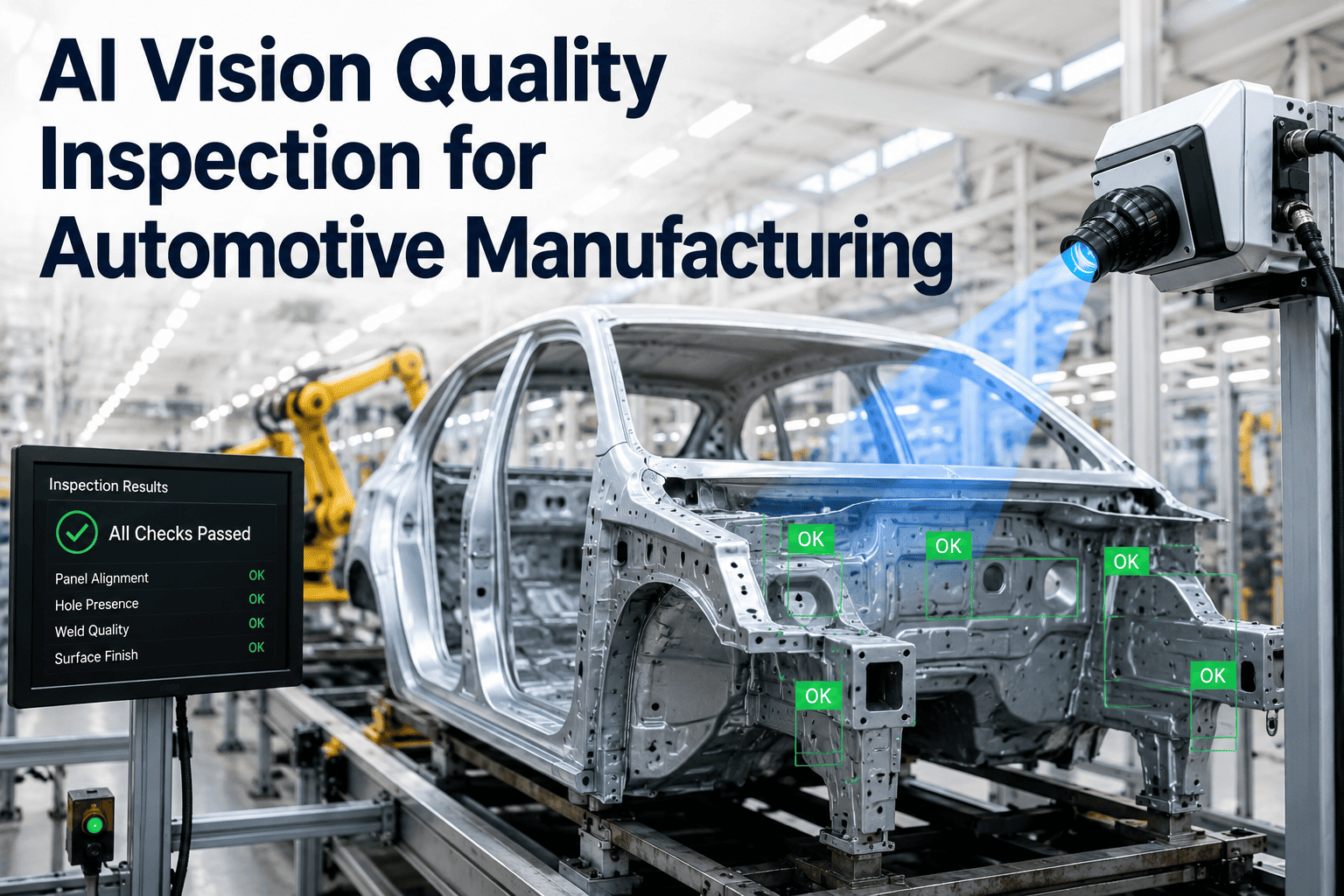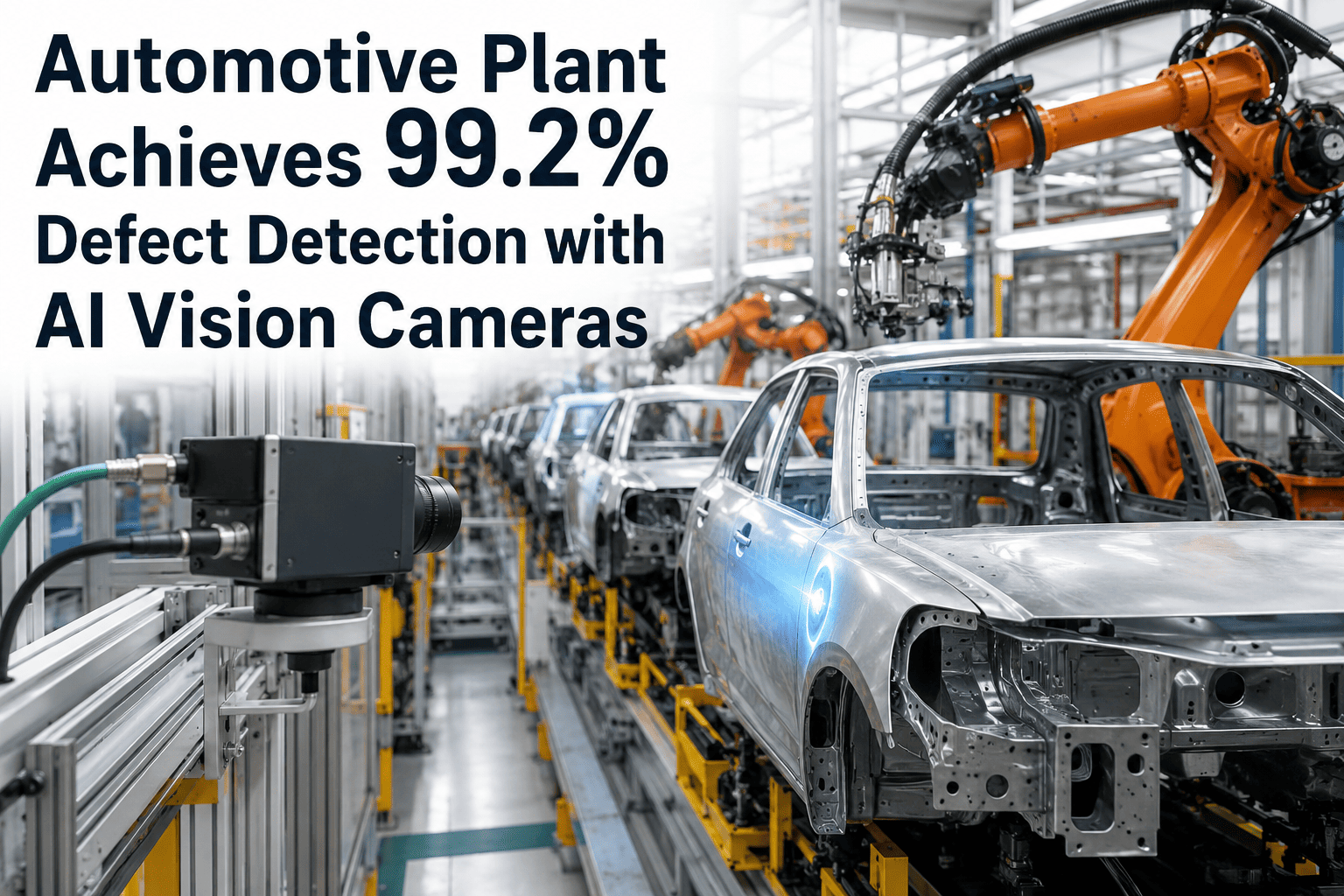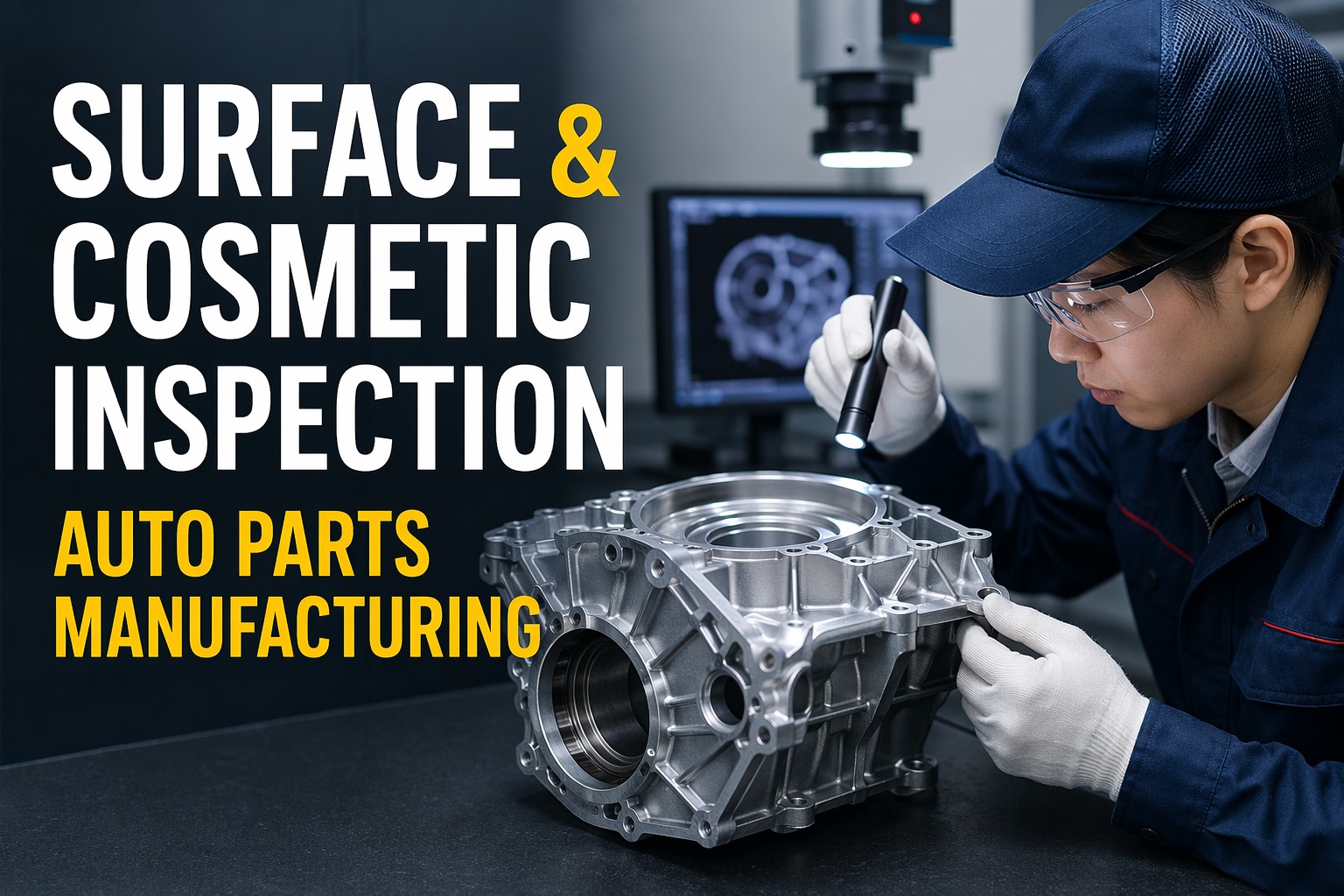
Your stamping press exits 120 parts per minute, and the operator at the end of the line is supposed to catch every burr, every missed hole, every surface pit — while also stacking racks and clearing jams. You already know how that ends. By the time a defect batch reaches the customer, you have already shipped it, and the PPM report tells the story you could not see in real time. AI vision defect detection changes that math by inspecting 100% of parts in motion at line speed, routing each one to pass, rework, or scrap without slowing the press, and writing every result back to your MES, ERP, and QMS so root cause analysis starts the moment a defect trend appears.
What AI Vision Catches That Operators Miss at Press Exit
Hover any defect tile to see the inspection detail — the failure mode, the detection method, and the routing decision the system makes in milliseconds.
Stamping Burrs
Press ExitStamping Burr Detection
Edge-gradient CNN trained on 12,000 burr images per die set; sub-pixel profile analysis catches rolled edges from dull inserts and die wear progression.
Porosity & Casting Voids
Machined SurfacePorosity & Void Detection
Hyperspectral+RGB fusion identifies subsurface gas porosity in aluminum castings that visual inspection cannot see; correlates with density maps from CT sampling.
Missing Operations
Machining CellMissing Operation Detection
Feature-presence model verifies every hole, thread, chamfer, and slot against the part CAD model — flags if a tapping station was skipped or a drill broke mid-cycle.
Surface Cracks
Forged PartsForging Crack Detection
Multi-angle LED illumination with dark-field imaging catches lap cracks and forge tears under 0.2mm that magnetic particle inspection would flag downstream.
Dimensional Drift
CMM ReplacementIn-Line Dimensional Verification
Calibrated photogrammetry extracts key characteristics — hole position, bend angle, profile tolerance — to ±0.05mm, replacing one in three CMM samples per shift.
Assembly Completeness
Sub-AssemblyMissing Component Detection
Presence/absence model verifies clips, fasteners, brackets, and weld nuts on sub-assemblies — catches the missed weld nut that stops the final assembly line 30 minutes later.
Wondering which of these defect modes is driving your PPM right now? Book a defect-mode discovery call and iFactory's vision team will map your top failure modes to detection methods before any hardware ships.
The Measured Impact of AI Vision on Auto Parts Lines
The auto parts sector runs on tight margins and tighter PPM commitments. Tier 1 and Tier 2 suppliers under IATF 16949 are expected to hold defect rates below 50 PPM for most programs, and below 25 PPM for safety-critical components. Manual inspection at line speed simply cannot sustain that. The benchmarks below are drawn from across NAICS 3363 stamping, machining, and casting operations that have deployed AI vision at press exits and machining cell exits.
reduction in escaped defects when AI vision replaces end-of-line operator inspection on stamping press exits
inspection coverage at line speed — every part, every cycle, no sampling gaps that let drift batches through
total inference latency per part on on-prem NVIDIA GPU edge appliances, well inside the cycle time of a 120 SPM press
average scrap cost reduction in the first six months as early-warning trend alerts catch die wear before it produces bad parts
These are not lab numbers. They are the floor of what a properly deployed AI vision system should deliver on an auto parts line. If a pilot is not trending toward at least 70% defect reduction by week six, the model is undertrained or the lighting and optics were specified wrong — and either is fixable. Book an ROI worksheet session to see the exact cost model against your current scrap rate and PPM exposure.
Three-Way Routing: Pass, Rework, or Scrap — Decided at Line Speed
The hardest part of in-line inspection is not finding the defect. It is deciding what to do with the part in the fraction of a second before the next one arrives. Traditional vision systems binary-sort to pass or fail, and failed parts pile up in a bin for a human to sort later. iFactory's AI vision system routes every part to one of three destinations through direct Level 2 PLC and DCS integration — no operator touch, no delay, no re-sorting.
AI Vision Inspection Station
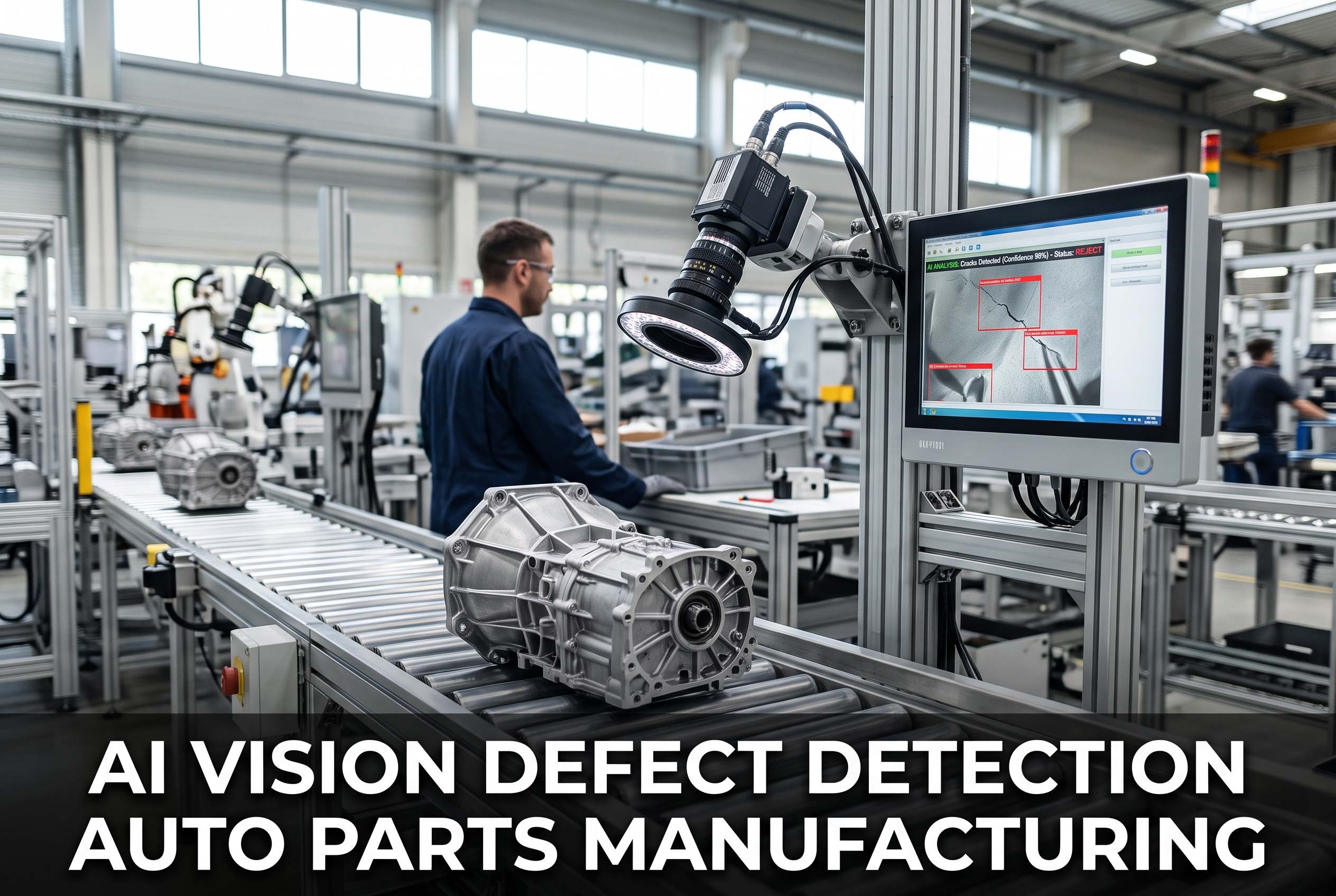
Cameras capture 4–8 images per part as it exits the press or machining cell. On-prem NVIDIA GPU runs inference in under 50ms and classifies the defect type with confidence score.
MES / ERP / QMS Write-Back
Every routing decision, defect image, and confidence score writes to the batch record via API. Lot identity maps to ERP so a scrap event triggers real-time cost posting and root cause capture.
Need three-way routing integrated to your specific PLC and MES stack? Talk to a vision integration specialist about your Level 2 control architecture before you spec hardware.
AI Vision vs. Legacy Inspection Methods on Auto Parts Lines
Most auto parts plants run a mix of inspection methods — operator visual check at the press exit, sample-based CMM in a lab, and maybe an older rule-based vision system on a high-volume line. Each has a role, but none of them give you 100% coverage at line speed with automated routing and traceability. Here is how the methods actually compare on the metrics that matter to your PPM report and your labor budget.
Run a Fixed-Price 8-Week Pilot on Your Toughest Line
iFactory deploys on-prem NVIDIA GPU inference, cameras, lighting, and PLC integration on one auto parts line — stamping, machining, or casting — for a fixed price and a fixed timeline. You see real PPM reduction and real scrap savings on your own parts before you commit to a plant-wide rollout.
Retrofitting AI Vision to Existing Stamping and Machining Lines
You do not need a new line to get AI vision defect detection. The system is designed to retrofit to existing press exits, machining cell exits, and sub-assembly checkpoints without re-engineering your line. The deployment sequence below is what an 8-week single-line pilot actually looks like — from first site visit to live routing decisions.
Line Audit & Defect Mode Mapping
Walk the line with your process and quality engineers. Collect 48 hours of reject samples, map your top 10 defect modes, and document cycle time, part presentation, and PLC tag availability at the inspection point.
Optics & Lighting Design
Specify camera resolution, lens, illumination type (dark-field, bright-field, structured light, polarized), and mounting geometry based on part reflectivity, defect size, and line speed. Mechanical design for the inspection station begins.
Model Training on Your Parts
Capture 5,000–15,000 images of your actual parts — good and defective. Train CNN models for each defect mode. Validate against held-out test set and your historical reject data. No generic stock models.
Install, PLC Integration & Dry Run
Mount cameras and lighting, install on-prem NVIDIA GPU edge appliance, wire PLC tags for three-way routing. Run shadow mode — inspect and classify but do not route — for 3–5 days to validate accuracy against operator inspection.
Live Routing & MES/ERP Write-Back
Enable automated pass/rework/scrap routing. Connect to MES and ERP via API for lot identity mapping and real-time scrap cost posting. Hand off dashboard with PPM trend, defect Pareto, and root-cause correlation views.
Want the full 8-week pilot plan mapped to your line? Book a pilot scoping session and we will bring the ROI worksheet to the first meeting.
From Defect Image to Root Cause: MES, ERP, and PLC Tag Capture
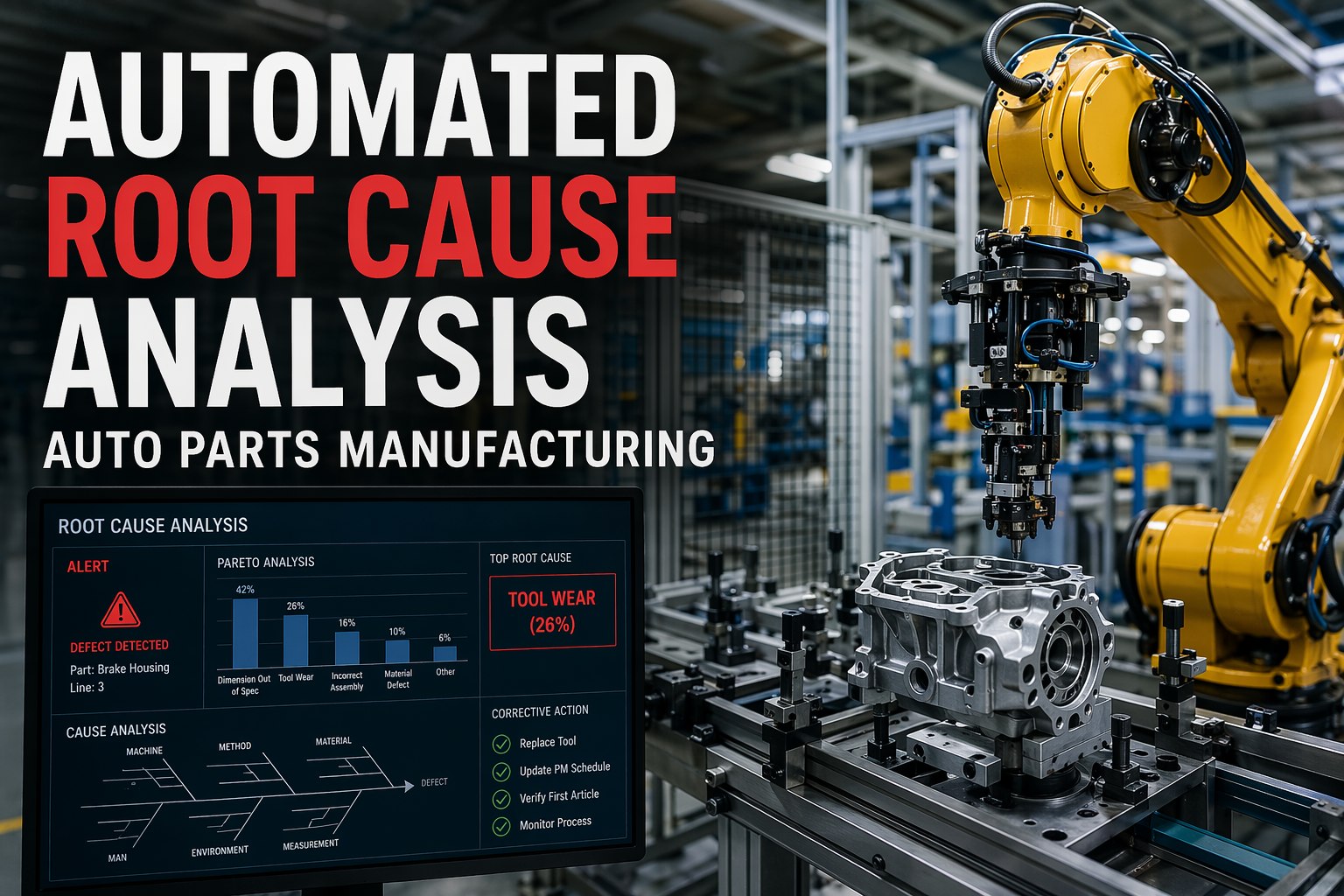
Finding the defect is only half the value. The other half — the half that actually reduces your scrap rate over time — is connecting each defect image to the process parameters that produced it. When a burr appears on a stamped part, the question is not just "is this part bad?" but "is the die insert wearing, and how many more parts before we need to change it?" iFactory's AI vision system answers that question automatically by capturing PLC process tags alongside every inspection and writing both to your MES.
PLC Tag Capture
Press tonnage, die temperature, lubrication flow, stroke count, cycle time — captured per part and time-synced to the vision inspection result. No manual data entry, no after-the-fact correlation.
AI Defect Classification
Each part is classified by defect type, severity, and location. The defect image, confidence score, and classification are bundled with the PLC tag snapshot into a single event record.
MES Batch Record
Defect event writes to the electronic batch record with lot ID, operator, shift, die number, and material heat number. ERP picks up the scrap cost posting in real time — no end-of-shift reconciliation.
Automated Root Cause
Trend dashboard correlates defect type against process parameter drift. "Burr count rising on Die #14, tonnage up 4%, lube flow down 12% — schedule die maintenance before scrap threshold breached."
This is the layer that turns AI vision from a sorting tool into a process improvement tool. The first month of data usually surfaces at least two process drift patterns your team suspected but could not prove — because the defect data and the process data were never in the same system before. Talk to a specialist about your PLC and MES integration points to see how much root-cause automation your current architecture can support.
Expert Perspective
We were running two operators on visual inspection at the end of a 90-SPM progressive die line, and we were still escaping 60 PPM to the customer. The first week after the AI vision system went live, it caught a burr trend on Die #7 that we would have missed entirely — tonnage had drifted 3% and lube flow was low. We changed the insert on a planned maintenance window instead of during a Friday night breakdown. That one catch paid for a third of the pilot. The operators did not get laid off — they got moved to die setup and changeover, which is where we actually needed them.
— Mark Devlin, Plant Manager, Tier 1 stamping operation (NAICS 336312), Ohio
PPM reduction in first 90 days of AI vision deployment on progressive die line
operators redeployed from inspection to die setup — higher-skill work, less fatigue
die wear trend caught in week one that would have caused an unplanned line stoppage
See Your PPM Drop in 8 Weeks — Not 8 Months
iFactory's fixed-price pilot puts AI vision defect detection on one auto parts line — cameras, GPU, PLC integration, MES write-back, and the ROI worksheet that proves the business case before you scale. Bring your toughest defect mode and your current PPM number to the first call.
Frequently Asked Questions
How fast can AI vision inspect auto parts on a stamping line?
AI vision running on an on-prem NVIDIA GPU edge appliance inspects each part in under 50 milliseconds — well inside the cycle time of a 120 strokes-per-minute progressive die press. The cameras capture multiple images as the part exits the die, the model runs inference, and the routing decision is sent to the PLC before the next part arrives. There is no line slowdown and no buffer accumulation.
Can the system be retrofitted to an existing stamping or machining line?
Yes — the system is designed for retrofit, not greenfield. Cameras, lighting, and the GPU appliance mount at the press exit or machining cell exit using existing conveyor or part-presentation geometry. PLC integration uses your existing Level 2 tags. The typical single-line pilot takes 8 weeks from first site visit to live routing, with no extended line downtime during installation.
How does the three-way pass, rework, and scrap routing actually work?
The AI model classifies each defect by type and severity, then sends a routing command to your Level 2 PLC or DCS. Parts with no defect route to packaging. Parts with reworkable defects — like burrs or missing threads — divert to a rework cell. Parts with critical defects — like cracks or porosity — route to a scrap bin with the lot ID tagged. The routing is automated and requires no operator decision at line speed.
What does the 8-week fixed-price pilot include?
The pilot covers one production line end-to-end: line audit and defect mode mapping, optics and lighting design, model training on your actual parts, camera and GPU hardware, PLC integration for three-way routing, MES and ERP API integration for lot identity and scrap cost posting, and a dashboard with PPM trends and defect Pareto. You see real inspection results on your own parts by week six and live routing by week eight. Book a pilot scope session to get the full statement of work and ROI worksheet.
How does AI vision integrate with our existing MES, ERP, and QMS?
iFactory connects via standard REST APIs and OPC-UA to your MES, ERP, and QMS. Each inspection event — defect image, classification, confidence score, and PLC process tags — writes to the MES batch record with lot and heat number. The ERP picks up scrap cost postings in real time. The QMS receives the defect data for CAPA workflows. No manual data transfer, no end-of-shift reconciliation, and no separate vision system database that your quality team has to log into separately.
What to Take With You
AI vision defect detection on auto parts lines is not a future-state concept — it is an 8-week deployment that drops your PPM, cuts your scrap cost, and frees your operators for higher-value work. The three pieces that matter: 100% inspection at line speed with under 50ms inference, automated three-way routing through your existing PLC, and MES/ERP write-back that turns every defect into a root-cause data point. If your stamping press or machining cell is still relying on operator visual inspection at 120 parts per minute, the math is already against you. The fixed-price pilot is the lowest-risk way to prove it on your own line, with your own parts, before you commit to anything plant-wide.
Ready to see your PPM drop? Book a pilot demo or talk to an auto parts vision specialist at iFactory today.