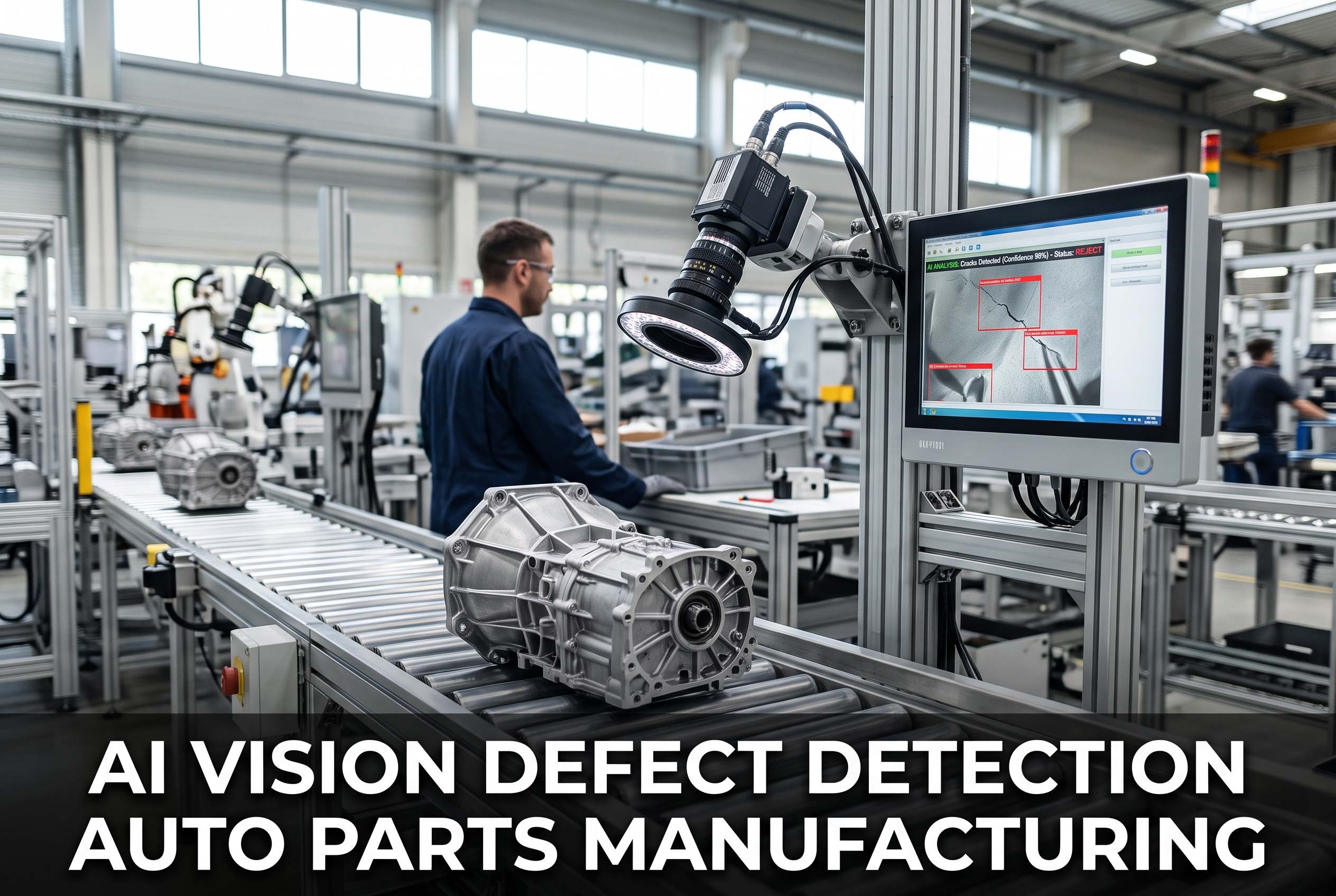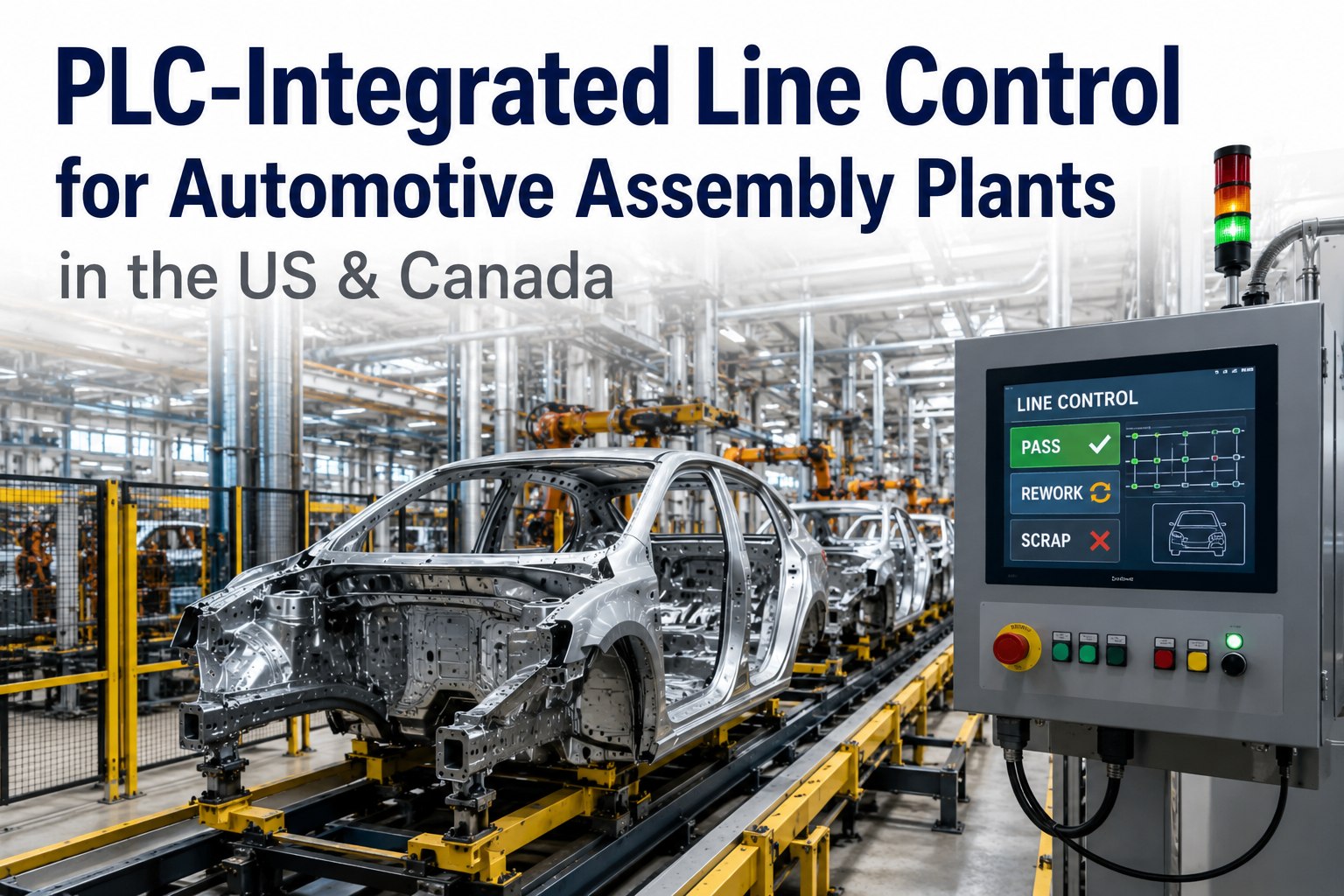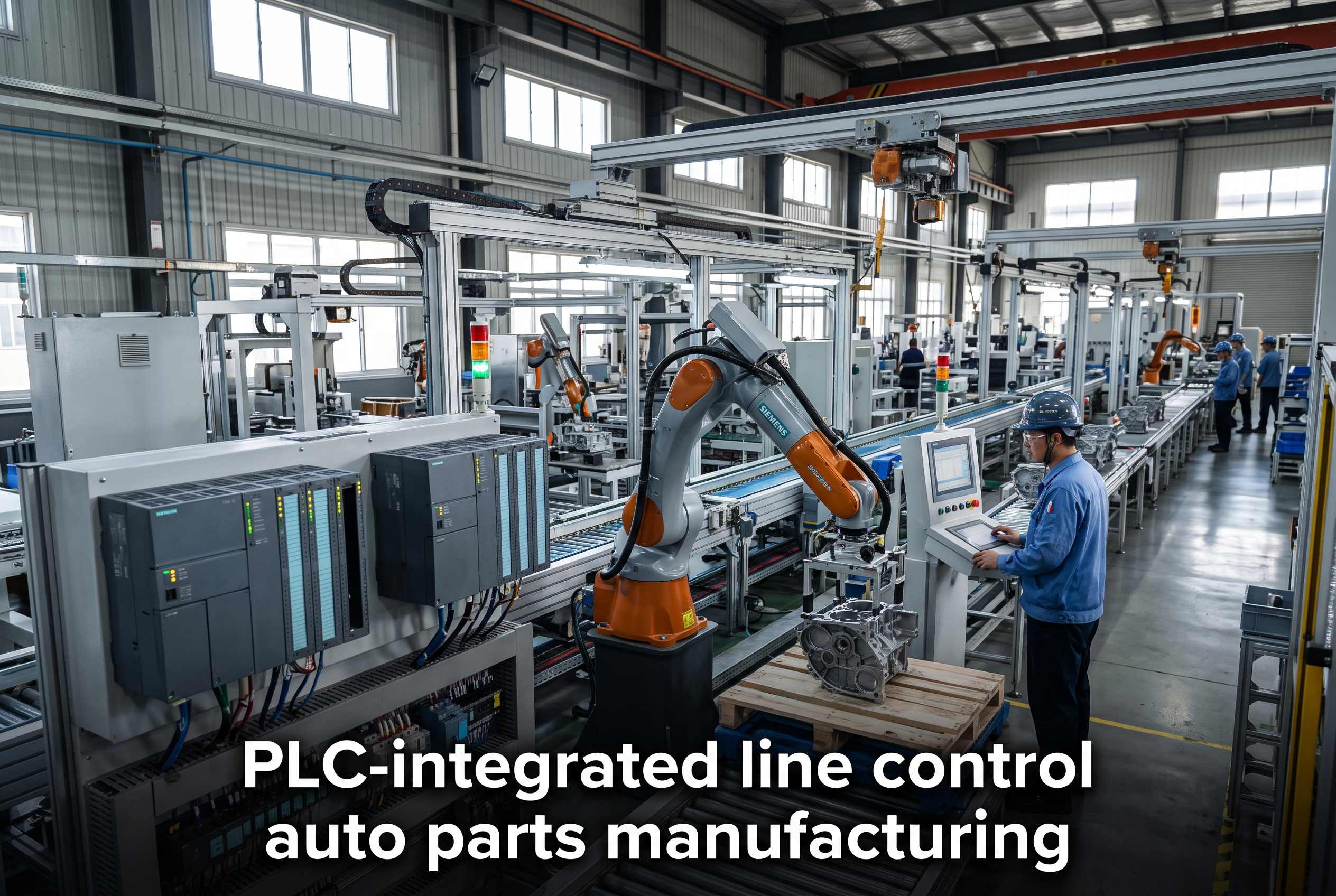
Your stamping press is cycling at 60 strokes a minute and the operator at the exit conveyor is pulling every third part to one side for a quick visual — burr check, hole presence, surface wipe. By the time the shift ends, that's roughly 1% of the day's output that got a real set of eyes on it. The other 99% went straight into the tote, and the customer will find the burrs you missed. This is the reality on most auto parts lines running PLC-integrated line control today: the PLC controls the press, the conveyor, and the stacker, but the quality decision still sits with a human who can't see a 0.2mm burr at production speed. AI vision retrofitted to your existing stamping and machining lines changes that math — 100% inspection in motion, automatic pass/rework/scrap routing back through the PLC, and every defect tied to the MES batch record for root cause analysis.
How AI Vision Talks to Your PLC in Real Time
From camera trigger to three-way sorting gate — the full data path that lets AI vision inspect 100% of parts in motion and route them without an operator in the loop.
Camera Trigger
Press cycle or proximity sensor sends a hard-wired trigger pulse to the GPU inference box — no network latency, no missed frames.
GPU Inference
On-prem NVIDIA GPU runs the trained model against the captured image — burr detection, porosity, missing holes, surface defects classified in milliseconds.
PLC Tag Write
Decision written directly to a PLC tag via EtherNet/IP or Profinet — pass, rework, or scrap integer value lands in the controller's data block.
Three-Way Gate
Diverter actuates — good parts continue to stacking, rework parts divert to the rework chute, scrap parts drop to the scrap bin with reason code logged.
Running stamping or machining cells without closed-loop PLC routing? Book a single-line AI vision assessment to see the full trigger-to-gate path mapped on your equipment.
What AI Vision Catches on a Stamping Press Exit
The defects that escape manual inspection on auto parts lines aren't the obvious ones — they're the ones that hide in the cycle time. A 0.2mm burr on a bracket ear, a missing pierce hole on every 50th part, a surface lamination from coil stock variation. These are the defect classes that deep learning vision models trained on your actual parts catch every cycle, every shift. Here's what gets flagged and routed before the part hits the tote.
Not sure which defect classes are driving your PPM? Talk to an AI vision specialist about a defect-mode discovery session on your highest-scrap line.
The Measured Impact: PPM, Scrap Cost, and OEE
Auto parts plants that retrofit AI vision with PLC-integrated routing don't see incremental improvement — they see a step change in the metrics that show up on the monthly operations review. The numbers below are what Tier 1 and Tier 2 suppliers report after the first 90 days of a single-line pilot going live. The biggest lever isn't catching more defects; it's catching them before they leave the cell, so rework is still possible and scrap carries a reason code.
reduction in customer-reported PPM after 90 days of 100% in-line inspection on stamping exits
average annual scrap cost recovered per press line based on Tier 2 supplier pilot data
inspection rate vs. 1–3% manual sampling — every part, every cycle, every shift
total trigger-to-gate latency, fast enough for 90+ strokes per minute press cycles
Run a Fixed-Price 8-Week Pilot on Your Hardest Line
iFactory deploys on-prem NVIDIA GPU inference, cameras, lighting, and PLC integration on one stamping or machining line in eight weeks — fixed price, measured PPM and scrap reduction baseline, and a full ROI worksheet before you scale to the rest of the plant.
Manual Sampling vs. AI Vision with PLC Routing
The difference between pulling parts for manual inspection and letting AI vision route every part through the PLC isn't just about catching more defects — it's about what happens to the defect data, how fast rework happens, and whether your MES ever sees the reason code. Here's the before-and-after on a typical 60-SPM stamping line.
Operator Pulls 1–3% of Parts
- Inspector grabs every Nth part, checks burr by feel and hole by sight
- Defects between samples ship to customer undetected
- Rework window closes — part is already in the finished tote
- Scrap reason codes written on a paper tag, transcribed hours later
- MES has no visibility into in-line defect rate, only final QA pass/fail
- Die wear goes undetected until dimensional check at end of shift
- Customer PPM drives containment, sorting, and chargebacks
100% Inspected, Auto-Routed at Line Speed
- Every part imaged at cycle speed, defects classified by trained model
- Three-way gate routes pass, rework, or scrap before part leaves the cell
- Rework parts diverted immediately — still salvageable, still warm
- Scrap reason code written to PLC tag and MES batch record in real time
- MES dashboards show live defect rate by class, by die, by coil lot
- Die wear trend visible from dimensional drift data across hours, not shifts
- Customer PPM drops 70–85% within the first quarter of go-live
Want to see the before-and-after modeled on your actual line's scrap rate and cycle time? Book an ROI worksheet session with iFactory's auto parts team.
MES, ERP, and QMS Integration: Closing the Data Loop
Catching the defect is half the job. The other half is making sure the defect data flows to the systems that need it — the MES batch record, the ERP work order, the QMS CAPA system, and the maintenance CMMS when a die needs attention. iFactory's AI vision platform doesn't sit in a silo; it writes to PLC tags, publishes to MES via REST API, and maps every inspected part to its ERP work order identity so root cause analysis takes minutes instead of a cross-functional meeting.
AI Vision GPU Box
On-prem NVIDIA GPU runs inference, stores images, and holds the defect classification model trained on your parts.
PLC / DCS
Pass/rework/scrap tag written to controller data block for gate actuation
MES
Defect event, image, and reason code written to batch record via REST API
ERP
Work order identity mapped to every inspected part for full genealogy
QMS / CMMS
CAPA triggered on defect trend, work order auto-created for die maintenance
Need defect data flowing into your MES and QMS, not just a reject chute? Book an integration architecture session to map the API and PLC tag structure against your stack.
The 8-Week Single-Line Pilot: What Happens and When
The fastest path to a plant-wide AI vision rollout is proving it on one line first. iFactory's fixed-price pilot gets a single stamping press or machining cell live in eight weeks — from baseline measurement through model training, PLC integration, and go-live. Here's the week-by-week.
Baseline & Discovery
Scrap rate, PPM, cycle time, and defect-mode audit on the pilot line. Camera and lighting placement scoped. PLC tag map and MES API endpoints documented.
Install & Image Capture
Cameras, lighting, and GPU inference box mounted on the line. Production runs while the system captures images — no PLC changes yet, no line impact.
Model Training & Validation
Deep learning model trained on captured images, validated against your QA team's labeled defect set. Confidence thresholds tuned for your PPM targets.
PLC Integration
Pass/rework/scrap tags written to the PLC, diverter gate tested in manual mode, three-way routing validated at full cycle speed with seeded defects.
Go-Live & ROI Handoff
Line runs in full automated inspection mode. ROI worksheet delivered with measured scrap reduction, PPM baseline, and scale-up plan for lines 2 through N.
Ready to put your hardest line on an 8-week timeline? Talk to a pilot engineer about scope, pricing, and available deployment windows.
Deployment Specs: On-Prem, Retrofittable, No Line Downtime
IT and OT teams ask the same three questions: where does the data go, who owns the model, and do we have to stop the line to install it. Here's the spec sheet.
Inference Hardware
NVIDIA GPU inference appliance, rack-mounted in your electrical room or line-side cabinet. On-prem only — no cloud dependency, no image data leaving the plant.
Camera & Lighting
Industrial machine vision cameras, LED strobe or continuous lighting spec'd per surface and material. Mounting brackets fabricated to your existing conveyor or press exit — no line modifications.
PLC Protocol
EtherNet/IP (Allen-Bradley), Profinet (Siemens), or Modbus TCP. Tag writes to existing controller data blocks — no new PLC, no program rewrite, validated by your controls engineer.
MES / ERP API
REST API publishes defect events, images, and reason codes to your MES. ERP work order identity mapped via barcode scan or PLC cycle count — every part traceable to its order.
Install Downtime
Camera and lighting mount during a planned maintenance window or changeover — typically 2–4 hours. PLC tag integration tested offline. Zero unplanned line stops during deployment.
Model Ownership
Trained model runs on your GPU box, owned by you. Retraining on new defect modes or SKUs handled by iFactory or your team via the model management interface.
Expert Perspective
We were sampling one part every fifty cycles on our press line and still getting hit with customer PPM chargebacks on burrs we never saw. The first week after the AI vision went live, the system flagged a burr trend on die station three that our inspector would have missed for another two shifts — the die was chipping. That one catch paid for a chunk of the pilot. What surprised me was the PLC routing. Parts that need rework now go straight to the rework bench while they're still in the same shift, not pulled out of a finished tote three days later when the customer finds them. The scrap reason codes landing in the MES automatically — that's the part my quality engineer won't stop talking about.
— Marco Velasquez, Plant Manager, Tier 2 stamping and welding facility (NAICS 3363), Ohio
from kickoff to go-live on a single stamping or machining line
unplanned line downtime during camera and GPU installation
pass, rework, and scrap routing — all automated through PLC tag writes
Stop Sampling. Start Inspecting 100% of Parts in Motion.
iFactory's AI vision platform retrofits to your existing stamping presses and machining cells with on-prem NVIDIA GPU inference, PLC-integrated three-way routing, and full MES/ERP/QMS integration. Fixed-price 8-week pilot, measured ROI, and a scale plan for every line in your plant.
Frequently Asked Questions
Can AI vision be retrofitted to an existing stamping press without replacing the PLC or line controls?
Yes. The GPU inference box, cameras, and lighting mount to your existing press exit or conveyor without mechanical modifications. The system communicates with your current PLC via EtherNet/IP, Profinet, or Modbus TCP — writing pass, rework, and scrap tags to existing or new data blocks. Your controls engineer reviews and approves every tag write. No PLC replacement, no program rewrite, no line control logic changes beyond reading the routing tag and actuating the diverter gate.
How fast can the system inspect — will it keep up with a high-speed stamping press?
The total loop from camera trigger to PLC tag write runs in under 150 milliseconds, which supports press cycles up to 90+ strokes per minute. The camera trigger is hard-wired from the press cycle or proximity sensor — no network dependency for the trigger itself. GPU inference on the captured image takes 30–80ms depending on model complexity, and the PLC tag write adds another 5–10ms. The diverter gate actuates based on the tag value as the part arrives, timed to the conveyor speed.
What does the 8-week fixed-price pilot include, and what happens after?
The pilot covers one stamping or machining line end-to-end: baseline scrap and PPM measurement, camera and lighting installation, GPU inference box deployment, model training on your parts, PLC integration with three-way routing, MES API connection, and go-live. You receive a measured ROI worksheet comparing before-and-after scrap cost, PPM reduction, and rework recovery. After the pilot, iFactory provides a scale-up plan for additional lines with per-line pricing — or you own the trained model and manage it in-house.
Does the image data leave the plant, and who owns the trained model?
No image data leaves the plant. All inference runs on the on-prem NVIDIA GPU appliance in your electrical room or line-side cabinet. There is no cloud dependency for inspection — if the network goes down, the system keeps inspecting and routing. The trained model is yours. iFactory handles initial training and retraining on new defect modes or SKUs, or your team can manage it through the model management interface. You own the model weights, the training images, and the inference hardware.
How does the system handle new parts or SKUs added to the line?
New SKUs require a brief enrollment process — typically 200–500 reference images of good parts captured during the first production run, plus any known defect examples. The model is fine-tuned or a new classification profile is created for that part number, usually within a day or two of production startup. The PLC routing logic and MES API integration don't change — only the vision model parameters. For plants with frequent SKU changeovers, iFactory can set up automatic profile switching tied to the MES work order so the correct model loads without operator intervention. Book a pilot scoping call to discuss your specific SKU mix and changeover frequency.