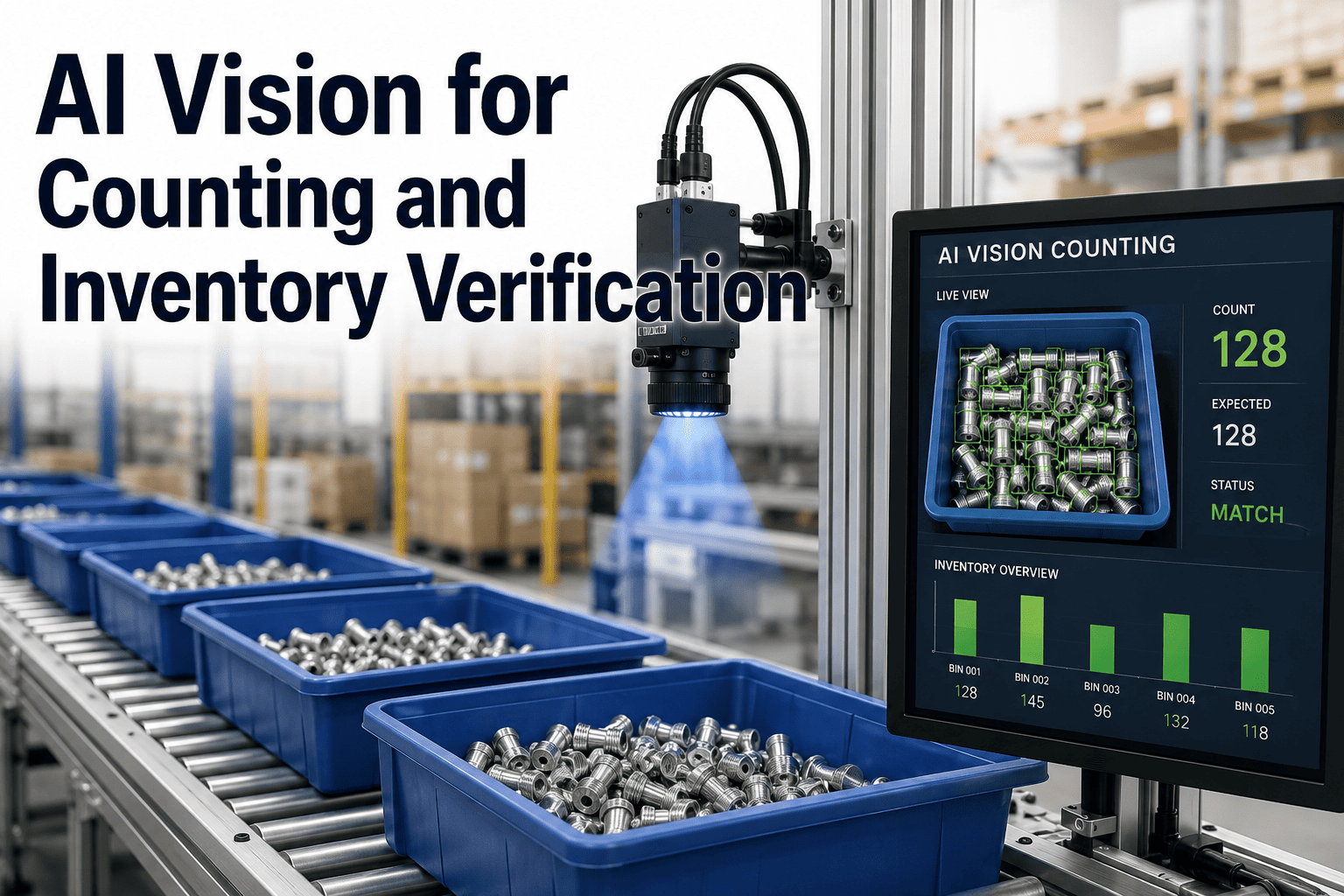
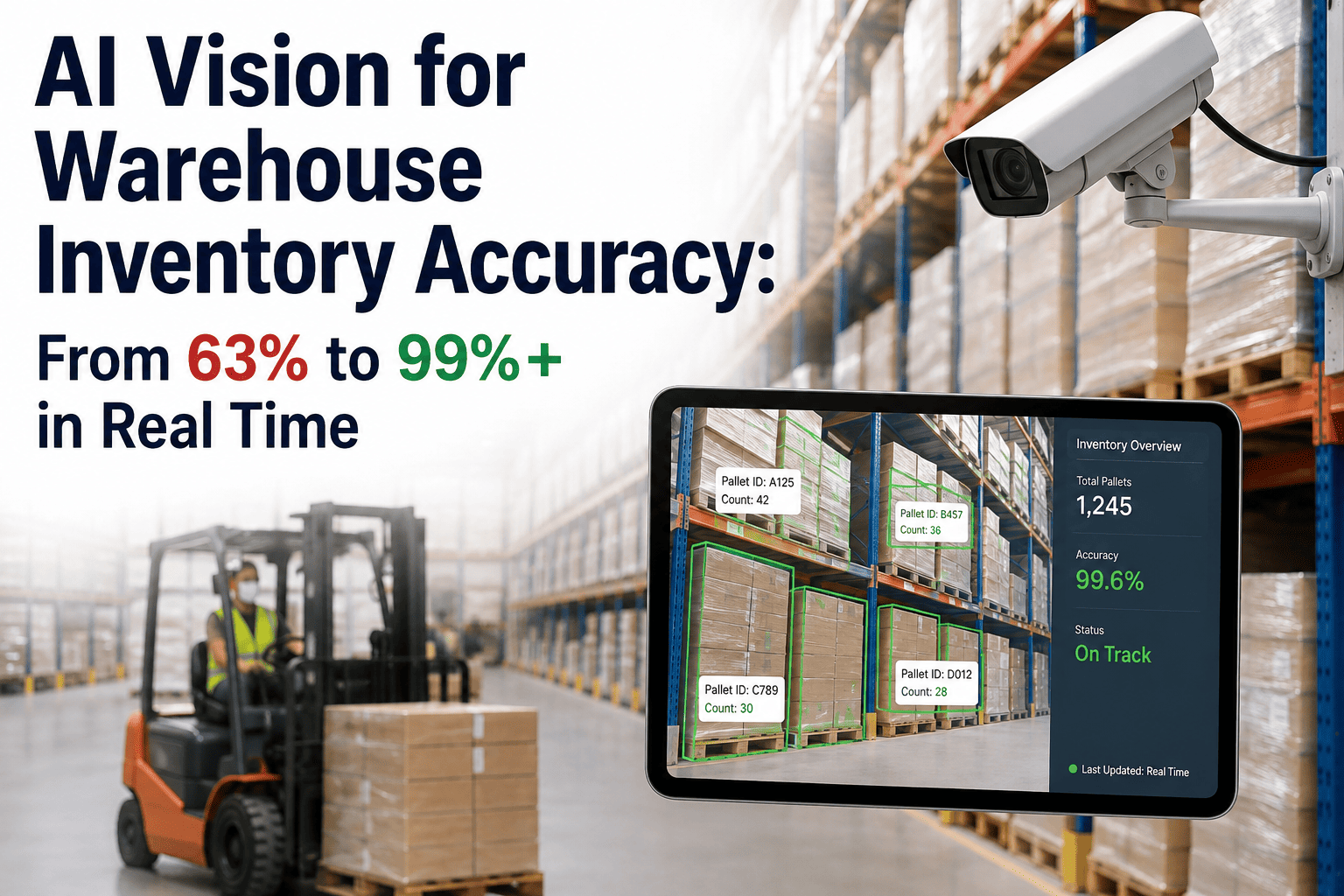
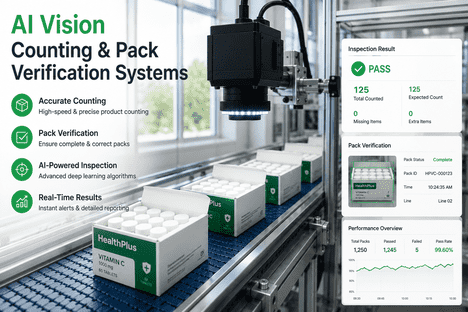
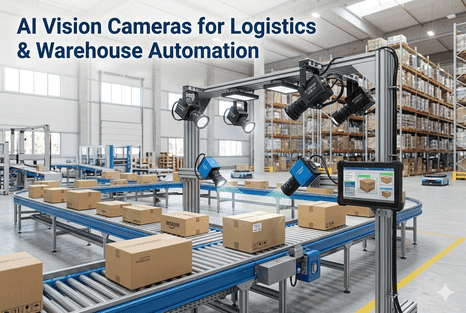
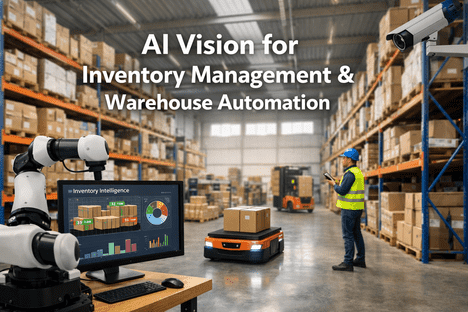
Every miscounted pallet, every skipped box on a shipping dock, and every parts tray that goes out with the wrong quantity costs far more than the missing items themselves. Downstream, it triggers stockouts, production stops from missing components, disputed shipments, and the labor of recounting, investigating, and reconciling. Manual counting and barcode scanning have been the default for decades, but both depend on human execution speed, line-of-sight access, and intact labels — conditions that fail routinely in busy warehouses and fast-moving production lines. AI vision cameras count objects by recognizing them visually, the way a person does but without fatigue, without needing labels, and at the speed of the conveyor or forklift. The result is real-time inventory verification that runs continuously without stopping the workflow.
AI Vision Counting System
AI Vision for Counting and Inventory Verification
Count parts, boxes, pallets, and finished units in real time with deep-learning cameras — no barcodes, no RFID tags, no manual tally sheets. Just accurate counts at the speed of your operation.
99%+
Counting accuracy on standard items
10x
Faster than manual counting
Zero
Labels or tags required
Live
Inventory data stream to ERP
The Hidden Cost of Wrong Counts
Inventory inaccuracies are one of the most expensive and least visible problems in manufacturing and distribution. The direct cost of a miscount is the value of the missing or excess items, but the cascade of downstream costs is usually far larger. A parts shortage discovered at the assembly station halts the line while someone searches for or reorders components. An overcount on a shipment leads to customer disputes, return logistics, and credit notes. An undercount means a partial delivery that damages the customer relationship and triggers a costly expediting cycle. Research across warehouse operations consistently shows that manual counting produces error rates of 1 to 4 percent depending on the item type and environment, and each percentage point of inaccuracy generates costs that multiply as the error moves downstream through the supply chain.
Downstream Cost Multiplier Per Miscount
At Counting Point
1x
Value of the miscounted items — the visible cost
At Next Process Stage
3x
Line stop, reordering, expediting, and rescheduling labor
At Shipping
5x
Disputed invoices, return freight, customer service time
At Customer Site
8-10x
Production stop at customer, penalty charges, relationship damage
A $50 miscount at the dock becomes a $400-$500 problem at the customer's assembly line.
Why Barcodes and RFID Are Not Enough
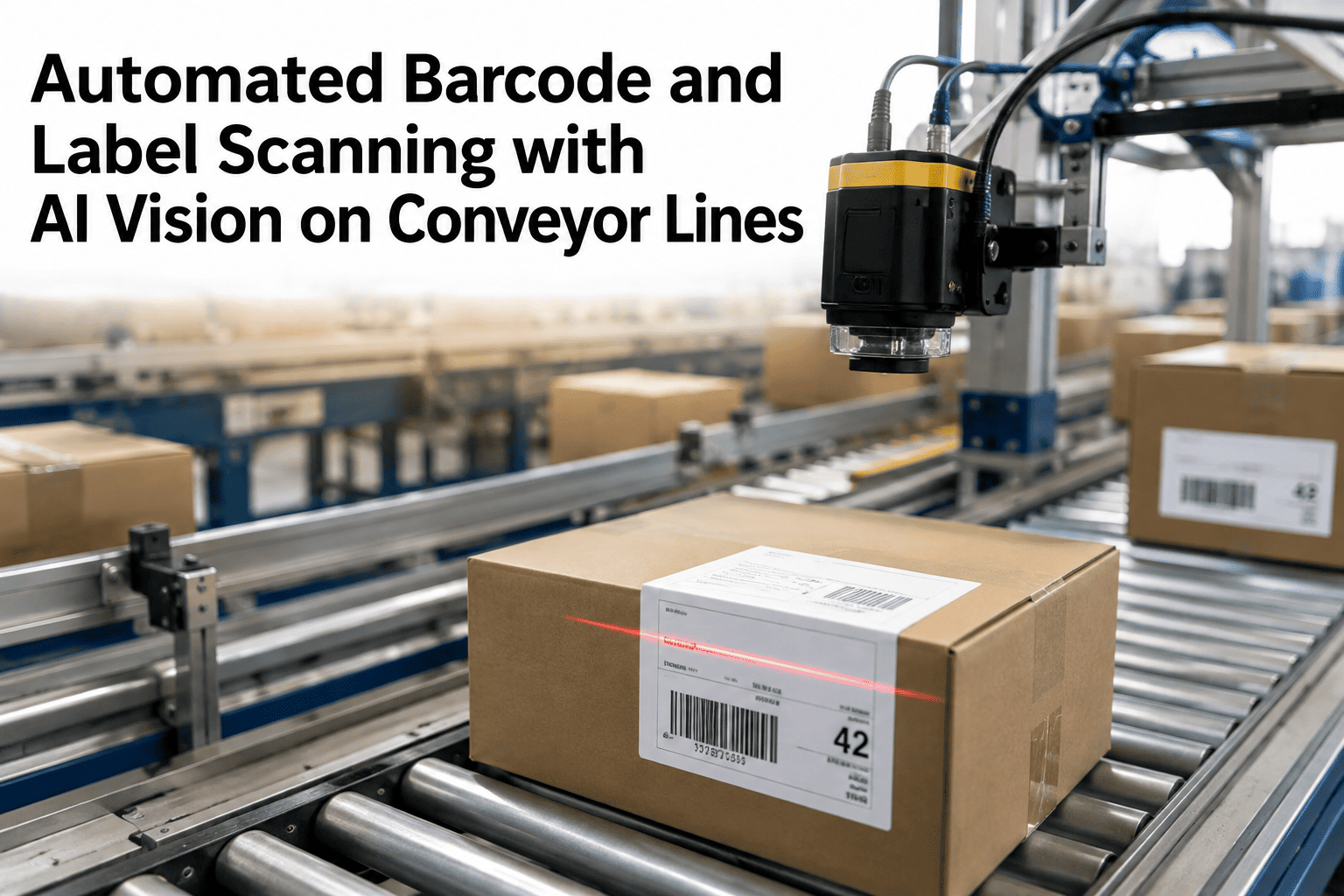
Barcode scanning is reliable when every item has a readable label, the scanner has clear line-of-sight, and the operator has time to scan each unit individually. In practice, labels get damaged, obscured by wrapping, or printed on curved surfaces that deflect the laser. Scanning a full pallet of 200 boxes means 200 individual scan events, each introducing a small failure probability that compounds across the load. RFID eliminates the line-of-sight problem but introduces tag cost, reader infrastructure, and signal interference from metal surfaces and liquid contents — and still requires every item to carry a tag. AI vision counts by recognizing the objects themselves, so it works on unlabeled items, items in transparent or damaged packaging, and bulk arrangements where individual tags or barcodes would be impractical or impossible to scan.
Manual Counting
Speed20-40 items/min
Error rate1-4%
Label neededNo
Line-of-sightYes
Fatigue factorHigh
Ongoing costFull labor cost
Barcode Scanning
Speed60-120 items/min
Error rate0.1-0.5%
Label neededYes, intact
Line-of-sightYes, required
Fatigue factorMedium
Ongoing costLabels + labor
AI Vision Counting
Speed200-1000+ items/min
Error rate0.1-0.5%
Label neededNo
Line-of-sightNo
Fatigue factorNone
Ongoing costMinimal
How AI Vision Counts: The Detection Pipeline
An AI counting system does not simply take a photo and count pixels. It runs a multi-stage pipeline that locates objects, classifies them, tracks them across frames to avoid double-counting, and outputs a verified total that feeds directly into inventory or MES systems. Understanding this pipeline makes clear why the accuracy is so much higher than manual methods and why the system handles occlusion, overlap, and variable spacing that would defeat simpler approaches.
From Camera Image to Verified Count
1
Capture
Industrial camera images the area — conveyor, pallet, shelf, or dock — at frame rate with controlled or enhanced lighting
2
Detect
Deep-learning object detection model identifies every instance of the target item, drawing bounding boxes around each one
3
Track
Multi-object tracker follows each detection across consecutive frames to prevent double-counting items that remain in view
4
Verify
Count is cross-checked against expected range and confidence scores, flagging anomalies for human review
5
Report
Verified count, timestamp, and images pushed to ERP, WMS, or dashboard in real time via API or PLC integration
Counting Scenarios Across Operations
AI vision counting is not a single-use tool — it applies wherever objects need to be quantified, and the value varies by scenario. On a production line, it verifies that the correct number of parts enter each package. In a warehouse, it confirms pallet build accuracy before shipping. On a loading dock, it validates outbound quantities against orders. The following scenarios represent the most common and highest-ROI deployments documented across manufacturing and logistics operations.
01
Parts Counting on Trays and Feeders
Small parts — fasteners, electronic components, stamped metal pieces — arranged on trays or in feeder bowls. Manual counting of 500 small parts on a tray takes 3 to 5 minutes and produces frequent errors. AI vision counts the entire tray in under one second, including parts that are overlapping, rotated, or partially obscured by neighboring items. The count is verified against the expected quantity before the tray moves to the next station, preventing wrong-quantity kits from reaching assembly.
500+ partscounted in under 1 second
02
Box Counting on Pallets and Skids
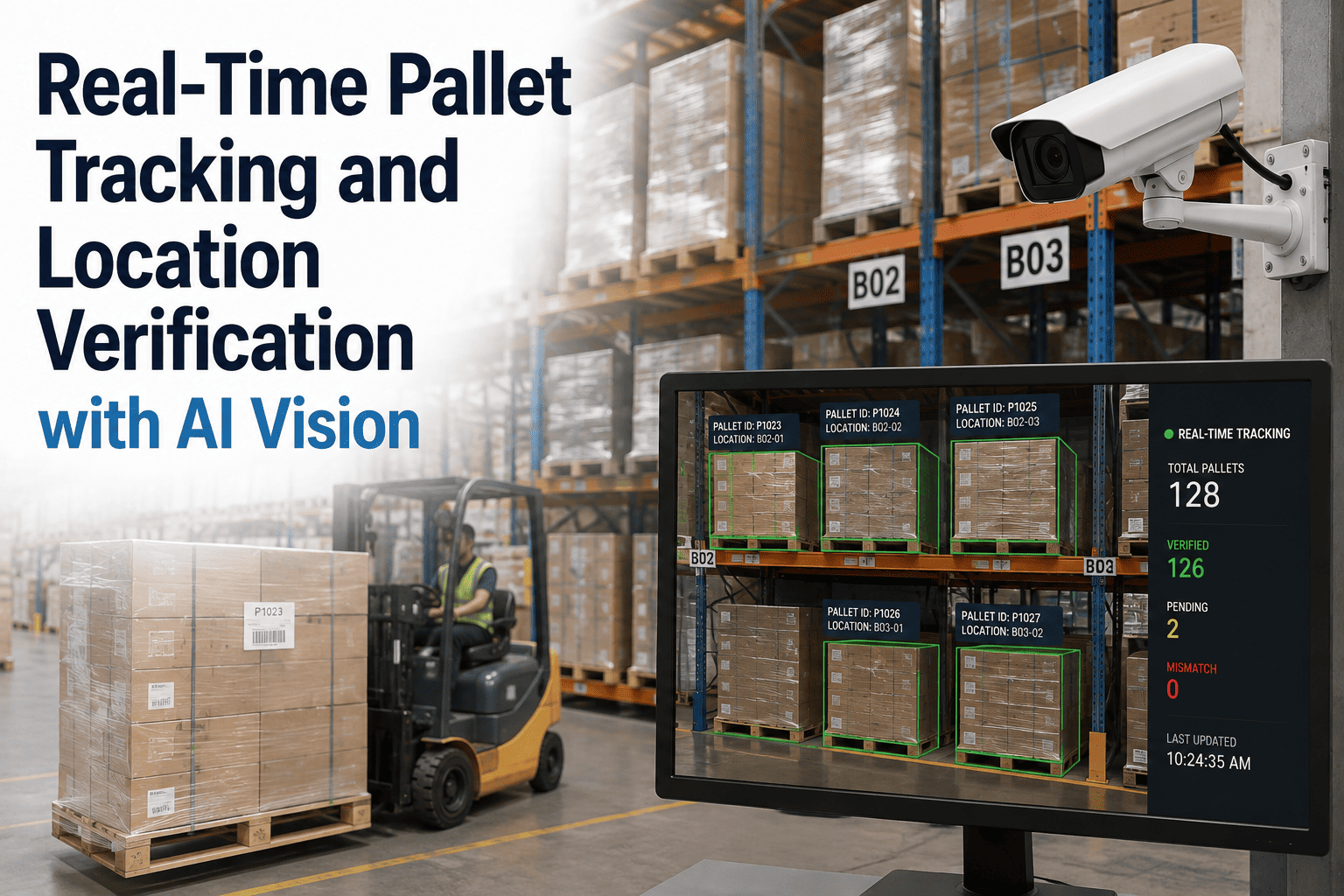
Verifying that a pallet contains the correct number of boxes before stretch-wrapping and shipping. Manual counts require walking around the pallet, counting visible boxes, and estimating hidden layers — a process that introduces 2 to 5 percent error on tall or shrink-wrapped pallets. A single overhead camera counts every visible box face and uses dimensional reasoning to infer hidden boxes, producing a total that is compared against the pick list before the pallet leaves the dock.
99%+accuracy on standard pallet builds
03
Finished Goods on Conveyor Lines
Counting finished products as they exit the production line — bottles, cans, packaged goods, or boxed units. The camera monitors the conveyor continuously, tracking each item as it passes through the field of view and incrementing the count in real time. If the count at the end of a batch does not match the expected output, the system alerts operators immediately, enabling root-cause investigation before the batch moves to packaging or shipping.
Real-timebatch count at full line speed
04
Warehouse Stock Verification
Periodic or continuous verification of shelf and rack contents without manual cycle counting. Cameras mounted on aisles image shelf sections, and the AI model identifies and counts items by type, comparing the visual count against the WMS record. Discrepancies are flagged automatically, reducing the labor of full cycle counts by 70 to 90 percent and catching stockout risks or misplaced inventory that would otherwise go undetected until a pick failure occurs.
70-90%reduction in cycle count labor
05
Inbound Receiving Verification
Counting and verifying received goods against purchase orders at the receiving dock. Instead of manually unloading and counting each carton, the camera images the incoming shipment as it is unloaded, counting units and verifying the total against the PO quantity. Mismatches are caught at the point of receipt rather than discovered later during production or picking, shifting the error correction upstream where it is cheapest to resolve.
At receipterrors caught before they enter inventory
06
Bulk Material Pile Estimation
Estimating the volume or quantity of bulk materials — sand, gravel, coal, grain, or scrap — stored in piles, bins, or stockpiles. The vision system uses 3D reconstruction or area-based estimation from overhead imagery to produce volume counts that replace manual measurement or expensive LiDAR surveys. Regular automated readings track consumption and replenishment trends without sending personnel into the stockpile area.
Continuousvolume tracking without manual survey
Manual counting is not just slow — it is structurally unable to achieve the accuracy that modern inventory and production systems require. Every miscounted shipment, every wrong-quantity kit, and every cycle count that misses a discrepancy is a cost that compounds. See AI vision count your actual products and packaging in a live demonstration.
Book a 30-minute demo and bring your hardest counting challenge.
Accuracy Benchmarks by Environment
Counting accuracy depends on the visual complexity of the scene. Neatly arranged, well-separated items on a clean background are straightforward for any detection model. Real-world counting scenarios involve overlapping items, variable lighting, reflective packaging, and cluttered backgrounds that challenge simpler approaches. The benchmarks below reflect performance on representative industrial imagery across common deployment environments, based on testing with modern YOLO-family detection architectures.
Counting Accuracy by Scene Complexity
Neatly spaced items, clean background
99.5%
Parts on tray, moderate overlap
98.2%
Boxes on pallet, multi-layer
97.1%
Mixed items in shipping container
95.4%
Small fasteners in feeder bowl
96.3%
Shelf stock with partial occlusion
94.0%
Accuracy improves continuously as the model is retrained on new production imagery from the specific deployment environment.
Integration: From Camera Count to ERP Record
A count that stays on the camera screen is useless for inventory management. The value of AI vision counting is realized when the count data flows automatically into the systems that run the operation — ERP, WMS, MES, or SCADA. The integration path is straightforward because the output of an AI counting system is a simple numeric value with a timestamp and location identifier, which maps directly to standard inventory transaction interfaces.
Data Flow From Camera to Business System
1
AI Camera
Captures, detects, tracks, and outputs verified count
2
Edge Device
Runs inference, applies business rules, formats output
3
API / PLC
Transmits count via REST API, OPC-UA, or digital I/O
4
ERP / WMS
Inventory record updated automatically, no manual entry
5
Dashboard
Real-time count visibility, trend charts, alert feeds
Frequently Asked Questions
How does AI vision counting handle overlapping or stacked items?
This is the core technical challenge of visual counting, and it is where deep learning outperforms traditional approaches. Earlier vision systems used blob analysis or template matching, which fail when items overlap because the boundaries between objects disappear. Modern object detection networks are trained on thousands of images that include overlapping, stacked, and partially occluded items, so the model learns to infer the presence of hidden objects from visible cues like edges, corners, and contextual patterns. Multi-object tracking across video frames adds another layer of verification — an item that disappears behind another object in one frame reappears in the next, and the tracker maintains its identity. For pallet-level counting where inner layers are completely hidden, the system uses the visible outer layer count combined with dimensional reasoning from the pallet dimensions to estimate the total, then flags the count for confirmation if confidence is below threshold.
We can demonstrate this on your specific product arrangement in a demo.
Does it work on items without barcodes or any kind of label?
Yes, this is one of the primary advantages of AI vision counting over barcode and RFID methods. The detection model is trained to recognize items by their visual appearance — shape, size, color, texture, and spatial context — not by any label or tag attached to them. This makes it uniquely suited for counting raw parts, bulk materials, unlabeled sub-components, and items in transparent or damaged packaging where barcode scanning is impossible. The trade-off is that the model must be trained on examples of each item type you want to count, but once trained, it recognizes those items regardless of labeling state. For operations that handle a wide variety of unlabeled SKUs, this eliminates the entire cost and logistics chain of applying and maintaining barcode labels.
Talk to our team about training for your specific item types.
How fast can the system count, and does it slow down our line?
AI vision counting runs in parallel with the production flow and does not require the line to stop or slow down. The camera captures images at frame rate — typically 30 to 60 frames per second on standard industrial cameras — and the edge inference device processes each frame in milliseconds. On a conveyor moving at normal production speed, the system detects and tracks every item passing through the field of view without introducing any delay. For static counting scenarios like pallets or trays, the count is produced in under one second from the moment the image is captured. The system does not need to physically interact with the items, so there is no mechanical bottleneck. The only constraint is camera placement — the field of view must cover the area where items pass or are arranged, and lighting must be sufficient for the model to detect features reliably.
What happens when we introduce a new product or package type?
Adding a new item type to the counting system follows the same training workflow used during initial deployment. You collect images of the new item in the positions and arrangements where it will be counted, label those images to identify the new item class, and retrain or fine-tune the existing model with the augmented dataset. Because the model already knows how to detect and count objects in your environment, the new item type typically requires only 200 to 500 labeled images to reach production-grade accuracy — a process that can be completed in one to two days. The existing item classes are preserved during retraining, so you do not lose accuracy on previously trained products. For facilities that frequently add new SKUs, the training workflow can be managed by your own quality or warehouse team after initial setup, making the system self-sufficient for ongoing expansion.
How does this integrate with our existing ERP or WMS system?
The AI counting system outputs structured data — a count value, item identifier, timestamp, location, and confidence score — through standard industrial communication protocols. The most common integration path is a REST API call from the edge device to your ERP or WMS, where the count is received as an inventory transaction and posted to the appropriate location and SKU record. For environments that prefer industrial protocols, the system can transmit counts via OPC-UA, MQTT, or Modbus TCP to a middleware layer that bridges to the business system. For simpler setups, digital I/O signals can trigger a count increment in the PLC that is already communicating with the ERP. The integration effort is typically one to three days depending on the protocol and the complexity of the business rules around count verification and exception handling.
Schedule a technical integration discussion with our engineers.
Stop Counting by Hand. Start Knowing in Real Time.
See AI Vision Count Your Products Accurately — in 30 Minutes
Bring images or video of the parts, boxes, or pallets you need to count. We will run the detection pipeline live, show you the accuracy on your actual items, and map the integration path to your ERP or WMS. No labels, no tags, no infrastructure changes — just a camera that counts.
Zero Labels
No tags or barcodes needed
10x Faster
Than manual counting
ERP Ready
Live data to your systems