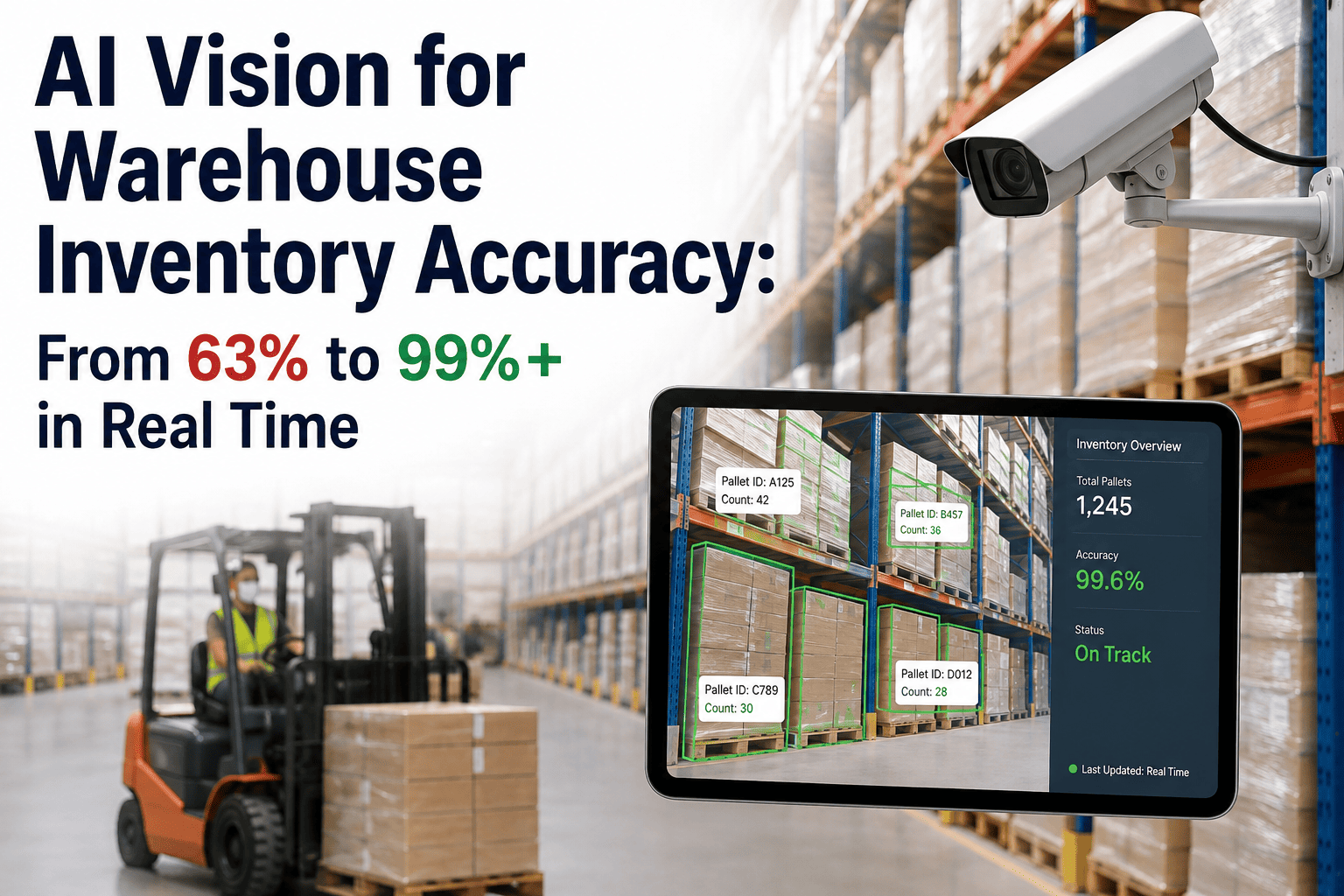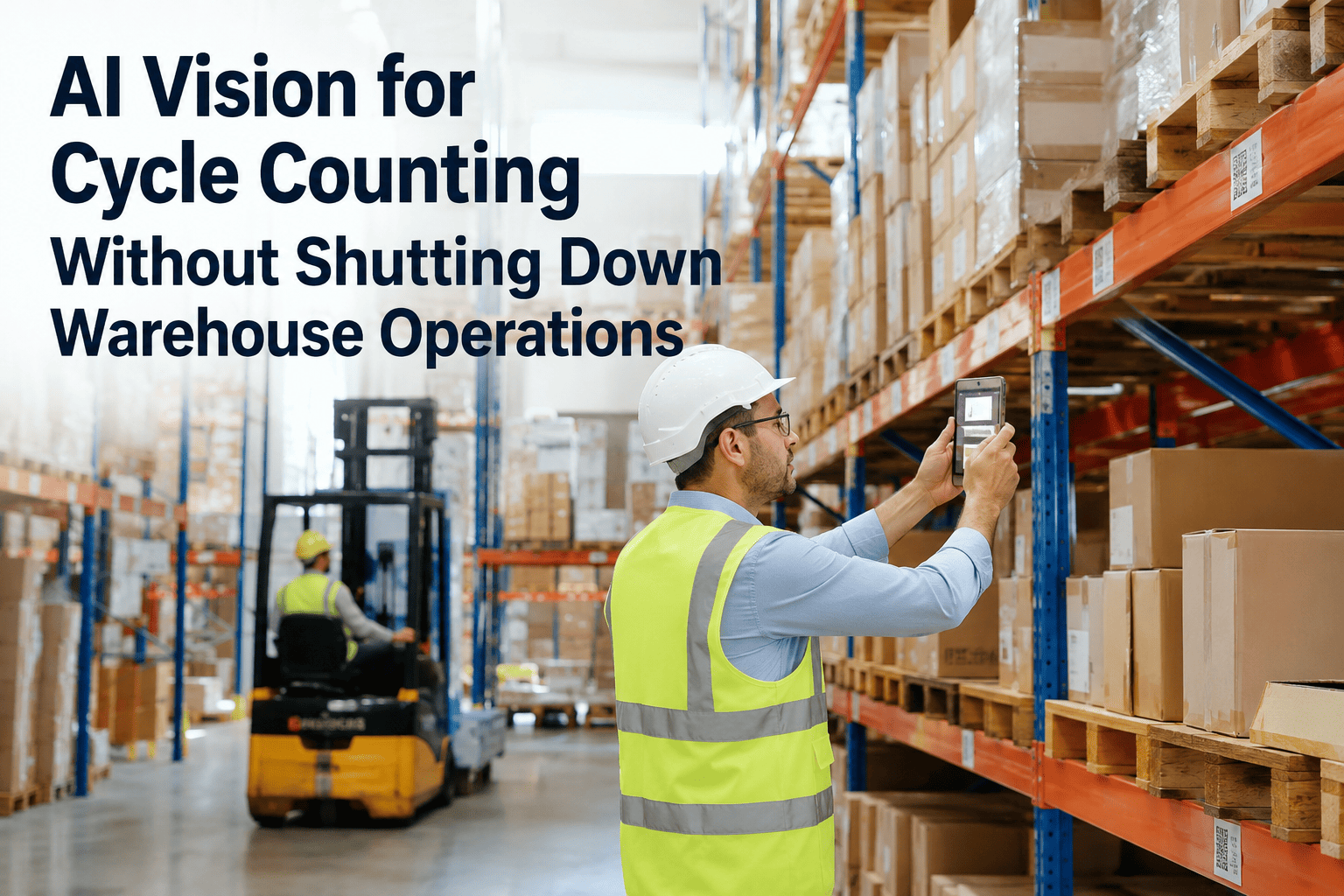
Every quarter, the shutters come down at 6 PM Friday, the last outbound trailer rolls, and a counting crew of thirty-two people walks in with clipboards and RF guns to spend forty-eight hours recounting what a warehouse management system already claims to know. By Monday morning the numbers still don't reconcile, three SKUs are unaccounted for, and the operation restarts two days behind on outbound. iFactory replaces that ritual with AI vision cameras that count pallets, cartons, and bin fill levels continuously while forklifts, pickers, and putaway crews keep working around them — schedule a walkthrough with a Book a Demo session and see it read your own aisles.
The Warehouse Doesn't Have to Stop for the Count Anymore
iFactory's AI Vision Cameras count every pallet, carton, and bin location every hour of every shift — no counting crew, no shutdown weekend, no gap between when a discrepancy happens and when someone catches it.
What a "Simple" Physical Inventory Actually Costs You
Most operations leaders quote the labor line and stop there. The full cost of a physical inventory shutdown lives across five hidden buckets, and every one of them scales with SKU count. A facility that ran a smooth annual count with two thousand SKUs a decade ago is running the same process today with eight or ten thousand active SKUs, three times the pick locations, and a fulfillment SLA that no longer tolerates a two-day pause. The math that made an annual shutdown acceptable in 2015 does not hold up under 2026 throughput expectations, and every quarter the gap between what the shutdown costs and what it delivers gets wider.
Lost Throughput
A single shutdown day can cost a mid-size warehouse up to $25,000 in missed shipments, delayed dock activity, and idle equipment — before overtime is even calculated.
Overtime & Temp Labor
Weekend and night-shift premiums stack up fast when thirty or more people are counting instead of picking, and temp counters often need training that consumes supervisor bandwidth.
Reconciliation Drag
The count itself is only half the work — matching handwritten sheets to WMS records, re-counting variances, and closing the books can take days after the physical count ends.
Human Error
Manual counting reliably produces 1 to 4 percent error rates depending on SKU complexity, meaning the "reconciled" number is itself carrying discrepancies into the next quarter.
Accuracy Decay
Even a perfect count starts drifting the moment operations resume — every mis-slot, mis-pick, and unlogged movement chips away at accuracy until the next scheduled shutdown.
How AI Vision Counts Without Stopping the Floor
Fixed overhead and aisle-mounted cameras hold their field of view constantly. Every time a location's contents change — a pallet lands, a carton leaves, a picker walks away — the model re-reads that location and updates the count. The floor never pauses because the counting never really stops. This is the architectural difference that separates AI vision from a faster clipboard: instead of moving counters through zones on a schedule, the count is a byproduct of the camera watching. Nothing on the floor changes about how putaway, picking, or replenishment happen. The system simply sees each movement and updates its record of what is where, in real time, without asking anyone to stop and confirm.
Continuous Visual Feed
Cameras cover storage bays, pick faces, staging lanes, and receiving zones with overlapping fields of view so every SKU location is seen from at least one angle.
Item & Location Recognition
Deep-learning models identify pallets, cartons, totes, and case stacks by shape, label, and position — no barcode scan required for the count itself.
Live WMS Comparison
Visual counts are matched against the WMS record in real time so any variance surfaces as an alert instead of a Friday-night surprise.
Task or Ticket
Variances route to the right team — a recount task to a floor associate, a slot correction to a putaway lead, or a WMS adjustment ticket to inventory control.
Four Warehouse Zones, Counted Continuously
A cycle count program only works if the whole warehouse is covered on a rotating schedule, and most programs quietly leave low-velocity or hard-to-reach zones under-counted for months at a time. Fixed AI vision inverts the problem — instead of moving counters through zones, the zones are watched continuously and the count updates as the contents change. Camera placement is engineered around the four functional zones below so no bay, no lane, and no forward pick face falls into a blind spot, regardless of aisle depth or rack height.
Manual Cycle Counting vs. Physical Shutdown vs. AI Vision
The industry has debated cycle counts against annual physicals for decades, and most warehouse operations end up running both — cycle counts for operational visibility, annual physicals for financial closure. AI vision is a third answer — one that inherits the operational continuity of cycle counting and the completeness of a physical count at the same time. The row-by-row comparison below shows why the tradeoff people have accepted for years — accuracy versus disruption — is not actually a tradeoff anymore.
| Metric | Manual Cycle Count | Full Physical Shutdown | iFactory AI Vision |
|---|---|---|---|
| Operational Disruption | Low | High — full or partial shutdown | None |
| Coverage per Cycle | Sample only | Complete | Complete, continuously |
| Frequency | Daily to weekly, per zone | Quarterly or annual | Every shift, every location |
| Labor Requirement | Ongoing counting shifts | Large surge crew | Minimal — exceptions only |
| Time to Detect Variance | Until next scheduled count | Until next physical | Minutes |
| Typical Accuracy | 96 to 98 percent | Point-in-time accurate, then decays | Up to 99 percent, sustained |
Why "Point-in-Time Accurate" Isn't Actually Accurate
A physical count produces one perfectly accurate number — for one moment. Then operations resume and the number starts drifting the same day. Every mis-slot, every unlogged movement, every mixed pallet that gets closed under one SKU code adds small variances that compound over weeks. Continuous vision holds the number steady because the count re-happens every time inventory moves. The chart below sketches the typical accuracy curve most warehouses live with today, and why so many finance teams quietly discount the WMS number as they get further from the last physical.
Stop Paying for Weekends You Can't Ship
iFactory keeps the floor moving, the count current, and the reconciliation happening in the background — book a walkthrough with your own aisle layout.
Three Counting Problems AI Vision Solves Quietly
The Mis-Slotted Pallet Nobody Would Have Found
A putaway driver dropped a pallet in the wrong bay at 2:47 PM. The WMS thought it was in location A-14; it was actually sitting in A-41. Under a manual cycle count schedule, that pallet stays "missing" until the next A-aisle count — potentially weeks. Vision caught the location mismatch in under a minute and routed a slot-correction task before the next pick wave started.
The Inbound Short That Wasn't Caught at the Dock
A supplier's ASN said 48 cartons; the trailer actually delivered 44. A rushed receiving associate closed the door and marked the receipt complete. Vision counted the cartons independently as they crossed the dock threshold and flagged the four-carton variance instantly, giving the buyer time to open a claim while the driver was still on-site.
The Pick Face That Ran Out Mid-Wave
A fast-moving SKU in the pick face was drawn down faster than the replenishment cycle expected. Vision watched the bin fill level fall past the trigger threshold and pushed a priority replenishment task ahead of the wave that would have hit the empty slot — no short-pick, no expedite, no unhappy customer.
Where the Payback Comes From
Continuous counting doesn't just replace a counting line-item in the operating budget. It changes several downstream cost lines at once — safety stock levels, expedite freight, short-pick recovery, customer credits, and audit prep — and the smaller ones tend to add up faster than the labor savings themselves. Most sites see the labor line first because it is the most visible, but the compounding value shows up in throughput preserved, orders shipped complete, and the buyers who finally trust the inventory number enough to reduce their standing buffer.
Recovered Shutdown Days
Every physical inventory day that no longer requires shutting the floor is recovered throughput, avoided overtime, and shipments that leave on schedule instead of the following Monday.
Sustained Inventory Accuracy
Bin-level accuracy stays at or near ninety-nine percent between reconciliations instead of decaying through the quarter, which cuts safety stock, expedites, and customer service adjustments.
Fewer Stockouts
Continuous, automated counting has been associated with up to a thirty percent reduction in stockouts across AI-enabled supply chains, because the pick face never quietly runs dry between scheduled checks.
Less Time on the Count Itself
Vision-driven counting has been shown to reduce inventory counting time by up to seventy-five percent, freeing counters and supervisors for value-added work like slot optimization and damage triage.
iFactory Sits Alongside the WMS You Already Run
Continuous cycle counting is only useful if it lands in the systems your operators, buyers, and controllers already use. iFactory pushes visual counts and variance alerts into the WMS, ERP, and inventory control workflows so the floor sees a single source of truth, not a parallel dashboard nobody checks. The integration philosophy is deliberately conservative: the WMS remains the system of record, associates keep the tools they know, and the vision layer adds accuracy and speed underneath rather than asking anyone to change how they work day to day.
WMS Reconciliation
Visual counts flow into the WMS as continuous updates, so bin-level accuracy is always live rather than as-of-last-count.
Variance Task Routing
Detected discrepancies become tasks routed to the right role — recount, slot correction, or inventory adjustment — inside the tools associates already use.
Audit & Compliance Trail
Every count and every reconciliation is logged with timestamp and image evidence, producing an audit trail that stands up to finance and external inventory audits.
Analytics & Trends
Long-term dashboards surface which SKUs, aisles, and shifts contribute most to variance, so root-cause work can target the actual sources of drift.
What Getting Started Actually Looks Like
One of the most common questions from operations leaders evaluating vision-based counting is what the first ninety days look like — how much internal lift is required, what the site needs to prepare, and when the numbers start becoming trustworthy. The honest answer is that most deployments hit reliable, WMS-integrated bin-level accuracy inside the first quarter, and the internal lift is significantly lighter than a WMS upgrade or a robotics install because the cameras sit on top of the operation rather than replacing anything the floor already relies on.
Site Assessment
Aisle-by-aisle walk, camera placement mapping, and identification of the first pilot zone — usually the highest-value or highest-variance area to demonstrate the count-vs-WMS delta quickly.
Pilot Zone Install
Cameras go up in the pilot zone during off-shift windows, baseline counts are established, and the vision output is validated against a manual reconciliation before any WMS write-back is enabled.
WMS Integration
Variance alerts and count updates begin flowing into the WMS through the chosen integration path, with a dedicated review cadence between the vision team and inventory control leads.
Coverage Expansion
Additional aisle groups come online in waves based on validated pilot performance, with the goal of full facility coverage inside the first quarter for most standard warehouse footprints.
Nothing about that timeline requires a shutdown, a warehouse-wide freeze, or a heroic IT project. The floor keeps running, receiving keeps receiving, and outbound keeps shipping while the counting layer is added underneath. By the time full coverage is live, the next scheduled physical inventory is already redundant for most operational purposes — the count that used to happen once a quarter is now happening every hour, every shift, in every zone that a camera sees, and the reconciliation that used to consume a weekend of overtime happens continuously in the background instead.
We used to shut down for two full days every quarter for a physical inventory, and we still finished the reconciliation with variances we couldn't explain. Continuous vision counting eliminated the shutdown entirely and put us at consistent bin-level accuracy that our finance team actually trusts. The buyers stopped padding safety stock and the outbound team stopped worrying about short-picks — that was the moment we knew this was different from a normal cycle-count program.
Frequently Asked Questions
Q: Do we still need to run an annual physical inventory if we deploy AI vision cycle counting?
Q: How does the system count SKUs that look nearly identical or come in mixed pallets?
Q: What happens when a forklift, associate, or piece of equipment blocks the camera's view of a location?
Q: How disruptive is the installation itself — do we have to shut down to put the cameras in?
Q: Does AI vision cycle counting replace our WMS, or does it work alongside it?
Watch Your Next Cycle Count Run Itself
Book thirty minutes with our team, walk us through your aisle layout, and see AI vision hold ninety-nine percent bin-level accuracy without a counting crew.