Every food and beverage manufacturer faces the same impossible pressure: deliver perfect quality at maximum speed across a supply chain riddled with natural ingredient variability, strict regulatory requirements, frequent changeovers, and a cold chain that never stops moving. Traditional quality inspection misses what human eyes fatigue on. Manual demand forecasting leads to stockouts and spoilage. Reactive supply chain management creates waste that costs the industry hundreds of billions annually. AI changes the entire equation — computer vision systems catching defects at 95% accuracy that human inspectors miss at speed, demand forecasting models cutting inventory spoilage by 10–15%, and supply chain intelligence that turns reactive replenishment into proactive orchestration. The result: manufacturers reporting 8–12% OEE improvements, 25–35% food waste reductions, and compliance documentation generated automatically in real time.
AI-Powered Food Manufacturing
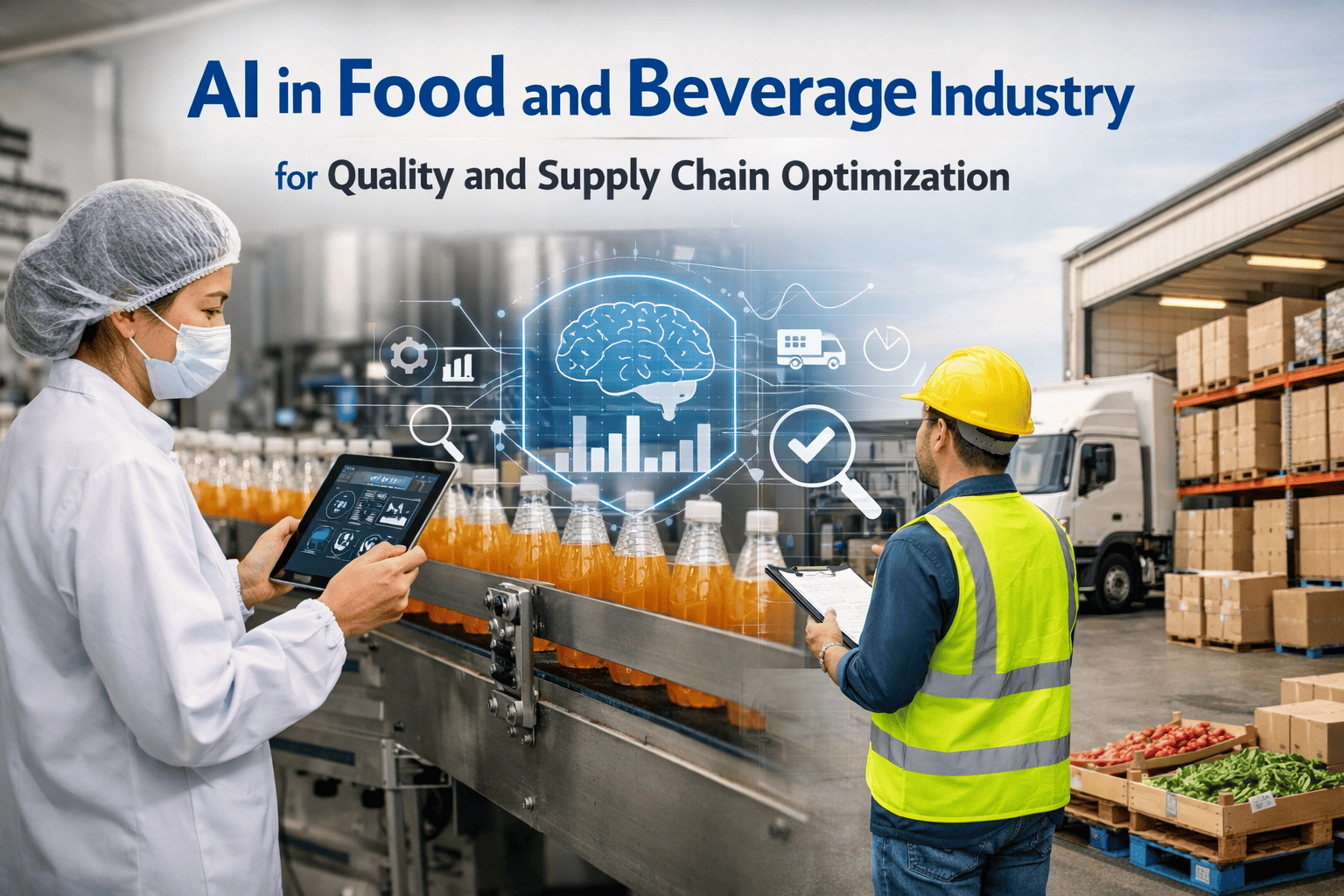
AI in Food and Beverage Industry for Quality and Supply Chain Optimization
Detect every defect, eliminate every unnecessary waste, and run a supply chain that anticipates demand — not one that reacts to shortages.
$88.37B
AI in food and beverages market projected by 2031 at 36.96% CAGR
95%
Defect detection accuracy with AI computer vision — PepsiCo deployment
35%
Food waste reduction achieved with AI-driven supply chain analytics
80%
Reduction in manual quality checks — Nestlé AI vision deployment
Sources: Mordor Intelligence · BCC Research · Frontiers in Nutrition · ScienceDirect · iFactory Production Data 2025
The Hidden Cost of Getting Quality Wrong in Food Manufacturing
Food manufacturing operates with zero tolerance for errors that other industries can absorb. A contaminated batch doesn't just create scrap — it triggers recalls, regulatory investigations, and brand damage that can persist for years. Foodborne illnesses still affect hundreds of millions of people annually worldwide. Manual inspection systems — the industry standard for decades — are fundamentally incompatible with the throughput, precision, and regulatory traceability modern food production demands. Human inspectors fatigue over long shifts, produce inconsistent judgments, generate only batch-level records unsuitable for surgical recall management, and simply cannot evaluate every unit at production line speeds. Meanwhile, over 60% of AI adoption in food manufacturing in 2025 is now focused on real-time quality inspection and contamination detection — because the industry has recognized that no other approach is adequate.
Quality Escapes
Defects reaching consumers
Common Losses
Foreign object contamination missed by manual inspection
Color, texture, and size deviations inconsistently rejected
Packaging integrity failures detected only at end-of-line
What AI Does
Computer vision inspects 100% of units at full line speed — detecting sub-millimeter foreign objects, color anomalies, and packaging failures with up to 95% accuracy across every shift.
Food Waste
Spoilage and overproduction losses
Common Losses
Inaccurate demand forecasting drives overproduction and spoilage
Shelf-life mismatch causes end-of-chain wastage across cold storage
Broad recall scopes waste edible product due to lack of traceability
What AI Does
ML models predict shelf life from storage conditions, optimize batch production to demand signals, and enable surgical per-unit recalls — reducing food waste by 25–35% across the full chain.
Supply Disruption
Stockouts and procurement failures
Common Losses
Demand spikes undetected until shelves are empty or production stalls
Ingredient procurement driven by static schedules not actual consumption
Supplier risk undetected until a disruption has already materialized
What AI Does
Predictive analytics processes POS data, weather patterns, and promotional calendars to forecast demand weeks ahead — optimizing procurement, eliminating stockouts, and anticipating supplier risks before they cascade.
Compliance Risk
Regulatory and recall exposure
Common Losses
Manual HACCP documentation creates gaps exploited during audits
Batch-level traceability forces over-broad recalls multiplying cost
Allergen cross-contamination risk undetected until consumer harm
What AI Does
AI generates real-time FSMA, HACCP, and BRC compliance documentation automatically from inspection data — delivering per-unit traceability that enables surgical recalls and complete audit readiness at all times.
Six AI Levers That Transform Food and Beverage Operations
Food and beverage manufacturing faces a complexity that most industries don't — natural ingredient variability, strict hygiene requirements, frequent SKU changeovers, and a cold chain that creates quality risk at every transfer point. Here are the six AI capabilities iFactory deploys to address every layer of that complexity simultaneously.
01
Computer Vision Quality Inspection
Deep learning vision systems inspect every unit at full production line speed — detecting foreign objects, color and texture deviations, packaging seal failures, fill level errors, and labeling compliance issues with over 94% accuracy. Unlike rule-based machine vision, AI learns what acceptable variation looks like in your specific product, handling seasonal ingredient changes without manual reprogramming.
Typical result: 95% defect detection accuracy, 80% reduction in manual inspections
02
AI Demand Forecasting and Inventory Optimization
ML models process point-of-sale data, promotional calendars, weather patterns, seasonal trends, and social signals to predict demand weeks ahead with high accuracy. Procurement is automatically optimized to match forecasted requirements — eliminating both stockouts and the overproduction that drives spoilage, reducing inventory carrying costs, and cutting waste at every level of the supply chain.
Typical result: 10–15% reduction in inventory spoilage and carrying costs
03
Predictive Shelf-Life Management
AI analyzes production parameters, cold chain temperature profiles, storage conditions, humidity, and packaging integrity data to predict exact shelf-life for each batch in real time. Dynamic expiry labeling, proactive stock rotation alerts, and supplier quality flagging enable food businesses to maximize sellable life while cutting end-of-chain waste that costs the industry an estimated $1 trillion annually.
Typical result: 25–35% food waste reduction across production and distribution
04
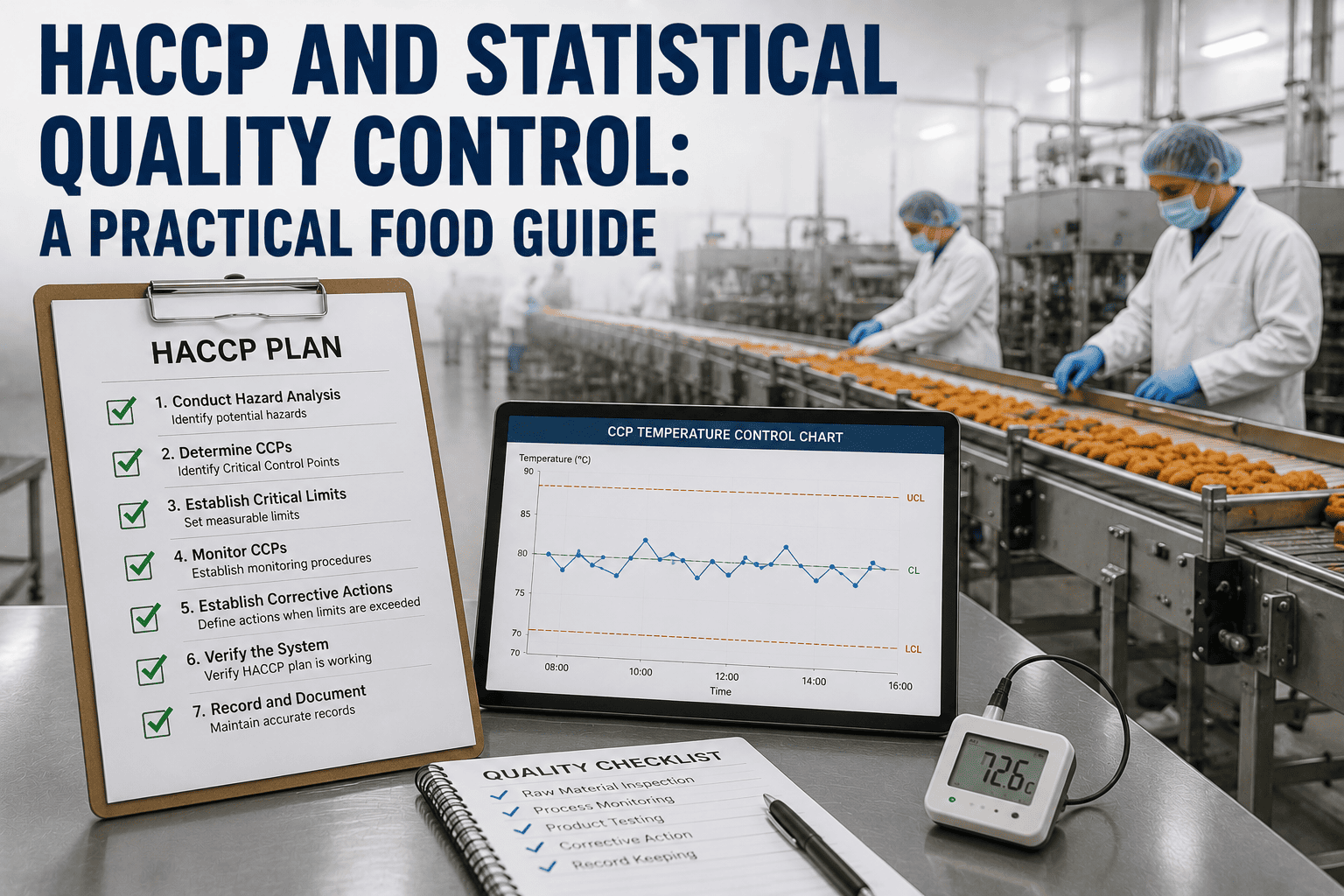
Real-Time HACCP and Compliance Automation
AI monitors critical control points across the production line continuously — temperature, pH, moisture, microbial risk indicators, and allergen cross-contamination risk — generating FSMA, HACCP, and BRC compliance documentation automatically. Every inspection decision is logged with timestamp, confidence score, and captured image, delivering audit-ready traceability at all times without manual data entry.
Typical result: 40–60% improvement in traceability depth, full audit readiness continuously
05
Supply Chain Risk Intelligence
AI processes supplier performance data, logistics telemetry, weather forecasts, geopolitical risk signals, and commodity price trends to identify supply chain vulnerabilities before they materialize as production stoppages. Predictive sourcing recommendations, dynamic safety stock adjustments, and alternative supplier alerts ensure continuity across the full ingredient procurement chain without manual monitoring.
Typical result: 30–50% reduction in supply disruption-related production losses
06
Production Process Optimization
AI continuously adjusts mixing times, oven temperatures, fermentation parameters, pasteurization profiles, and packaging speeds based on real-time ingredient property data — compensating for natural batch variability that causes recipe drift and rework. Digital twin simulation validates process changes before physical trials, cutting time-to-validate new recipes and formulations by up to 50%.
Typical result: 8–12% OEE improvement, 30% reduction in rework and scrap
Want to identify which AI capabilities deliver the fastest ROI for your food production operations? Book a free production optimization assessment.
Before vs. After: What AI Changes in Food and Beverage Manufacturing
The gap between traditional food manufacturing and AI-powered operations is not a matter of degree — it is structural. From quality inspection to supply chain management, every critical process changes fundamentally when AI replaces manual and statistical methods.
Quality Inspection
Sample-based manual inspection, fatigue-driven inconsistency
100% inline inspection at full speed — 95% defect detection accuracy
Demand Forecasting
Historical averages, seasonal adjustments, manual overrides
Multi-variable ML models incorporating POS, weather, promotions in real time
Shelf-Life Management
Fixed-date labels based on average batch performance
Dynamic per-batch shelf-life prediction from real-time production and cold chain data
Compliance Documentation
Manual HACCP logs, batch records, periodic audits
Automated per-unit records, continuous CCP monitoring, audit-ready at all times
Recall Management
Broad batch recalls due to insufficient traceability — high cost and waste
Surgical per-unit recalls targeting only affected production windows
Waste Generation
10–30% production waste from overproduction, rework, and spoilage
25–35% waste reduction through predictive production and shelf-life management
Measurable Results from AI Food Manufacturing Deployments
The outcomes below are documented results from real AI deployments at major food and beverage manufacturers, published research, and industry operational assessments from 2024 and 2025 — not estimates or projections.
95%
Defect Detection Accuracy
PepsiCo's AI computer vision deployment on snack lines improved defect detection accuracy to 95% — eliminating reliance on human inspectors while enhancing throughput and regulatory compliance
80%
Manual Check Reduction
Nestlé's AI vision system for wrapper integrity and fill-level inspection reduced manual quality checks by 80%, improving consistency while redirecting surplus food to charitable partners
35%
Food Waste Reduction
AI-driven supply chain analytics, demand forecasting, and shelf-life prediction deliver 25–35% food waste reduction across production, distribution, and retail by eliminating overproduction and spoilage
94%+
AI Packaging Inspection Accuracy
CNN, RNN, and SVM models trained on spectral and image data achieve average accuracies above 94% for spoilage, contamination detection, and packaging integrity verification in production environments
8–12%
OEE Improvement
Early AI adopters in food processing report 8–12% overall equipment effectiveness gains and 10–15% inventory spoilage cuts through combined quality, production, and supply chain optimization
60%
Traceability Improvement
AI-integrated supply chains deliver 40–60% improvement in traceability depth — enabling surgical recalls, full audit readiness, and consumer transparency that manual batch records cannot provide
Sources: Mordor Intelligence 2026 · BCC Research · ScienceDirect · Frontiers in Nutrition · ioni.ai PepsiCo/Nestlé Case Data 2025
Industry Applications: Where AI Delivers the Biggest Wins in Food and Beverage
AI optimization adapts across every food and beverage segment — but certain production environments see outsized returns because of the severity of their quality risk, the complexity of their ingredient variability, or the perishability of their products.
Meat, Poultry and Seafood
The highest food safety risk segment in the industry — pathogen detection, temperature compliance, and cut consistency demand inspection precision that human systems cannot maintain at production throughputs. AI vision systems detect contamination, foreign objects, and trim inconsistencies in real time. Cold chain AI monitors temperature excursions across the full distribution network, flagging compliance failures before they reach retail.
Bakery and Confectionery
Natural ingredient variability from flour batches, humidity, and ambient temperature creates constant recipe drift that manual process control cannot compensate. AI continuously adjusts mixing times, proofing temperatures, and oven profiles based on real-time dough property data — maintaining consistent product quality across every batch. Computer vision grading eliminates color, size, and shape defects before packaging.
Dairy and Beverages
Strict pasteurization compliance, fill accuracy, and packaging seal integrity requirements create quality control complexity at scale. AI monitors critical control points continuously — pasteurization temperature profiles, fill weights, and cap seal pressure — generating HACCP documentation automatically. Demand forecasting for perishable SKUs reduces costly overproduction and cold chain waste across the distribution network.
Snacks and Packaged Foods
High-speed production lines running millions of units per shift require quality inspection that no human workforce can match for consistency or coverage. AI computer vision systems inspect every unit for size, color, texture, and packaging integrity at full line speed — automatically adjusting cooking times and temperatures to maintain specification while minimizing energy use and production waste per batch.
Fresh Produce and Cold Chain
Perishability makes demand forecasting errors uniquely expensive — unsold product becomes immediate waste. AI processes weather data, retail POS trends, and logistics telemetry to match production and procurement precisely to demand. Computer vision grading systems automate quality sorting at packing facilities — replacing subjective manual grading with consistent, high-speed AI classification for blueberries, apples, kiwifruit, and other high-value produce.
Large-Scale Food Retail and QSR
Multi-location food operations face supply chain complexity that manual vendor management cannot handle at scale. AI orchestrates procurement across hundreds of suppliers, monitors shelf life and waste data in real time, and optimizes menu-level demand forecasting for quick-service operations. Retailers using AI supply chain intelligence report measurable reductions in spoilage write-offs and out-of-stock incidents simultaneously.
The Market Is Accelerating — Exponentially
The global AI in food and beverages market reached $13.39 billion in 2025 and is projected to hit $88.37 billion by 2031 — a 36.96% CAGR. The AI in food safety and quality control segment alone will reach $13.7 billion by 2030 at 30.9% CAGR. Over 60% of AI adoption in food manufacturing in 2025 is already focused on real-time quality inspection — yet less than 30% of global food manufacturers have fully integrated AI-based traceability systems. The window to lead is wide open. Manufacturers who deploy now lock in quality and supply chain advantages that compound year-over-year as AI models improve on their own specific production data.
44.8%
CAGR of AI food market 2024–2025
41.05%
CAGR for AI predictive maintenance in food through 2031
How iFactory Deploys AI in Food and Beverage Operations
iFactory connects to your existing production lines, MES, SCADA, and ERP systems — no replacement of existing infrastructure required. Our AI layer ingests the production data you already generate and transforms it into real-time quality intelligence, supply chain foresight, and compliance automation.
Week 1–2
Connect and Integrate
Integrate with your existing production line sensors, MES, SCADA, ERP, and cold chain monitoring systems via standard protocols. Deploy computer vision hardware at quality inspection points. Begin streaming production parameters, inspection data, and supply chain signals into iFactory's analytics engine — with zero disruption to live production operations.
Week 3–4
Train and Baseline
AI vision models are trained on your specific product portfolio — learning the boundary between natural ingredient variation and actual defects from your own production data. Demand forecasting models establish baseline accuracy across your SKU range, seasonal patterns, and distribution network. Supply chain risk models learn your supplier network and ingredient criticality.
Week 5–6
Deploy and Automate
Activate real-time quality inspection at full production speed. Live demand forecasts and procurement recommendations go to planning teams. HACCP compliance documentation generates automatically from CCP monitoring data. Supply chain risk alerts activate. Operators receive process optimization recommendations via dashboard or through closed-loop automated adjustment.
Week 7–8
Measure and Scale
Quantify defect reduction, waste reduction, forecast accuracy improvement, compliance efficiency gains, and supply chain savings against your pre-deployment baseline. Present board-ready ROI analysis. Expand to additional production lines, SKUs, and supply chain nodes based on demonstrated results from the initial deployment.
Ready to eliminate quality escapes and supply chain waste from your food production operations? Schedule your free food manufacturing assessment.
Frequently Asked Questions
How does AI quality control work in food manufacturing?
AI quality control in food manufacturing uses deep learning computer vision systems to inspect every production unit at full line speed — detecting foreign objects, color and texture deviations, packaging integrity failures, and fill level errors with over 94% accuracy. Unlike rule-based machine vision that requires manual reprogramming, AI learns acceptable variation from your own product data and continuously improves. All inspection decisions are logged with images and confidence scores, creating per-unit traceability for FSMA, HACCP, and BRC compliance automatically.
Book a demo to see it on your production line.
What ROI can food manufacturers expect from AI deployment?
Early adopters in food processing report 8–12% OEE improvements, 10–15% inventory spoilage reductions, and 25–35% food waste reductions. PepsiCo achieved 95% defect detection accuracy eliminating the cost of quality escapes. Nestlé reduced manual quality checks by 80%. Supply chain AI delivers 30–50% reductions in disruption-related production losses. Most iFactory deployments deliver measurable gains within the first 8 weeks, with full ROI typically documented within 6 to 12 months.
Schedule a demo to model your specific savings.
Does AI quality inspection handle natural ingredient variability?
Yes — this is precisely where AI outperforms rule-based vision systems. Traditional machine vision requires exact specifications and breaks down when ingredient properties shift seasonally or between suppliers. iFactory's deep learning models are trained on thousands of examples of acceptable product variation specific to your production environment — they learn what good looks like in your products, not a fixed template. The system handles seasonal changes, supplier variation, and recipe adjustments without manual reprogramming.
How does AI help food companies meet HACCP and FSMA compliance?
iFactory monitors all critical control points continuously — temperatures, pH, moisture levels, and allergen risk indicators — and generates HACCP, FSMA, and BRC compliance documentation automatically from real-time inspection data. Every production decision is timestamped and logged with inspection images, creating audit-ready records at all times without manual data entry. This per-unit traceability also enables surgical recalls that target only affected production windows, dramatically reducing recall scope, cost, and waste compared to broad batch-level recalls.
How long does AI deployment take and will it disrupt production?
iFactory deploys in 8 weeks with zero disruption to running production operations. Computer vision hardware integrates with existing production lines during weeks 1–2. AI models train on your specific products during weeks 3–4. Quality inspection and supply chain optimization go live in weeks 5–6. ROI is measured and validated in weeks 7–8. No production stops, no existing equipment replacement, and no ERP or MES system changes required for initial deployment.
Stop Settling for Missed Defects and Supply Chain Waste
Your Production Lines Already Generate the Data. Let AI Turn It Into Quality.
iFactory connects to your existing production, MES, and supply chain infrastructure to deliver real-time quality inspection, demand forecasting, HACCP compliance automation, and waste reduction — running within 8 weeks with zero production disruption.
8 Weeks
From integration to live AI quality inspection
Zero
Production disruption during deployment
95%
Achievable defect detection accuracy
36.96%
Annual growth rate of AI in food and beverage market