In early 2025, a cement manufacturer in western India received a BRSR Core audit notice — and discovered that their ESG data was scattered across 14 spreadsheets, three ERP modules, two utility billing systems, and a filing cabinet of environmental clearance certificates. The sustainability team spent 11 weeks assembling the report manually. Three data points were later flagged as inconsistent by the auditor. The resubmission cost ₹18 lakh in consulting fees and delayed their green bond application by four months. Twelve months later, the same plant deployed AI-driven ESG tracking connected to their SCADA, energy meters, water flow sensors, and production MES. The next BRSR submission was auto-generated in 72 hours — with meter-level traceability on every number. The auditor completed review in two days. The difference wasn't better sustainability intentions. It was better data infrastructure.
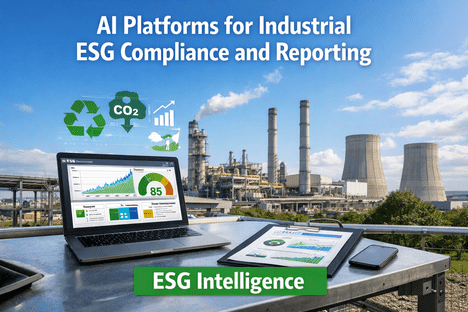
ESG Intelligence
ESG Reporting Isn't a Spreadsheet Exercise.
It's an Operational Data Problem.
ESG-focused investments are projected to reach $33.9 trillion by 2026. The EU's CSRD mandates digitally tagged ESG data. India's BRSR Core requires the top 1,000 listed entities to disclose detailed metrics. The shift from voluntary narrative to verified performance means your ESG report is only as good as the operational data behind it — and spreadsheets can't deliver what auditors now demand.
$33.9T
ESG-focused investments projected by 2026
$14.87B
AI in ESG market projected by 2034
63%
Of companies using or planning AI for ESG reporting
89%
Of investors factoring ESG into decisions
Sources: Market.us 2025 · Veridion Industry Survey · Lucid ESG Investment Report · CSRD/BRSR Regulatory Framework
The Compliance Crisis: Why Manual ESG Reporting Is Breaking
Industrial ESG reporting was manageable when it meant a voluntary sustainability narrative in the annual report. In 2026, it means auditable, meter-level data across Scope 1, 2, and 3 emissions, water intensity, waste diversion, energy consumption per unit of production, safety incidents, and governance metrics — all verified under limited or reasonable assurance standards. Most plants aren't failing on sustainability ambition. They're failing on data infrastructure.
14+ Data Sources
ESG data lives in SCADA, ERP, utility bills, lab reports, HR systems, waste manifests, and manual logs. No single system connects them. Every report requires weeks of manual compilation.
11 Weeks
Average time for a mid-size manufacturer to assemble an ESG report manually. By the time data is collected, cleaned, and formatted, it's already outdated.
Scope 3 Blind Spot
Scope 3 often accounts for 70%+ of a company's total carbon footprint. Most plants have zero visibility into supply chain emissions — and regulators are now requiring it.
Audit Failure Risk
Under CSRD double materiality and BRSR Core, inconsistent data triggers resubmission, delays financing, and damages ESG scores from agencies like MSCI and EcoVadis.
Greenwashing Liability
Regulators are prosecuting unsubstantiated ESG claims. Without meter-level traceability, every number in your report is a potential legal exposure.
Reporting ≠ Reducing
Manual ESG reporting consumes so much effort that teams have no capacity left for actual improvement. The report becomes the goal instead of the sustainability outcome.
Still assembling ESG reports from spreadsheets? See how AI automates compliance and frees your team to actually improve sustainability.
What AI-Powered ESG Intelligence Actually Does
AI doesn't just format your ESG report faster — it transforms ESG from a retrospective compliance burden into a real-time operational intelligence layer. The platform connects directly to your plant's operational systems and continuously calculates, monitors, and optimizes every ESG metric in the background.
01
Automated Data Collection & Harmonization
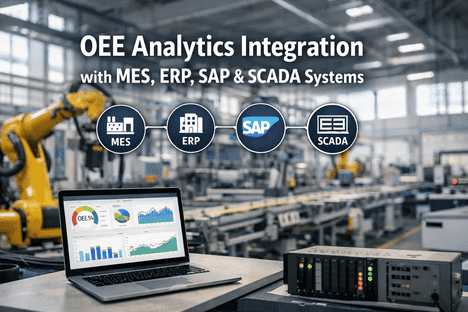
AI ingests data from SCADA, MES, ERP, energy meters, water sensors, waste manifests, HR systems, and safety logs — automatically mapping data structures, validating quality, and harmonizing units. Eliminates the 11-week manual compilation cycle entirely.
Manufacturers report ESG assessment time reduced from 4–6 hours to under 1 hour per metric
02
Real-Time Carbon & Emissions Tracking
Continuous Scope 1 (direct combustion), Scope 2 (purchased electricity), and Scope 3 (supply chain) emissions calculation. AI applies location-based and market-based grid emission factors automatically — updating as tariff structures and grid mix change.
CSRD requires digital tagging of all ESG data by 2026 — AI makes this native, not bolted on
03
Multi-Framework Compliance Engine
AI simultaneously maps your operational data against GRI Standards, ISSB S1/S2, BRSR Core, SASB, CDP, TCFD, and local regulatory requirements — flagging gaps and generating framework-specific disclosures from a single data set.
Real-time gap analysis flags missing disclosures with actionable recommendations instantly
04
Predictive ESG Performance
Beyond backward-looking reporting, AI forecasts where your ESG metrics are heading — projecting year-end emissions intensity, water consumption trends, and safety incident rates. Enables course correction mid-year, not just disclosure at year-end.
Forward-looking analytics shift ESG from annual reporting to continuous operational improvement
05
Audit-Ready Report Generation
One-click generation of audit-ready ESG reports with meter-level traceability on every data point. Every number links back to its source sensor, timestamp, and calculation methodology — satisfying limited assurance requirements without manual evidence compilation.
72-hour report generation vs. 11-week manual process — with full audit trail built in
Your Plant Already Generates the Data. AI Turns It Into Compliant ESG Disclosures.
iFactory connects to your existing SCADA, MES, ERP, and metering infrastructure — and continuously calculates emissions, water intensity, energy efficiency, waste metrics, and safety KPIs. No manual data collection. No spreadsheets. No audit surprises.
The Regulatory Landscape: What Industrial Plants Must Report in 2026
ESG reporting mandates are converging globally — with different frameworks requiring overlapping but distinct disclosures. AI platforms eliminate the complexity of multi-framework compliance by mapping operational data to every applicable standard simultaneously.
CSRD (EU)
50,000→10,000 companies
Double materiality, digitally tagged data, Scope 1-2-3, limited assurance
Mandatory
BRSR Core (India)
Top 1,000 listed entities
Energy intensity, water discharge, GHG emissions, waste management, safety
Mandatory
ISSB S1/S2
Global baseline
Climate-related financial disclosures, transition plans, scenario analysis
Adopting
EU Carbon (CBAM)
Steel, cement, aluminum, fertilizer
Embedded carbon per ton, €53–65/tonne CO₂ pricing, import certificates
Mandatory
India CCTS
Heavy industry, power
Emissions intensity, carbon credit trading, PAT scheme successor
Emerging
ISO 14001:2026
All certified manufacturers
Climate resilience, biodiversity, real-time IoT data for lifecycle proof
Updated
The ROI of AI-Driven ESG Compliance
AI ESG platforms don't just save reporting time — they unlock financial value through faster green financing access, lower carbon trading costs, improved ESG scores, and reduced regulatory risk.
Reporting Time
90% Faster
From 11 weeks of manual compilation to 72-hour automated generation. Sustainability teams shift from data collection to actual sustainability improvement.
Audit Accuracy
100%
Meter-level traceability on every data point eliminates manual errors. Automated compliance engines replace spreadsheet-based reconciliation with sensor-to-report audit trails.
Energy Reduction
20%+
IoT-connected ESG platforms don't just report energy — they optimize it. Plants using AI energy monitoring report 20%+ consumption reductions that directly improve ESG scores.
Green Finance Access
Accelerated
Audit-ready ESG data accelerates green bond applications, sustainability-linked loans, and ESG fund eligibility. Delayed or inconsistent reporting blocks access to preferential capital.
Carbon Cost Avoidance
€53–65/t CO₂
Under EU ETS and CBAM, every ton of CO₂ above your benchmark carries a direct financial cost. AI optimization reduces emissions intensity — turning compliance cost into competitive advantage.
ESG Score Improvement
Measurable
Consistent, transparent, data-backed disclosures improve ratings from MSCI, Sustainalytics, and EcoVadis — directly affecting investor confidence, customer procurement, and supply chain access.
Why iFactory for Industrial ESG Intelligence
01
ESG Built on Operational Data, Not Surveys
Most ESG platforms start from the report and work backward. iFactory starts from the plant floor — connecting SCADA, MES, energy meters, water sensors, and maintenance systems to calculate ESG metrics from actual operational data. Every number has a sensor behind it, not a self-reported estimate.
02
Unified ESG + Energy + Water + Maintenance
Energy optimization reduces your Scope 1 and 2 emissions. Water optimization reduces your water intensity. Predictive maintenance prevents emissions-causing equipment failures. iFactory unifies all three into one platform — so every operational improvement automatically flows into your ESG dashboard.
03
Multi-Framework, Multi-Geography Compliance
One data set maps simultaneously to CSRD, BRSR Core, GRI, ISSB, SASB, CDP, TCFD, and local environmental regulations. When frameworks update — as ISO 14001 did in 2026 — the compliance engine adapts automatically. No manual remapping required.
04
Multi-Plant ESG Portfolio View
Operating 5 plants or 50? iFactory normalizes ESG metrics across every facility — comparing emissions intensity, water consumption, energy efficiency, and safety performance. Corporate sustainability teams see the full portfolio from one dashboard with drill-down to individual sensor data.
ESG Compliance Is Not Optional Anymore. But Spreadsheets Are.
iFactory transforms your ESG reporting from a manual, annual burden into a continuous, automated, audit-ready system powered by the operational data your plant already generates. Connect your meters. Automate your compliance. Start proving your sustainability — not just claiming it.
Frequently Asked Questions
Which ESG frameworks does iFactory support?
iFactory's compliance engine maps operational data simultaneously to GRI Standards, ISSB S1/S2, BRSR Core (India), CSRD (EU), SASB, CDP Climate Change and Water Security questionnaires, TCFD recommendations, and local environmental regulatory frameworks. When frameworks update, the compliance mapping adapts automatically. One data set serves every framework — no duplicate data collection for different reports.
How does AI ESG tracking differ from standalone ESG reporting software?
Standalone ESG software starts with the report template and asks you to fill in the numbers. iFactory starts with your plant's actual operational systems — SCADA, MES, energy meters, water sensors, waste logs — and calculates ESG metrics directly from sensor data. The difference is traceability: every number in your ESG report links back to a physical sensor, a timestamp, and a validated calculation methodology. This is what auditors under limited assurance standards now require.
Can this handle Scope 3 emissions tracking?
Yes. iFactory tracks Scope 3 through three mechanisms: supplier-provided emissions data (via Digital Product Passports and supplier scorecards), industry-average emission factors for purchased goods and services, and transportation/logistics emissions calculated from procurement and shipping data. As your supply chain provides more granular data over time, Scope 3 accuracy improves progressively. The platform also identifies which suppliers contribute most to your Scope 3 footprint — enabling targeted engagement.
How does this help with carbon trading and CBAM compliance?
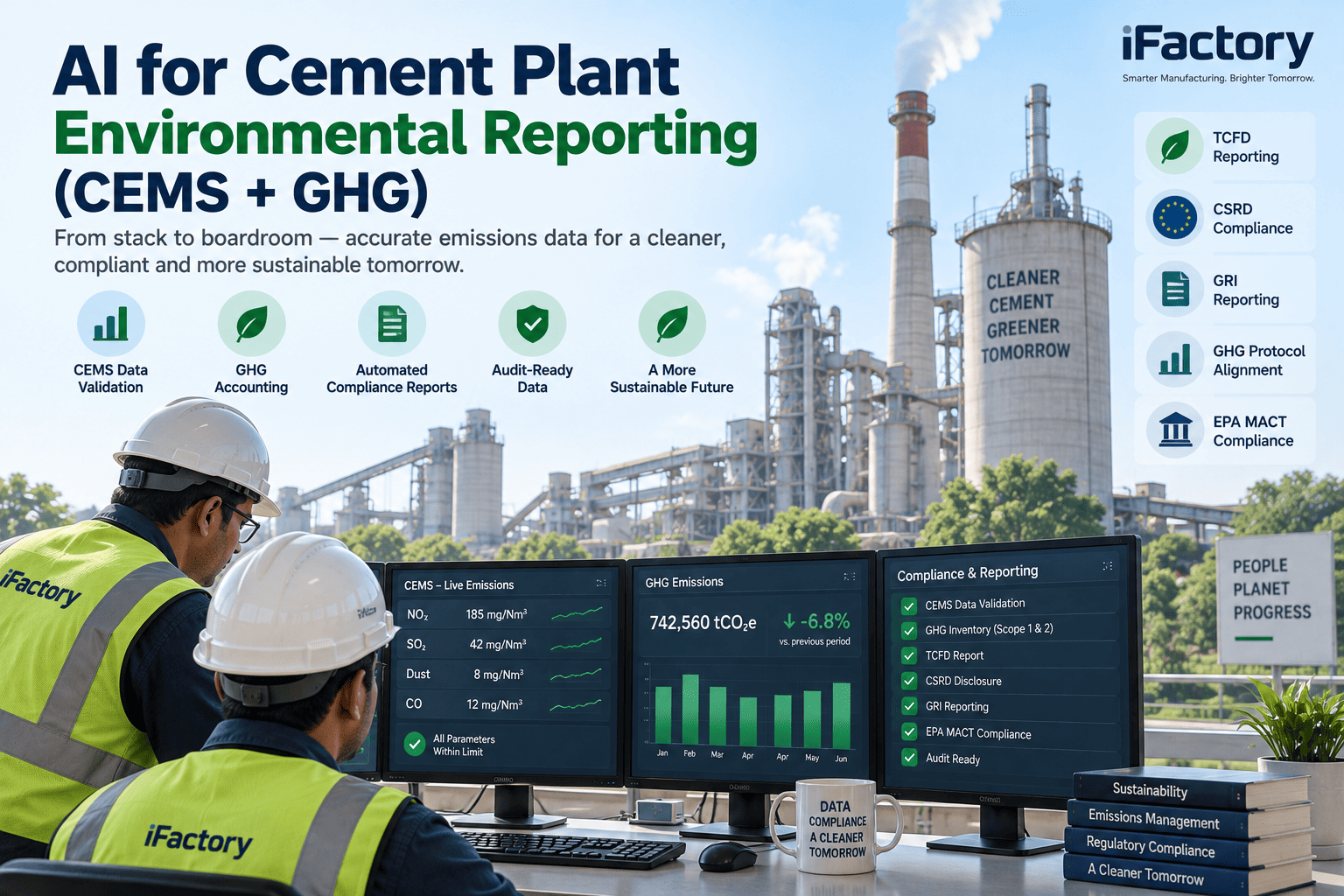
iFactory calculates embedded carbon per ton of product (steel, cement, aluminum) in real time — the exact metric required for EU CBAM certificates. The system tracks emissions intensity against benchmarks, calculates carbon credit obligations, and identifies optimization opportunities that reduce your per-ton carbon cost. For plants subject to India's emerging CCTS or the EU ETS at €53–65/tonne CO₂, every kilogram of CO₂ reduced per ton of production translates directly into financial savings.
How fast can we deploy AI ESG tracking?
Data integration with existing SCADA, MES, and metering systems typically takes 30 days. First automated ESG dashboards — energy intensity, water consumption, emissions — are live within 45 days. Full multi-framework compliance reporting with audit trails reaches production maturity within 90 days. Most plants generate their first automated ESG report within the first quarter of deployment — replacing the manual process entirely.