A medical device manufacturer in Minnesota ran 340 inspections per week across three production lines. Every inspection was paper-based — printed checklists, handwritten measurements, physical signatures, and filing cabinets that consumed an entire room. When the FDA arrived for a routine inspection in 2023, auditors asked to see calibration verification records for a specific dimensional gauge used on Line 2 during the third week of September. Finding that record took four hours and two maintenance technicians pulling files. The FDA inspector noted the retrieval delay as an observation. But the deeper problem surfaced three months later during an internal review: 14% of paper inspection forms had at least one field left blank, 8% had measurement values outside specification limits that were signed off without corrective action, and three forms had dates that preceded the production runs they supposedly inspected. None of these gaps were intentional. They were the inevitable result of a system that relied on human memory, paper discipline, and after-the-fact review to catch errors. A competitor supplying the same customer had deployed an AI-powered inspection management platform the previous year. Their inspection forms could not be submitted with blank fields. Out-of-spec measurements triggered automatic hold notifications. Every record was time-stamped, geo-located, and linked to the specific asset and operator. Their FDA inspection took four hours total — not four hours to find one document.
iFactory Inspection Intelligence
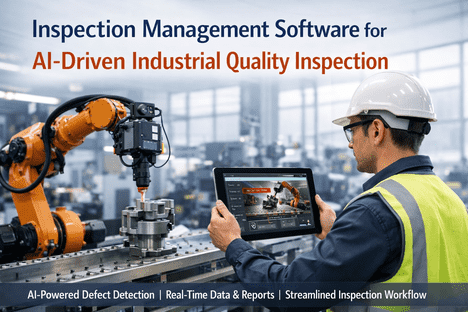
Inspection Management Software for AI-Driven Industrial Quality Inspection
How AI-powered inspection platforms are replacing paper checklists with intelligent workflows that prevent defects from escaping, automate compliance documentation, and turn inspection data into continuous improvement intelligence
90%+
Defect detection accuracy in mature AI inspection
85%
Audit preparation time reduced with digital inspection
14%
Of paper inspection forms contain incomplete data
53%
Defect reduction achieved by AI quality systems
The Problem with Paper — and Why Spreadsheets Are Not the Answer
Paper inspection forms have survived in manufacturing longer than almost any other manual process. The reason is simple: inspections feel too variable, too context-dependent, and too operator-specific to digitise easily. But the cost of that persistence is enormous — in missed defects, compliance gaps, lost data, and the inability to turn inspection results into actionable intelligence.
14% of paper forms have blank fields. Operators skip measurements under time pressure, forget to record serial numbers, or leave signature lines empty. These gaps become audit findings and — worse — allow defective product to advance undetected.
02
Out-of-Spec Pass-Through
Measurement values outside specification limits get signed off because paper forms cannot enforce hold logic. The operator records the number, the supervisor signs, and the non-conformance enters the downstream process. By the time someone reviews the data, the batch has shipped.
Paper records cannot be searched, trended, or correlated. When a customer complaint arrives, tracing the inspection history for that specific lot requires manual file retrieval that can take hours or days — if the records can be found at all.
04
No Real-Time Visibility
Quality managers cannot see inspection status until forms are collected, reviewed, and entered into a system — typically hours or days after the inspection occurred. Problems that could be caught in minutes compound into batch-level failures.
05
Zero Intelligence Value
Paper forms capture data but generate no insights. Recurring defect patterns, operator-specific quality variations, equipment-linked failure modes, and seasonal trends all hide in filing cabinets where no analysis can reach them.
How AI-Powered Inspection Management Works
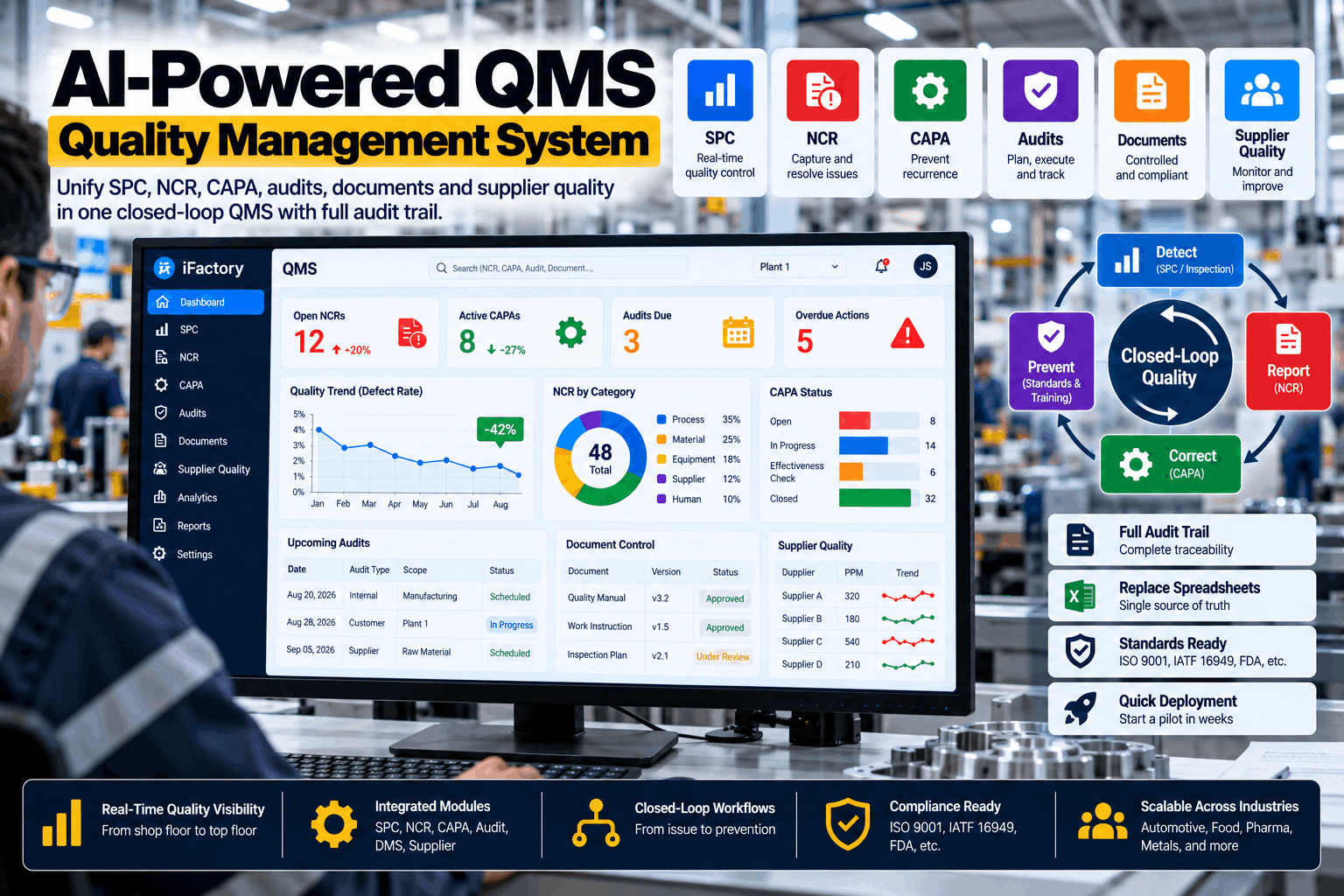
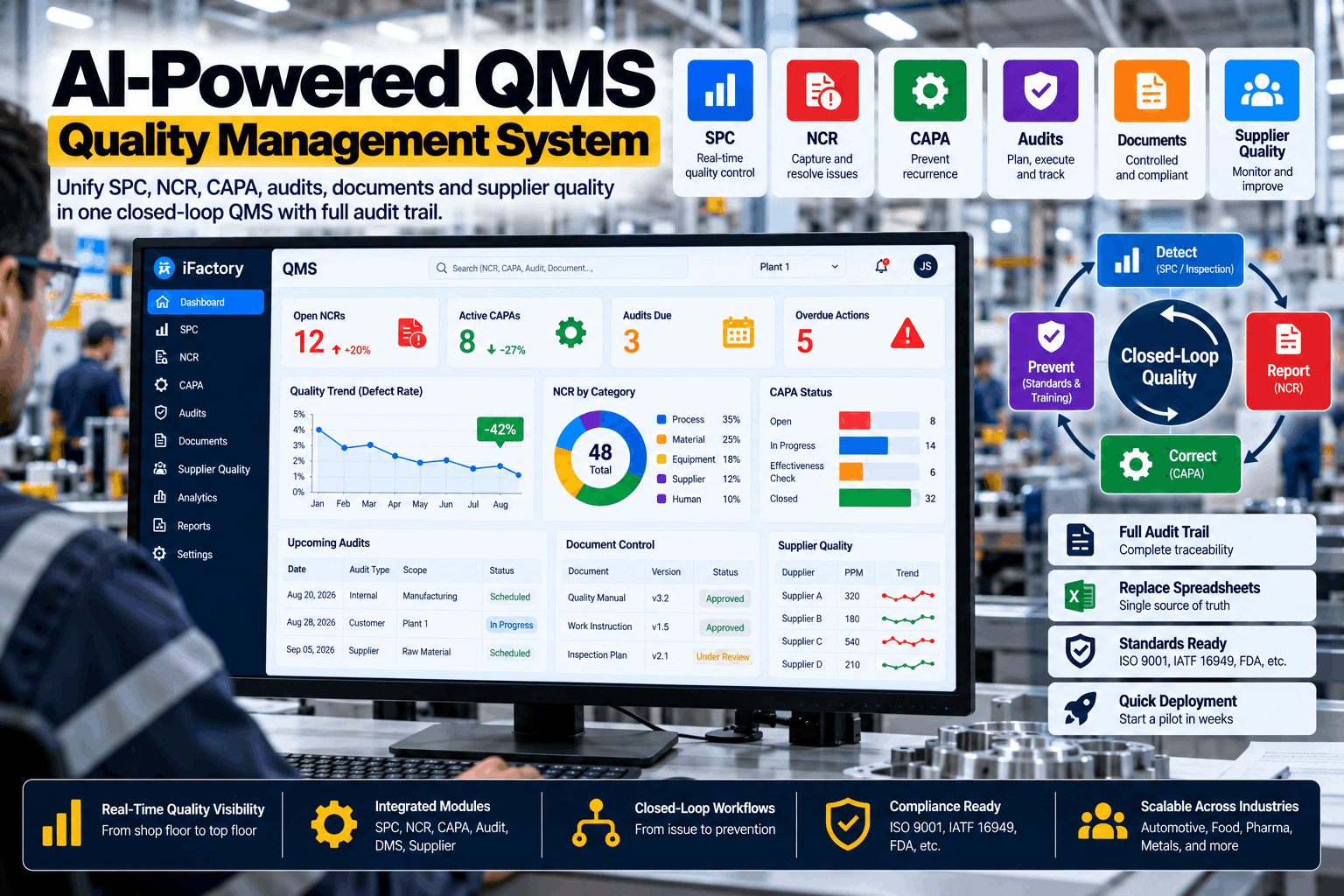
An AI-powered inspection platform does not simply replace paper with a screen. It fundamentally changes what an inspection can do — enforcing data completeness in real time, triggering automatic responses to out-of-spec readings, and converting every inspection result into intelligence that improves the next production run.
Configure
Intelligent Form Design
Inspection templates with mandatory fields, specification limits, conditional logic, photo capture requirements, and calibration verification links. Forms adapt dynamically — if a measurement falls outside tolerance, additional fields appear for non-conformance documentation. Templates map to specific standard clauses for automatic compliance traceability.
Execute
Guided Mobile Inspection
Inspectors work from mobile devices with step-by-step guided workflows. GPS and NFC confirm they are at the correct asset. Barcode scanning links results to specific equipment, lots, and production orders. Forms cannot be submitted with incomplete data. Time stamps are automatic and tamper-proof.
Enforce
Real-Time Validation and Hold Logic
The moment an out-of-spec measurement is entered, the system triggers immediate action — automatic hold on the affected lot, notification to the quality supervisor, and a non-conformance record pre-populated with the inspection data. No defective reading can pass through without documented disposition.
Analyse
AI Pattern Recognition and Trending
AI analyses inspection data across time, operators, shifts, equipment, and product lines to surface patterns invisible to individual inspectors. Recurring defect clusters, operator-specific quality variations, equipment-linked failure modes, and pre-failure trending are identified automatically and escalated before they become systemic.
Improve
Closed-Loop Corrective Action
Inspection findings auto-trigger CAPA workflows routed by severity. AI recommends corrective actions based on historical effectiveness data. Post-action inspections verify that corrections resolved the root cause. The feedback loop ensures every finding drives permanent improvement, not just temporary fixes.
Ready to see how digital inspections would work on your production floor? Book a free inspection workflow assessment.
AI Vision Inspection: Beyond Human Capability
For visual quality inspections — surface defects, assembly verification, label accuracy, colour consistency — AI computer vision now exceeds human inspector performance on both speed and accuracy. The technology has matured from laboratory demonstrations to production-floor deployments across manufacturing.
Surface Defect Detection
AI vision systems detect scratches, dents, cracks, porosity, and discolouration at resolutions below what the human eye can consistently identify — and at line speeds that make 100% inspection economically viable for the first time.
Assembly Verification
Camera systems confirm correct component placement, orientation, count, and fastening torque markers. Missing parts, reversed components, and assembly sequence errors are caught before the unit leaves the station — eliminating downstream rework.
Dimensional Measurement
AI-powered vision gauging measures critical dimensions at production speed — no manual gauging, no sampling. Every unit is measured, every measurement is recorded, and out-of-tolerance parts are diverted automatically.
Fatigue-Free Quality
Human visual inspectors experience accuracy degradation after 20-30 minutes of continuous inspection. AI vision maintains identical detection sensitivity across all shifts, all hours, all conditions — eliminating the single largest source of inspection variability.
Inspection Types Covered by a Unified Platform
A comprehensive inspection management platform does not handle just one type of check. It unifies all inspection activities — from incoming material through final release — under a single system with consistent data capture, analysis, and compliance documentation.
| Inspection Type |
When It Happens |
What AI Adds |
| Incoming Material |
At receipt of raw materials and purchased components |
Supplier quality scoring, automatic sampling plans based on vendor history, trend alerts |
| In-Process |
During production at defined control points |
Real-time SPC, automatic hold on out-of-spec readings, operator performance analytics |
| Final Product |
Before release to warehouse or shipment |
100% AI vision for critical attributes, automated release certification, lot traceability |
| Equipment and Safety |
Scheduled and condition-triggered asset checks |
Predictive scheduling based on condition data, calibration tracking, compliance automation |
| Layered Process Audit |
Scheduled multi-level verification of process adherence |
Randomised scheduling, defect trend correlation, escalation automation for repeat findings |
| Regulatory and Compliance |
Internal audits and external certification inspections |
One-click evidence packages, cross-standard clause mapping, pre-audit gap identification |
The Business Impact of Digital Inspection
The return on inspection management software comes from three sources: defect cost avoidance, compliance efficiency, and continuous improvement intelligence. Each compounds over time as the system accumulates data and AI models mature.
53%
Defect reduction with AI quality systems
85%
Less audit preparation time
100%
Data completeness enforced
Zero
Paper forms remaining
Want to calculate your specific inspection ROI? Get a customised savings analysis from our engineers.
Frequently Asked Questions
How long does it take to digitise our existing paper inspection forms?
Most organisations digitise their core inspection forms within 2-4 weeks. The platform includes template builders that replicate existing form layouts while adding enforcement logic, conditional fields, and specification limit checks. Complex forms with extensive conditional branching may take longer, but the most commonly used 80% of forms typically go live within the first month.
Can inspectors use the system on the production floor without WiFi?
Yes. Mobile inspection apps work offline with full functionality — forms, photo capture, barcode scanning, and measurement recording all operate without a network connection. Data syncs automatically when connectivity resumes. This is essential for manufacturing environments where shop floor WiFi coverage may be inconsistent or restricted in certain zones.
Does AI inspection require training data from our specific products?
For AI vision inspection, yes — models are trained on images of your specific products showing both acceptable and defective examples. Transfer learning from pre-trained industrial vision models accelerates this process significantly. Most deployments achieve production-ready accuracy within 2-4 weeks of image collection and training. For form-based inspection analytics, AI begins generating insights from the first week of digital data collection.
How does inspection software integrate with our existing QMS and ERP?
Inspection platforms connect via REST APIs to existing quality management systems, ERP platforms, and CMMS tools. Inspection results flow into quality records, non-conformance findings trigger CAPA workflows in your QMS, and lot-level data syncs with ERP for traceability. Most integrations complete within 2-4 weeks without disrupting current systems.
Will our inspectors resist switching from paper to digital?
Initial resistance is common but typically resolves within 1-2 weeks. The key is that digital inspection is faster and easier than paper for the inspector — guided workflows reduce decision-making, auto-population eliminates repetitive data entry, and photo capture replaces written descriptions. Operators who initially resist almost universally prefer the digital system within their first full week of use because it reduces their cognitive load and paperwork burden.
Inspect Smarter. Comply Faster. Improve Continuously.
Replace Paper Checklists with Intelligent Workflows That Prevent Defects Before They Escape
iFactory's AI-powered inspection management platform digitises every inspection type, enforces data completeness, triggers automatic holds on out-of-spec readings, and turns inspection data into the continuous improvement intelligence your quality team needs.
90%+
AI detection accuracy
2-4wk
Deployment to value