How Industrial Businesses Can Reduce Errors With Digital Systems
By Josh Brook on April 23, 2026
Every industrial business loses money to errors it cannot see. Wrong entries in production logs. Missed checklist steps. Quality defects that reach the customer. Batches scrapped because a parameter drifted and nobody caught it in time. The damage is not just the direct cost — it is the customer trust, the regulatory exposure, and the compounding rework that follows. Digital systems do not eliminate human judgment. They eliminate the conditions that cause human error.
iFactory Blog · Quality Operations · Pain Point Series · 2026
How Industrial Businesses Can Reduce Errors With Digital Systems
Manual processes, paper logs, and disconnected workflows are not just slow — they are error machines. Here is exactly how digital systems eliminate the conditions that cause mistakes before they reach the floor, the customer, or the regulator.
of transactional finance and accounting errors eliminated by automation
94%
of business professionals prefer a unified platform over disconnected tools
40%
average profitability increase from effective AI integration into operations
12mo
typical ROI payback period for automation investment
Sources: McKinsey Global Institute · Kissflow Workflow Automation Report 2026 · SS&C Blue Prism 2026 · Thunderbit Automation Statistics 2026 · Cflow Digital Transformation Stats · WEF Global Lighthouse Network
Where Industrial Errors Actually Come From
Before you can reduce errors, you need to know their true source. Most industrial operations attribute errors to human mistakes — but the deeper cause is almost always a system that allows human mistakes to happen without detection or prevention. These are the six environments where industrial errors are born.
01
Manual Data Entry
Production logs filled by hand. Quality readings transcribed from paper. Shift reports typed from memory hours after the fact. Every transfer is a chance for a number to change.
High frequency · High cost
02
Verbal Instructions
Changeover parameters passed verbally between shifts. Setup instructions communicated on sticky notes. No version control. No audit trail. No way to know what was actually said or done.
High frequency · Medium cost
03
Skipped Checklists
Paper checklists signed after the fact. Digital forms bypassed under production pressure. Critical inspection steps marked complete without being performed. Invisible until a failure occurs.
Medium frequency · Very high cost
04
Late Visibility
Problems discovered in daily or weekly reports instead of the moment they occur. A parameter drifts at 9 AM. The supervisor sees it at the 4 PM review. Six hours of production affected.
Low frequency · Catastrophic cost
05
Siloed Systems
Quality data in one system. Production data in another. Maintenance records in a third. Nobody has a complete picture. Cross-system discrepancies create invisible gaps that audits expose too late.
Ongoing · Compounding cost
06
Unversioned Documents
Standard operating procedures printed and laminated two years ago. Updated specs emailed last month but not distributed to the floor. Operators working from outdated instructions — confidently.
Medium frequency · High regulatory cost
The Cost of Industrial Errors — By the Numbers
Industrial errors are not just an operational inconvenience. They carry a calculable financial impact across rework, scrap, customer claims, regulatory penalties, and lost throughput. Understanding the real cost is what makes the case for digital systems undeniable.
What Industrial Errors Actually Cost · 2026 Benchmark Data
Direct and indirect cost categories · Cross-industry research · McKinsey, WEF, Kissflow, Thunderbit
Direct production cost impact
Operational and compliance exposure
Preventable with digital systems
6 Digital Systems That Directly Eliminate Industrial Errors
Each digital system below targets a specific category of industrial error. Together they form an interconnected error-prevention architecture — not a collection of standalone tools. The goal is to remove the conditions that allow errors to occur, not just to report them after the fact.
System 01
Data Accuracy
Automated Data Capture — No Manual Entry
The ProblemManual data entry is the single largest source of preventable industrial errors. Every time a human transcribes a measurement, a reading, or a record, accuracy depends on attention, fatigue level, and handwriting legibility.
The SolutionIIoT sensors, barcode scanners, and digital forms with structured inputs replace manual transcription at the source. Data flows directly from the machine or process into your central system — with no human in the data transfer loop.
ResultUp to 80% of transactional data errors eliminated at source. Timestamp accuracy. Complete audit trail without human intervention.
System 02
Process Compliance
Digital Checklists with Mandatory Completion Logic
The ProblemPaper checklists can be signed without being completed. There is no system that knows whether a step was actually done or just ticked. Skipped safety or quality checks are invisible until a failure occurs.
The SolutionDigital checklists with mandatory sequence enforcement — each step must be completed before the next unlocks. Photo verification for critical checks. GPS or NFC confirmation for physical inspections. Every action timestamped and tied to an operator ID.
ResultZero skipped steps. Complete compliance documentation generated automatically. Audit-ready records with no additional admin burden.
System 03
Real-Time Visibility
Live Dashboards with Instant Deviation Alerts
The ProblemMost quality problems are not discovered at the moment they occur — they are discovered in end-of-shift reports, daily reviews, or customer complaints. By then, hours of production are affected and the root cause is buried.
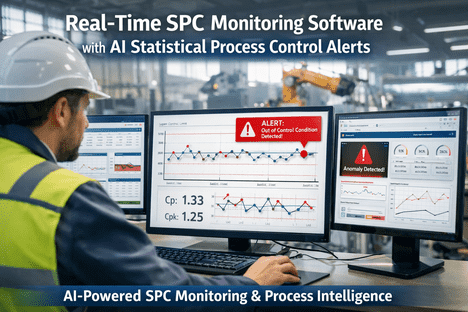
The SolutionReal-time dashboards that surface parameter deviations the moment they cross defined thresholds. Automated escalation alerts sent directly to supervisors or maintenance — without waiting for a report. SLA codification inside workflows so every step has an enforced completion window.
ResultProblems caught in minutes instead of hours. Affected batch size reduced by 60–90%. Root cause investigation starts while the evidence is still live.
System 04
Workflow Automation
Automated Workflows That Remove Manual Handoffs
The ProblemManual handoffs — approvals passed by email, status updates communicated verbally, work orders printed and walked to the floor — introduce delay, ambiguity, and version confusion at every transition point.
The SolutionWorkflow automation eliminates manual handoffs entirely. When a quality check fails, the system automatically opens a non-conformance record, notifies the responsible engineer, and halts the affected line until resolution is confirmed — with no human coordination required.
Result83% of IT leaders confirm workflow automation is essential for digital transformation. Average manual reporting reduction of 70%+ within 90 days of deployment.
System 05
Document Control
Centralized Document Control with Version Lock
The ProblemOperators work from outdated SOPs because the updated version was emailed but never reached the floor. Different shifts use different versions of the same work instruction. Nobody knows which is current.
The SolutionA single document control system where SOPs, work instructions, and specifications live in one place. Every update is versioned, timestamped, and pushed to every relevant device simultaneously. Operators can only access the current version — previous versions are locked and archived, not deleted.
ResultAll operators on the same instruction at all times. Full change history for regulatory audit. Zero SOP version confusion across shifts or locations.
System 06
Predictive Intelligence
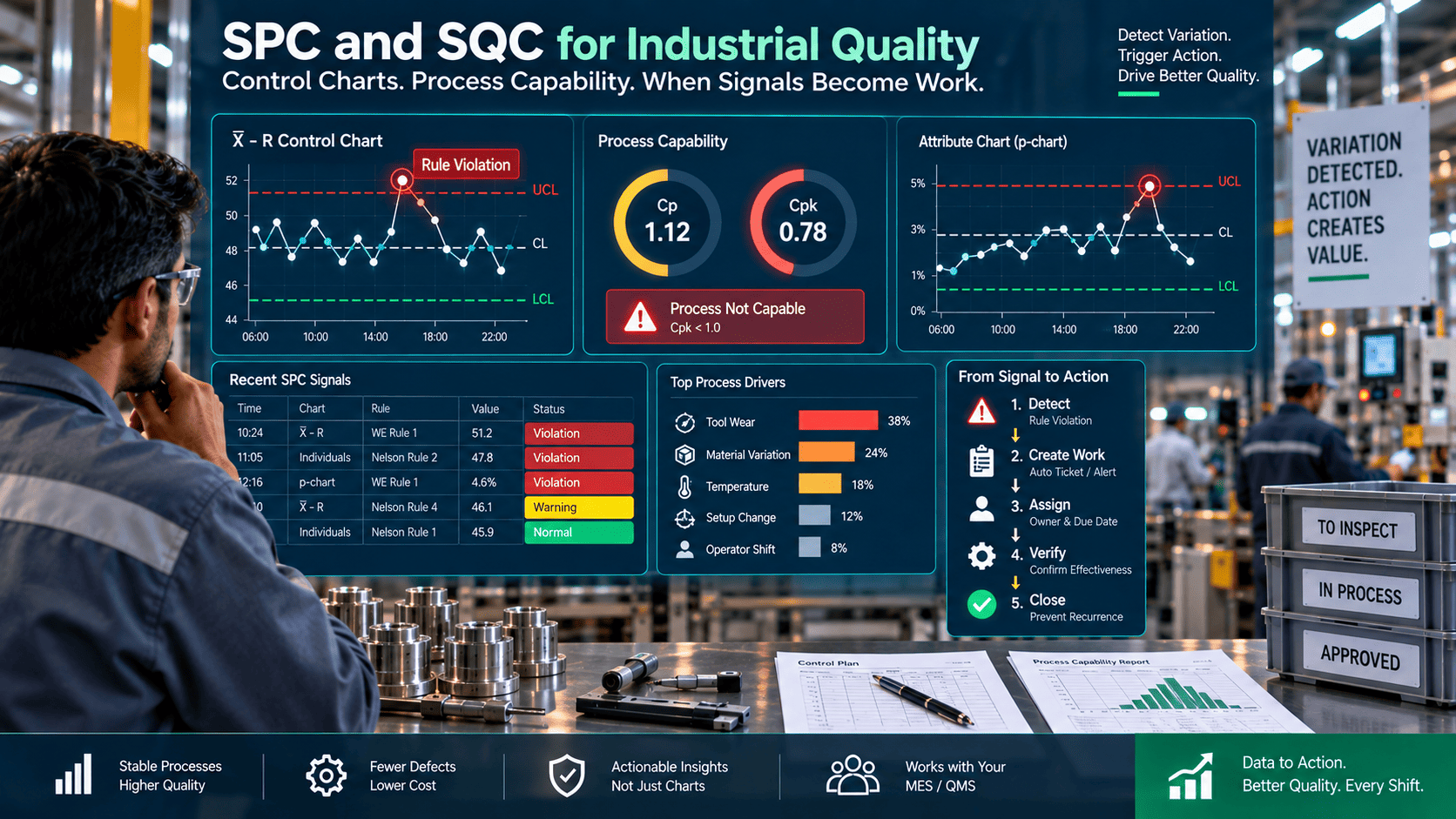
AI-Assisted Anomaly Detection Before Errors Occur
The ProblemMost quality control systems find errors after they have occurred — in the finished product, during inspection, or at the customer. Reactive quality is expensive because it means the error already happened at scale.
The SolutionAI models trained on historical production data learn what normal looks like for every parameter on every line. When a combination of inputs begins trending toward a known failure pattern, the system flags it — before the output becomes defective. Predictive, not reactive.
Result82% of industrial companies view AI as a key growth driver. Predictive quality catching deviations before they reach inspection reduces scrap rates by 30–60% in connected environments.
Error Reduction by the Numbers — What Digital Systems Actually Deliver
These are not theoretical projections. They are documented performance improvements from published industry research across organizations that have deployed digital error-reduction systems at operational scale.
80%
Data entry errors eliminated by automated capture replacing manual transcription
McKinsey / RPA research
70%
Reduction in manual reporting hours within 90 days of digital system deployment
WEF Lighthouse Network
−40%
Unplanned downtime reduction from predictive maintenance and real-time alerting
McKinsey Operations
30–60%
Scrap rate reduction in AI-connected production environments with anomaly detection
KPMG 2026 Industrial Tech
+53%
Labor productivity increase at WEF Global Lighthouse Network facilities
WEF Global Lighthouse
100%
Audit trail completeness with digital checklists vs. paper-based compliance records
Industry compliance data
The Error Reduction Implementation Sequence
Not all digital systems should be deployed at the same time. Implement them in the wrong order and you automate problems you have not yet fixed. Follow this sequence to build error-reduction capability that compounds at each phase.
Phase 1
Fix Data at Source
Replace manual data entry with automated capture on your highest-volume processes first. This is the foundation — every other system depends on accurate, real-time data.
Phase 2
Enforce Checklists
Deploy digital checklists with mandatory completion logic on all safety and quality-critical steps. Eliminate the ability to skip steps under production pressure.
Phase 3
Build Visibility
Create live dashboards with real-time alerts. Move from discovering problems in reports to catching them the moment they occur on the floor.
Phase 6
Predict and Prevent
With clean data and connected processes, layer in AI anomaly detection. Shift from finding errors to preventing conditions that cause them.
Phase 5
Control Documents
Centralize all SOPs and work instructions with version lock. Ensure every operator works from the same current instruction simultaneously.
Phase 4
Automate Workflows
Eliminate manual handoffs in quality escalations, non-conformance handling, maintenance tickets, and approval routing.
Want to see how iFactory maps this exact sequence to your current operation? Book a 30-minute walkthrough — we will show you where your highest error exposure is and which digital system addresses it first.
Before vs. After — The Operational Transformation
Here is what the same production scenario looks like before and after digital error-reduction systems are in place. These are not edge cases — this is the daily operating reality in most traditional industrial businesses versus their digitally connected competitors.
Without Digital Systems
With Digital Systems
Operator records batch weight manually on paper log — risk of misread, illegible entry, or wrong batch number
Scale sends weight directly to ERP via sensor — zero transcription, timestamp automatic, batch linked by barcode scan
Changeover checklist signed at end of shift from memory — 2 of 8 steps routinely skipped under pressure
Digital checklist enforces sequence — step 3 does not unlock until step 2 is confirmed with photo evidence
Temperature deviation occurs at 10:15 AM — discovered in afternoon report at 4:30 PM — 6 hours of production at risk
Temperature crosses threshold at 10:15 AM — supervisor alerted by 10:17 AM — affected window: 2 minutes
Quality failure found in inspection — root cause investigation requires interviewing 3 shifts and checking 4 separate logs
Every parameter, operator action, and process event timestamped — root cause identified in the analytics dashboard in 8 minutes
Updated SOP emailed to floor supervisor — printed copies from 18 months ago still in operator binders
SOP update pushed to all connected devices simultaneously — previous version locked — confirmation of receipt logged
Frequently Asked Questions
Which type of industrial error causes the most financial damage?
Unplanned downtime from undetected process deviations consistently causes the highest single-event financial damage — averaging $260,000 per hour in heavy industry according to industry research. However, the highest cumulative damage comes from systematic data entry errors and skipped quality checks, which compound over months before they are detected. Digital systems address both: real-time alerting handles the acute events, and automated data capture eliminates the chronic systematic errors.
How quickly do digital error-reduction systems show measurable results?
The fastest results appear in the first 30–60 days and come from automated data capture and digital checklists — both reduce visible errors immediately because they remove the mechanism by which those errors occur. Real-time alerting shows impact within 60–90 days as teams establish response protocols. Predictive AI systems require 3–6 months of connected data before the models are reliable enough to deliver proactive error prevention. Most operations recover the investment within 12 months based on scrap reduction and reporting time savings alone.
Do digital checklists actually work — or do operators find workarounds?
Digital checklists with mandatory sequence enforcement and physical verification requirements — photo upload, NFC tap, barcode scan — are significantly harder to bypass than paper equivalents. The key design principle is that the system must make completing the step correctly faster than working around it. Checklists that require a 30-second NFC tap get used. Checklists that require a 3-minute form entry get bypassed. Implementation design matters as much as the technology itself. Book a demo to see how iFactory designs digital checklists for compliance rather than checkbox compliance.
What is the difference between detecting errors and preventing them?
Error detection systems — inspections, QC holds, customer returns — find mistakes after they have already occurred and been incorporated into output. Error prevention systems — real-time parameter monitoring, AI anomaly detection, mandatory checklist logic — change the conditions so the mistake cannot happen or is caught before it becomes a defect. The financial difference is significant: a defect caught at the sensor costs a parameter adjustment. A defect caught at inspection costs rework. A defect caught by the customer costs the relationship. Digital systems shift the interception point as far upstream as possible.
Can small and mid-size industrial businesses afford digital error-reduction systems?
The SaaS and pay-as-you-grow sensor models available in 2026 have made digital error-reduction accessible to operations of any size. Starting with a single production line, one digital checklist system, or one connected asset requires far less capital than a full facility deployment. The correct question is not whether it is affordable — it is whether the current cost of errors exceeds the cost of the system. For most mid-size industrial operations, a single prevented batch scrap event pays for months of platform subscription. Contact iFactory to discuss the right starting point for your operation size and budget.
Stop Losing Revenue to Preventable Errors · iFactory Platform
See How iFactory Eliminates Industrial Errors Before They Reach the Floor
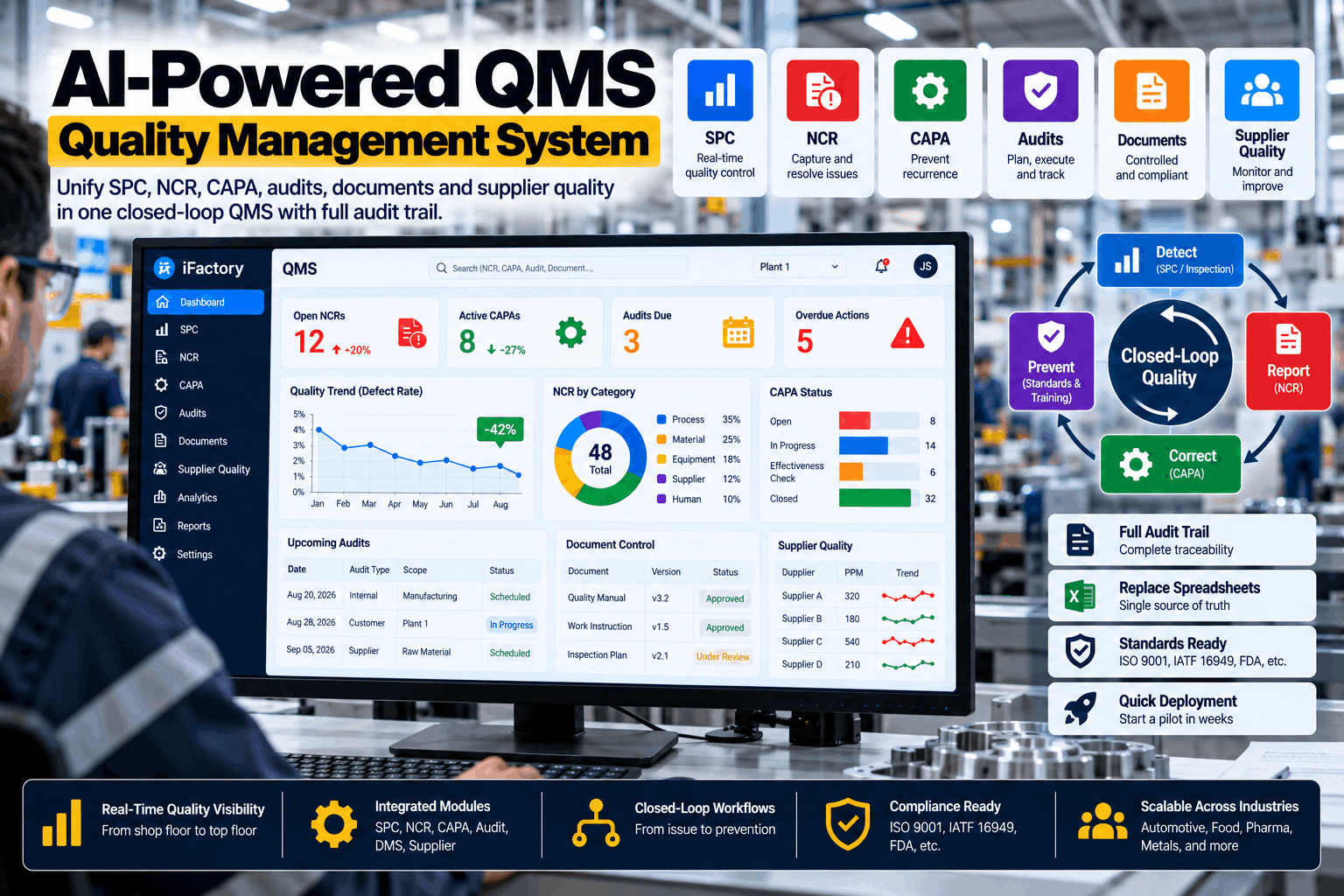
iFactory connects automated data capture, digital checklists, real-time alerts, workflow automation, and AI anomaly detection into one platform — so every error category covered in this guide is addressed from a single system, without replacing what already works.