The numbers tell a clearer story every quarter. Deloitte's 2026 State of AI in the Enterprise report finds that worker access to AI rose 50% in a single year, and the number of companies with 40% or more AI projects in production is set to double within six months. Rootstock's 2026 manufacturing technology survey found that 94% of manufacturers now use some form of AI, with predictive AI adoption jumping 12 points to 48% and supply chain planning AI leaping 19 points to 35%. In logistics, AI has matured from dashboards into execution — Microsoft's supply chain organisation is scaling past 100 operational agents by end of 2026 after reporting hundreds of hours saved monthly. The AI-in-supply-chain market itself has grown nearly sevenfold in five years to reach $19.8 billion, with companies citing 307% ROI in under 18 months. This is not an emerging technology story any more. It is a transformation story unfolding simultaneously across manufacturing, logistics, healthcare, retail, aerospace, and every other industrial sector — and the gap between early adopters and laggards is widening fast enough that by 2028 many companies simply will not be able to catch up. This article maps how AI is reshaping the core operating logic of each major industry, what the measurable impact looks like, and what the next 18 months will demand of leaders who want to move from pilot purgatory into scaled transformation. If you want help translating these shifts into a specific plan, book a strategy session with our team.
Cross-Industry AI Intelligence
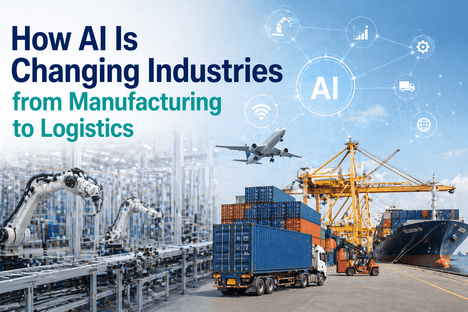
How AI Is Changing Industries from Manufacturing to Logistics
The measurable ways artificial intelligence is reshaping productivity, forecasting, automation, and decision-making across manufacturing, logistics, supply chain, healthcare, retail, and beyond — with the numbers, case studies, and sequencing that matter for leaders in 2026.
Industries transformed
Manufacturing
Logistics
Supply Chain
Healthcare
Retail
Energy
Aerospace
Pharma
94%
of manufacturers now use AI in operations
307%
ROI within 18 months in supply chain AI
$19.8B
AI-in-supply-chain market, growing 45% CAGR
What Has Actually Changed
The shift in 2026 is not that AI became more capable — although it did. The shift is that AI has finally moved from being a tool you apply to individual problems into being the operating layer that orchestrates whole functions. Predictive maintenance stopped being a pilot and became a baseline expectation. Forecasting stopped producing weekly reports and started making real-time replenishment decisions. Visual inspection stopped sampling products and started grading every unit. Agentic AI stopped flagging issues and started reasoning through corrective actions and executing them. The organisations that see AI as a platform rather than a product are already capturing value at a scale the pilot-bound majority cannot reach.
Worker access to AI rose 50% in 2025, and the share of companies with 40%+ AI projects in production is set to double within six months.
Deloitte State of AI in the Enterprise 2026
94% of manufacturers now use some form of AI; predictive AI adoption rose 12 points to 48% in a single survey cycle.
Rootstock State of Manufacturing Technology 2026
AI-in-supply-chain market hit $19.8B in 2026 with 45% CAGR and companies reporting 307% ROI in under 18 months.
Grand View Research + industry analysis
Adoption is most advanced in manufacturing, logistics, and defense — robotics, autonomous vehicles, and drones are reshaping operations.
Deloitte 2026 AI enterprise research
How AI Is Reshaping Each Major Industry
The impact of AI is not uniform. Every industry has its own bottlenecks, data assets, regulatory constraints, and economic pressures — so the shape of transformation differs. What follows is a sector-by-sector scan of the most significant shifts under way, grounded in current deployment evidence rather than speculation.
Manufacturing
94%
Using AI in operations today
From pilot purgatory to shop-floor backbone — AI now runs predictive maintenance, real-time quality inspection, and energy optimisation at scale.
35-50% unplanned downtime reduction via predictive maintenance
90%+ defect detection accuracy with mature AI vision
20-40% energy consumption cuts through AI optimisation
Logistics & Supply Chain
307%
Reported ROI within 18 months
Agentic supply chains are automating carrier selection, route optimisation, and exception handling — reducing execution latency dramatically.
Microsoft operating 100+ supply chain AI agents by end-2026
Autonomous end-to-end replenishment emerging as killer use case
AI-powered vision cuts warehouse processing errors substantially
Healthcare & Pharma
+24pts
YoY AI adoption increase
Real-time virtual replicas of supply chain assets now optimise spoilage reduction, shelf-life prediction, and temperature-critical returns.
AI clinical copilots support diagnosis, triage, and decision support
Generative AI accelerates drug discovery and molecule design
Agentic returns processing unlocking multi-million-euro productivity
Retail & E-Commerce
78%
Of global enterprises with AI in supply chain
AI-powered inventory systems, personalisation engines, and last-mile logistics are reshaping the economics of commerce from warehouse to doorstep.
Demand forecasting accuracy up to 30% better with AI models
Dynamic pricing driven by real-time competitive data
Last-mile delivery time compressed via AI route planning
Automotive & Mobility
27.5%
Of smart factory demand
Automotive leads physical AI deployment — Tesla, BMW, Mercedes, and BYD all piloting humanoid robots alongside mature cobot lines and AI vision.
BYD targets 20,000 humanoid units in 2026 alone
AI vision inspects weld, paint, and assembly at line speed
Agentic scheduling across 1,500+ product variants
Energy & Utilities
20-40%
Energy consumption reduction with AI
Grid management, predictive asset maintenance, and AI-driven load balancing are transforming how energy is produced, distributed, and consumed.
Wind and solar forecasting precision enables grid balance
Digital twins monitor turbines, pipelines, and substations
AI compliance agents automate regulatory reporting
Which of these sector shifts overlap with your business priorities? Book a cross-industry benchmark review with our team.
From AI Capabilities to Business Outcomes
Every real AI deployment follows the same logical flow: a core AI capability powers a specific business application, which in turn produces a measurable outcome. Leaders who understand this flow avoid the trap of acquiring technology without a clear path to value. The diagram below maps the three layers that together form the backbone of AI transformation across every industry.
AI Capabilities
Predictive Analytics
Computer Vision
Generative & LLM
Agentic Reasoning
Reinforcement Learning
Applications
Predictive Maintenance
Quality Inspection
Demand Forecasting
Route Optimisation
Worker Copilots
Business Outcomes
35-50% less downtime
90%+ defect detection
20-40% energy savings
30% forecast accuracy gain
307% ROI in 18 months
The AI Maturity Ladder — Where Most Companies Actually Sit
Despite the adoption headlines, very few companies are yet at the top of the AI maturity ladder. Deloitte data shows only 24% of manufacturers will adopt true agentic AI systems by end-2026, and BCG research suggests only 35% of manufacturing digital transformations achieve true operating-model impact. The rest are still spread across the first three rungs. Understanding exactly where your organisation sits — and what the next rung demands — is the single most valuable piece of self-knowledge in any AI strategy.
Stage 4
Agentic AI orchestrates functions end-to-end; AI agents reason, plan, and execute within guardrails; operating model fundamentally redesigned around AI-native workflows
Stage 3
Multiple production AI use cases delivering measurable value; data foundations stable; governance embedded; enterprise platforms replacing point solutions
Stage 2
A handful of pilots live; some delivering value; others stuck in pilot purgatory; data and integration gaps preventing broader rollout
Stage 1
Strategy conversations; proofs-of-concept; talent and tooling assessment; first use cases not yet in production
Productivity Impact by Industry
The productivity gains reported by AI-active organisations differ by industry — driven by how much of their existing operations are data-rich, labour-intensive, or decision-heavy. The bars below show documented productivity gains from mature AI deployment across six major industrial sectors.
Logistics & Warehousing
+45%
Discrete Manufacturing
+40%
Process Manufacturing
+32%
Want a specific productivity forecast for your operations? Talk to our specialists about a tailored impact model.
Frequently Asked Questions
Which industry is seeing the biggest AI-driven transformation right now?
Logistics and supply chain are currently seeing the most rapid operational transformation — 78% of global enterprises have AI in their supply chains, the market is growing at a 45% CAGR, and documented ROI figures frequently exceed 300% within 18 months. Manufacturing is close behind, with 94% AI adoption in operations, and automotive leads on physical AI deployment. Healthcare and pharma are the fastest-growing segment, with AI adoption jumping 24 percentage points in a single year.
What is the most valuable AI use case for mid-sized industrial companies?
Predictive maintenance remains the highest-value, lowest-risk entry point for most mid-sized industrial companies. It produces measurable results in 3-6 months, 95% of adopters report positive ROI, and 27% achieve payback in under one year. It also establishes the data foundations — sensor networks, equipment telemetry, and failure-mode libraries — that every subsequent AI use case depends on. Companies that start here build compounding momentum; companies that skip straight to agentic AI without the data substrate tend to stall.
Why do so many AI projects stall in pilot purgatory?
The most common reasons are unreliable data, fragmented systems, and weak governance. KPMG's research shows 76% of manufacturers cite unreliable data as a top AI risk — even though 83% believe their data foundations are strong. Pilots often succeed in controlled conditions and fail when deployed against real-world data variability. Projects that reach scale invariably combine three ingredients: clean and standardised data, clear ROI ownership by a business leader (not just a tech team), and governance that treats AI oversight as everyone's job rather than a specialist function.
Will agentic AI replace supply chain and manufacturing planners?
Not in the near term. Agentic AI will automate a significant portion of routine planning decisions — Deloitte projects up to 50% of routine production decisions will be agent-led by 2028 — but complex strategic decisions, cross-functional trade-offs, and exception handling continue to require human judgement. The pattern in leading companies is "human-on-the-loop" rather than "human-in-the-loop" — planners shift from operating the system to supervising it, and from doing the work to designing the workflow. Headcount shifts but does not uniformly shrink.
How should a company just starting with AI sequence its investments?
Start with the data foundation — industrial IoT sensors, standardised protocols, a unified data fabric. Then deploy one or two high-value applications where the data exists and the ROI is provable, typically predictive maintenance or AI vision for quality. Build governance and talent capability in parallel. Only then expand into agentic AI and cross-functional use cases. The sequencing matters because each stage produces the inputs the next stage needs. Companies that skip stages consistently underperform those that move patiently through the ladder.
Translate Industry AI Shifts Into Your Own Operations
Turn Cross-Industry AI Momentum Into Measurable Results in the Next 12-18 Months
iFactory's team helps industrial businesses move from AI curiosity to AI capability — with data foundations, use-case portfolios, and agentic workflows that deliver compounding value rather than isolated pilots. Start with a focused strategy review and leave with a sequenced plan.
94%
Manufacturers now using AI
307%
Supply chain ROI in 18 months
50%
Worker AI access growth YoY
4
Maturity rungs to climb