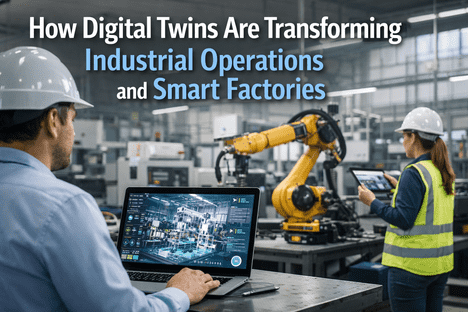
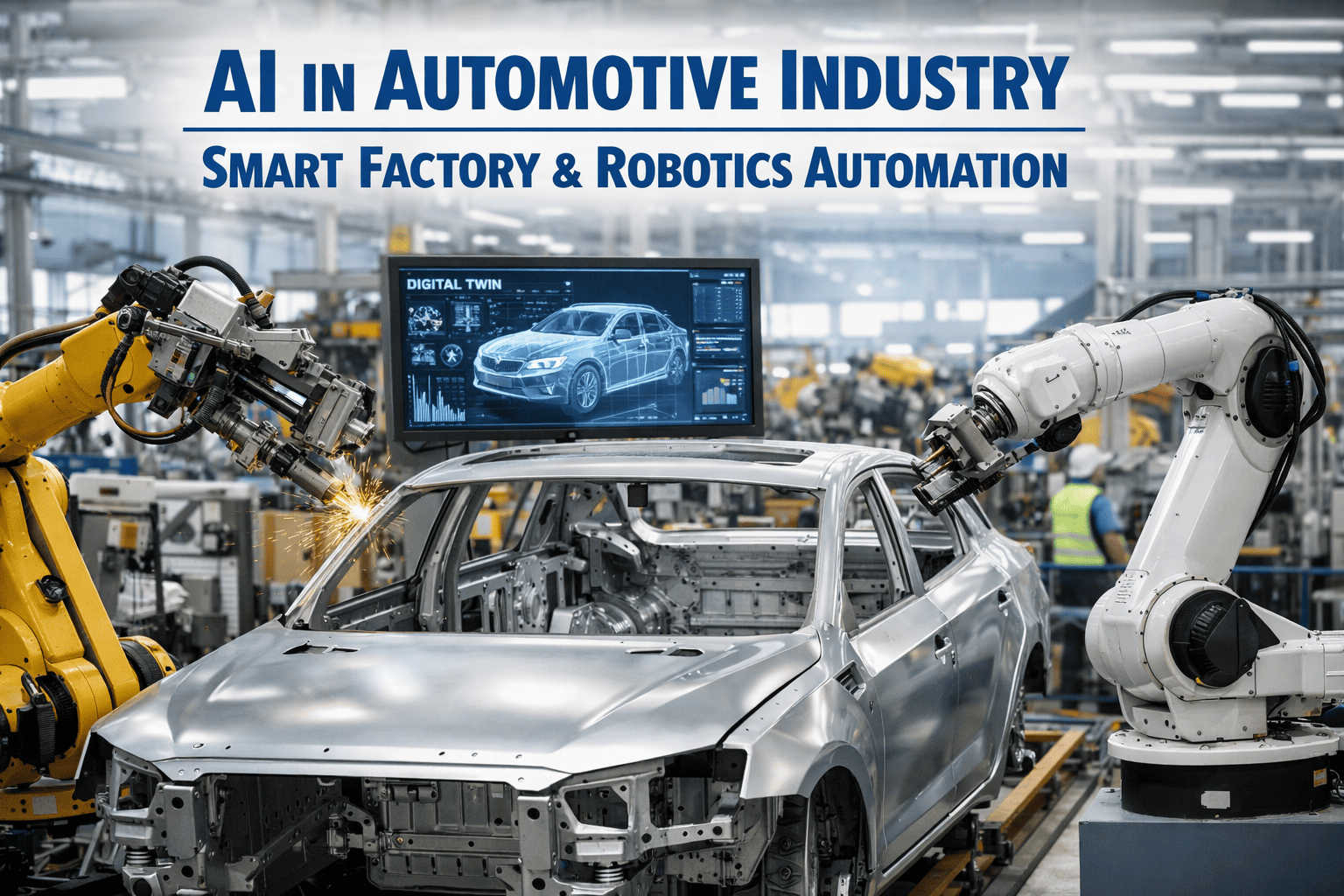
At Hannover Messe 2026 in April, something unusual happened: the word "concept" vanished from the keynote scripts. NVIDIA, Siemens, ABB, Dell, Microsoft, and Schneider Electric all demonstrated the same thing — not futuristic renders, but running factories where AI agents reason through supply chain disruptions, humanoid robots move cases across real production floors in Erlangen, and digital twins simulate line changes before they touch physical equipment. Samsung formally committed its entire global manufacturing footprint to AI-driven operations by 2030. Tesla is converting Fremont to produce up to one million Optimus humanoids per year. The Association for Advancing Automation reports that 86% of employers now treat AI, machine vision, and collaborative robotics as the dominant driver of business transformation through 2030, and 58% of global business leaders already use physical AI in some form — a number set to reach 80% within two years. The greenfield plant being designed today will not compete with the factory of 2026. It will compete with the factory of 2030 — software-defined, agent-orchestrated, and continuously self-optimizing. Getting the architecture right before breaking ground is now a strategic decision, not an engineering one. A future-ready greenfield strategy review starts with knowing which trends are real, which are noise, and which will rewrite your plant economics within five years.
Greenfield Trend Intelligence 2026
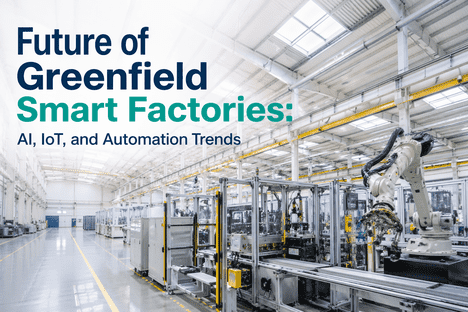
Future of Greenfield Smart Factories: AI, IoT, and Automation Trends
The trends rewriting how new factories are designed, built, and operated — from agentic AI and physical AI to industrial metaverse, private 5G, edge compute, and humanoid deployment. A practical map of what will matter, when, and why.
Shifts reshaping greenfield factory design
Agentic AI
Physical AI
Humanoid Robotics
Industrial Metaverse
Private 5G
Edge Compute
Digital Twins
Software-Defined Ops
86%
Name AI as top transformation driver
58→80%
Physical AI adoption in 2 years
The Greenfield Factory Has Fundamentally Changed
For decades, a greenfield factory was defined by concrete, steel, and fixed automation. The technology stack lived on top of the physical plant, added during commissioning or in post-launch phases. That sequence is now obsolete. The 2026 greenfield plant is a software-defined system that happens to have a building around it — where the intelligence layer, the data fabric, and the autonomous agents are architected into the blueprint at the same moment as the foundation and the utilities. The sources of competitive advantage have moved from scale and labor cost to adaptability, agent autonomy, and speed to optimize.
2018
Connected
Sensors, PLCs, SCADA, dashboards — data collected, humans decide
2022
Analytical
Predictive maintenance, AI vision inspection, MES-ERP integration
2026
Agentic
AI agents reason, plan, and act; humans supervise rather than operate
2030
Autonomous
Self-optimizing plants, humanoids at scale, continuous learning
The 7 Trends Rewriting Greenfield Factory Design
Not every trend deserves equal weight. Some are mature technologies crossing the adoption chasm this year. Others are experimental pilots that will mainstream by 2028. A proper greenfield strategy accounts for both — building infrastructure that serves today's use cases while staying open to the ones arriving on a 24-month horizon.
01
Mainstream
Agentic AI on the Factory Floor
AI agents now reason through supply chain delays, temperature spikes, and demand shifts — planning corrective actions autonomously. Up to 50% of routine production decisions are projected to be managed by agents by 2028, with 74% of companies planning agentic AI deployment within two years.
02
Mainstream
Physical AI & Vision-First Operations
AI vision remains the leading factory investment at 41% of manufacturers. Interest in large language models for worker copilots more than doubled from 16% to 35% in a single year — reshaping how operators interact with their equipment.
03
Accelerating
Industrial Metaverse & Digital Twins
Digital twins have become the operating system of modern plants — used for strategic decisions, virtual commissioning, and live operations. Siemens, NVIDIA, ABB, and Microsoft are now integrating Omniverse-based twins directly into IIoT suites.
04
Accelerating
Humanoid Robots Entering Production
Humanoid pilot deployment reached 13% manufacturer interest in 2026. Siemens deployed HMND 01 humanoids at Erlangen; BYD targets 20,000 humanoid units this year; Tesla is scaling Optimus to one million units annually at Fremont.
05
Mainstream
Private 5G & Edge Compute Networks
Private 5G blends on-site deterministic latency with cloud scalability. Edge compute nodes now host AI inference directly at the asset — essential architecture for vision systems generating 5+ Gbps of data per camera.
06
Mainstream
Cobots & AMRs at Scale
70% of collaborative robot orders in 2025-26 came from non-automotive sectors. AMR deployments in logistics are projected to grow at 14.2% CAGR through 2029, transforming material flow inside new plants.
07
Emerging
Sovereign Industrial AI Clouds & Software-Defined Factories
Deutsche Telekom's Industrial AI Cloud — one of Europe's largest, built on NVIDIA infrastructure — signals the next frontier: sovereign, sector-specific AI platforms that host digital twins, simulations, and agent fleets for entire industries. Software, not hardware, is becoming the primary differentiator between new factories.
Which of these trends should actually flow into your greenfield design today — and which can wait? Book a trend-prioritization call with our engineers.
Now vs Next: How Greenfield Plants Will Shift by 2030
The easiest way to see the future is to compare the capabilities a greenfield plant shipped with in 2022 to what will be table stakes at commissioning in 2030. Every bar below shows the same operational function — and how far the reference architecture is shifting beneath our feet.
Decision Making
Human-in-the-loop
→
Agent-led, human-on-the-loop
Quality Inspection
Sampling + paper forms
→
100% AI vision, real-time holds
Material Movement
Forklifts + fixed conveyors
→
AMR fleets + humanoid picking
Commissioning
Physical testing on live equipment
→
Virtual commissioning in digital twin
Worker Experience
Manuals, tribal knowledge
→
LLM copilots, AR guidance
Network Backbone
Wired Ethernet + isolated WiFi
→
Private 5G + edge compute fabric
Optimization Loop
Quarterly Kaizen events
→
Continuous AI retraining monthly
Factory Intelligence Heatmap — Where Adoption Is Concentrated
Not every domain matures at the same pace. The grid below maps adoption intensity across operational areas and trend categories based on current deployment data — darker cells mean the technology is production-ready and widely deployed; lighter cells signal pilot or emerging status.
AI & Agents
Vision & Sensors
Robots & AMRs
Digital Twins
5G & Edge
Maintenance
Deployed
Deployed
Scaling
Deployed
Scaling
Quality
Deployed
Deployed
Pilot
Scaling
Scaling
Logistics
Scaling
Scaling
Deployed
Scaling
Scaling
Assembly
Scaling
Deployed
Scaling
Scaling
Pilot
Material Handling
Pilot
Scaling
Deployed
Pilot
Scaling
Energy & Utilities
Scaling
Scaling
Pilot
Scaling
Scaling
Deployed — production ready
Scaling — crossing mainstream
Pilot — emerging, monitor closely
Signals From the World's Largest Manufacturers
When Samsung, Siemens, NVIDIA, Hyundai, and Rockwell all commit simultaneously to the same architectural shift, greenfield planners should treat that as a strategic signal — not a vendor announcement. The commitments below cluster tightly around three themes: AI-driven factories, physical AI deployment, and sovereign industrial clouds.
Samsung
All global manufacturing transitioning to AI-driven factories by 2030 with specialized AI agents for quality, production, and logistics
Siemens & NVIDIA
Building the world's first fully AI-driven adaptive manufacturing sites with an "AI Brain" continuously analyzing digital twins
Tesla
Converting Fremont to produce up to one million Optimus humanoids per year; deploying units in Tesla's own factories first
Hyundai
Debuted Atlas humanoid for production settings; gradual deployment across global operations over the coming years
Rockwell
Building its largest-ever factory in Wisconsin, purpose-built with advanced automation, robotics, and digital systems
Deutsche Telekom
Operating Europe's largest Industrial AI Cloud on NVIDIA infrastructure as a sovereign platform for factory-scale digital twins
The Five Forces Converging on Your Next Greenfield Build
Trends do not exist in isolation. The 2026 greenfield factory is shaped by five simultaneous forces — any one of them would demand a rethink; together they make the traditional plant architecture genuinely obsolete. A consulting engagement accounts for all five in the master plan.
Labor Shortage
Persistent structural gap across US and EU — automation is no longer a preference
AI Maturity
Foundation models now usable as factory copilots and agent planners
Reshoring Capital
Government incentives plus FDI shifts driving record new-plant investment
Energy Costs
AI-based energy optimization now a baseline requirement, not a bonus
Sustainability
ESG metrics tracked in real time; circular design embedded from day one
Your Next
Greenfield Factory
Designed for 2030, not 2022
Ready to translate these forces into a concrete design brief? Talk to an iFactory specialist about sequencing technology into your build plan.
Frequently Asked Questions
What makes a 2026 greenfield factory different from one built five years ago?
The 2021 greenfield plant was automated — predefined machines running predefined programs, with digital layered on top. The 2026 plant is agentic — AI agents plan, decide, and act within defined boundaries, digital twins continuously simulate changes before execution, and the reference architecture treats software as the primary product and the building as a container. Sensor density, edge compute presence, network architecture, and data modeling choices all flow from that shift.
Should we invest in humanoid robots in our new factory design?
For most greenfield projects breaking ground in 2026-27, the honest answer is: design the facility so humanoids can be added later, but deploy cobots and AMRs now. Humanoid reliability is currently around 200-500 hours between maintenance intervals compared to 50,000+ hours for industrial arms. The right approach is to specify aisle widths, door heights, and charging station locations compatible with humanoid operation — then add them when reliability and cost catch up, likely in the 2027-28 window.
Is private 5G actually worth the investment over wired and WiFi?
For most greenfield plants above a certain complexity threshold, yes. Private 5G provides deterministic latency for real-time control, handles massive data volumes from AI vision systems where a single 12 MP camera at 60 fps can generate 5.7 Gbps, and enables flexible reconfiguration without re-cabling. The investment typically pays back inside three years through reduced cabling costs, faster line changes, and the ability to deploy mobile robots and wearables without connectivity gaps. It also provides the backbone that future AI agents and humanoid platforms will expect.
How should we think about digital twin investment for a new factory?
Treat digital twin as core infrastructure, not an analytics project. The modern greenfield twin serves three functions: virtual commissioning that validates control logic before equipment arrives, real-time mirror of operations for AI agents to reason against, and simulation sandbox for testing line changes and new products without touching the physical plant. Siemens, NVIDIA Omniverse, Microsoft Fabric, and Dassault all now offer production-grade twin platforms — the decision is less "whether" and more "which integrates with your MES and ERP choice."
What's the single biggest mistake greenfield planners are making in 2026?
Designing the physical plant first and then trying to fit digital architecture into the result. This almost always produces under-sized conduits, insufficient edge compute rooms, inadequate network capacity for future AI vision loads, and cabling paths that cannot accommodate AMR or humanoid routing. The fix is simple but requires discipline: run the digital architecture design in parallel with facility engineering, with both teams working from the same master document. Decisions made in the wrong order cost three to five times more to retrofit later.
Build for 2030. Start Designing in 2026.
Make Your Next Greenfield Plant Future-Ready Before the First Brick Is Laid
iFactory's consulting team maps the trends that matter — agentic AI, physical AI, private 5G, digital twins, humanoid-ready design — directly into your master plan. Turn a capital project into a ten-year strategic asset that outperforms peers every year it is in operation.
7
Trends reshaping design
86%
Leaders prioritizing AI
80%
Physical AI in 2 years
2030
The horizon to design for